Wednesday, March 15, 2023 |
|
EPIC Newsletter
Emergency Preparedness Infection Control for Arizona's SNFs
|
|
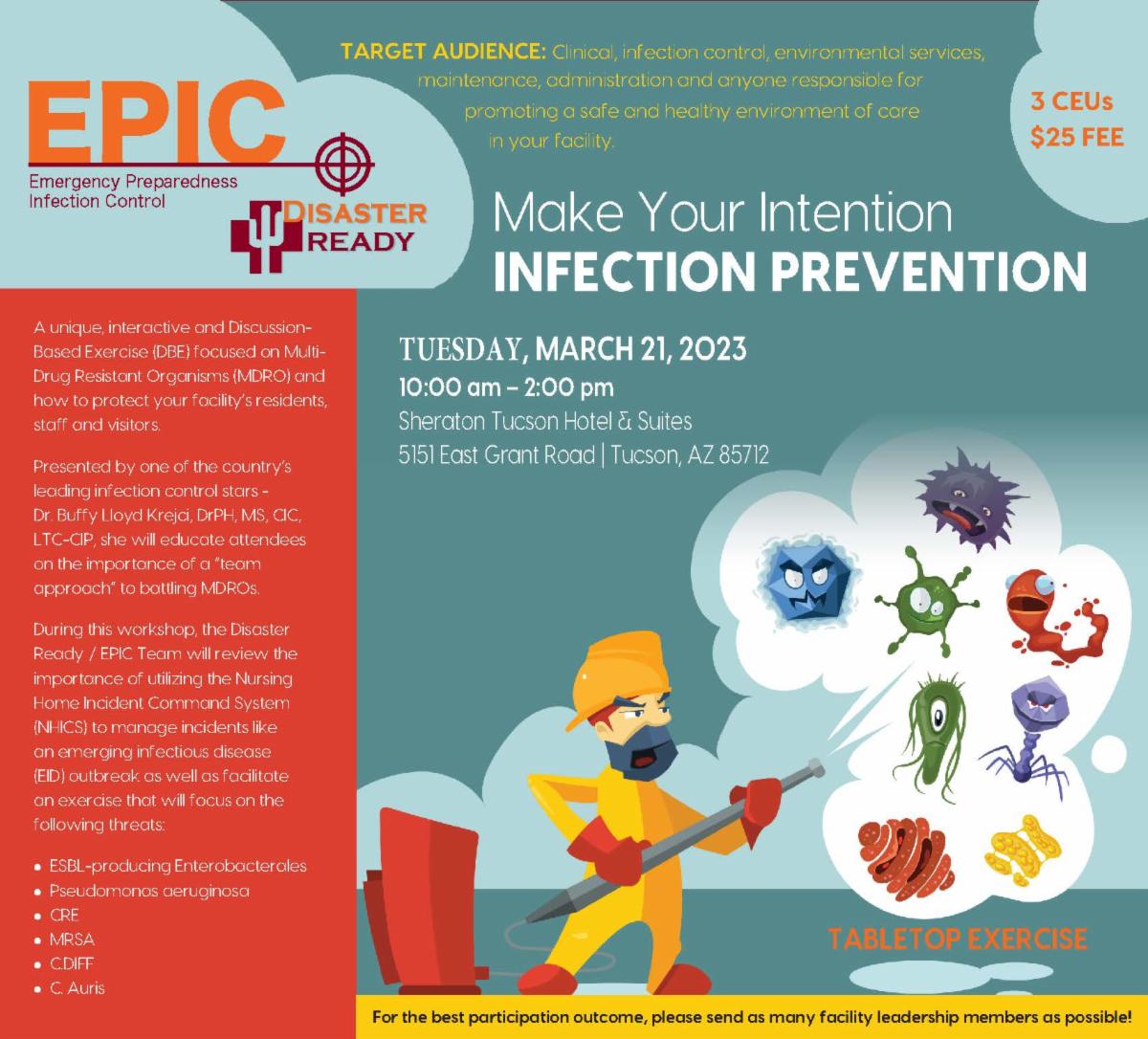
Make Your Intention Infection Prevention
Table Top Exercise
|
|
|
|
Tuesday March 21, 2023|3.0 CEUs |
10:00 am - 2:00 pm
For the best participation outcome, please send as many facility leadership members as possible!
Location: Sheraton Tucson Hotel & Suites
5151 East Grant Road
Tucson, AZ 85712
|
|
Free Onsite Technical Assistance in Industrial Hygiene Available
Through the EPIC grant, we are offering technical assistance to facilities to address industrial hygiene issues. This can include water management, housekeeping, and all environmental services.
Our grant experts at Clark, Sief, Clark, Inc., under the leadership of consultant Derrick A. Denis, will visit your facility and offer support and guidance on issues affecting infection prevention and control. To sign up for a complimentary visit, please email Derrick at DerrickDenis@csceng.com.
|
|
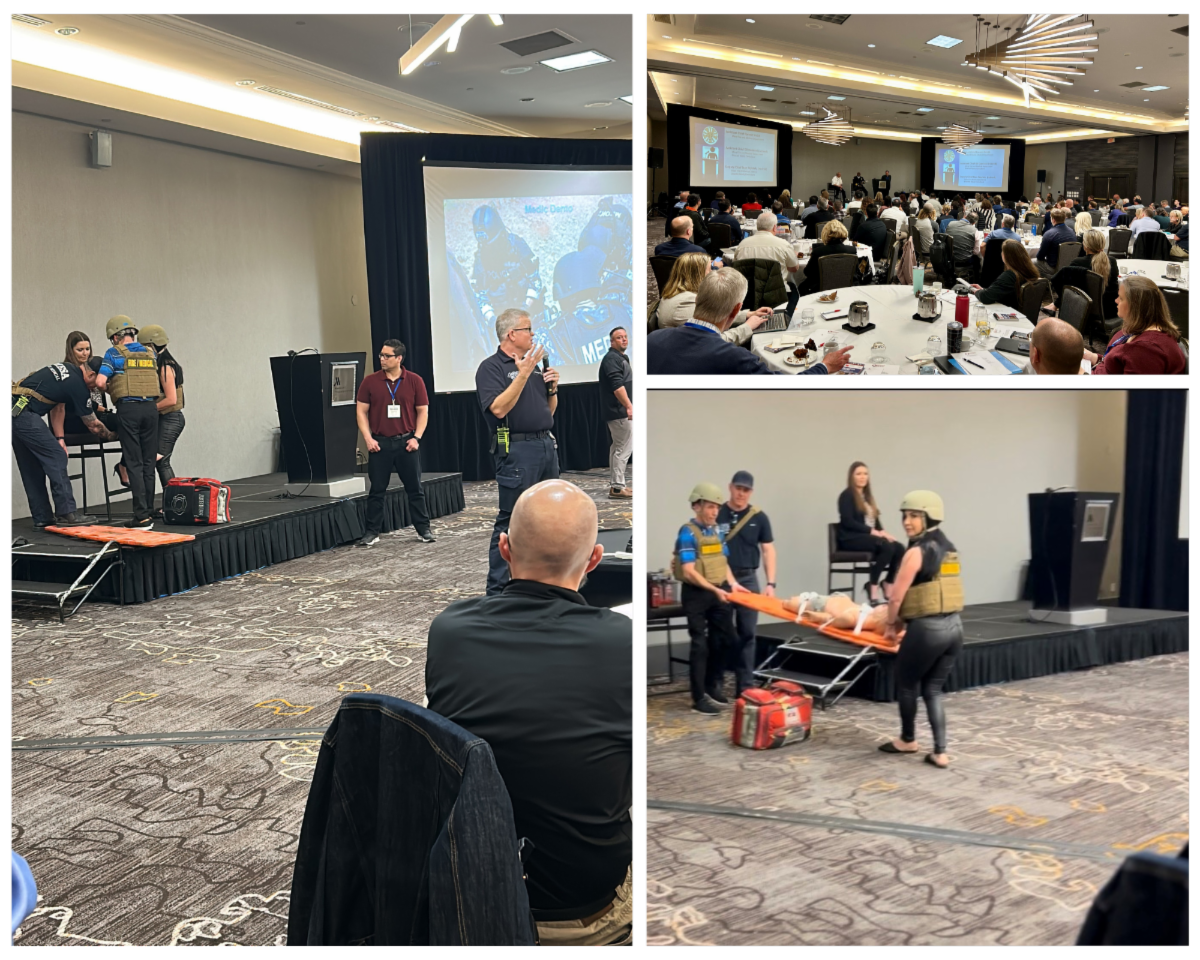
The Disaster Ready Summit was recently held on March 2 at the Marriott Phoenix Airport and was a huge success. Thank you to Stan Szpytek and Gil Damiani for their hard work during the day! Over 170 long term care professionals and others registered for the full day program.
This year's summit focused on the importance of the Nursing Home Incident Command System (NHICS) and how to prepare and respond to an armed intruder / active shooter incident in a long term care facility. The program also included a segment where two providers shared their real-world brushes with disaster as well as a special presentation by Kathleen Collins Pagels who shared her own harrowing personal experience with a fast-moving fire in her house. ADHS also spoke about the need for continuity of operations planning in facilities that serve vulnerable populations.
Special thanks to Chief Mary Cameli of the Mesa Fire & Medical Department, Chief Tom Shannon of the Scottsdale Fire Department and the Phoenix Fire and Police Departments for their assistance in coordinating a "live" demonstration on how first responders manage a shooting incident in a health care facility. Finally, thanks to all attendees for investing their time in this annual event to help ensure that their facilities are Disaster Ready.
|
|
Infection Preventionist Call
The EPIC Infection Preventionist call is scheduled for Thursday, March 23 at 1:00 pm.
Please email Kay Huff with any questions or to receive the Zoom link for the monthly calls.
|
|
|
Medical Response and Surge Exercise Planned
AzCHER will be conducting a Medical Response and Surge Exercise (MRSE) on Thursday, May 18, 2023. This exercise is intended to evaluate the hospital's ability to (virtually) decompress rapidly, because an emergent incident is creating a surge in patients. Long term care facilities will be the reception sites for these patients.
The responsibility for the FSE compliance is on participating LTC facilities. An Evaluator must be present to watch/document actions and create an after-action report with an improvement plan. Coordinated Consulting will be sending out a player/participant registration link to establish a contact list for hospitals to call during the exercise.
If you have questions, please contact AHCA’s Gil Damiani 480-682-7760 or Gild@azhca.org.
Please complete the following Registration no later than April 21, 2023.
|
CMS Explains Key Dates for COVID Waivers
Evan Shulman, CMS director of the division of nursing homes, spoke at length about several nursing home waivers that are set to expire with the end of the public health emergency, as well as some rules that would outlast the PHE. He said that all Section 1135 waivers would end on May 11 when the public health emergency (PHE) was scheduled to end. There will be no additional exceptions or waivers granted to facilities in specific areas with high needs or outsized COVID impacts at that time, he said. That warning specifically applies to waivers that are in place for temporary nurse aides in as many as 18 states, as well as among some individual providers that previously demonstrated “exceptional barriers” to certification. Shulman made clear that when the PHE ends, those aides will have only until Sept. 10 (four months) to get trained and certified.
As for the three-day stay waiver, it too will end May 11. CMS SNF team lead John Kane said any Part A stay that starts on or before May 11 could still qualify for full coverage. But after the switch flips on May 12, a three-day hospital stay would be required for providers to be paid for skilled care. Kane also noted that a waiver that allowed patients to receive an extended benefit period without a 60-day wellness period would expire after May 11, but that a new period started before May 12 would qualify for the full extended coverage. Kane said many providers had contacted CMS about doing away with the three-day stay permanently, but he urged those people to contact Congress since only it has the authority to change such statutory requirements. Shulman, meanwhile, reiterated that some SNF rules were enacted separate from the public health emergency, meaning some critical infection control and prevention requirements will stay in place after May 11. Those include:
- The COVID vaccine mandate for healthcare workers. Because it was established through an interim final rule, the requirement for a two-dose series of the initial shot can be required through most of 2024 without any additional action by CMS.
- Education about and access to COVID-19 boosters for residents and staff. This requirement lasts through May 2024.
- COVID data reporting to the National Health Safety Network. A rule requiring information to be submitted does not expire until Dec. 31, 2024, although Shulman said his agency was working with the CDC to limit reporting burdens.
- Specific COVID testing regulations that started in August 2020, prior to CDC national standards, will expire with the PHE on May 11. But Shulman noted that nursing homes “are still required to have an effective infection prevention and control program that follows accepted national standards. In other words, nursing homes are still going to be expected to test appropriately for COVID-19 … past the end of the PHE.
- Medicare immunizers’ ability to bill Medicare Part B directly for vaccines administered in nursing homes. Enforcement discretion around that change ends June 30, and at that point, nursing homes must resume billing.
|
|
Environmental Services Important in Infection Control
Exposure to germs in the environment can lead to illness in both residents and health care professionals. Environmental services (EVS) in infection prevention and control strategies can effectively prevent health care-associated infections. Long term care facilities should develop a standardized process to ensure that cleaning and disinfecting surfaces are done properly. Improving EVS services also includes looking at the cleaning and disinfecting products. There are countless products out there, and we must ensure that those used in facilities are EPA registered for health care use, and more recently ensure that they are effective against COVID-19. This information can be found on the EPA’s N List of COVID-19 disinfectants.
Facility procedures must clearly describe the steps to be taken in order to ensure a safe and hygienic environment. The Infection Preventionist should review the EVS policies and procedures with facility leadership at least annually to verify that they are up to date. Policies for cleaning include cleaning schedules and a clear distinction of who is responsible for cleaning what equipment.
Cleaning practices that must be specified in EVS policies and procedures include the following:
- Approved cleaning and disinfecting products, their use(s), and storage
- Procedures and schedules for routine cleaning and trash removal
- EVS staff safety, personal protective equipment, eye protection, chemical safety, and Safety Data Sheets (SDS)
- Terminal cleaning procedures
- Cleaning in isolation rooms and multidrug-resistant organism awareness
- Floor cleaning and buffing
- Hazardous and nonhazardous spills
- Disposal of biohazard containers (include steps to take if sharps are discovered in the regular trash)
- Use of wipes, mops, and other cleaning supplies
- Maintenance of the EVS cart
- Routine cleaning of common areas
- Cleaning of glass and windows
- Maintenance of carpets, privacy curtains, mattresses, and other soft surfaces
|
Arizona Poison Center Information
Questions about your medications? Check out the link below to learn more about the Arizona Poison Center.
Calls are answered by licensed pharmacists certified as specialists in drug and poison information. All information is kept private. You will be asked: What happened and when? What was the medicine? How much of the medicine was involved? What is the person's: Age? Weight? Other health problems? How are they feeling now? A poison is any substance that is harmful to your body. Any prescriptions or over-the-counter medications can be a poison.
|
|
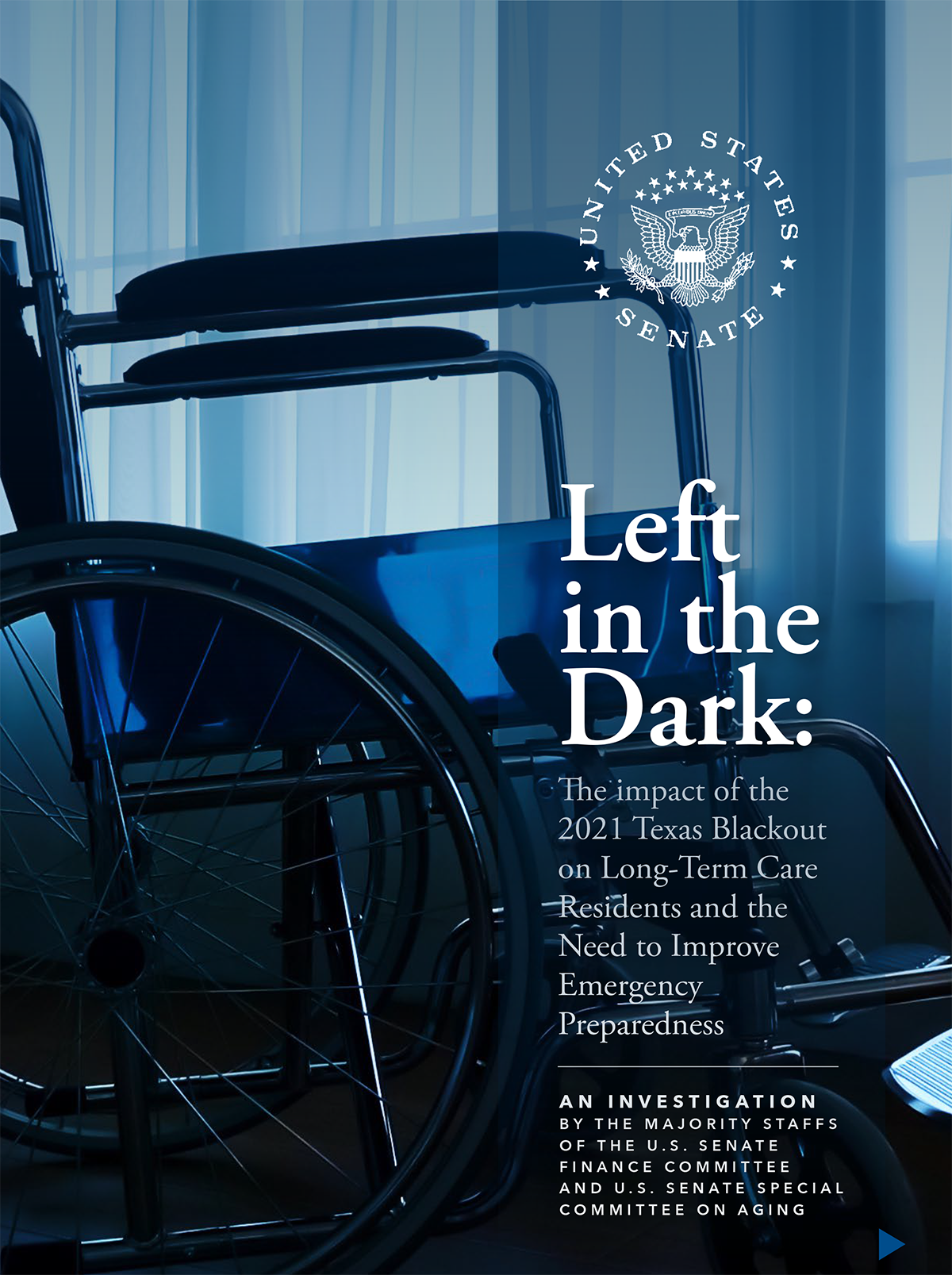
Emergency Preparedness Report
The Senate Finance Committee and Senate Special Committee on Aging released an emergency preparedness report that called on AL and SNF residents to be involved in emergency planning, response, mitigation, management, and recovery, and called for passage of the Real Emergency Access for Aging and Disability Inclusion (REAADI) for Disasters Act.
This report was generated due to a February 2021 winter storm that negatively impacted hundreds of long term care residents. The report recommends that federal, state, and local government agencies require providers to improve disaster planning, increase transparency and have emergency backup power.
The Disaster Ready team is available to help you with any of these issues. Just reach out to Krysten Dobson with further questions.
|
|
Life Safety Alert: Storage is Prohibited in Stairwells
If you operate a multi-story health care facility or senior living community, you may have asked yourself the question, "Can I use those big empty spaces in the building's stairwells to store things like emergency water or other items?"
Unfortunately, the answer is a resounding "no." The Life Safety Code (NFPA 101, 2012 edition) as enforced by CMS in regulated health care facilities as well as local codes that regulate senior living communities strictly prohibit storage of any type within the means of egress including stairwells. A stairwell is a vertical component of the means of egress that is designed to be a conduit for safe evacuation during an emergency. Nothing can be placed in any part of a stairwell including areas below the stairs on the lowest landing. While some may think it is wasted space, the Life Safety Code cites this provision so that nothing can compromise emergency evacuation.
Contact Stan Szpytek, AHCA's Life Safety / Disaster Ready consultant with any questions at Stan@azhca.org.
|
|
Note the top SNF Deficiency: F884 Reporting to NHSN
The number one cited deficiency in Arizona this FFY 2023 is F884 NHSN Reporting, it has been cited 47 times so far. F884 requires a facility to report weekly confirmed or suspected cases of COVID-19, COVID-19 vaccine status of residents and staff, therapeutics administered to treat COVID-19 and other reporting as specified in CMS QSO-21-19-NH and CMS QSO-20-29-NH.
One way to help ensure your facility stays in compliance with this requirement is to have at least two or more individuals able to enter data in to the COVID-19 Module | LTCF | NHSN | CDC. One of the most frequently stated reasons that data is not entered by a facility is that no one has access, because the individual(s) assigned to submit the data were no longer with the facility, or were out on PTO.
If you need assistance with NHSN data entry or securing a staff member eligible to report data, please contact Simi Williams with HSAG at swilliams1@hsag.com.
|
|
|
CDC COVID-19 Guidance for Assisted Living Centers
-
Stay up to date with COVID-19 vaccines, including recommended booster doses.
-
Maintain ventilation improvements.
- Avoid contact with people who have suspected or confirmed COVID-19.
-
Follow recommendations for isolation if you have suspected or confirmed COVID-19.
-
Follow the recommendations for what to do if you are exposed to someone with COVID-19.
-
If you are at high risk of getting very sick, talk with a healthcare provider about additional prevention actions.
-
People may choose to mask at any time. People with symptoms, a positive test, or exposure to someone with COVID-19 should wear a high-quality mask or respirator when indoors in public. Centers should check their Community Level weekly as the CDC updates the data every Thursday by 8 p.m. ET.
|
|
Check out our DR EPIC Helpline!
To submit questions, email the DR EPIC online helpline at EPIC@azhca.org. You can also call the DR EPIC phone Helpline at 602-241-4644 and we will assist you. or valuable infection prevention resources! Go to: EPIC.DisasterReadyaz.org to explore these tools.
|
|
Questions? Contact EPIC@azhca.org |This program is funded by ADHS
The Disaster Ready Emergency Preparedness Infection Control (DR EPIC) program provides education and technical assistance for skilled nursing providers throughout the state. Individual providers will need to exercise their independent discretion in how to apply this information and technical assistance to the unique operation of each facility. For that reason, a facility’s of its professional judgment and due diligence in utilizing the program for infection control and risk management practices is solely within the facility’s control for which it is entirely responsible.
Copyright 2022.
|
|
|
|
|
|
|