|
Product Stewardship Updates
October 3, 2024
| |
|
CALIFORNIA ENACTS
NATION'S FIRST TEXTILES STEWARDSHIP LAW
| |
|
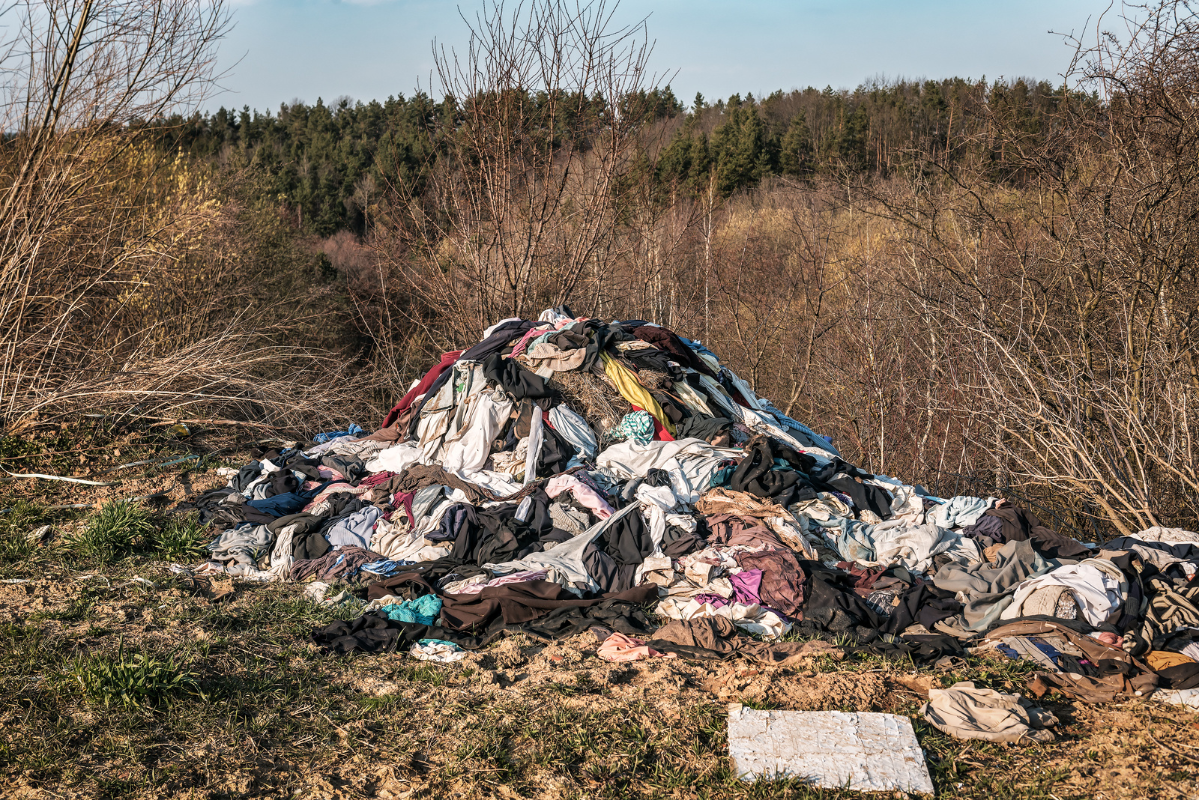
On September 28, California Governor Gavin Newsom signed into law SB707, the Responsible Textile Recovery Act of 2024, the first statewide extended producer responsibility (EPR) program for textiles in the United States. The law mandates that producers of household textiles, including clothing, footwear, and hospitality items, finance and manage a statewide program to collect, encourage reuse, fund repair, or recycle post-consumer textiles.
The California Product Stewardship Council (CPSC) was instrumental in developing and advocating for SB707 over many years, working closely with policymakers and industry stakeholders to ensure its passage. PSI was among the bill’s supporters and has advocated for EPR for textiles for over a decade. PSI members that are interested in joining a national textiles EPR workgroup can contact us at info@productstewardship.us.
Read more about California’s textile EPR law in our News Alert.
| |
GOVERNOR NEWSOM VETOES EPR FOR EV BATTERIES AND MARINE FLARES; ENACTS SEVERAL EPR AMENDMENTS AND REUSABLE GAS CYLINDERS LAW | |
|
The textiles law bumps California’s total EPR laws to 12, the most of any state, but Governor Newsom chose not to make it 14 when he vetoed two other EPR laws that passed the California legislature this year. While the governor agreed with the intent of both bills, he wrote in his veto memo that the EV batteries bill (SB 615) as written is too burdensome for the Department of Toxic Substances Control (DTSC) to oversee, and the marine flares bill (SB1066) lacked a comprehensive program scope and both the funding and enforcement authority for DTSC to oversee the law.
Governor Newsom did enact two amendments that expand the PaintCare program to include furniture paint, marine paint, and other related products and to significantly strengthen the carpet EPR program with provisions that ensure better sorting, more recycling, and the introduction of post-consumer recycled content requirements. The governor also enacted (SB1280), a law that prohibits the sale of non-reusable or non-refillable propane cylinders. Although not EPR, this bill effectually requires that all 1lb cylinders be reusable, just as 20lb barbeque tanks currently are – a significant step in reducing safety concerns and the financial and management burden of single-use gas cylinders at household hazardous waste facilities.
| |
|
PSI AT THE FOREFRONT OF
VAPE PRODUCT WASTE MANAGEMENT
| |
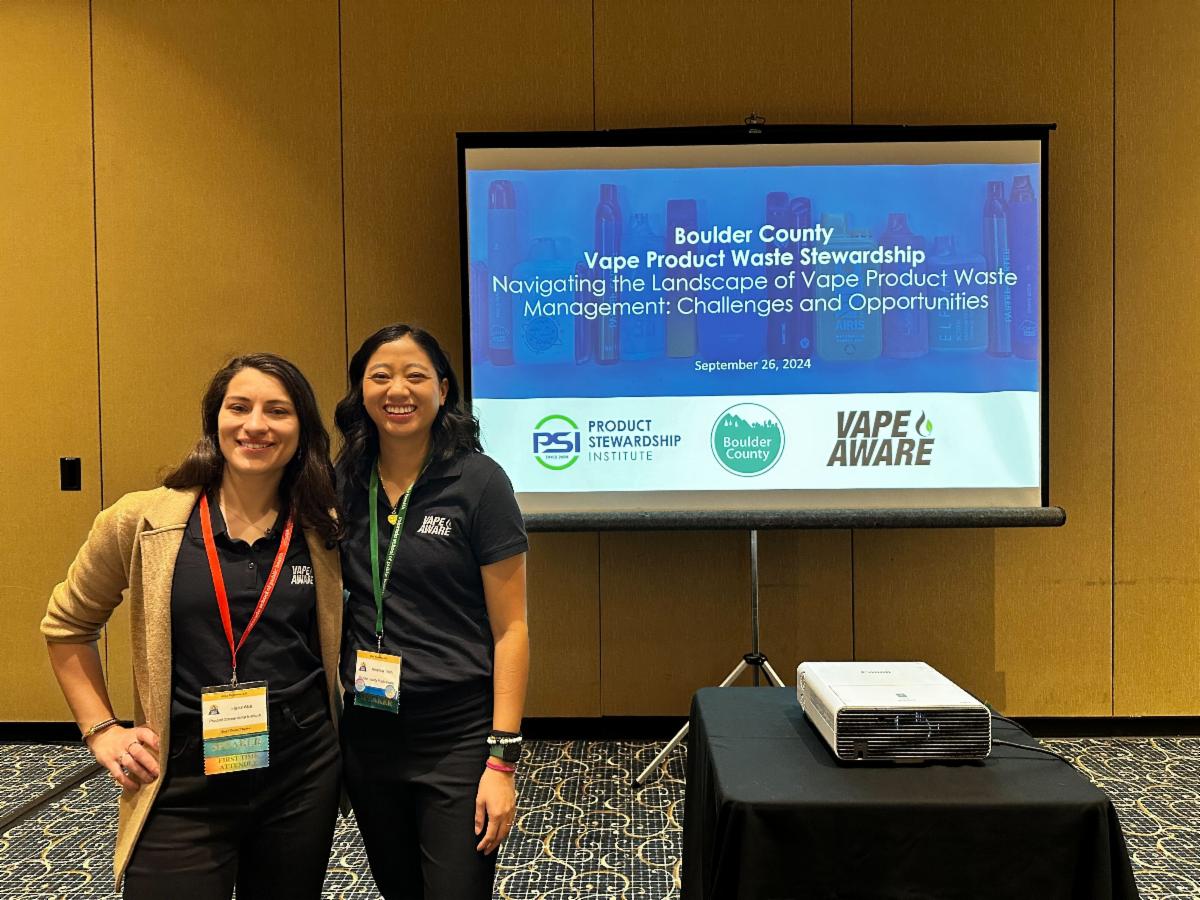
Hanz Atia, Policy and Program Associate, PSI with Amanda Trinh, Community Health Program Specialist, Boulder County Public Health. Photo Credit: Fran Babrow, Adams County, Colorado | |
|
Vape product waste (VPW) is an emerging environmental and public safety issue, with over 309 million e-cigarette units sold in the U.S. in 2023. PSI staff and members are leading the way toward effective policy solutions with research and a recent webinar about the complexities of VPW, best management practices, and policy options. The webinar, which attracted over 780 registrants, featured leading public health and HHW management experts including Boulder County, a PSI member whose pioneering Vape Aware program offers numerous options for vape waste disposal.
Boulder County and PSI recently presented on the Vape Aware program and policy research that we conducted together last year at the Public Health in the Rockies Conference and the NAHMMA Hazardous Materials Management Conference. The presentations were among the most attended sessions at their respective conferences, reflecting the high level of interest and growing need for effective solutions to VPW management. PSI and Boulder County are collaborating again this year to foster national discussion and action on VPW management. Contact us at info@productstewardship.us if you want more information or to get involved.
| |
|
OREGON PACKAGING EPR
WEBINAR SERIES PROVIDES INFORMATION
TO SUPPORT PRODUCER COMPLIANCE
| |
|
On September 10th, PSI hosted the last in a four-part series of educational webinars designed to inform producers about their upcoming obligations under Oregon’s EPR law for packaging. Each of the four webinars, which were conducted on behalf of the Oregon Department of Environmental Quality (DEQ) and in partnership with Circular Action Alliance (the producer responsibility organization operating in Oregon), focused on a specific category of producer obligations. These categories are food serviceware, printing and writing paper, consumer goods and B2B packaging, and e-commerce and online retail packaging. The webinars have received positive feedback from participants. Answers to the questions that were not answered during the first two webinars have been compiled into extended Q&A reference sheets. The answers to questions received on the last two webinars will be posted soon.
Producers who missed the webinars are encouraged to view the recordings and read the extended FAQ’s, which include useful knowledge that producers need to prepare for and comply with Oregon’s EPR law. Producers can also contact CAA, which is working collaboratively with the Oregon DEQ to ensure producers understand and have the tools they need to navigate the requirements of the law. The recordings, presentations, and extended Q&A responses are available from PSI’s website on the page called Preparing Producers for Oregon Packaging EPR.
| |
|
Celebrating 25 Years!
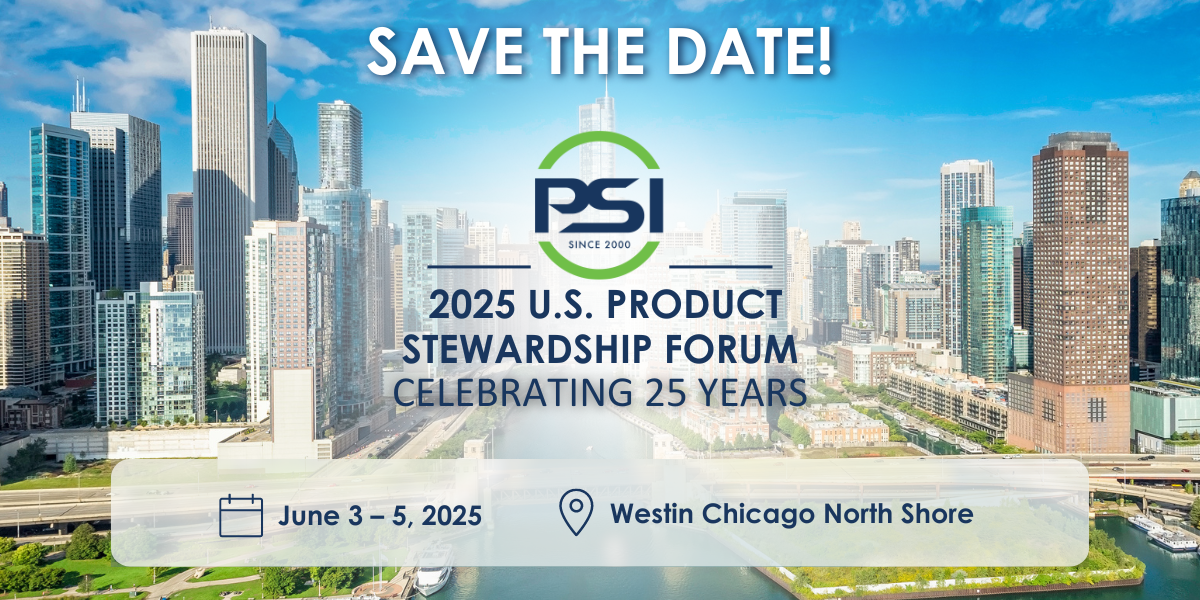
2025 U.S. PRODUCT STEWARDSHIP FORUM
June 3 - 5, 2025 | Westin Chicago North Shore
| |
|
Sponsorship information for PSI’s 2025 U.S. Product Stewardship Forum is now available. PSI’s forum is the place to go for meaningful content and in-depth conversations on the EPR issues that matter most. More than 250 leaders from private industry, state, local, and tribal governments, academic institutions, and environmental organizations are expected to attend. The inaugural forum in 2000 launched the U.S. EPR movement. As PSI enters its 25th year, the organization continues to play a leadership role – bringing together diverse stakeholders from around the globe for information sharing, EPR solutions development, and networking. We hope you’ll join us June 3-5, 2025 in Wheeling, Illinois.
Contact info@productstewardship.us to learn more
about sponsorship and the conference!
| |
|
PSI PRESENTS ON THE STATE OF EPR IN THE U.S.
AT CANADIAN STEWARDSHIP CONFERENCE
| |
Scott Cassel, CEO and Founder, PSI with Dan Wong, President, Canadian Product Stewardship Conference and other attendees. Photo credit: Justin Friesen | |
Last week, PSI’s CEO and Founder, Scott Cassel, moderated a popular session at the Canadian Stewardship Conference about EPR in the United States. The session, which aimed to foster cross-border collaboration, highlighted long-term progress, recent developments, and forward-looking trends for EPR in the U.S. Scott was joined by Neil Menezes of General Mills who serves as Vice-Chair of the National Board of Directors at Circular Action Alliance. Neil shared his dual perspective on the emergence and implementation of packaging EPR in the U.S. The discussion emphasized the influences of Canadian and European programs on the rollout of packaging EPR in the U.S., opportunities for harmonization (or at least greater consistency), and producer readiness for packaging EPR. | |
|
Building Reusable Packaging Systems:
Case Studies and Practical Steps for Municipalities
| |
|
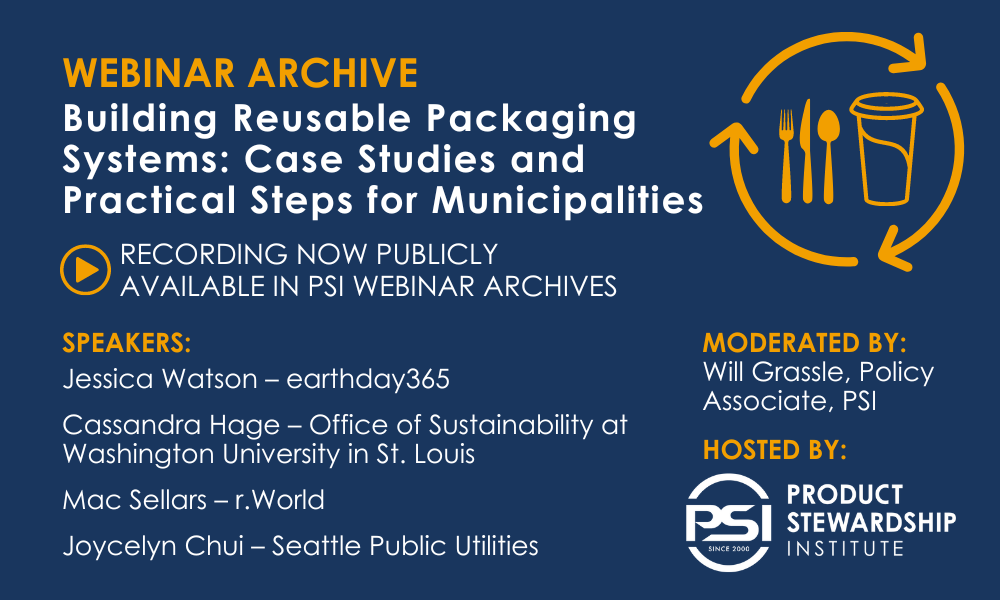
On September 18, PSI hosted a webinar about the successes, challenges, and lessons learned to date for developing and scaling reusable packaging systems. The webinar featured speakers from earthday365 and Washington University, who described their efforts to establish both open- and closed-loop reusable packaging systems in St. Louis, r.World, a reusable packaging solutions company that worked with earthday365 in St. Louis on a feasibility study, and Seattle Public Utilities, who shared information about their award-winning Reuse Seattle program, which is building city-wide reuse systems. PSI’s own Will Grassle, who moderated the webinar, presented his recently published municipal guide to reuse, Supporting Reusable Food Serviceware in Your Community: A Guide for Municipalities. The new guide provides recommendations that municipalities, businesses, and organizations can undertake to invest in reusable packaging systems in their communities and complements PSI’s plastic reduction guides for restaurants and universities.
The recording of this webinar is now available to the public in PSI’s Webinar Archives.
“Presentations were very candid and helpful regarding the successes and challenges with implementing reusable food ware programs.”
“Important topic, great speakers, and very informative!”
“I’m now trying to figure out how we can get something organized in our region!”
| |
Addressing Vape Product Waste: Management Challenges and policy Solutions | |
|
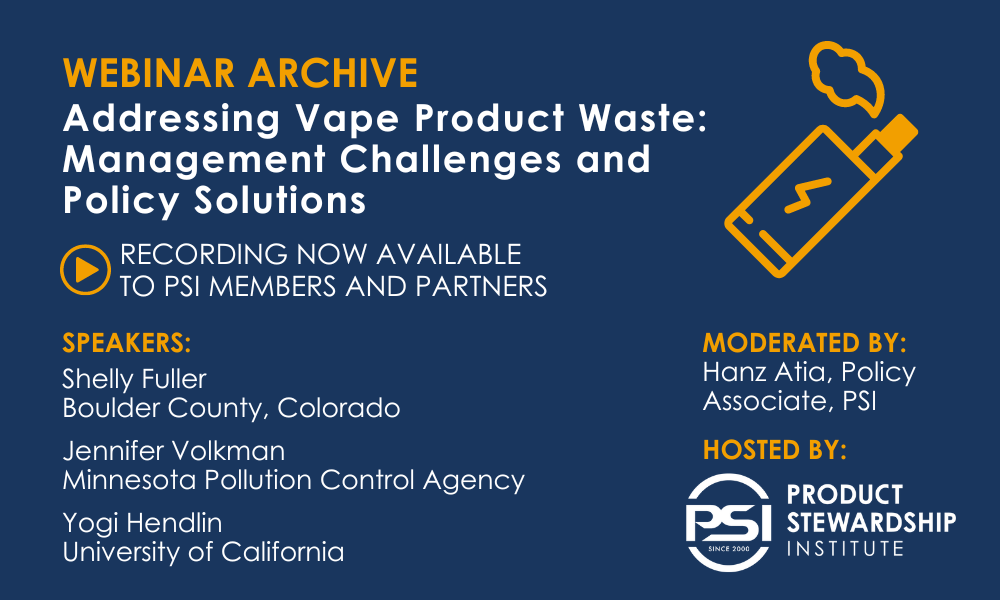
PSI’s October 2 webinar on vape product waste (VPW) attracted over 780 registrants, highlighting the growing concern about the environmental and safety impacts of disposable vapes. Panelists from Boulder County, the Minnesota Pollution Control Agency (MPCA), and the University of California’s Environmental Health Initiative discussed the issues with VPW, best management practices for this complex product, and possible state and local policy solutions. The webinar was moderated by PSI’s Hanz Atia, who shared the findings of recent research that PSI conducted with Boulder County on policy options for VPW.
The recording of this webinar is now available to PSI Members and Partners in our Resource Library. Not a member or partner? Join online or email info@productstewardship.us for more information.
| |
A MUST-READ FOR ALL EPR PROFESSIONALS! | |
|
PERSPECTIVES ON PRODUCT STEWARDSHIP:
Navigating an extended producer
responsibility path to a circular economy
by Scott Cassel, CEO and Founder of PSI
| |
Learn about the emergence of the EPR movement in the U.S., Canada, and Europe; the basic elements of all effective EPR bills; how to build consensus with other stakeholders; and key definitions, terminology, and issues. Includes in-depth case studies on packaging, paint, and batteries. | |
|
If you are a PSI Member or Partner, contact
info@productstewardship.us for 30% discount code. Signed copies available.
Not a member or partner? Join online or email for more info.
| |
In a recent Idaho Statesman article about more frequent truck fires caused by improper lithium-ion battery disposal, PSI’s Policy and Programs Manager, Megan Mabin, emphasizes EPR as part of the solution for safely handling battery waste and recovering valuable material to support the developing circular economy. | |
Last week, the American Institute for Packaging and the Environment (AMERIPEN) announced that longtime Executive Director, Dan Felton, is stepping down November 1, 2024. Dan has been named the new President and Chief Executive Officer of the Flexible Packaging Association. Read more. | |
|
MEDICAL SHARPS: Needles and other medical waste have recently washed ashore in Maryland and Delaware, leading to beach closures. These incidents highlight the health and safety risks of improper disposal and underscore the need for effective medical waste management programs and accessible collection sites. Read more.
PLASTICS RECYCLING: California has sued Exxon Mobil, claiming the company misled the public about plastics recycling to justify increasing plastic production, highlighting how corporate greenwashing has fueled the packaging waste crisis. Read more.
TEXTILES: The Ellen MacArthur Foundation cites EPR as the best path forward for managing textiles waste because EPR policy creates the necessary framework for a fragmented apparel industry to collaborate on circular economy solutions. Read more.
PLASTICS RECYCLING: Keurig Dr Pepper faced charges for misleading recyclability claims about its K-Cup coffee pods, settling for $1.5 million. This case highlights the risks companies face when making false sustainability claims and emphasizes the need for truth-in-labeling. Read more.
| |
The Product Stewardship Institute is a policy expert and consulting nonprofit that pioneered product stewardship in the United States. Since 2000, PSI has helped enact 141 extended producer responsibility (EPR) laws across 20 product categories in 33 states — the bedrock on which the circular economy is built. We work with businesses, nonprofits, academia, and governments to ensure that products are responsibly managed from design to end of life. Join us at www.productstewardship.us. | |
|
The Product Stewardship Institute, Inc. is an equal opportunity employer and provider. Persons with disabilities who require alternatively formatted materials to ensure effective communication should contact Amanda Nicholson at info@productstewardship.us or 617.236.4855.
| | | | |