May 2023
“Sunsets are proof that endings can be beautiful.”--Beau Taplin
As the school year winds down, we can reflect on how far we have come this year, as well as look forward to an upcoming time of refreshment. Reflection & Refreshment: what a timely theme, given that the month of May has been designated as Mental Health Awareness Month. In this month’s issue of our newsletter, we are putting a spotlight on what area districts are doing to sustain the mental health and wellness of their students. You will learn how a district is embedding preventative measures into their practices in an effort to reinforce their commitment to supporting the Whole Child. Additionally, we will share strategies that these districts are implementing to meet the social emotional needs of foster care and highly mobile youth. Be sure to visit the “Summer and Beyond Directory", to discover out-of-school time opportunities that you can share with your students and families. Here’s to you for your hard work this school year! Take time to enjoy some beautiful sunsets.
The Student Wellness Department
| |
Strengthening and Uplifting Youth in Foster Care | |
|
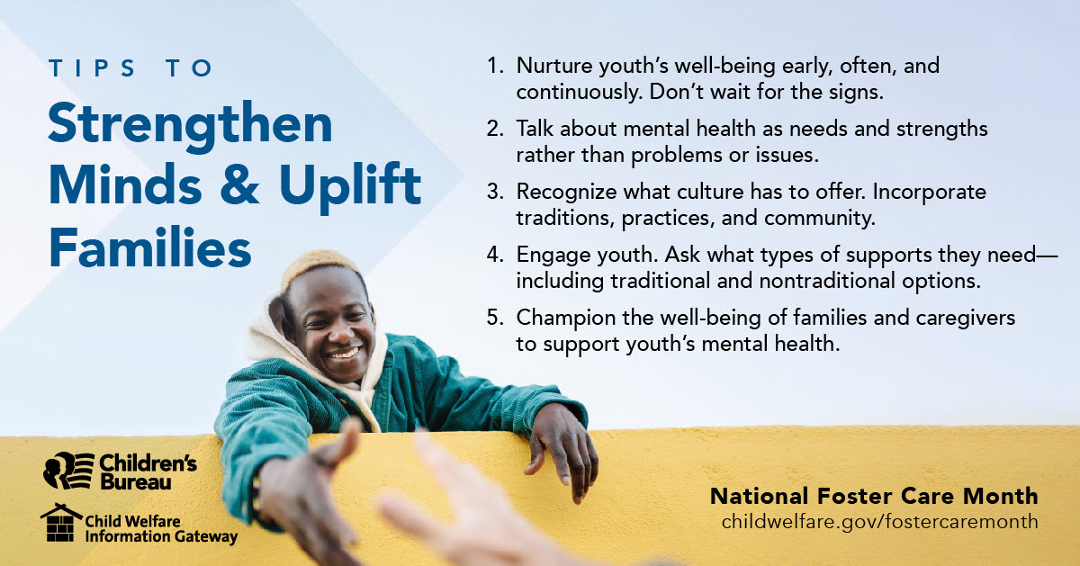
May is National Foster Care Month, which is an initiative of the Children’s Bureau, a sector of the Administration for Children and Families. This year’s campaign will focus on acknowledging the work of foster parents, family members, volunteers, mentors, policymakers, child welfare professionals, and educators who help ensure stability for children in foster care. Additionally, it is a time to renew one’s commitment to supporting youth in foster care by “strengthening minds and uplifting families.” This theme emphasizes the importance of taking a comprehensive and culturally responsive approach to meeting all needs of this population, including mental and behavioral health.
According to the Ohio Department of Education (ODE), “children in foster care face many educational barriers, including high mobility, increased incidences of trauma, and mental, behavioral and physical health conditions.” The 2015 Every Student Succeeds Act (ESSA) created guidelines to promote educational stability and improved outcomes for youth in foster care. State and federal guidelines as well as resources for educational professionals supporting children in foster care are available on the Ohio Department of Education website.
With over 16,000 students in the foster system in Ohio, school districts need to regularly evaluate their practices to ensure that every child entering their school is handled with care. Some questions to consider when evaluating effectiveness are:
- Is the district in contact with foster parents and the child welfare case worker?
- What is the transition process for incoming students?
- Are there protocols and procedures for responding to highly mobile students?
- How is the district supporting the whole child in attending to needs such as attendance, trauma, and behavioral health support?
The ODE has a variety of tools to ensure compliance as well as best practices for educational and child welfare professionals, including enrollment checklists and available presentations to utilize for staff professional development. Presentations contain specific information for school enrollment staff, district points of contact, foster care liaisons, transportation coordinators, and caseworkers. Additionally, the Educational Service Center of Northeast Ohio (ESC of NEO) offers professional networking opportunities for School Counselors, School Social Workers, Family and Community Engagement Coordinators, and other professionals addressing the needs of the whole child.
When reflecting on foster care month and the responsibilities of adults, remember the proverb, “It takes a village to raise a child.” It is truly a collaborative effort of adults and community members to provide a safe, stable, and healthy environment for all children, including those who are most vulnerable.
For questions or additional information about procedures for students in the foster care system, please contact Family and Community Project Liaison, Carrie Sullivan, at carrie.sullivan@escneo.org.
Additional resources are listed below:
Tips for Supporting Mobile Students
Cuyahoga County Children and Family Services
Ongoing Adoption and Kinship support
Image Options (all shareable graphics via the Children’s Bureau)
| 1 https://www.childwelfare.gov/fostercaremonth/about/ | |
|
CLICK for resources on:
- Mental Health Awareness Month
- Foster Care Month
- Teacher Appreciation Week
- National Prevention Week
| |  |
|
CLICK HERE for resources on:
| | |
 |
Supporting Highly Mobile Students Through the PBIS Framework
The Positive Behavioral Interventions and Supports (PBIS) framework is a tiered, comprehensive approach to improving student behavior and academic outcomes in schools. Extensive research has shown that when implemented with fidelity, it is effective in supporting a wide range of students, including those who are highly mobile and/or are in foster care.
The more than 16,000 Ohio students in foster care often face significant academic and behavioral challenges. Students in foster care have an average grade point average of 2.47, compared to 3.0 for the general student population. They are also more likely to be chronically absent and have higher rates of suspension and expulsion.
Despite these challenges, a study published in the Journal of School Violence found that support provided at all tiers of the PBIS framework improved the behavior and academic outcomes of this vulnerable population. Another study published in the Journal of Child and Family Studies found that PBIS was effective in reducing disruptive behavior and improving social skills among students in foster care who had experienced trauma.
Examples of supports that can be provided to this student population include the following:
Universal (Tier I) Level
- School-wide expectations that are clear, concise and posted throughout the school provide consistency and stability across different environments.
- Explicit instruction and modeling of expectations ensures that all students understand what is expected of them.
- Consistent routines and procedures provide predictability for students whose lives outside of school can be in a constant state of upheaval.
Targeted Level (Tier II)
- A peer mentoring program that pairs students with positive role models can assist in building relationships and facilitate a transfer of skills.
- The use of checklists and visual supports may help students with organization and time management.
- Checking in and out with a mentor daily provides a trusting adult within the building with whom to set goals and receive feedback.
- Inclusion in a counseling small group that focuses on self-awareness and relationship-building may assist with lagging social skills due to high mobility.
Intensive Level (Tier III)
- Counseling services to address emotional and behavioral needs, including trauma-focused therapy, may be appropriate for students who have experienced trauma.
- Connections to community resources are important for students who are new to the schools or community.
- Individualized academic support and accommodations, such as extra tutoring or extended time on assignments, may be necessary to ensure students receive services for their specific needs.
In addition to these supports, the PBIS framework emphasizes the importance of collaboration and communication between schools and families at all three tiers. This is critical for students who have experienced changes in the home setting. Finally, the use of data and ongoing assessments will determine which interventions are most effective so adjustments can be made as needed.
Information on foster care in Ohio can be found at THIS ODE website. For more information or assistance with supporting highly mobile students through PBIS in your district, contact Linda Blanch at linda.blanch@escneo.org.
| |
|
Vandermolen, L. A., & Hummel, J. (2017). Effectiveness of a Positive Behavioral Interventions and Supports (PBIS) Intervention in Improving Behavior and Academic Outcomes for Foster Care Youth. Journal of School Violence, 16(3), 327-342.
Barnes, T. N., Brackett, M. A., Johnson, S. R., & Dixon, A. L. (2020). Effects of a Positive Behavioral Interventions and Supports (PBIS) Intervention on Trauma-Exposed Children in Foster Care. Journal of Child and Family Studies, 29(9), 2542-2555.
| |
Bay Village Schools: Community Connections through a Care Coordinator | |
|
Many of the districts in our region have dedicated personnel and developed initiatives to prevent substance misuse and support positive mental health. This month, we are pleased to spotlight the Bay Village School District’s efforts in promoting the mental well being of their students through the appointment of a Care Coordinator.
During the 2018-2019 school year, The Bay Village School District furthered their implementation of Positive Behavior Interventions and Supports (PBIS) by mapping their current social, emotional and mental supports and services in the district. The same year, the district-wide team strengthened their suicide intervention and threat assessment tools and protocols. The district partnered with a MetroHealth Child and Adolescent Psychologist who provided Tier III support and professional development for school counselors, staff and parents. During the 2020-2021 school year, with the previous foundational exploration completed, the school counselors advocated for a new comprehensive approach for supporting the needs of students and families. Megan Basel, formerly a Normandy Elementary school counselor, was offered the federally-funded Care Coordinator position for the 2021-2022 school year. According to Megan, the goal of the Care Coordinator is to “examine and understand the needs of students and families in crisis, to develop knowledge and skills in students and families accessing mental health care and to facilitate the care and support between school, home, and community providers.” Megan collaborates with a number of staff members and community partners, including MetroHealth, school psychologists, Bay Family Services, county and private mental health providers, school resource officers and the Bay Village police.
Megan reports that one of the most rewarding aspects of her job is providing families with timely and appropriate community connections during a pivotal moment in their lives. She values the opportunity to be the district contact for families who may be overwhelmed by the myriad of community options that are available. When asked how districts can meet the challenge of creating consistency in their prevention programming, Megan stressed the importance of having a district-wide framework to support it, gathering the appropriate stakeholders for exploration and discussion, and involving staff with appropriate areas of expertise. These practices will result in consistency and longevity.
___________________________
The Student Wellness Department of the Educational Service Center of Northeast Ohio and Mental Health Supports
The Student Wellness Department of the Educational Service Center of Northeast Ohio assists districts with mapping current practices and reviewing their effectiveness in addressing the mental well-being of students. This practice supports the whole child approach as advocated by the Ohio Department of Education. Please contact Nyeshja.Malone@escneo.org if you would like more information about how our Student Wellness Department can support your building or district needs.
Substance Abuse and Mental Health Services Administration's (SAMHSA) National Prevention Week (May 7-13)
The Substance Abuse and Mental Health Services Administration’s (SAMHSA) National Prevention Week (May 7-13) is a good time for reflecting on prevention efforts in your district or organization. Check out some of the links in this issue for more information and resources on prevention programming for youth.
| | | | |