SW-Header.png
 

September/October 2023


“You’re off to great places! Today is your day! Your mountain is waiting, So get on your way!”

— Dr. Seuss


The Educational Service Center’s Student Wellness Department welcomes you to the 2023-2024 school year! We hope this finds you feeling rested and ready to face new challenges that may come your way. As always, our staff is eager to support you through our wide array of programs and resources. 


Speaking of staff, we continue to grow and are thrilled to welcome 6 new consultants to our department. As the year progresses, we hope you will have the opportunity to meet: Lindsay Ciavarelli, Jennie Canganelli, Christina Delaney, Leah Eulerle, Holly Jacobsen, and Karen Lackey.


In this edition of our newsletter, you’ll find valuable information on addressing chronic absenteeism and preventing suicide and violence in schools. These are two heavy topics but formulating a systematic plan to address them is critical in today’s social environment. 


Again, welcome back, and here’s to an exceptional school year ahead!


The ESC of Northeast Ohio Student Wellness Department 

Preventing Youth Suicide: Let’s Talk about It!

According to the Ohio Suicide Prevention Foundation (OSPF), suicide rates in Ohio, as well as nationwide, have increased for youth ages 10-24. Despite being the second leading cause of death for young people, there is still much stigma attached to suicide as well as hesitation around talking about it with others. There is hope, however, as suicide is preventable! Many young people who are thinking of suicide typically demonstrate warning signs, and talking directly to them about suicide often provides relief for the individual.  


Nationwide Children’s Hospital suggests the following tips for educators, parents and supportive adults to engage students and teenagers in conversation around mental health.


  • Do not wait for a crisis. A good opportunity to talk about suicide or mental health issues is when things are going well.
  • Check in regularly and ask your student or child directly how they are doing and if they have ever had thoughts about ending their life.
  • Look for changes in mood or behavior that might be a warning sign that something is wrong. Examples include a lack of interest in activities previously enjoyed, signs of depression or malaise, or a change in eating or sleeping patterns.
  • Most importantly, if a youth expresses thoughts of suicide, take them seriously! Listen with empathy, act immediately, and never keep their information a secret. Parents need to be notified and advised of next steps to ensure safety and access to care.  


Lastly, it is important to reflect on the adage, an ounce of prevention is worth a pound of cure. Schools benefit from having clear, evidence-based suicide protocols to respond to concerning behavior or threats of self-harm prior to a tragedy, as well as plan for re-entry following an absence relate to suicide risk.  


For additional assistance regarding comprehensive suicide prevention, please contact Nyeshja Malone, Administrative Assistant for the Student Wellness Department, at 216-901-4213.


CLICK HERE for resources:

  • National Suicide Prevention Month
  • National Attendance Awareness Month

CLICK HERE for resources:

  • National Bullying Prevention Month
  • Safe Schools Week

CLICK HERE for resources:

  • Local Resources
  • National Resources
 
SW-PBIS.png

Supporting Attendance through Multi-Tiered Systems of Support (MTSS)


The start of a new school year provides the opportunity to consider or re-evaluate how a building’s MTSS framework may be used to prevent unwanted behaviors and encourage positive outcomes. The connection between school attendance and academic success has been widely researched and is well documented. Unfortunately, common practices utilized by schools to reduce absenteeism (sending letters to parents/guardians, making home visits, filing misdemeanor charges) have been shown to be minimally effective. The good news is that “even small improvements in absences and tardies may encourage growth towards more attainable and realistic goals, especially for students with a history of poor attendance” (Balfanz & Byrnes, 2012).


Many factors contributing to absenteeism are addressed within the PBIS framework. Instead of forming a new team to implement standalone and parallel initiatives, a school or district may consider integrating attendance support into its current PBIS continuum of practices. The following are initial tasks a team will complete before developing tiered interventions:


1- Collect data on the number and percent of students who are regular attenders, at risk, chronically absent, and severely chronically absent. It’s important to note that looking only at average daily attendance can mask problems (e.g. it’s possible to have 90% daily attendance and still have 20 to 30 percent of students who are chronically absent). Some questions to consider when measuring attendance include:


  • What day of the week or month is the most problematic? What time periods?
  • What grade levels or classes have the highest absence rate?
  • What student subgroups are most affected?
  • Are attendance problems more prevalent in specific neighborhoods?


2- Write measurable goals based on the specific attendance patterns in the school or district. 


3- Identify existing practices and strategies that could be adapted to achieve the desired goal. If existing supports are not available, appropriate or effective, identify other evidence-based interventions that might be adopted and integrated into the current tiered framework. 


4- Develop an intervention plan that includes monitoring of student progress and implementation fidelity. 


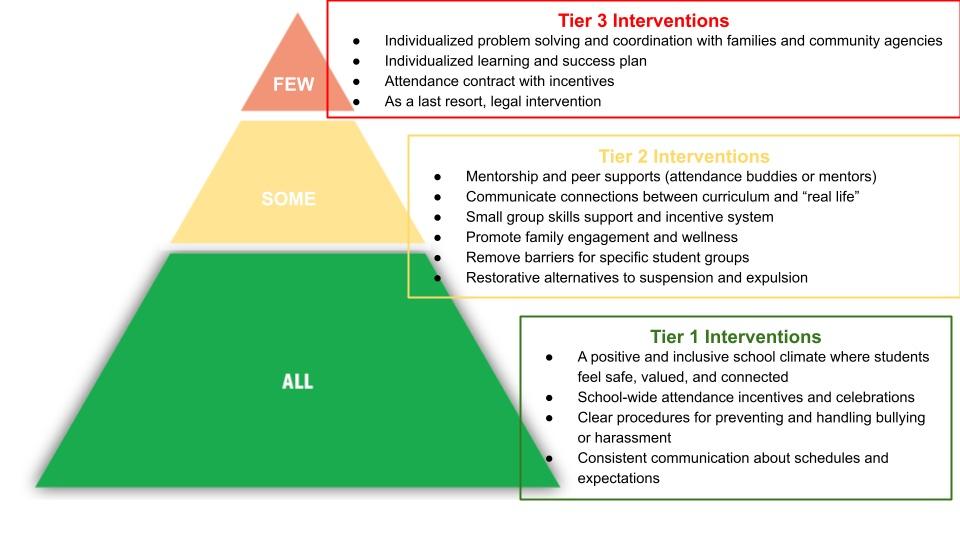
Throughout the process, it is important to consider the causes of absenteeism (why are students not coming to school?) as there is a greater need to match the intervention to the reason for the absences as the severity of the behavior increases. Below are examples of interventions and supports that may be used at each tier:


This list of interventions is not exhaustive and schools/districts are encouraged to adapt or create strategies based on their unique needs and resources. As stated, the key is to use a data-driven approach to identify students’ specific attendance challenges and tailor interventions accordingly. For more information, check out THIS webpage, from the Ohio Department of Education. You will find information, support and resources for improving attendance - of particular note is the new Ohio Attendance Guide. 


As always, the Student Wellness Department is here to help! Contact Nyeshja Malone at nyeshja.malone@escneo.org to learn more.

Balfanz, R., & Byrnes, V. (2012). Chronic Absenteeism: Summarizing What We Know from Nationally Available Data. Baltimore, MD: Johns Hopkins University Center for Social Organization of Schools.

 
SW-District-Spotlight.png
 

Brooklyn City Schools Implement House Bill 123           


Ohio House Bill 123, also known as the Safety and Violence Education Students Act (SAVE Students), requires school districts to provide one hour, or one standard class period, of instruction to students in grades 6 through 12 on the following topics:


  • Suicide awareness and prevention
  • Safety training and violence prevention
  • Social inclusion


Local boards must use a training program approved by the Ohio Department of Education which can be found at THIS website. Parents may opt out of the instruction. 


On May 17, 2023, the ESC of Northeast Ohio hosted a virtual session providing districts the opportunity to share their implementation plans for HB 123. The session recording can be accessed by clicking here and entering the following passcode: 2JyGR6D. (Note: the period must be included when entering the passcode).


The Brooklyn City School district’s comprehensive plan for meeting the HB 123 requirements is outlined below. 


SUICIDE PREVENTION

Erika’s Lighthouse (video-based instruction)

  • Grades 4 and 5
  • Present Level 1 program, “We All Have Mental Health,” once per year, by school counselor in classroom SEL lessons.
  • Grades 6-8
  • Present Level 2 program, “Depression Awareness,” twice per year by Mental Health Coordinator during Intervention/Enrichment class.
  • Grades 9-12
  • Present Level 3 program, “Depression Education and Suicide Awareness,” four times per year by Mental Health Coordinator during Intervention/Enrichment class.  
  • Students receiving online learning will also receive instruction.


VIOLENCE PREVENTION

Sandy Hook Promise’s Say Something

  • Age-appropriate videos will be presented to grades 6-12 once a year by the Mental Health Coordinator during the Intervention/Enrichment class period.


SOCIAL INCLUSION

Sandy Hook Promise’s Sandy Hook Start with Hello

  • Grades K-7
  • Appropriate video lessons taught once per year by the school counselor during SEL lessons.
  • Grades 8-12
  • Video lessons taught once per year by the school counselor during grade level meetings.
  • District-wide spirit week will reinforce lesson material.

If your district would like assistance in developing a plan to meet the requirements for this bill, reach out to Denise Pietrzak at denise.pietrzak@escneo.org. 

 
SW-Upcoming-Trainings-V3.png

ESC of Northeast Ohio and Partner Events


CSTAG Full Day Training (Level 1 & 2)

September 1, 2023

8:30 a.m.- 4:30 p.m.


Cornerstone of Hope 2023 National Symposium, Traumatic Loss and Grief Support

September 6-8


Homelessness and Foster/Kinship Care Informational Session

September 15, 2023

1-3 p.m. 


PBIS Tier 1: PreK-12 School Aged New Teams

October 2

9 a.m.-3:30 p.m.


Early Childhood Overview Positive Behavior Interventions and Supports

October 6

8:30- 11:30 a.m.


PBIS Overview for Mental Health Professionals

October 6

12-3 p.m.


Early Childhood PBIS Tier I New Teams

October 18

9 a.m.-3:30 p.m.


School Crisis Response Training: Being Prepared for Tragic Loss

Oct. 26 and 30

8:30-3 p.m.


PBIS Tier I: PreK-12 School-Aged New Teams Cohort 1

November 6

9 a.m.-3:30 p.m.


Strategies and Considerations: Responding to Challenging Behaviors

November 6

9 a.m.-3 p.m.


CSTAG Full Day Training (Level 1 & 2)

November 13

8:30 a.m.-4:30 p.m.


PBIS Tier II Systems (Fall/Spring)

November 14

9 a.m.-3:30 p.m.


Student Wellness On-Demand Webinars


School Counselor & Social Worker Network

 
Facebook  Twitter