THE TTALK QUOTES
On Global Trade & Investment
Published Three Times a Week By:
The Global Business Dialogue, Inc.
Washington, DC   Tel: 202-463-5074
Email: Comments@gbdinc.org
 
No. 40 of 2018
FRIDAY, JULY 20, 2018

Click HERE for Tuesday's quote from Nick Giordano of
the National Pork Producers Council   
 

SIGNAL FROM TOKYO

"Together with Japan, we are sending a strong signal to the world that two of its biggest economies still believe in open trade, opposing both unilateralism and protectionism." 
 
Cecilia  Malmström  
EU Trade Commissioner
July 17, 2018 
CONTEXT
Last Tuesday, July 17, was a milestone in the evolution of the global trading system.  In Tokyo, on that day, Prime Minister Shinzo Abe and the two EU president - Donald Tusk, President of the EU Council, and Jean-Claude Juncker, President of the European Commission - signed the EU-Japan Economic Partnership Agreement.     
 
The EU press release announcing this development included statements from both Jean-Claude Juncker and from the EU Trade Commissioner, Cecilia Malmstrôm.  That release was the source of today's featured quote, and we shall return to it in a moment.  First, however, some history and some highlights.
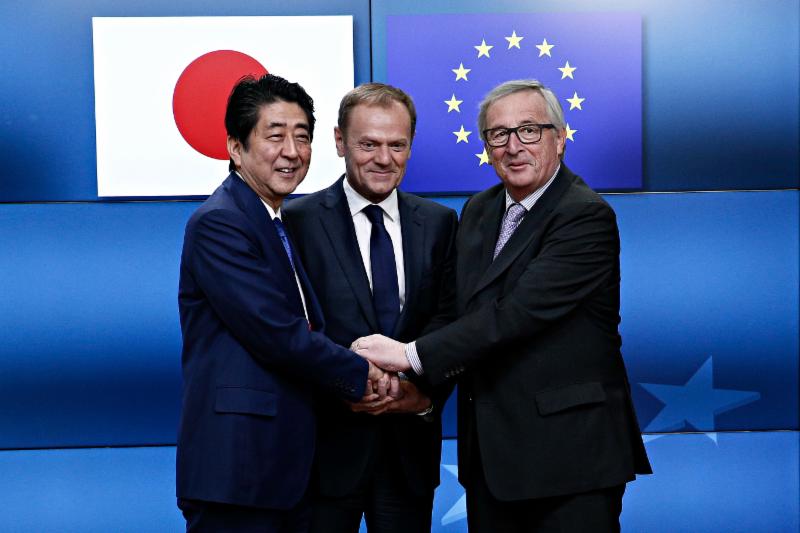
 
Prime Minister Abe, President Tusk, & President Juncker shake on a deal.
July 2017   Photo: Shutterstock.com 
 
A TIMELINE
The agreement has been in the works for years, and it is not done yet.  It still needs to be ratified by the European Parliament and the Japanese Diet.  The goal of the parties is to complete those ratifications within the next several months so that the agreement can enter into force early in 2019.  We assume that target will be met, thus rounding out this chronology:  
 
May 2011 - At an EU-Japan summit, the two sides agree to prepare for free trade negotiations between the EU and Japan.  
 
April 2013 - The first round of negotiations is held in Brussels.
 
July 6. 2017 - The outline of a deal between the EU and Japan is announced in Brussels.  
 
December 8 - EU Trade Commissioner Cecilia Malmström announces that the EU and Japan have agreed on the final legal text for the EU-Japan Economic Partnership Agreement.  
 
July 17, 2018 - Prime Minister Abe, President Juncker, and President Tusk sign the agreement in Tokyo.  
 
[And to Speculate on the next steps,]
 
3rd Quarter 2018 -  The Japanese Diet ratifies the Agreement.  
 
4th Quarter 2018 - The European Parliament ratifies the Agreement.  
 
1st Quarter 2019 - The EU-Japan Economic Partnership Agreement enters into force.

WHAT'S IN IT?  
That's too big a question for a TTALK Quote.  For the answer, or at least a good starting point, we recommend the EU's "Key elements of EU-Japan Economic Partnership Agreement," which gives a few more highlights than the July 17 press release and is quite useful.   Their focus, of course, is on the benefits of the agreement for EU exporters, and so they note that
 
... tariffs on more than 90% of EU exports to Japan will be eliminated at entry into force ...  and  
 
Once the agreement is fully implemented, Japan will have scrapped duties on 97 percent of goods imported from the EU (in tariff lines)... .
 
In its explanatory note, the EU puts a lot of emphasis on the opportunities the agreement opens up for EU agricultural producers, with specific references to pork, wine, and cheese.   
 
In the service sector, the agreement is likely to benefit EU providers like DHL, among others.  That, at any rate, is how we read this comment in the EU's summary paper:  
 
The agreement will also ensure a level playing field between EU suppliers of postal and courier services and their Japanese competitors, such as Japan post.
 
We will leave it at that for now, but we are likely to return to this agreement sooner rather than later with a look at some of its other special, if not novel, features,  such as the tie-in to the Paris Agreement on climate change and provisions for "civil society oversight."  
COMMENT
This new FTA between the Japan and the EU has been heralded as the largest bilateral free trade agreement ever, covering some 600 million people and close to one-third of global GDP.  It is a big deal.  And to the extent that it is a trade liberalizing measure, it should be welcomed.  But there are some difficult questions associated with it.  The most obvious, of course, is the question, Which effect will be greater: trade creation or trade diversion?  For example, to the extent that it makes the EU's car market more open to imports from Japan, our guess is that it will create trade.  In agriculture, however, the principle effect could well be diversion, as Japan shifts the source of some of of its imports from the U.S. to the EU. 

And indeed, it is hard to read statements like today's featured quote from Commissioner Malmström - and they are everywhere - without seeing in them, and so in the agreement, an effort to hit back at the United States. When we say "hit back," we are thinking particularly of the fact that both Japan and the EU now face tariffs of 25 percent on their steel exports to the United States.  And Japan has the added grievance of having had its hopes for a TPP agreement with the United States dashed in the first days of the Trump Administration.
Whatever one thinks of that analytical observation, the diversionary potential is obvious, and pork is a pretty good example.  Consider the following two passages.  This first is from an EU summary of the agreement and the second from Nick Giordano of the National Pork Producers Council in the U.S.

From the EU:

The agreement will eliminate or sharply reduce duties on agricultural products in which the EU has a major export interest, such as pork [emphasis in the original], the EU's main agricultural export to Japan, ensuring duty-free trade with processed pork meat and almost duty-free trade for fresh pork meat exports.

From Nick Giordano:

We are absolutely clamoring for FTA negotiations with Japan.  Japan is our top export market, and we are very concerned about the impact of the EU-Japan FTA and the CPTPP on exports.

The key point here is that those barriers in Japan against imports of pork that will disappear for the EU in the months ahead will still be in place for exports from the United States.

This brings us to the question, what about a U.S.-Japan FTA?  The rumor mill tells us that Japan is simply not interested.  The rumor mill is usually right, but we wonder, given the totality of the U.S.-Japan relationship, can it really be the case that Japan, which has now opened the door to the EU, will keep it relatively shut against the United States?
SOURCES & LINKS
EU Press Release is the release from Tokyo heralding the signing of the EU-Japan Economic Partnership Agreement.  This was the source for today's featured quote as well as other elements of this entry.  
 
Key Elements takes you to an EU Commission fact sheet on the agreement.
 
Giordano at GBD is a link to the transcript of Nick Giordano's presentation at the June 29 GBD event on the U.S. national security tariffs on steel and aluminum.  This was this source of his quote in the Comment Section above. 

TO GET THE TTALK QUOTES IN YOUR INBOX

Or Other GBD Notices, click below.
©2018 The Global Business Dialogue, Inc.
1717 Pennsylvania Ave., NW, Suite 1025
Washington, DC   20006
Tel: (202) 463-5074
R. K. Morris, Editor
Joanne Thornton, Associate Editor