Alignment. Quality. Access.
OECD leads the state's initiatives to create an integrated system of quality, early learning and development programs to help give all Illinois children a strong educational foundation before they begin kindergarten.
Learn more.
|
|
|
|
|
|
Theresa Hawley
Executive Director
|
Dear Early Learning Partner,
Welcome to the first edition of Early Learning Insights. I am thrilled to introduce
you to our newest way of keeping in contact with
each and every one of you. Each month, we will send you updates on the
most important initiatives in Early Childhood Education--from programs our office is hard at work implementing to the successes you share with us in the field. In this edition, you will learn a little bit more about ExceleRate. You will discover a bit of Federal policy information, and you will meet a few providers who are doing great things. I hope you will look forward to receiving this letter in your inbox each month. In the meantime,
visit our website
for more detailed information on what we are doing to serve Illinois' youngest children.
All the best,
Theresa
|
ExceleRate Illinois Accelerates Early Childhood Success
With funding from the Federal Race to the Top - Early Learning Challenge grant, Illinois created a new Quality Rating and Improvement System to ensure coordinated and continuous improvement is a top priority for all early learning programs throughout the state.

ExceleRate Illinois makes continuous quality improvement an everyday priority among early learning programs. It establishes standards for helping infants, toddlers and preschool age children develop intellectually, physically, socially and emotionally. Those standards are related to four domains; teaching and learning, family and community engagement, leadership and management, and qualifications and continuing education. ExceleRate Illinois provides a framework for early learning professionals to identify opportunities for improvement, increase their skills and take steps to make positive changes.
ExceleRate Illinois includes all early learning and development programs and encourages them to meet the same standards but offers a path to show different forms of evidence. This means that if programs are currently monitored through Preschool for All, Chicago Public Schools, Head Start of national accreditation, they use existing monitoring to meet standards within ExceleRate. For programs that are not currently monitored they are offered an assessment path, with technical assistance through the local Child Care Resource & Referral Agencies and resources in place to help them succeed.
ExceleRate Illinois includes four Circle of Quality designations that can be reached once standards are met. The licensed Circle of Quality is the foundational level at which a licensed program meets state DCFS licensing standards. A Bronze Circle of Quality program engages its teachers in trainings. Programs at the Silver Circle of Quality meet or surpass quality standards across the four domains, while Gold Circle of
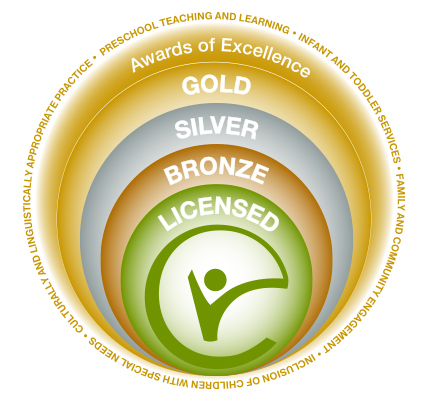 Quality programs meet or exceed the highest possible goals for all standards. Across all Circle of Quality designations is the importance of continuous quality improvement.
ExceleRate Illinois educates parents and providers about the importance of quality in early learning and development. For parents it offers them the ability to make an educated decision and feel confident about where they choose to place their children for this stage of development. Providers benefit by participating in ExceleRate Illinois because it helps them stay current with best practices, connects them with Early Childhood experts, and offers support and encouragement to focus on whole child development. For more information on ExceleRate Illinois, visit www.excelerateillinois.com. Even programs who have achieved the Gold Circle of Quality can still improve and seek Awards of Excellence - a special recognition for programs that implement research-driven, proven practices to focus on high-risk children and prepare them for success in school and life. These awards cover several areas and technical assistance is provided. See the ExceleRate Awards of Excellence overview to learn more.
|
 |
|
Small Wins Mean Great Promise for Illinois Innovation Zones
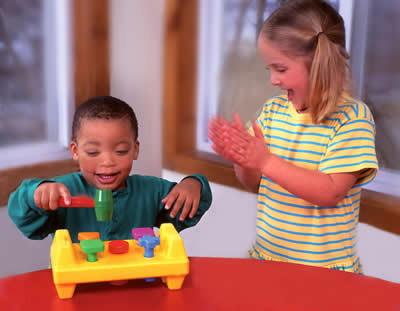
To support high needs children and families in Illinois, the Governor's Office of Early Childhood Development partners with Illinois Action for Children to implement and oversee the Innovation Zones initiative. Since December 2012, Innovation Zones have helped the state test new strategies to engage the highest needs children in quality early learning programs. The most effective strategies will be recommended for large scale or statewide adoption. The seven Innovation Zones are: Aurora, Cicero, Greater East St. Louis, North Lawndale (Chicago), Pilsen and Little Village (Chicago), Thornton Township (South Chicago Suburbs), and Williamson County (Marion). Each community participated in a discovery process to better understand community assets, needs, and the root causes of the challenges they face in their early learning systems. The communities engaged diverse stakeholders to identify strategies and build plans to increase enrollment of children with high needs in high quality early learning programs. In August 2014, Innovation Zones launched these new strategies, which the Early Childhood and Parenting Collaboration at the University of Illinois-Urbana Champaign is evaluating to gauge effectiveness.

Photo: Illinois Action for Children
Innovation Zones are making great strides. Leah Pouw, director of Program Innovation at Illinois Action for Children, calls these improvements "small wins"- steps or successes that incrementally improve the development of one child or one program, paving the way for further impact. In North Lawndale, small wins have meant building a pipeline of coordinated referrals through establishing connections with teen programs, homeless shelters, and the Department of Children and Family Services to connect families to formal programs. The Cicero Innovation Zone has developed pop-up preschools in highest-need neighborhoods to build families' familiarity with early childhood education and ultimately connect them with formal programs. In Greater East St. Louis, small wins have included the development of a Professional Learning Community to support programs in achieving ExceleRate Illinois Circles of Quality. The Williamson County Innovation Zone conducted a survey in three districts to determine which children are not being formally served and how they can be reached, while simultaneously developing and streamlining developmental screening procedures throughout the region.
Each community is making unique and measured strides toward success. Stay tuned for an overall update from Innovation Zones, plus information about expanding the program.
|
|
|
Elgin Home Visiting Programs Amplify Parent Voices to Improve Enrollment
Elgin was one of six targeted Illinois communities selected through a statewide needs assessment to receive funding from the Maternal, Infant, and Early Childhood Home Visiting (MIECHV) program starting in 2012. The Elgin MIECHV partners are: Family Focus DuPage, Kane County Health Department (KCHD), School District U-46, and VNA Health Care. Each agency receives funding for expanded home visiting services, and KCHD receives additional support to provide coordinated intake and community systems development.In 2013, the Elgin MIECHV partners saw a decline in home visiting enrollment, and they launched an action plan to raise their collective enrollment from 70% to 100% of caseload capacity. As part of this plan, KCHD facilitated a "force field analysis" with their referring partners.
|
|
|
An Elgin Home Visiting program at work
|
Through this interactive process, program supervisors and staff identified key factors that promoted and hindered enrollment in home visiting and learned that 21% of families approached about home visiting declined services. This discussion led to a survey to determine why families didn't want to participate. The results? While 33% of families who declined home visiting said that they were too busy with school or work, a full 50% of families declined because they thought that they did not need the services, even though they met the eligibility requirements. In response, the Elgin partner agencies developed an improvement plan that included parent empowerment and a public awareness campaign. The programs recruited home visiting families to share their stories in bilingual video testimonials shared in the community. Additionally, the program re-purposed its website, adding videos and testimonials from home visitors and more detail about each program. The new website and supporting materials use the logo and design from iGrow -- an Illinois campaign that partners

professionals with families to promote Home Visiting -- to promote consistency and overall awareness.
Today, home visiting enrollment in Elgin is at 100% capacity (and has been for several months), the number of average monthly referrals to home visiting has increased, and the declination rate has decreased. In Kane County, only home visiting programs in Elgin are directly supported by MIECHV funds, but KCHD has worked to integrate MIECHV-related resources and procedures among participating home visiting programs across the county. See http://kanehomevisits.org/ to view the video testimonials and to learn more about this initiative. OECD appreciates the partners' collaborative work and their ongoing efforts to apply lessons learned through MIECHV to a broader network of providers.
|
Federal Action Alert: Together, We Can Sustain MIECHV Funding!
|
|
|
Image: Elgin Home Visiting
|
The Maternal, Infant, and Early Childhood Home Visiting Program (MIECHV) is a federal initiative funding state-level home
visiting programs that use effective, research-based models of care to prevent child abuse and neglect, promote healthy child development, and improve the health and well-being of children. If Congress does not reauthorize the program by the end of March, it will cease operations. We are calling on Congress to pass a re-authorization of MIECHV to promote the well-being of children in Illinois and throughout the country. Please
contact your legislators
and ask them to support this key bipartisan priority for Illinois!
Final Head Start Eligibility Rule Available
The Federal Office of Head Start recently announced the completion of the Final Rule on Head Start Eligibility, amending Head Start Program Performance Standards in two sections. The new changes

include updated eligibility requirements for the most recent
Head
Start
reauthorization and strengthened procedures for ensuring only
truly eligible children participate in Head Start programs. The Office
of Head Start hopes this new rule will improve the integrity of the progra
m while serving the intended children. For more information, see the
text of the final rule
.
Image: Federal Office of Head Start
|
|
Kathy Davis & Jill Grove, Early Learning Center
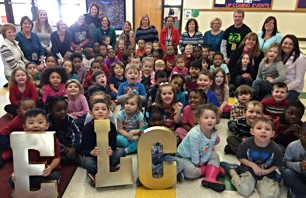
Jill Grove is the Principal and Kathy Davis is the PreK Programs Coordinator at the Early Learning Center in Springfield. Open since 2005, the Early Learning Center is a NAEYC-accredited program that
serves 700 high-risk preschool students in half-day programs. The Early Learning Center also runs a birth to age three home visiting program using the Parents as Teachers model, serving ninety five families in preparation for preschool and for life. The Early Learning Center is funded through a combination of funds from District 186, the Prevention Initiative, Preschool for All, and Special Education funding through ISBE.
The Early Learning Center is proud to be a Gold Circle of Quality Program. When asked about what Gold has meant for their program, Kathy said, "To us, becoming Gold is not an achievement, but rather a step in continuous quality improvement." That quality improvement shows through in parents and visitors to the school that notice a joyful and positive atmosphere--one that focuses on strong relationships between the teachers and children, an open door policy which allows parents to visit the classroom at any time, and teachers' mission to be "difference makers" in the lives of their children. This strong focus on family values and relationship building has allowed the Early Learning Center to grow year after year and to exude joy that is noticed by everyone who walks through the doors of the Center.
The Early Learning Center's hard work is being noticed all around. Recently, our State's First Lady, Diana Rauner, invited Jill and Kathy, along with approximately 10 other Early Childhood professionals in the Springfield area, to a breakfast at the Governor's Mansion to discuss Early Learning in Springfield. With Mrs. Rauner, the professionals discussed Springfield's system of Early Childhood and their shared passion for serving young children. They even got to meet Stella, one of the new First Dogs! Jill and Kathy look with excitement toward the future of Early Childhood in Springfield and hope to continue serving children through purposeful play, positive reinforcement, and partnering with parents.
|
Illinois Wins Selective Preschool Grant
The Office of Early Childhood
Development
is
to announce
that
thrilled
Illinois received one of the largest Preschool Development Grant - Expansion Grant awards throughout the country, amid strong competition from 35 states with robust, pre-existing preschool programs. Over the next four years, Illinois will receive $20 million annually to create high-quality, full-day preschool slots with community supports in high-need areas throughout the state. In combination with pre-existing grants and programs, Illinois will use these new funds to serve nearly 28,000 more preschool-aged children and almost 9,000 at-risk infants and toddlers over the next four years alone. Stay tuned for updates regarding implementation, which begins in March 2015, and see the press release regarding all grant winners from the U.S. Department of Education.
Measles Spreads Throughout the Country
In an outbreak traced to contamination at a Disney park in California, a scourge of measles has spread throughout the country, mainly in young children. Those at highest risk of contracting measles include unvaccinated individuals and infants below the age of recommended vaccination (12 to 15 months for a first shot, 4 to 6 years old for a booster). The Center for Disease control is reporting that 644 cases of measles were contracted in 2014, the largest number since 2000. Early Learning providers are encouraged to remain alert and educate themselves about the symptoms of a measles infection. Information on Illinois immunization requirements for children in childcare programs is available via the Illinois State Board of Education's Immunization Guidelines
and the Department of
Public
Healt
h's list of
Immunization

Illinois Partners with Early Head Start
In December, communities in Illinois were awarded $18 million in annual federal funds through the Early Head Start-Child Care Partnerships program. This program allows early learning
providers to better serve low income infants and toddlers by
 partnering local child care centers or family child care providers with Early Head Start programs, allowing parents to work by providing a full-day, full-year child care experience. Funds will be provided to the City of Chicago, Child Care Resource & Referral of Joliet, Proviso Leyden Council for Community Action, Inc. in Maywood, and the Rockford Human Services Department. For more information on Early Head Start-Child Care partnerships, see the U.S. Department of Education's website.
|
| Did you know that the Office of Early  Childhood Development has a help page? Simply provide us with your comment, question, or concern on this page, and someone will respond within a few days. |
|
|