|
Some highlights from EFI to check out this month:
- Welcome Cara Gallagher, John Zobitz, Hannah O'Grady, and Quinn Thomas to the EFI Steering Committee
- Registration and late-breaking posters for the EFI2025 Conference closes April 14th The meeting is May 19-22, 2025 at Virginia Tech
- New Alfred P. Sloan grant to EFI to support equitable pathways to environmental data science training
- Methods webinar: May 5, 2025 at noon US Eastern "Distance Sampling Applications in Ecology" by Tiago Marques (University of St. Andrews)
- EEFI webinar: 9th April at 1pm CET Shane Morris (University of Veterinary Medicine, Vienna) will present "Forecasting the energy and water consequences of global change on animals using biophysical models"
- OEFI webinar: 20 May at 3pm Sydney time by Nagur Cherukuru (CSIRO) on "Recent advances in satellite earth observation based water quality monitoring and forecasting in complex coastal ocean waters"
| | EFI Steering Committee Election Results | | |
Thank you to all the candidates who ran for the Steering
Committee and thanks to the EFI members who voted in the election!
The EFI community elected Quinn Thomas (Virginia Tech) and Cara Gallagher (Aarhus University). The Steering Committee appointed John Zobitz (Augsburg University).
| | Steering Committee Members and Terms of Service | | |
Antoinette Abeyta (1-year term), University of New Mexico Gallup
Antoinette's research focus is on broadening the participation of historically excluded individuals in STEM by addressing social, cultural, and technological training. Antoinette participates in the EFI Education and DEI working groups and the Alfred P. Sloan Foundation grant.
Alistair Hobday (1-year term), CSIRO, Australia
Alistair is the Director for CSIRO's Sustainable Marine Futures Program. He studies the impacts of climate change and extreme events on marine biodiversity and fishery resources and develops physical and biological seasonal forecast systems. He is co-lead of the Oceania Ecological Forecasting Initiative Chapter.
Cara Gallagher (2-year term), Aarhus University
Cara's research incorporates biological mechanisms, such as animal energetics and behavior, to enhance forecasts of human impacts on wildlife populations. She helps launch working groups, organize seminars, and apply for funding as a member of the European EFI Steering Committee.
John Zobitz (2-year term), Augsburg University
John is the Data Science Program Director at Augsburg. John has been involved with EFI since its inception, particularly in the Education and DEI working groups and is developing a NEON forecasting challenge of soil fluxes.
Korryn Bodner (1-year term), University of Guelph
Korryn is the co-founder and current chair of the Canadian Ecological Forecasting Initiative Chapter Steering Committee. Her new research focuses on how to better predict and prevent the emergence and spread of infectious diseases that impact wildlife, domestic animals, and humans.
Michael Gerst (1-year term), National Institute of Standards and Technology
Michael's background is in multi-disciplinary decision and risk science and much of his work over the past decade has been at the intersection of social and physical sciences. He has helped lead Translation working group initiatives.
Mike Dietze (Chair, 2-year term), Boston University
Mike is the founding director of EFI's grassroots community. His lab develops forecasts for a wide range of systems, including terrestrial carbon sequestration, tick-borne disease,
leaf phenology, soil microbiome, and forest pests.
Quinn Thomas (2-year term), Virginia Tech
Quinn is the co-director of the Virginia Tech Center for Ecosystem Foreasting. He is the PI of the NSF-funded EFI Research Coordination Network (RCN) and lead of the NEON Ecological Forecasting Challenge. He is leading the organizing committee for the EFI2025 Conference.
Hannah O'Grady (EFI Student & Early Career Association Representative, 1-year term),
University of Notre Dame
Hannah is a second-year graduate student who forecasts community shifts at centennial timescales. She is currently one of the EFISECA co-chairs.
Jason McLachlan (ex officio, non-voting member), University of Notre Dame
Jason is chair of the EFI Education Working Group, co-chair of the Diversity, Equity, and
Inclusion working group and leads the education efforts in the EFI RCN and the Alfred P. Sloan Foundation grants.
| | EFI Steering Committee Members Rotating Off - Thank You! | | |
Thank you to Anna Sjodin (EPA), Chris Brown (University of Maryland), Istem Fer (Finnish Meteorological Institute), and Kayode Oshinubi (Northern Arizona University) for their service to the EFI community and their thoughtfulness and input to the Steering Committee!
They have made valuable contributions working toward the sustainability of EFI, in particular exploring and making decisions about fiscal sponsorship, as well as leading the 2024 EFI Conference organizing committee, and keeping EFI's diversity, equity, and inclusion goals at the forefront of discussions. The group has provided perspectives from across a range of career stages and experiences in academia and government organizations.
While we will miss seeing them on the Steering Committee calls, we look forward to their continued efforts with other EFI activities and working groups.
| | Ecological Forecasting Initiative Receives Alfred P. Sloan Foundation Funding | | |
Thanks to generous funding from the Alfred P. Sloan Foundation, EFI will be able to continue work to ensure equitable pathways to earth and environmental data science graduate programs through collaborations with Tribal Colleges & Universities, Minority Serving Institutions, research universities, and professional organizations. This new funding will help EFI expand collaborations started with previous seed funding.
This initiative will develop and pilot three new environmental data science modules to enable a culturally relevant introduction to data, computing, and ecological forecasting; translate seven developed modules from the classroom to permanently archive online repositories for wider access; provide a new environmental data science microcredentialing opportunity for individuals who serve as tribal liasions; and develop and deliver at least six in-person environmental data science workshops, among other goals.
Details about collaborators and participating institutions can be found at: https://ecoforecast.org/new-funding-for-ecological-forecasting-initiative-activities/
| | EFI2025 Conference - Registration & Late breaking Poster Submissions Close on April 14! | | |
The countdown is on!
Less than two weeks to get registered and submit late-breaking poster abstracts.
Less than two months from the Conference on May 19-22, 2025.
If you aren't signed up yet, we would love to have you join us at Virginia Tech in Blacksburg, Virginia, for 3.5 days of talks and posters on the state of ecological forecasting, workshop for skill development, working group activities, a field trip to Mountain Lake Lodge and NEON's Mountain Lake Biological Station, and square dancing.
You can see the schedule on the conference webpage at https://bit.ly/efi2025.
Note that due to uncertainty in travel planning, particularly for our federal partners, the early bird registration rate is extended through the full registration period until April 14.
Standard registration rate = $125, Student registration rate = $50
Register at https://bit.ly/efi2025-register and find details about the venue and travel recommendations in the Conference Handbook.
Important Dates
- April 14, 2025: Late breaking poster abstract submissions and registration closes
- April 21, 2025: Hotel booking closes for those using the Conference block at The Inn at Virginia Tech
- May 5, 2025: Refunds for cancellations are available until this date
- May 19-22, 2025: EFI2025 Conference
| | |
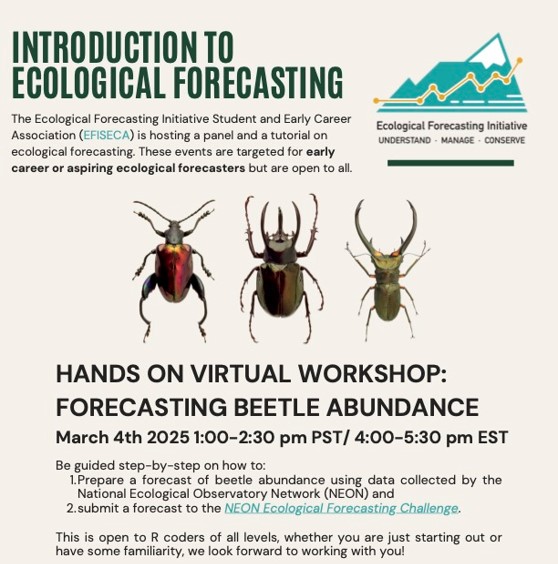
Resources from the Tutorial on forecasting beetle abundance using the NEON Forecasting Challenge
| | | Using the NEON Ecological Forecasting Challenges in the Classroom | | |
The NEON Ecological Forecasting Challenge is a powerful teaching resource.
If you are an instructor who would like to incorporate a forecasting challenge in your course, we now have a webpage with resources to help you get started.
https://projects.ecoforecast.org/neon4cast-ci/use-in-course.html
Resources include
- Best practices gleaned from experience in >10 courses
- Materials and activities from courses that have used the challenge
- Example code to create a leaderboard for forecast submissions from your class
Find more information about the five NEON Forecasting Challenge themes (terrestrial carbon and water fluxes, aquatic ecosystems, tick populations, beetle communities, and plant phenology) at: neon4cast.org. Reach out to info@ecoforecast.org if you have questions.
Other Forecasting Challenges
Want to develop a new forecast challenge? EFI has cyberinfrastructure to support stand-alone Forecasting Challenges that allow people to submit forecasts that are checked for alignment with the metadata standards, scored, cataloged, and visualized on a dashboard. There is also shared code available for individuals who want to synthesize across forecasts that have been submitted to those stand-alone Challenges. Reach out to info@ecoforecast.org if you are considering setting up a Challenge.
| | Statistical Methods Seminar | | |
EFI is co-hosting the fourth round of the Statistical Methods webinar series with the Ecological Society of America Statistical Ecology Section. Presenters provide an overview of a quantitative method in ecology and environmental science, the R or Python code or package related to the statistical method, and common pitfalls or stumbling blocks.
Note: The April 7 call was canceled.
| | Oceania Ecological Forecasting Initiative (OEFI) Chapter | | |
OEFI hosted its first call of 2025 in mid-March. The group discussed a plan to develop a horizon scanning manuscript to identify emerging trends, knowledge gaps, and future priorities for the Oceania community. An open invitation was given to OEFI members to who want to participate as a co-author. If you would like more information about this opportunity, you can contact info@ecoforecast.org.
The group will host a virtual seminar on 20 May at 3pm Sydney time by Nagur Cherukuru (CSIRO) on "Recent advances in satellite earth observation based water quality monitoring and forecasting in complex coastal ocean waters"
Add the call to your calendar using this Google Calendar Link or this Outlook .icals Import File.
Other seminars will be held on 24 July, 24 September, and 20 November. Details will be added to the OEFI webpage
https://ecoforecast.org/oceania-ecological-forecasting-initiative/ and sent to the OEFI email listserv, which you can sign up for here.
The OEFI co-chairs are also pleased to announce their session on "Ecological forecasting: Advancing ecological theory and management in Oceania with near-term forecasts" was accepted for the MODSIM conference to be held 30 November - 4 December 2025. Abstracts for the session can be submitted from April to August.
| | European Ecological Forecasting Initiative (EEFI) | | |
The next EEFI seminar will be on 9th April at 1pm CET
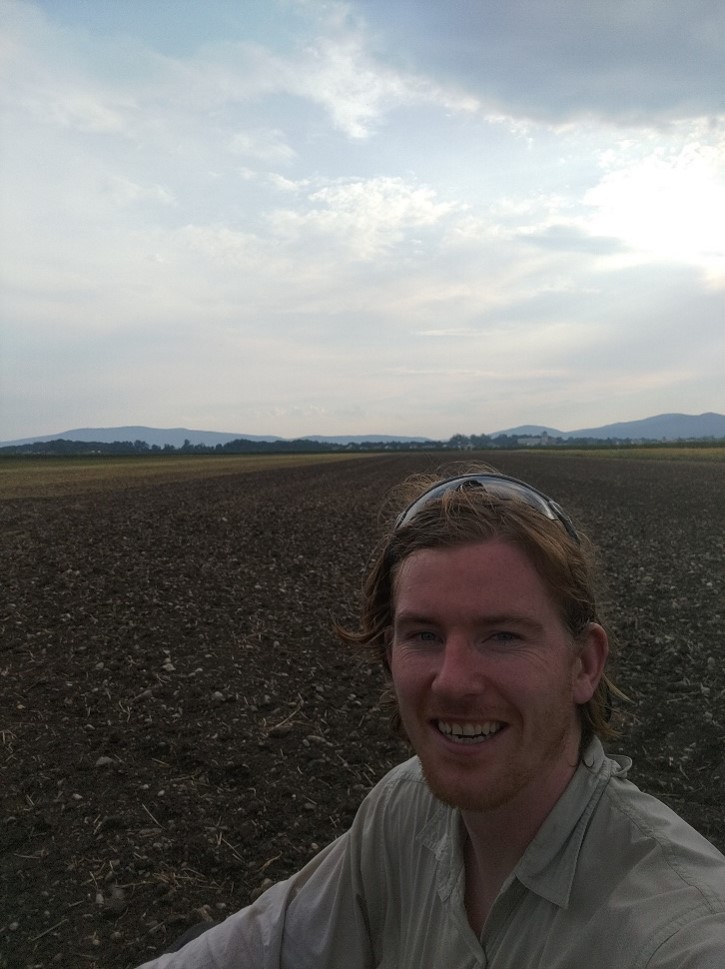
Shane Morris (University of Veterinary Medicine, Vienna) will present "Forecasting the energy and water consequences of global change on animals using biophysical models"
Add the call to your Google Calendar or to Outlook with this .icals Import File
| |
Abstract: Predicting and managing species responses to future environmental change requires accurately modelling organism-environment interactions. Biophysical models, which capture heat and water exchange, offer enormous promise due to their mechanistic insights and wide applicability. For once the potential water and energy impacts of global change can be quantified, the knock-on effect on species’ behaviour, phenology, survival, distribution, etc., can be assessed. Here, Dr. Morris will offer an introduction to these models, focusing on the microclimate and endotherm models, with reference to work he has done on Australian marsupial species such as the Tasmanian devil, the Vombatids, and the mountain pygmy possum.
Find details about upcoming seminars on the EEFI seminar page, https://euro-ecoforecast.wordpress.com/seminar-series/
| | EEFI Google Group: Updates and communications for EEFI activities are shared via the EEFI Google Group: https://groups.google.com/g/european-efi. Click the link then click the "Ask to join" button to be added to the group and stay up to date with activities and opportunities to participate in EEFI. | | Canadian Ecological Forecasting Initiative | | |
The Canadian Ecological Forecasting Initiative (CEFI) is in the early stages of planning to host the 2026 EFI Annual Meeting in Toronto. CEFI has been active in applying for funding to support the conference, as well as a range of related activities including workshops and a seminar series. This initiative has been led by Marie-Josée Fortin and supported by the steering committee.
In light of recent discussions around the Operating Principles and Procedures addendum for International Chapters, CEFI has begun developing its own bylaws and membership structure. The CEFI Steering Committee is currently exploring different membership models and considering how best to integrate communications with EFI.
CEFI is also looking forward to participating in the upcoming EFI Annual Meeting in Virginia, where several CEFI members will present their research!
If you want to stay up to date on the goings-on of CEFI, please visit the CEFI website, https://canadianefi.ca/, and subscribe to the mailing list!
| | Working Group Calls and Summaries | | |
The Working Groups are open for anyone to join at any time. Email EFI to be added to the mailing lists or Slack channels for these groups.
-
Theory - Tuesdays at 2pm US ET on January 14, February 11, March 11, April 8, and May 13
-
Translation & Actionable Science - Wednesdays at 2pm US ET on January 15, February 5, March 5, April 9, and May 7
-
Education - Mondays at 1pm US ET on January 13, February 10, March 10, April 14, and May 12
-
Diversity & Inclusion - Wednesdays at 1pm US ET on January 22, February 19, March 19, April 30, and May 28
-
Cyberinfrastructure/Methods - Wednesdays at 2pm US ET on January 22, February 19, March 19, April 16, and May 14
-
Student & Early Career Association (EFISECA) - Wednesdays at 11am US ET on January 22, February 26, March 26, April 30, and May 28
| | |
EFI Steering Committee
The 2024-2025 cohort of the Steering Committee had their final call in mid-March, where they finalized who to appoint to the Steering Committee to join the two members voted by EFI members. The group also discussed updates about potential fiscal sponsorship options and discussed the next steps. While this cohort hoped to wrap up the process of setting up fiscal sponsorship, there are still a few more decisions that will need to be made by the incoming cohort. Finally, the group discussed the text drafted by a subcommittee of EFI international chapter leaders for an addendum to the EFI Operating Principles and Procedures. That addendum will go out for review and comment by the EFI community once the draft is finalized.
Ecological Forecasting Initiative Student & Early Career Association (EFISECA)
This spring, EFISECA is focused on supporting early career and student forecasters dealing with funding and support uncertainty. The March call was used to solicit opinions on how to best support EFISECA members with professional, research, and wellness resources to ensure we can still keep doing the best science possible. The group agreed on assembling a resource database to guide continued funding, equity, and professional development activities for ecological forecasters. During the April call, this discussion will continue with invited panelists to answer any questions members may have about the new funding and academic landscape. Interested students and early career researchers are welcome to join future meetings. Email info@ecoforecast.org to connect with the group.
Theory & Synthesis
The Theory working group is preparing for a working group they will lead at the EFI2025 Conference. The goal of the Conference working group is to jumpstart a manuscript to synthesize what predictability means and its relationship to forecasting and exploring the parallels between predictability and stability. The group discussed a strategy for structuring the working group, including short presentations with examples from the literature and crowd-sourcing metrics for predictability, and laying out goals for the manuscript.
Translation & Actionable Science
The Translation working group is getting close to being ready to start recording the tutorials on the why, what, who, when, and how to connect with partners and forecast users. The list of quotes for each tutorial topic is almost finalized and ready to check to distribute quotes across all topics. Once the list of quotes is finalized, the narrators for each tutorial will work to make their recordings so the group can start to roll them out in time for the EFI2025 Conference.
Education and Diversity, Equity, and Inclusion
The Education and DEI working groups continue to work together asynchronously to develop an agenda for the EIF2025 Conference working group to develop an "EFI University for Everyone" curriculum that provides the framework outlining an ecological forecasting curriculum that is accessible to everyone. The group plans to start with sharing personal approaches and student user stories. This will transition into reflecting on design justice principles to evaluate the resources in light of student user stories. The goal at the end of the working group is to create a list of proposed activities ready to share with the EFI community to provide accountability to and from the community.
Methods & Tools and Cyberinfrastructure
The Cyberinfrastructure and Methods working group focused on preparing for the EFI2025 Conference workshop to present and promote a working version of the spatial forecast challenge to assess wildfire recovery at the conference. The group has now succeeded in operationalizing the forecast challenge workflow. In the next few months, they will transition to developing the tutorial materials for the workshop.
| | Call for Papers - AGU & ESA Special Collection | | |
Ecological Forecasting in the Earth System - This joint special collection between AGU and the Ecological Society of American focuses on the emerging field of ecological forecasting, which involves predicting the future states of ecosystems. The issue welcomes contributions that use novel methodologies (e.g., machine learning, process-modeling, uncertainty quantification, forecast evaluation, digital twins, inverse modeling), interdisciplinary approaches (e.g., integration with decision science, computer science), real-time data integration (e.g., data assimilation, measurements and monitoring to support forecasting), and multi-forecast synthesis to enhance the accuracy, uncertainty representation, applicability, and equality of ecological forecasts.
Accepted submissions to the following journals will be included in the special collection.
AGU Journals: Journal of Geophysical Research: Biogeosciences; Journal of Geophysical Research: Machine Learning and Computation; Water Resources Research; Journal of Advances in Modeling Earth Systems
ESA Journals: Ecology; Ecological Applications; Ecological Monographs; Ecosphere; Frontiers in Ecology and the Environment; Earth Stewardship
Submission deadline: October 31, 2026. Find details HERE.
| | |
New EFI Members
Hannah O'Grady - University of Notre Dame
Ryan Hollingshead - Delaware Division of Public Health
Rebecca Lee - Texas A&M
Res Altwegg - University of Cape Town
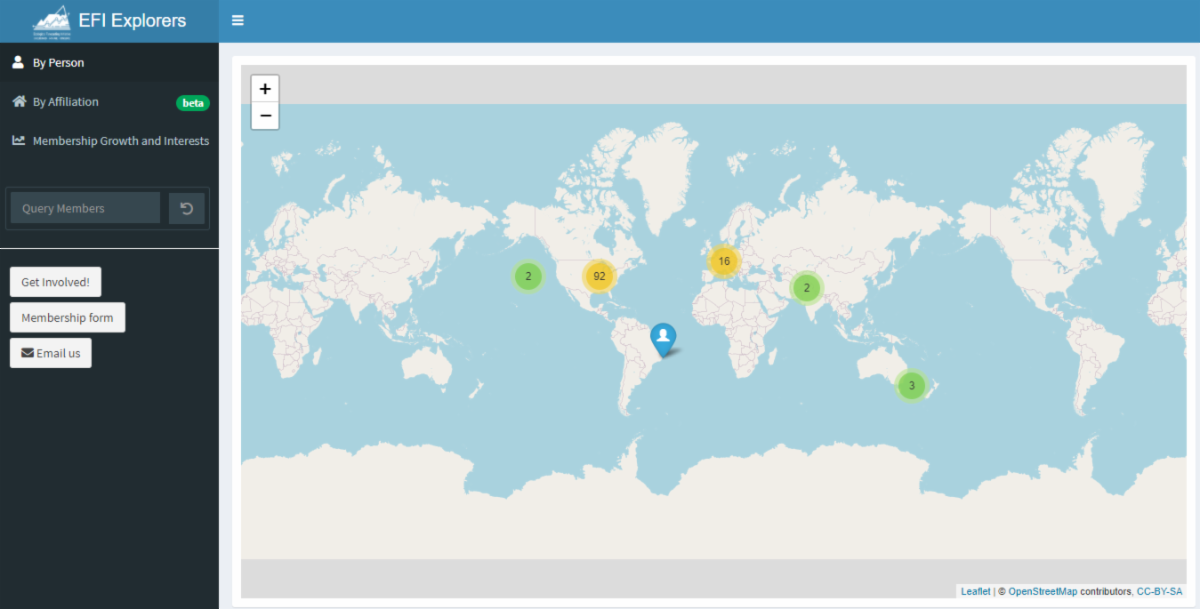
The EFI Members page provides a directory of the 319 EFI members and a map showing the general location of EFI members. EFI membership is free, allows individuals to be elected to the EFI Steering Committee and cast a vote in the Steering Committee elections, and demonstrates a commitment to the field of ecological forecasting. If you are not already a Member you can sign up here.
| | |
EFI Logos
The EFI logos are available for people to use in presentations.
| | |
EFI Slack Group
The EFI Slack Group provides an outlet for the group to share ideas and conversations on the day-to-day timescale. This is a great resource for real-time updates and discussions for Working Groups, the NEON Ecological Forecast Challenge, new papers, job postings, and funding opportunities.
Email EFI to request access to the Slack Group.
#funding and #jobs Channels
As a reminder, you can post and view funding and job opportunities to the EFI Slack. If you are not on Slack, you can still share opportunities by emailing the information to info@ecoforecast.org.
Funding opportunity -
-
Volkswagen Foundation Night Science: Space for the Creative Mind - the purpose of this funding is to support collaborations between 2 scientists exploring innovative and unconventional ideas in the natural, life, and engineering sciences working in basic research. At least one partner must be employed at a German research institution. Application due July 5, 2025
Jobs posted with upcoming due dates
| | |
Shop for EFI Gear
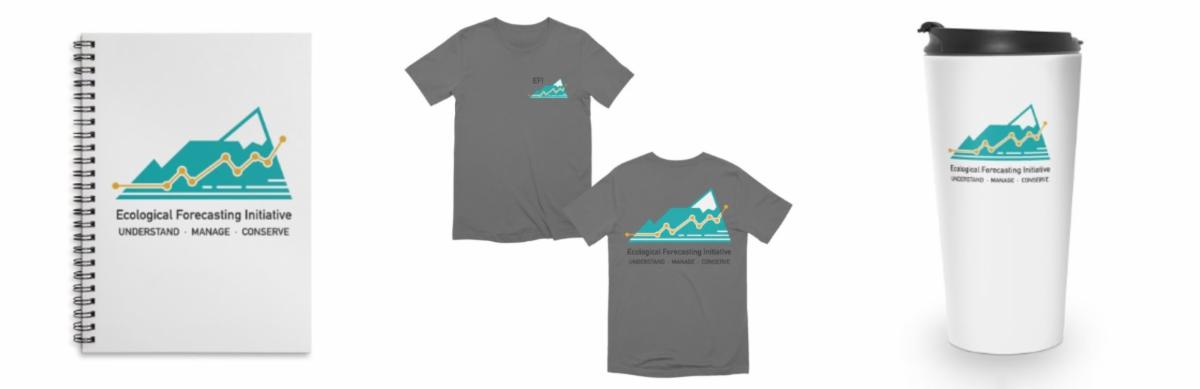
You can get your own shirt, magnet, notebook, and more from the EFI Store, https://ecoforecast.threadless.com/. Proceeds generated from the sale of products will be used to support EFI awards and activities. We have kid-size shirts and baby onesies for all those future ecological forecasters!
| |
-
April 14, 2025: Ecological Forecasting Initiative 2025 full registration and late-breaking poster submission closes
-
May 5, 2025: Statistical Methods Seminar - Distance sampling applications in ecology
-
May 14, 2025: EEFI Seminar by Mikhail Sofiev, Finnish Meteorological Institute
-
May 19-22, 2025: Ecological Forecasting Initiative 2025 Conference at Virginia Tech
-
May 20, 2025: OEFI virtual call by Nagur Cherukuru, CSIRO
-
June 2-7, 2025: "Perspectives and Challenges in Biodiversity Forecasting" session at the SIBECOL Conference, Pontevedra, Galicia
-
June 23-27, 2025: "Ecological Forecasting for Integrated Science" session at eLTER 2025, Tampere, Finland
-
June 24, 2025: OEFI virtual call
-
September 24, 2025: OEFI virtual call
-
November 20, 2025: OEFI virtual call
-
November 30 - December 4, 2025: OEFI-hosted session on “Ecological forecasting: Advancing ecological theory and management in Oceania with near-term forecasts” at the 26th International Congress on Modelling and Simulation (MODSIM25). Abstracts are due by August 2025.
| | | | |