|
A few things to highlight this month:
-
EFI2026: Call for workshop and working group proposals is open!
-
EFI seed funding opportunity: Social Science Ecoforecasting RFP
-
ESA 2025 Ecoforecasting Award: Congrats to Mary Lofton and colleagues!
-
EFI bylaws: International chapter addendum ratified!
-
EFI ASLO session: Abstracts due Nov 25
-
Upcoming webinars:
-Stats series: Nov 3 at noon ET, Decision support using the {prioritizr} R package" by Richard Schuster
- EEFI series: Nov 12 at 1pm CET, "Global lake responses to climate change" by Iestyn Woolway
Please check out the full newsletter for details about these updates and more!
| | EFI2026 Conference Call for Working Groups & Workshops | | |
The Canadian EFI Chapter Steering Committee looks forward to welcoming you to Toronto on August 4-7, 2026 for the EFI 2026 Conference! The Conference will assemble local, regional, national, and global leaders from the mathematical sciences, environmental sciences, epidemiology, data sciences, one health, and related disciplines to advance the state of ecological forecasting.
🎤There will be keynote addresses, short research and poster presentations, working group and workshops, and time for networking to bring together individuals from academia, government agencies, industry, and the non-profit sectors to to share cutting-edge research and applications in ecological forecasting broadly.
📣Call for Working Groups and Workshop Proposals are now open!
🤝Working Groups: Working Group sessions provide extended time (1/2 day or full day) to work on specific projects with others in the EFI community. These sessions, open to all conference participants, will take place on August 4. Working Groups can be related to the standing EFI Working Groups, other projects, or targeted topics of discussion of interest to the EFI community that will benefit from dedicated in-person time at the conference.
Submit working group ideas to: https://bit.ly/efi2026-workinggroups
📖Workshops: As a community of practice, sharing hands-on knowledge is foundational to EFI. To advance this goal, we invite workshop submissions for the Conference. Workshops are an opportunity to provide topical training, tutorials, and demonstrations for the EFI community. You can find other examples of workshops held at the EFI 2024 and the EFI 2025 conferences. Workshops are approximately 1-2 hours in length and will be interspersed in the schedule on August 5-7.
Submit workshop ideas to: https://bit.ly/efi2026-workshops
📅 Key Dates (subject to change if needed)
-
December 8, 2025: Abstract submissions, travel scholarships, and visa requests opens; Individuals particularly concerned with a long visa processing time can email their request and abstract to info@ecoforecast.org before December 8
- January 23, 2026: Proposals for working groups and workshops submissions close
- March 13, 2026: Registration opens
- April 15, 2026: Abstracts and travel scholarship submissions close
- May 1, 2026: Accepted contributions and travel scholarships announced
- May 29, 2026: Early bird registration closes
- July 1, 2026: Full registration closes
- August 4-7, 2026: EFI2026 Conference
| | International Chapter Addendum - Now Ratified | | |
The EFI Steering Committee ratified the Section 6 International Chapter addendum to the EFI Operating Principles and Procedures (OPP) following the two-week period for written comments from the EFI community posted in the previous newsletter. This new OPP section describes the bylaws and responsibilities for the International Chapters.
A new International Chapter Playbook is now available to provide guidance to individuals who are considering starting a new international EFI chapter and to provide resources for current EFI chapter Steering Committee members and Co-chairs.
| | Proposal Invitation: EFI Social Science Ecoforecasting Award | |
The Translation and Actionable Science Working Group is coordinating the second round of seed funding to provide $1,000 awards to support five Project Groups to empower social scientists to lead interdisciplinary ecological forecasting projects.
The awards are not restricted to just the US or to specific career stages.
Each Project Group will use the award to either
1) develop a proposal for an identified external funding opportunity or
2) convene a group to explore ideas and funding sources.
These activities should advance the use of social science in ecological forecasting and address ethical, methodological, or empirical gaps and advancements in the field of ecological forecasting.
Proposals are due December 15, 2025. Awards will be announced by January 15, 2026.
Please share with your colleagues and networks!
| | Coastal and Marine Ecoforecasting Working Group Kickoff Call | |
The goal of the Coastal and Marine Ecological Forecasting (CMEF) working group is to foster an inclusive space that connects EFI members and working groups, engages new participants, and drives innovation in ecological forecasting in coastal and marine systems. There are two opportunities for the EFI community to participate.
-
CMEF will have its first kickoff call on November 20 at noon US ET/5pm UTC. Email info@ecoforecast.org if you would like to be included on the email list for this group and receive the calendar invite for the call. Given the global interest in coastal and marine forecasting, we know this time will unfortunately not work for everyone. Notes and a recap will be sent following the call. There is also a #coastal-marine channel in the EFI Slack group where updates will be shared.
-
Anyone with an interest in coastal and marine forecasting is invited to complete a brief multiple-choice survey (~10 questions) to share your interests, expertise, and perspectives in CMEF. Your input will help guide the future direction and activities of the working group. Survey results will be discussed during the November 20 kickoff meeting. https://nd.qualtrics.com/jfe/form/SV_3Rj03Ph51b2R2f4
| Call for Submissions for a Special Session at ASLO|SIL 2026 | | |
Cayelan Carey, Rohit Shukla, and Mary Lofton (Virginia Tech) are leading a session on data science, modeling, and forecasting at the upcoming 2026 Association for the Sciences of Limnology and Oceanography (ASLO) and International Society for Limnology (SIL) joint meeting on May 12-16 in Montreal, Quebec, Canada!
They invite submissions related to all areas of aquatic forecasting, and especially welcome submissions from early career researchers spanning all subdisciplines of the aquatic sciences.
The deadline to submit abstracts is November 25.
SS070 Exploring the confluence of data, models, and forecasts for advancing adaptive management strategies for aquatic ecosystems
Management of aquatic ecosystems often requires extrapolating beyond current conditions to understand how ecosystems may respond to future management scenarios, climate conditions, or other environmental pressures. Ecological models and forecasts are widely applied to provide managers with estimates of future aquatic ecosystem conditions, yet tailoring model predictions, projections, and forecasts to specific management needs can be challenging. Moreover, advances in environmental sensing technology and machine learning in recent decades have led to increased availability of high-frequency, multi-scale data for many aquatic variables. This deluge of “big data” in aquatic sciences requires new approaches to iteratively assimilate these data into models and then update visualizations and dashboards used by decision-makers. In this session, we explore the confluence of data, models, predictions, and people to craft adaptive management strategies for aquatic ecosystems. We invite submissions that examine how data, models, and forecasts can be integrated into management decision-making processes. Relevant submissions could include development of data-driven workflows and automated pipelines to handle high-frequency aquatic ecosystem data, data-model integration, model development, iterative updating of model predictions, projections, and forecasts, uncertainty quantification, and development of management decision-making tools. We seek a diverse set of presentations across data science, modeling, and forecasting applications in aquatic ecosystems, with a common theme of using these technical tools and computational intelligence to co-design aquatic management frameworks that are resilient to ongoing anthropogenic and environmental pressures. Our overarching goal is to illuminate the value of modeling and forecasting as tools for bringing together people, data science, and knowledge to manage aquatic ecosystems.
| Workshop at The International Biogeography Society (TIBS) | |
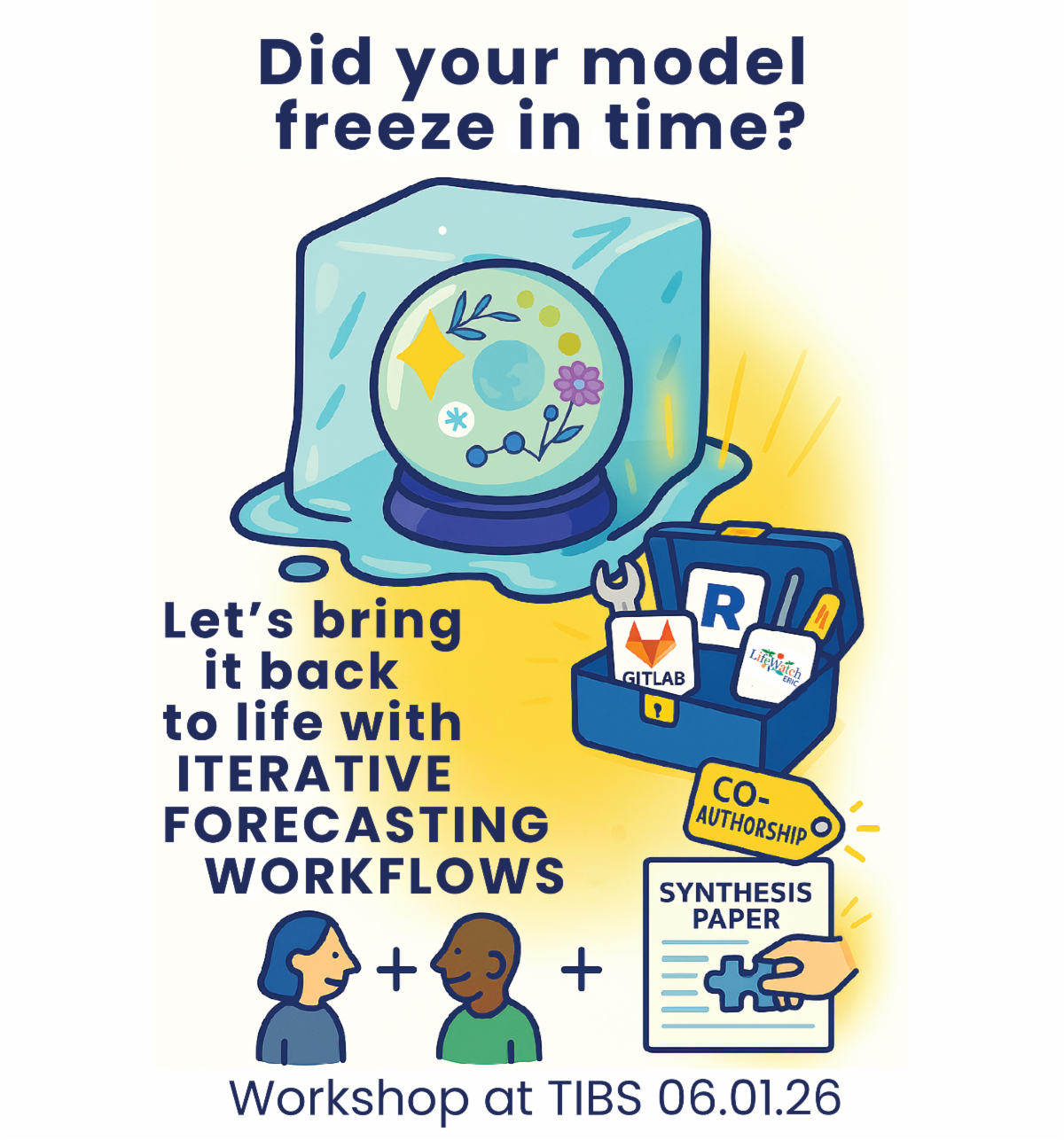
Building Workflows for Near-Term Iterative Forecasting Workshop
Location: Aarhus University, Denmark
Dates: 6-10 January 2026
Many of us have created predictive models that once offered a glimpse into the future—then quietly froze in time, never updated despite new data becoming available.
But workshop leaders, Cara Gallagher (Aarhus University), Billur Bektaş (ETH Zürich), Patrícia Singh (University of Potsdam), and Maria Paniw (Spanish National Research Council), want to change that. Built up by the European Ecological Forecasting Initiative (EEFI), this hands-on workshop is part of a growing effort within the forecasting community to bring those models back to life—and to help those building new models design them to stay alive from the start.
Together, we’ll explore how to transform static predictions into dynamic, self-updating forecasts that evolve and improve as new data arrive.
You’ll get access to our biodiversity dataset — complete with environmental variables — and the chance to build your own predictive model using the same inputs. Your model will then be evaluated against ours using forecasting skill scores and other performance metrics to see how well it performs.
If you create and submit a relevant model, we’ll be thrilled to invite you as a co-author on our upcoming synthesis paper!
For more information: https://conferences.au.dk/tibs-aarhus-2026/workshop-1-2
Register now (early bird closes 31st Oct; full registration closes 15th Dec):
https://conferences.au.dk/tibs-aarhus-2026/registration
| | Ecological Forecasting Outstanding Publication Award | | |
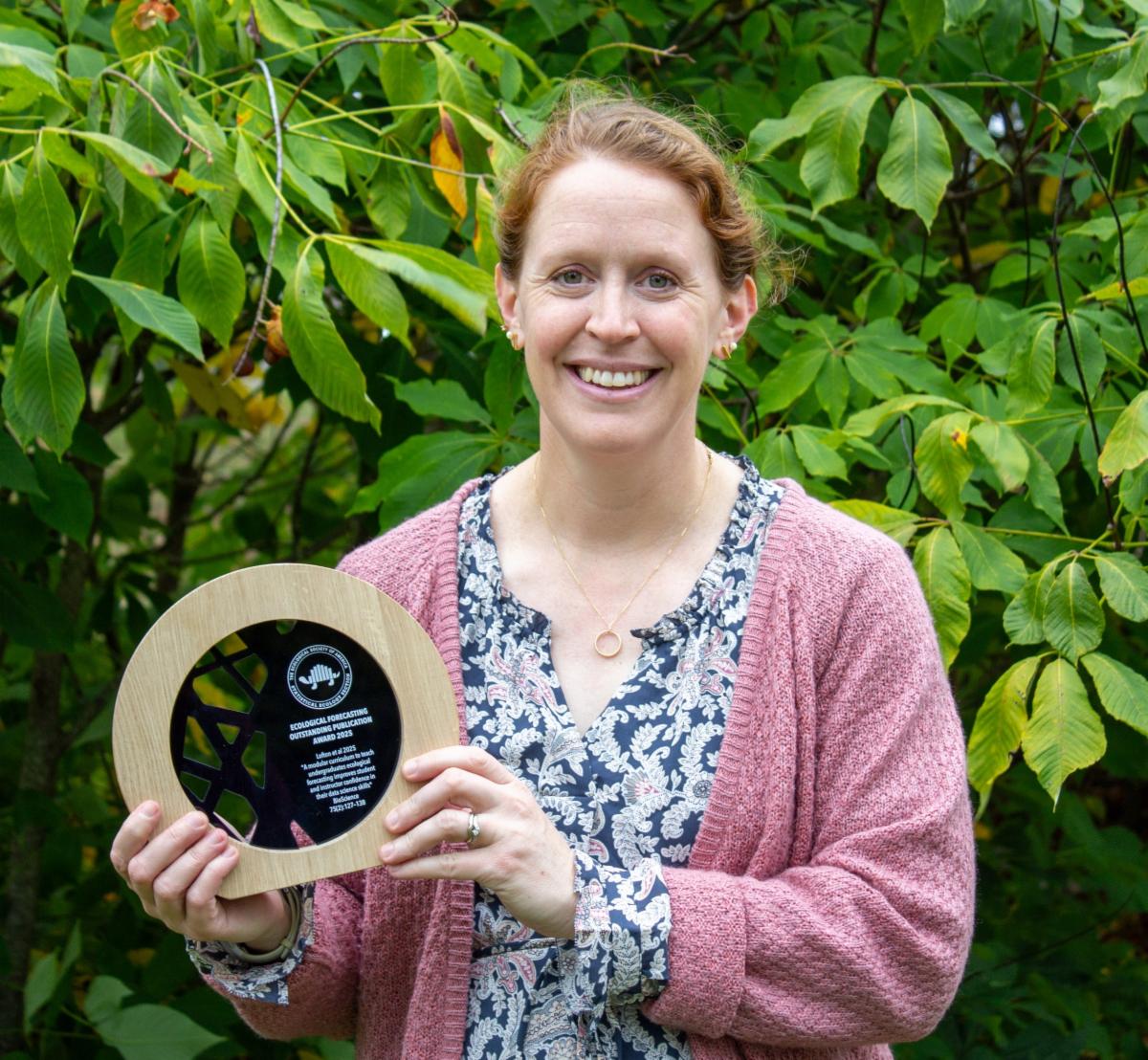
Congratulations to lead author, Mary Lofton (Virginia Tech) and co-authors for winning the 2025 Ecological Forecasting Award for their 2025 Bioscience paper,
"A modular curriculum to teach undergraduates ecological forecasting improves student and instructor confidence in their data science skills"
Access the paper at https://doi.org/10.1093/biosci/biae089
This award comes from the Ecological Society of America Statistical Ecology Section. The awards committee found the work Loften et al. have put into the Macrosystems EDDIE forecasting modules to be inspiration to folks new to forecasting. One committee member referred to the project as “an elegant example of executing [forecast training] at scale”, while another referred to the modules as “a really good piece of software” in their own right. The committee was also excited to see all the work and rigor that went into the educational assessment of the modules and the demonstrated positive impact they have had on student learning. Overall, when it comes to advancing the field of ecological forecasting, this paper reinforces the critical importance of innovation and methodological advancements in the teaching the next generation of ecological forecast users and producers.
We'd also like to thank Princeton University Press for adding a book prize to this year's award, which is in addition to the cash prize from ESA and plaque.
Nominations for the 2026 prize are due March 1. The prize is open to any scholarly publication in the past 3 years. Awardees must be ESA members. More information about nomination criteria and past recipients can be found here.
| | EFI & ESA Statistical Method Seminar Series | | |
EFI is co-hosting the fifth round of the Statistical Methods webinar series with the Ecological Society of America Statistical Ecology Section. Presenters provide an overview of an R or Python package with advice about common pitfalls or stumbling blocks.
Details and links to register for the calls will be added to the webinar page:
https://ecoforecast.org/workshops/statistical-methods-seminar-series/
| | |
"Decision support using the {prioritizr} R package"
Richard Schuster (Nature Conservancy Canada & Carleton College)
November 3, 2025 at noon US ET
Register at: https://bit.ly/3H9A3wt
The {prioritizr} R package (https://prioritizr.net) is a decision support tool for custom-tailored conservation planning. Its flexible interface provides systematic conservation prioritization using mixed integer linear programming. It can leverage a variety of commercial and open-source exact algorithm solvers to identify optimal solutions and is compatible with a variety of spatially explicit and nonspatial tabular data formats. Dr. Schuster will give an introduction to the package, provide worked examples, and showcase a few ways {prioritizr} has been used.
| | European Ecological Forecasting Initiative (EEFI) | | |
Seminar Series
-
Iestyn Woolway (Bangor University) will present on "Global lake responses to climate change" on 12th November at 1pm CET.
-
Juan Gallego-Zamorano (Dutch Centre for Field Ornithology, Sovon) presented on "Modelling Birds’ Annual Cycle Using Euro Bird Portal Data" for the October call. See the recording here: https://youtu.be/VGwygi9Xbmg
You can find details, calendar invites, and recordings from previous seminars on the EEFI Seminar webpage.
Survey: Request for Input from the European Community
EEFI's Working Group 1 is looking to develop a holistic framework for evaluating ecological forecasting success and quality. The group is currently seeking diverse perspectives from both academic and non-academic users and developers of ecological forecasts from across Europe, and would be very grateful if you could complete the following questionnaire and circulate it amongst your networks:
https://app.onlinesurveys.jisc.ac.uk/s/edinburgh/ecological-forecasting-success-and-quality
The questionnaire asks about your context, your use of ecological forecasts, and what you deem important to success and quality.
There is a mix of multiple-choice and written-response questions. The questionnaire should take 20-30 minutes to complete.
If you are interested in contributing from beyond Europe, please get in touch with Emily Simmonds (esimmon2@ed.ac.uk) and Vicky Boult (v.l.boult@reading.ac.uk).
European Ecological Forecasting Applications Database
EEFI has launched the EEFI Forecasting Applications Shiny App, which aims to collect and showcase ecological forecasting efforts across Europe. Including:
- Forecasting applications (operational forecasts that make explicit predictions with uncertainty estimates),
- Modeling applications with forecasting potential (ecological models that could become forecasting tools if linked to data streams), and
-
Observatories with forecasting potential (long-term monitoring networks or data-collection systems that could feed into iterative forecasts).
Find additional details about all EEFI activities at https://euro-ecoforecast.wordpress.com.
| | Oceania Ecological Forecasting Initiative (OEFI) Chapter | | Working Group Calls and Summaries | | |
The Working Groups are open for anyone to join at any time. Email EFI to be added to the mailing lists or Slack channels for these groups.
Polls will be sent in December to the working group email lists and on Slack to schedule monthly calls for January to May 2026.
Upcoming Calls
-
Theory - Wednesdays at 11am US ET on November 12, and December 10
-
Translation & Actionable Science - Thursdays at 3pm US ET on November 20, and December 18
-
Education/Diversity & Inclusion - Monday, November 3 at 3:30pm, and Friday, December 5 at 1:30pm
-
Cyberinfrastructure/Methods - Mondays at 3:30pm US ET on November 17, and December 8
-
Student & Early Career Association (EFISECA) - Tuesdays at 11:30pm on September 23, October 28, and November 25
-
Coastal and Marine Ecoforecasting (CMEF) - Thursday at noon US ET, November 20
| | |
EFI Steering Committee
The Steering Committee discussed plans for upcoming conference sessions, options for future EFI annual conferences, and an application for fiscal sponsorship. Two other major topics of discussion were ratifying the International Chapter amendment to add it to the Operating Principles and Procedures, and a discussion of logo licensing considerations.
Ecological Forecasting Initiative Student & Early Career Association (EFISECA)
This past month EFISECA hosted its first meeting of the fall semester welcoming new EFISECA members and discussing the “hidden curricula” of both graduate school and ecological forecasting. Older EFISECA members were happy to share their advice for succeeding (and enjoying!) graduate school and shared helpful resources for ecological forecasting. EFISECA meetings take place the fourth Tuesday of every month from 11:30-12:30 EST for the remainder of the fall semester. See the Google Calendar invite here.
Tomorrow's October 28th call will be a non-academic careers Q&A with three guest panelists with careers in the industry and nonprofit sectors. See the #student_early-career Slack channel for further details.
Theory & Synthesis
The Theory working group explored concepts of intrinsic and realized predictability in forecasting based on a table of predictability papers being collated by the group, and the pros and cons of setting up a systematic literature review based on the goal of the paper. The group also considered a figure in development that will highlight multiple hypotheses about predictability.
Translation & Actionable Science
Following the last newsletter, Abby Keller (University of California, Berkeley), Alison Gerken (USDA), and Alexis O'Callahan (University of Arkansas) have taken on the role of co-chairs for the working group. Much of the October call focused on advertising plans for the Social Science and Ecoforecasting Award (see details above). Following that, Alexis provided an overview and shared updates about the "How" tutorial in the series that the working group has been developing on engaged research. You can find recordings and resources from the Introduction, Why, When, What, and Who tutorials here: https://ecoforecast.org/engaged-research-tutorials/. Abby also briefly shared the background work she has been doing for a group manuscript to evaluate the impacts of forecasts.
Education and Diversity, Equity, and Inclusion
The Education and DEI working groups continue to meet jointly. The group discussed a National Geographic funding opportunity, which may be a nice way to follow up on ideas from the "EFI University for Everyone," if ideas can be fleshed out in time for the November proposal deadline. The group shared ideas about how to support new EFI members looking for educational resources and community support. The discussion wrapped up with individuals sharing activities they are working on for current educational efforts.
Methods & Tools and Cyberinfrastructure
The Cyberinfrastructure and Methods working groups hosted a guest who spoke about his work to forecast the outcomes of post-fire seeding treatments, the spatial temporal issues he is grappling with, and the potential connections to the spatial forecast of fire recovery using MODIS LAI developed by the working group. You can find the html version of the tutorial here and the GitHub repository here for the MODIS LAI forecast challenge.
Coastal and Marine Ecoforecasting (CMEF)
The CMEF working group will have its kick-off call on November 20 at noon US ET! See the details about the call and an associated survey above.
Ethics
The newly formed Ethics working group had its inaugural call last week. The goal of the group is to provide recommendations for policies and suggestions on a range of ethical dilemmas that can be associated with forecast discussions, funding, generation, and dissemination to provide guidance regarding EFI activities and for EFI members. The first call focused on brainstorming and grouping examples of ethical dilemmas. Future calls will determine the topics the group will focus on and develop recommendations.
| | Call for Papers - AGU & ESA Special Collection | |
Ecological Forecasting in the Earth System - This joint special collection between AGU and the Ecological Society of American focuses on the emerging field of ecological forecasting, which involves predicting the future states of ecosystems. The issue welcomes contributions that use novel methodologies (e.g., machine learning, process-modeling, uncertainty quantification, forecast evaluation, digital twins, inverse modeling), interdisciplinary approaches (e.g., integration with decision science, computer science), real-time data integration (e.g., data assimilation, measurements and monitoring to support forecasting), and multi-forecast synthesis to enhance the accuracy, uncertainty representation, applicability, and equality of ecological forecasts.
This Eos article is a useful resource if a) you are considering submitting to the special issue or b) didn't have it on your radar previously, but now want to learn more.
Accepted submissions to the following journals will be included in the special collection.
AGU Journals: Journal of Geophysical Research: Biogeosciences; Journal of Geophysical Research: Machine Learning and Computation; Water Resources Research; Journal of Advances in Modeling Earth Systems
ESA Journals: Ecology; Ecological Applications; Ecological Monographs; Ecosphere; Frontiers in Ecology and the Environment; Earth Stewardship
Submission deadline: October 31, 2026. Find details HERE.
| | |
New EFI Members
Katie Hoffman - Virginia Tech
Jennifer Paige - University of California, Davis
Catherine Courtier - University of California, Davis
Mallory Allman - UNC Chapel Hill
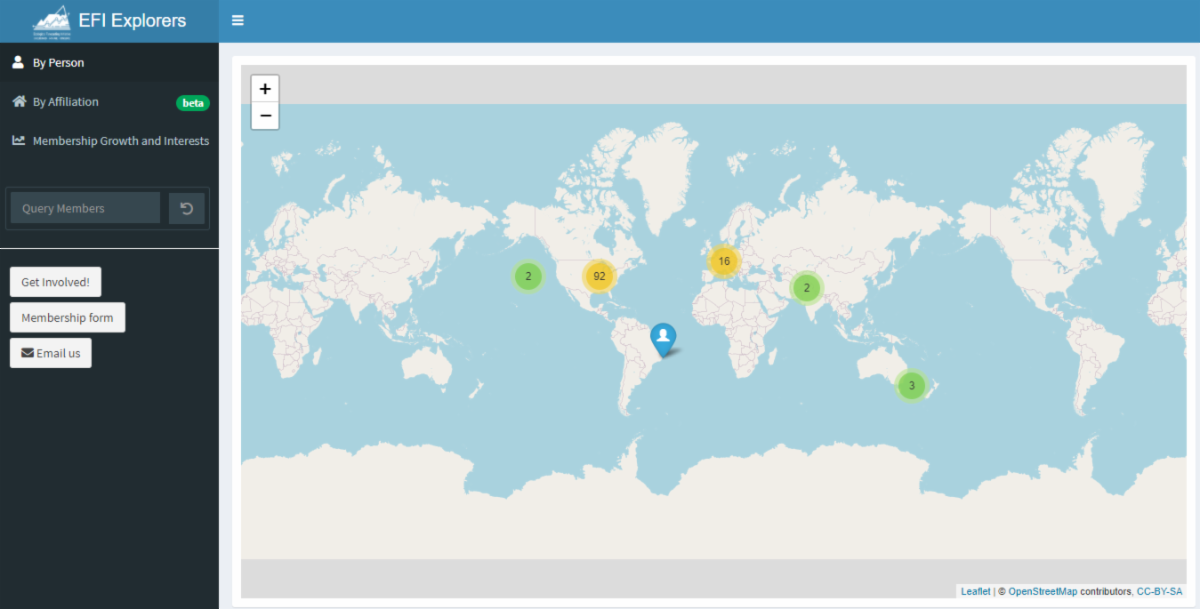
The EFI Members page provides a directory of the 357 EFI members and a map showing the general location of EFI members. EFI membership is free, allows individuals to be elected to the EFI Steering Committee and cast a vote in the Steering Committee elections, and demonstrates a commitment to the field of ecological forecasting. If you are not already a Member you can sign up here.
| | |
EFI Logo
The EFI logo is available for people to use in presentations.
| | |
EFI Slack Group
The EFI Slack Group provides an outlet for the group to share ideas and conversations on the day-to-day timescale. This is a great resource for real-time updates and discussions for Working Groups, the NEON Ecological Forecast Challenge, new papers, job postings, and funding opportunities.
Email EFI to request access to the Slack Group.
#funding and #jobs Channels
As a reminder, you can post and view funding and job opportunities to the EFI Slack. If you are not on Slack, you can still share opportunities by emailing the information to info@ecoforecast.org.
Funding
-
Better Scientific Software (BSSw)Fellowship Program. The BSSw Fellowship Program gives recognition and $25,000 in funding to leaders and advocates of high-quality scientific software. The application deadline is October 31. See details here.
-
Scientific Software Research Faculty Award. Five years of salary support for new research professor positions in existing academic departments to be filled by scientific software-focused researchers. The application deadline is January 21. See details here.
-
Summer Graduate Student Research Fellowships at the Morton Arboretum. Project scope is open, but should identify Arboretum collaborators and align with one of three areas of research: Arboriculture and urban forestry; Ecosystem restoration and management; Tree biodiversity and conservation science. The application deadline is November 1. See Slack for details.
Job postings
-
Natural and Working Lands Research Scientist at California Air Resources Board/Research Division/Lands and Climate Science Section (US). Conduct research to assess the direct and indirect interactions between air quality, climate, and Natural and Working Lands. Apply by November 2. See details in Slack.
-
Postdoc at Tohoku University (Japan). Jamie Kass is recruiting a postdoc to do biodiversity modeling research. The position is listed as a Specially Appointed Assistant Professor (this refers to a job similar to a postdoc in most countries outside Asia). See the job posting here. But also see details in Slack. They would like to hire someone soon, so please email ASAP with a CV if interested.
-
Postdoc at University of California, Santa Cruz (US). Alexa Fredston is recruiting a postdoc to develop spatial Bayesian models that integrate several data streams for humpback whales. This work will be done in collaboration with Mevin Hooten at the University of Texas, Austin. Application review begins December 16 and will be left open until the right candidate is identified. See the job posting here.
-
Research Scientist at the New England Aquarium (US). The research scientist will oversee the North Atlantic Right Whale Consortium (NARWC) Sightings & Effort Database (SED). See the job posting here.
-
PhD Student at the University of Guelph (Canada). Korryn Bodner is recruiting a graduate student to forecast blacklegged tick (Ixodes scapularis) abundance and the pathogens it transmits. Applications will be reviewed on a rolling basis. See details in Slack.
-
Two faculty positions at the University of Utah (US). Associate/Full Professor in AI for Environmental Monitoring and Assistant/Associate Professor in AI for Environmental Monitoring/Forecasting. Application review begins November 15.
-
Postdoc at Indiana University, Bloomington (US). Kim Novick is recruiting a postdoc to conduct research focused on reducing bias and uncertainty in the measurement and monitoring of forecast carbon uptake from local to global scales. For best consideration, apply by November 15. See the job posting here.
-
Postdoc at the National Institute for Theory and Mathematics Fellows Program (US). The Program seeks to recruit young scientists trained in either mathematics (pure and applied), physics, or biology who have demonstrated exceptional research promise. Application review begins November 1 for students with degrees attained by Sept 1, 2026. See the program details here.
-
Graduate student at Virginia Tech (US). Cayelan Carey is recruiting a PhD graduate interested in measuring, modeling, and forecasting how reservoir water quality is changing. Students are encouraged to email Dr. Carey by November 1. See details in Slack.
-
Graduate student and Postdoc at Rutgers University (US). David Klinges is recruiting a postdoc and a PhD student to develop projects related to the EcoClimate lab, which combines computational modeling, field studies, and laboratory experiments to understand how terrestrial species and ecosystems respond to climate change. See details in Slack.
| | |
Shop for EFI Gear
You can get your own shirt, magnet, notebook, and more from the EFI Store, https://ecoforecast.threadless.com/. Proceeds generated from the sale of products will be used to support EFI awards and activities. We have kid-size shirts and baby onesies for all those future ecological forecasters!
| |
-
November 3, 2025: Statistical Methods Seminar; Richard Schuster (Nature Conservancy Canada & Carleton College). Decision support using the {prioritizr} R package.
-
November 12, 2025: EEFI monthly seminar; Iestyn Woolway (Bangor University). Global lake responses to climate change
-
November 20, 2025: OEFI virtual call
-
November 30 - December 4, 2025: OEFI-hosted session on “Ecological forecasting: Advancing ecological theory and management in Oceania with near-term forecasts” in the “Environment and ecology” stream at the 26th International Congress on Modelling and Simulation (MODSIM25; Adelaide, Australia).
-
December 1, 2025: Statistical Methods Seminar; Michael Dumelle (U.S. Environmental Protection Agency); {spmodel} R package
-
December 8, 2025: EFI2026 Conference abstract, travel scholarships, and visa requests opens
-
December 10, 2025: EEFI monthly seminar; Speaker TBD
-
January 5, 2026: Statistical Methods Seminar; Speaker TBD
-
January 14, 2026: EEFI monthly seminar; Jory Griffith, GEO BON
-
January 23, 2026: EFI2026 Conference proposals for working groups and workshops closes
-
February 2, 2026: Statistical Methods Seminar; Maximilian Pichler (University of Regensburg) - {cito} R package for training and interpreting deep neural nets
-
February 11, 2026: EEFI monthly seminar; Vivien Sainte Fare Garnot, University of Zurich
-
March 2, 2026: Statistical Methods Seminar; Viktoriia Radchuk and Ludmilla Figueiredo (Leibniz Institute for Zoo and Wildlife Research); {estar} R package to measure ecological stability
-
March 11, 2026: EEFI monthly seminar; Freya Olsson, Radboud University
-
March 13, 2026: EFI2026 Conference registration opens
-
April 8, 2026: EEFI monthly seminar; Alessio Bulckaen, Basque Centre for Climate Change – ARIES
-
April 13, 2026: Statistical Methods Seminar; Abby Keller (University of California, Berkeley); {eDNAjoint} R package to analyze environmental DNA data, particularly when paired with traditional survey data in a Bayesian framework
-
April 15, 2026: EFI2026 Conference abstract and travel scholarship submissions close
-
May 1, 2026: EFI2026 Conference accepted contributions and travel scholarships announced
-
May 4, 2026: Statistical Methods Seminar; Therese Donovan, Larry Clafeld, Kaitlin Huber, and Kayley Dillon (University of Vermont); {AMMonitor 2} R package
-
May 13, 2026: EEFI monthly seminar; Speaker TBD
-
May 29, 2026: EFI2026 Conference early bird registration closes
-
June 8-12, 2026: Improving Predictions in Ecology: Can complex problems get away with simple solutions? ANdiNa VIII Workshop (Nerín, Spain)
-
June 10, 2026: EEFI monthly seminar; Speaker TBD
-
July 1, 2026: EFI2026 Conference full registration closes
| | | | |