This newsletter intends to explore, analyze and provide insightful perspectives on the future of education. In doing so, we aim to understand how to prepare our students best to meet the demands and challenges of the world in 2043. | | |
|
As we all know, science and technology are evolving unprecedentedly, and society faces numerous complex challenges that require scientific insight and solutions. These challenges will define the next two decades, from climate change, sustainable energy, and global health inequities to cybersecurity and more (World Economic Forum, 2020).
We face a future where the demand for skilled scientists, engineers, medical professionals, and technologists will intensify. The U.S. Bureau of Labor Statistics projects faster-than-average growth for these occupations between 2020 and 2040 (BLS, 2022). This underlines the importance of equipping our students today with the knowledge, skills, and innovative mindset they will need to navigate this landscape successfully.
| |
|
Let us examine some of the critical challenges that will face society in 2043:
-
Climate Change and Environmental Sustainability: As the Intergovernmental Panel on Climate Change (IPCC, 2022) emphasized, the urgency to address climate change and pursue sustainable practices will only grow more pronounced. It will require innovative minds to design green technologies, create sustainable food and energy sources, and devise effective climate policies.
-
Healthcare and Biomedical Challenges: The ongoing development and spread of diseases, coupled with an aging global population, will demand a new generation of medical professionals and bioengineers (World Health Organization, 2023). These experts will be at the forefront of creating advanced treatments, healthcare technologies, and public health strategies.
-
Data Security and Cyber Protection: The increasing digitalization of our world underscores the need for skilled professionals capable of managing, analyzing, and protecting data, as well as maintaining cybersecurity (Cybersecurity & Infrastructure Security Agency, 2022).
-
Food and Fiber Production: In the face of growing population demands and climate change challenges, agricultural practices in 2043 are anticipated to be heavily influenced by innovations in biotechnology, artificial intelligence, and automation. We can expect more widespread adoption of precision agriculture, employing technologies like drones, GPS, and data analysis to increase yield efficiency and reduce environmental impact FAO, 2022). Gene editing technologies, like CRISPR, will enable us to create crop varieties that are more resistant to pests, diseases, and extreme weather conditions, increasing the resilience of our food systems (Jaganathan et al., 2018). Fiber production will also see advancements, with innovations such as bioengineered fibers designed to be more sustainable and customizable for various industrial uses (Drew et al., 2019).
-
Changes in Commerce: Commerce in 2043 will likely be entirely digital. Physical stores will continue to exist but will be augmented with virtual and augmented reality technologies, providing consumers with personalized and immersive shopping experiences (Poushneh & Vasquez-Parraga, 2017). Blockchain technology will enhance transparency and efficiency in transactions and supply chains, while AI and machine learning will personalize marketing efforts and predict consumer behaviors with even greater accuracy (Tapscott & Tapscott, 2016).
-
Transportation: Advancements in autonomous vehicles, high-speed rail, hyperloop systems, and even flying cars will revolutionize how we move people and goods (Sperling, 2018). Moreover, adopting electric and hydrogen-powered vehicles will help decrease the transportation sector's environmental impact.
-
Communication: Communication will be driven by the widespread availability of high-speed, low-latency internet access due to satellite and quantum communication technology advancements. This will enable more efficient and secure data transfer, revolutionizing areas like telemedicine, remote work, and online education (Tang et al., 2020).
These are just some of the exciting changes we can anticipate in 2043, all of which underscore the importance of equipping our students with the skills and knowledge they will need to thrive in this future landscape.
Educators are tasked with nurturing the next generation of scientists, engineers, and medical professionals. By incorporating relevant, research-driven approaches to learning, we can help our students rise to these challenges and shape a sustainable, equitable future.
| |
Value of Student Directed Research | |
We are excited that one of the most critical components of the Collegiate Edu-Nation model is Student Directed Research. Student Directed Research requires students from grades 3-12 to take ownership of their learning and engage in rigorous, relevant research projects. This program builds on Bill Daggett's Rigor and Relevance Model, championing in-depth, critical thinking paired with real-world relevance (Daggett, 2017). | 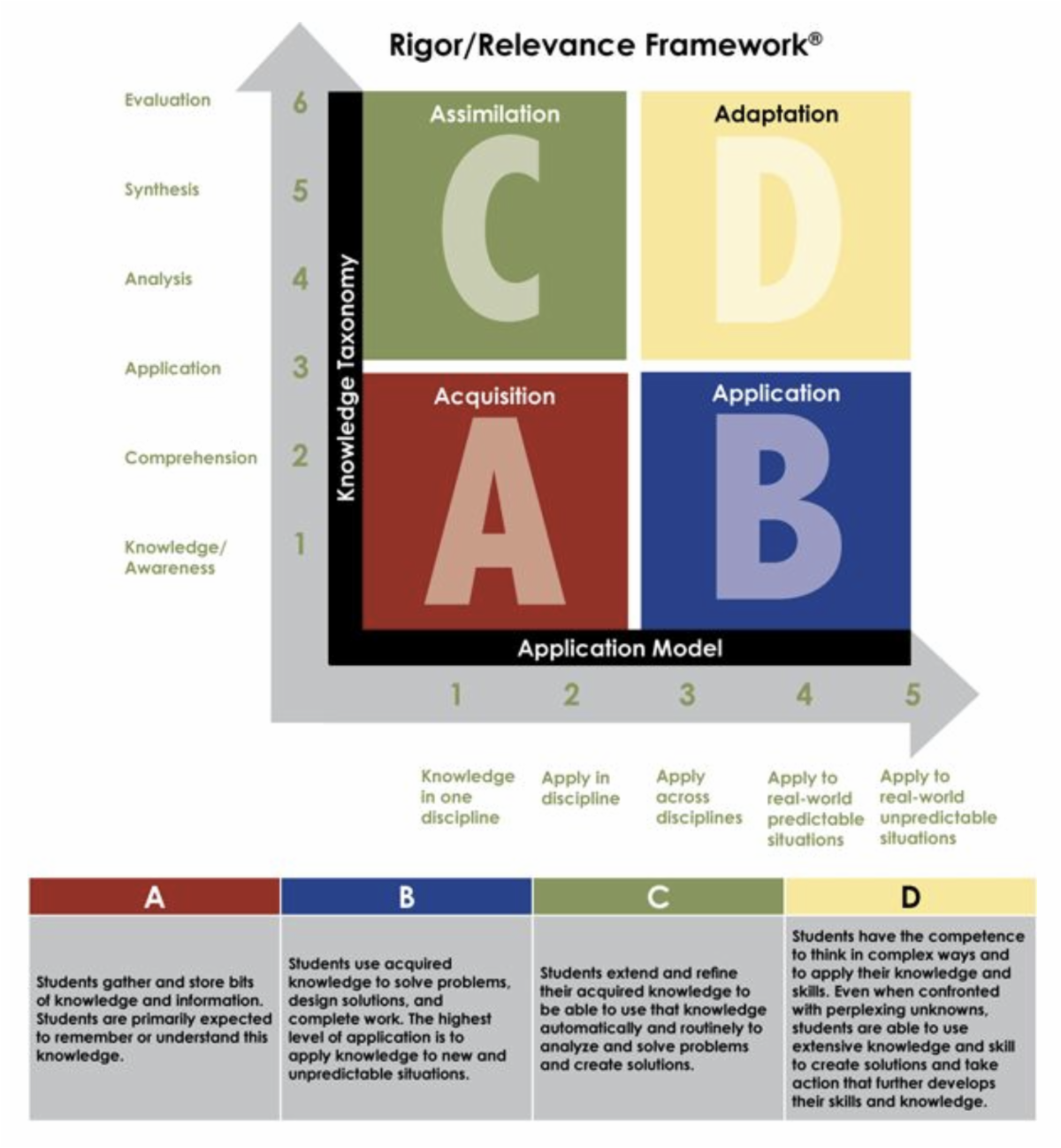 | |
Figure 1. Rigor and Relevance Model (Dr. Bill Daggett).
Collegiate Edu-Nation contends that this approach to education empowers our students, building their critical thinking, problem-solving, and communication skills, all of which are invaluable tools for their future college studies and careers.
Here are some key research findings that underscore the immense value of student-directed research:
-
Increased Engagement: Student-directed research fosters a higher level of engagement, motivation, and involvement in learning. According to Vansteenkiste et al., students who participated in self-directed learning projects significantly improved critical thinking skills, content knowledge, and academic performance (Vansteenkiste et al., 2004).
-
Development of Higher-Order Thinking Skills: Bencze & Bowen (2009) reported that student-directed research projects contribute to developing higher-order thinking skills, such as problem-solving, data analysis, and scientific reasoning. The study concluded that students involved in such projects showed notable improvements in their abilities to design experiments, collect and analyze data, and draw valid conclusions.
-
Improved Academic Performance and Self-Efficacy: A study by Lent et al. (2008) found that student-directed research projects could enhance academic performance and self-efficacy. Students who participated in these projects recorded significant improvements in their academic performance, alongside increased confidence and self-efficacy.
-
Personalized Learning: Student-directed research allows learning experiences tailored to each student's interests and needs. As the National Education Association (2014) reports, such personalized learning can boost student engagement, motivation, and academic achievement.
These studies indicate that student-directed research presents a multitude of benefits. By encouraging our students to take the helm of their learning journeys, we equip them with vital skills for future success.
As educators, we hope you will embrace this dynamic approach to learning and inspire your students to undertake their research projects. We look forward to the outstanding contributions our students will bring to the world of discovery and innovation!
| |
UPCOMING CEN EVENTS - MARK YOUR CALENDARS
VIRTUAL IN-SERVICE FOR TEACHERS
- September 6, 2023
- November 8, 2023
- January 10, 2024
MEET THE EXPERT CAREER EXPLORATION FOR HIGH SCHOOL STUDENTS - FOOD SYSTEMS AND CULINARY ARTS
- September 27, 2023
- November 1, 2023
- December 13, 2023
- January 17, 2024
| |
References
Bencze, J. L., & Bowen, G. M. (2009). A national study of science teachers' perspectives on student-directed research activities. Journal of Research in Science Teaching, 46(4), 384-403.
Bureau of Labor Statistics, U.S. Department of Labor. (2022). Occupational Outlook Handbook. Retrieved from https://www.bls.gov/ooh/
Cybersecurity & Infrastructure Security Agency. (2022). Cybersecurity Overview. Retrieved from https://www.cisa.gov/cybersecurity
Daggett, W. R. (2017). Rigor and Relevance Framework. International Center for Leadership in Education. Retrieved from https://www.leadered.com/our-philosophy/rigor-relevance-framework/
Drew, D., Kaplan, D., & Etzl, R. (2019). "Engineered biological nanofibers for advanced fiber and textile materials". Macromolecular Bioscience, 19(1), 1800224.
FAO. (2022). "Digital technologies in agriculture and rural areas". Retrieved from http://www.fao.org/3/ca4885en/ca4885en.pdf
Intergovernmental Panel on Climate Change (IPCC). (2022). Climate Change and Land. Retrieved from https://www.ipcc.ch/srccl/
Jaganathan, D., Ramasamy, K., Sellamuthu, G., Jayabalan, S., & Venkataraman, G. (2018). "CRISPR for Crop Improvement: An Update Review". Frontiers in plant science, 9, 985.
Lent, R. W., Singley, D., Sheu, H.-B., Gainor, K. A., Brenner, B. R., & Treistman, D. (2008). Social cognitive predictors of domain and life satisfaction: Exploring the theoretical precursors of subjective well-being. Journal of Adolescent Research, 23(6), 641-665.
National Education Association. (2014). Personalized Learning: A Guide for Engaging Students with Technology. Retrieved from https://www.nea.org/assets/docs/PB14_PersonalizedLearning_final.pdf
Poushneh, A., & Vasquez-Parraga, A. Z. (2017). "Discernible impact of augmented reality on retail customer's experience, satisfaction and willingness to buy". Journal of Retailing and Consumer Services, 34, 229-234.
Sperling, D. (2018). Three revolutions: Steering automated, shared, and electric vehicles to a better future. Island Press.
Tapscott, D., & Tapscott, A. (2016). Blockchain revolution: how the technology behind bitcoin is changing money, business, and the world. Penguin
Vansteenkiste, M., Simons, J., Lens, W., Sheldon, K. M., & Deci, E. L. (2004).
Motivating learning, performance, and persistence: The synergistic effects of intrinsic goal contents and autonomy-supportive contexts. Journal of Educational Psychology, 96(4), 849-866.
World Economic Forum. (2020). The Global Risks Report 2020. Retrieved from http://www3.weforum.org/docs/WEF_Global_Risk_Report_2020.pdf
World Health Organization. (2023). Global Health and Aging. Retrieved from https://www.who.int/ageing/publications/global_health.pdf
| | | | |