|
Dear Friends,
As winter gives way to spring, we hope you are having a meaningful and hope-filled start to the season.
We are grateful to present you the second issue of the Educating for Peace newsletter. This initiative was inspired by the dedicated teachers and educators in our growing network who are seeking thoughtful and timely resources on peace and disarmament education. This newsletter serves as a platform to highlight educational initiatives, share practical tools, and strengthen a community of educators committed to fostering dialogue and learning around this vital topic.
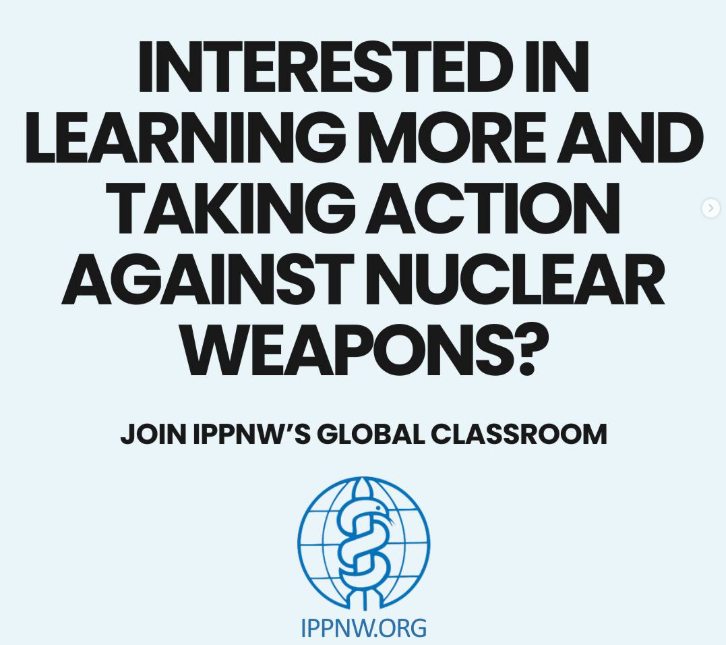
In this issue, we are excited to spotlight several valuable resources. One highlight is the recently launched Global Classroom from the International Physicians for the Prevention of Nuclear War (IPPNW), a 10-month educational program designed for anyone interested in learning more about nuclear weapons, their humanitarian consequences, and pathways toward disarmament. We also feature the Critical Issues Forum (CIF) program facilitated by the James Martin Center for Nonproliferation Studies, which has developed an extensive “Learning and Engagement” resource page available on its website. These materials offer educators accessible and thoughtful ways to bring complex human security issues into the classroom.
We are also looking ahead to our upcoming Educating for Peace conference, which we are co-organizing on the weekend of April 25–26. This gathering will bring together teachers from diverse disciplines and schools committed to peace and disarmament education. Our hope is to create a space for meaningful exchange where we can learn from one another in the spirit of dialogue and collaboration.
As peace scholar Elise Boulding reminds us: “War is not inherent in human beings. We learn war and we learn peace. The culture of peace is something which is learned, just as violence is learned and war culture is learned. So we are engaged in an enormous learning process for the whole planet. The new community-based ways of teaching and learning which draw on the people of the community to teach and have the children moving in and out of a school room and into the community, learning to appreciate all the resources of that community — that’s the start of a peace culture.”
In deep gratitude,
Kevin Maher (Ikeda Center), Tetsushi Ogata (Soka Institute for Global Solutions), and Masako Toki (James Martin Center for Nonproliferation Studies)
|