|
The American Revolution was not won by the thirteen colonies alone. It was not simply a war fought by farmers with muskets and pitchforks against British redcoats on the fields of Lexington, Saratoga, and Yorktown. It was a global war against the British Empire, fought across continents, oceans, rivers, ports, forts, and colonies. France played an important role, especially by providing the fleet that helped trap the British at Yorktown. But the story does not end there. Spain — and the Latino and Hispanic people of North America, the Caribbean, and Latin America — played a decisive role in securing American independence.
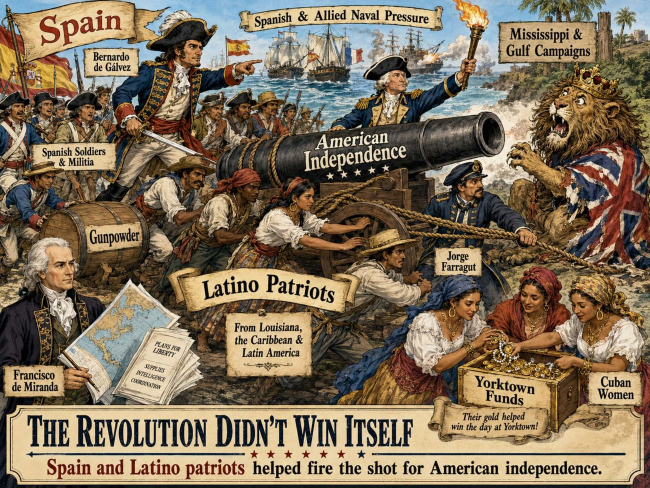
Too often, the Revolution is told as a narrow story: George Washington and the Continental Army, colonial militias, British troops, and French assistance. That version leaves out a powerful truth. France provided crucial naval power at the decisive moment, but Spain provided something just as essential: money, guns, gunpowder, supplies, soldiers, and strategic military pressure against Britain. Spanish power weakened the British Empire. Latino soldiers, sailors, officers, merchants, women, and communities supplied, financed, fought for, and helped defend the American cause. They were not spectators watching from the sidelines. They were active participants in the struggle that gave birth to the United States.
Even before Spain formally entered the war in 1779, Bernardo de Gálvez, the Spanish governor of Louisiana, was already helping the American revolutionaries. From New Orleans, he understood that the Mississippi River was not just a river — it was a lifeline. Whoever controlled it could move weapons, food, soldiers, and information through the heart of the continent. As early as 1775, Gálvez provided the Continental Army with weapons, gunpowder, medicine, uniforms, food, and other critical supplies. These were not small gestures of sympathy. They were acts of strategic support at a time when the American cause was fragile and uncertain.
Gálvez also helped keep the Mississippi River open as a supply route for the revolutionaries and allowed American agents to pressure British shipping and outposts along the river. While George Washington struggled to hold the eastern colonies together, Gálvez was helping to secure the western frontier. His actions made it harder for Britain to use the Mississippi Valley as a base for surrounding and crushing the rebellion.
When Spain declared war on Britain in 1779, Gálvez moved from quiet assistance to open military action. He gathered a diverse and determined force that reflected the multicultural world of Spanish America: Spanish regular soldiers, Creole militia, American Indians, free Black fighters, and local volunteers. Together, they marched through heat, rain, swamps, rivers, disease, and difficult terrain to attack British positions across the Gulf Coast and Mississippi Valley.
Gálvez’s campaign was bold and highly effective. His forces captured British positions at Baton Rouge, Fort Manchac, and Natchez. In 1780, he took Mobile. Then came his greatest victory: Pensacola, the British capital of West Florida. The siege of Pensacola was one of the most important yet under-told campaigns of the American Revolution. Gálvez led his forces against a heavily defended British stronghold, endured fierce resistance, and forced the British surrender in May 1781.
These victories were not symbolic. They were strategic. By driving the British out of the Gulf Coast and lower Mississippi region, Gálvez destroyed Britain’s ability to attack the American colonies from the South and West. His campaign protected the American flank, secured vital supply routes, and prevented Britain from tightening a military noose around Washington’s army. While Washington fought in the East, Gálvez helped make sure the British could not strangle the Revolution from the Gulf.
Spain’s contribution also extended far beyond the battlefield. This was an age of empires, and sea power mattered enormously. Britain was not merely fighting rebellious colonies; it was defending a worldwide empire. Once Spain entered the war, Britain had to divert ships, soldiers, money, and attention to defend its holdings in the Caribbean, the Gulf of Mexico, Central America, the Atlantic, and beyond. Spanish pressure forced Britain to fight on multiple fronts at once. Every British ship sent to defend the Caribbean was a ship not available to crush the American colonies. Every soldier sent to defend imperial possessions elsewhere weakened Britain’s ability to concentrate fully on Washington.
France is rightly remembered for the fleet of Admiral de Grasse, which blocked British escape at Yorktown. But fleets do not sail on courage alone. Armies and navies require food, powder, weapons, pay, intelligence, and coordinated support. Spain and its colonies helped provide that material foundation. Spanish money, Spanish guns, Spanish gunpowder, and Spanish military campaigns helped keep pressure on Britain and helped sustain the larger Allied war effort. The final victory at Yorktown depended not only on ships in the Chesapeake, but also on the supplies, funds, and battlefield victories that made Britain vulnerable.
Latino and Hispanic patriots also played crucial individual roles. Francisco de Miranda, born in Caracas, Venezuela, served under Gálvez and fought in the Pensacola campaign. Miranda was more than a soldier. He was a diplomat, strategist, and revolutionary thinker whose later life would make him a hero of Latin American independence. During the American Revolution, he helped secure supplies and maintain connections that strengthened the anti-British effort. His work in Cuba helped support French Admiral de Grasse, whose fleet would become essential at Yorktown.
That connection was critical. At Yorktown in 1781, British General Lord Cornwallis found himself trapped between Washington’s American troops, French forces under Rochambeau, and de Grasse’s fleet blocking escape by sea. The final British surrender at Yorktown did not happen by accident. It required soldiers, ships, supplies, coordination, and money. France provided the fleet that closed the trap. Spain and Latino America helped provide the money, guns, supplies, and pressure that made the trap possible.
One of the most moving examples came from Cuban women in Havana. As the Franco-American siege of Yorktown faced a desperate shortage of funds, women in Cuba donated money and jewelry to help keep the campaign alive. Their sacrifice helped pay and supply the forces pressing Cornwallis at the decisive moment of the war. These women were not footnotes. They were patriots. Their rings, necklaces, coins, and personal treasures became part of the price paid for American independence.
Another Hispanic patriot, Captain Jorge Farragut of Minorca, also joined the American fight against Britain. Minorca was a Spanish island in the Mediterranean, and Farragut brought his courage and commitment to the revolutionary cause. His son, David G. Farragut, would later become one of the most famous naval officers in American history and the first admiral of the United States Navy. Remembered for the Civil War command, “Damn the torpedoes,” David Farragut carried forward a family legacy rooted in Hispanic service to the United States.
The names of Bernardo de Gálvez, Francisco de Miranda, Jorge Farragut, and the Cuban women who supported Yorktown deserve a permanent place in America’s founding story. Their contributions were military, financial, diplomatic, and moral. They supplied the Revolution when it was weak. They opened rivers and ports. They fought British forces from the Mississippi to the Gulf Coast. They helped finance the final victory. They forced Britain to stretch its empire thin. They gave the American cause room to survive and the strength to win.
This history has not disappeared completely. Galveston, Texas, bears the name of Gálvez. Monuments in Washington, D.C., New Orleans, Pensacola, Philadelphia, and other places honor these figures. Organizations and historians have worked to preserve their legacy. But too many Americans still grow up learning a version of the Revolution that leaves Latinos and Spain in the shadows.
That must change.
The truth is clear: France’s fleet helped close the door at Yorktown, but Spain helped load the gun. Spain weakened Britain. Gálvez secured the Gulf and Mississippi. Miranda helped connect military, diplomatic, and supply networks. Cuban women helped sustain the Yorktown campaign. Hispanic patriots like Jorge Farragut joined the fight for independence. Latino soldiers, officers, communities, and women gave money, guns, supplies, strategy, and courage when the American cause needed them most.
Without Spain and without Latino and Hispanic support, the American Revolution might have ended very differently.
Latinos were not guests in America’s founding story. They were there from the beginning. They helped win the War for Independence. And America owes them the recognition they earned.
|