NASA STTR Phase I awards Elementum 3D, University of Utah, and Penn State to develop GRX810 cold spray AM process

Elementum 3D, in partnership with Penn State Applied Research Laboratory (ARL) and the University of Utah, has been awarded a NASA STTR Phase I contract to develop GRX810 for Cold Spray Additive Manufacturing and Repair. Notably, GRX810 was recognized as NASA's Commercial Invention of the Year for its groundbreaking advancements.


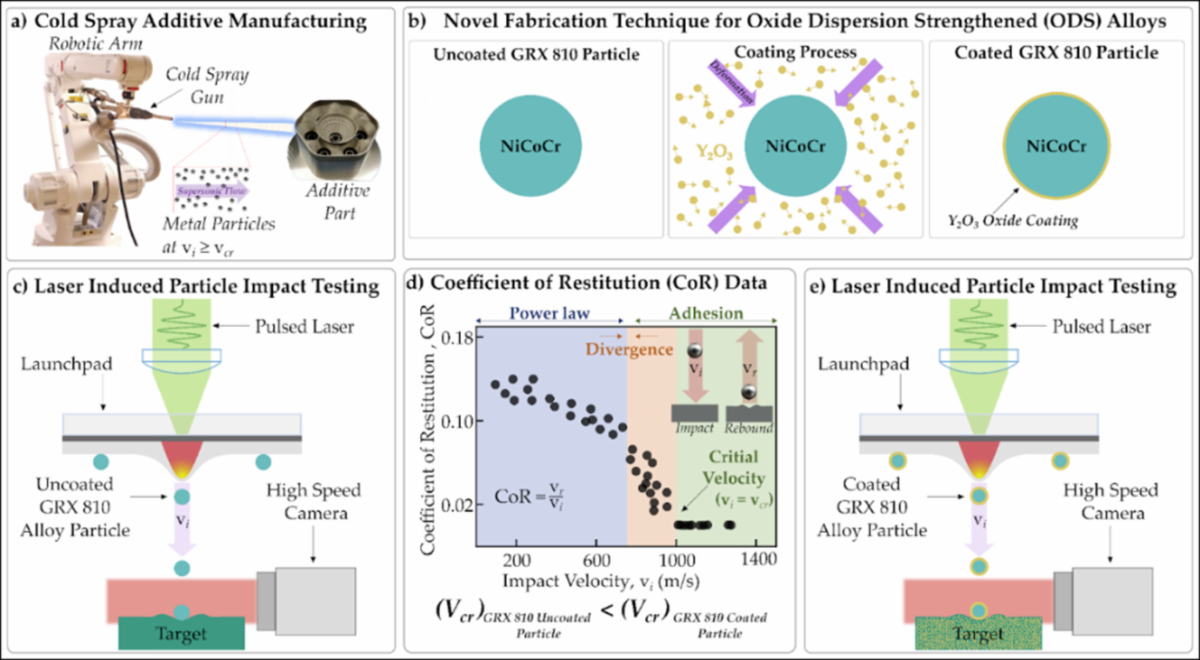
Cold Spray Additive Manufacturing (CSAM) (Figure 1a) is a popular technique that repairs aerospace and space components by launching millions of particles at high speeds. This process ensures a uniform, dense coating and strong metallurgical bonding. However, the awardees understand there are complexities in the bonding mechanics of GRX 810 (Figure 1b). GRX-810 depends heavily on particle and target chemistry, microstructure, impact velocity, and temperature. Even a thin oxide layer can dramatically alter the bonding characteristics, forcing the process to require a higher critical velocity and producing a subdued micro-jetting phenomenon.


Researchers find it difficult to systematically probe the influence of these parameters and optimize the cold spray bonding process. Nevertheless, Penn State ARL has developed CSAM parameters for new materials, including nickel alloys.

Figure 1. (a) Cold Spray Additive Manufacturing. (b) Example of ODS coating on GRX-810. (c) & (e) Diagram of Laser Induced Particle Impact Testing. (d) LIPIT data analysis to determine material bonding characteristics.

In this project, the team proposes a combined approach that uses results from small-scale experiments to guide full-scale CSAM builds.


First approach, Laser-Induced Particle Impact Testing (LIPIT) (Figure 1c) will provide a novel, high-throughput impact testing system that overcomes these challenges by launching single particles at a time. In LIPIT, a pulsed laser targets a launch pad made of a metal ablative film and an elastomer layer. When the laser fires, it rapidly ablates the metal layer, creating a small explosion that forces the elastomer layer to expand quickly.


Second approach, a high-frame-rate camera (1 billion frames per second) will record the impact event, providing temporal resolution and high-speed videography of the process. This recording enables researchers to measure rebound and impact velocities, which they use to calculate the coefficient of restitution (CoR) (Figure 1d). They can then connect the CoR data to advanced contact mechanics models, allowing precise mapping of particles and target parameters for bonding optimization and microstructure control.


Throughout the STTR Phase I contract, the team will conduct systematic experiments with both coated and uncoated GRX 810 particles (Figures 1c, e) to optimize metallurgical bonding. Understating and advancing the bonding mechanics of GRX 810 will be an important milestone in expanding the adoption of cold spray additive manufacturing.


Three Elementum 3D employees to present at ICAM 2025

Elementum 3D is honored to have three of our material experts presenting at the 2025 ASTM International Conference on Advanced Manufacturing (ICAM). The conference will be held October 6–10 in Las Vegas.


With over 800 presentations across 26 symposia, ICAM 2025 is where global leaders in additive manufacturing, academia, government, regulatory agencies, and national labs converge to define standards, qualifications, and certifications across the entire advanced manufacturing value chain.


We invite you to attend the Elementum 3D presentations at ICAM and experience five days of exchanging ideas with like-minded decision-makers, innovators, and industry leaders. Together we can shape and drive global manufacturing.


Elementum 3D Presentations:


10/7 AM | Jeremy Iten, Chief Technology Officer

GRX-810 - An Oxide Dispersion Strengthened (ODS) AM Alloy with Exceptional High Temperature Creep Resistance


10/7 AM | Alec Saville, Materials Scientist

Success and Challenges with Qualifying A6061-RAM2 and A7050-RAM2 Alloys for LB-PBF Additive Manufacturing of Metal Components


10/8 PM | Jason Ting, Director of Atomization Operations

Mechanical and Functional Properties of “Reactive” Laser Powder Bed Fusion of Borated Aluminum Alloy 6061 


Elementum 3D and OSU CDME developing advanced copper-based materials capability for additive manufacturing of RF components under Navy STTR Phase II program

In May, Elementum 3D and The Ohio State University Center for Design and Manufacturing Excellence (OSU CDME) began work on a 2-year Small Business Technology Transfer (STTR) Phase II research contract with Naval Sea Systems Command (NAVSEA). This Phase II program follows the company’s successful Phase I Base and Option efforts.


Additive manufacturing enables production of high-performance components that would otherwise not be feasible by traditional means. It also can offer improved costs and reliability by minimizing subcomponents that need to be brazed or joined and reducing other manual manufacturing steps.


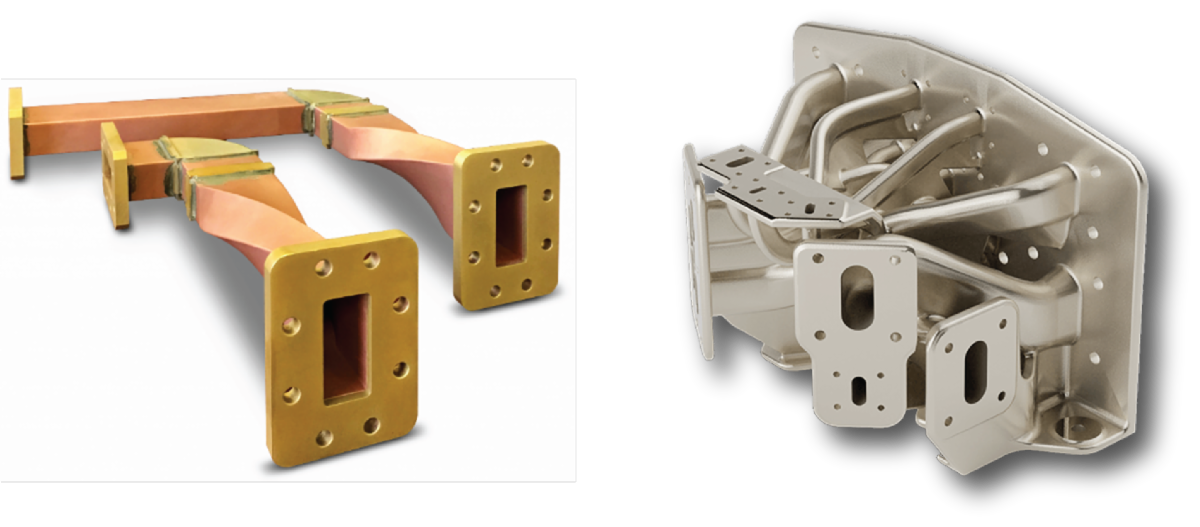
The focus of the program is to develop broad capability for RF and electro-optical electronics including AM feedstock, process, design methodologies, and post processing. RF and microwave system components are often fabricated using labor-intensive manual processes like joining and bending (below, left), and it is believed that AM can help reduce labor costs and lead times for legacy system component replacement as well as enhance the capabilities of next generation components (below, right).

Legacy waveguides fabricated by joining and bending (left, source: Axsera ) vs. AM-enabled waveguide with increased complexity and space efficiency (right, source: Swissto12)

This work expands on Elementum’s copper feedstock and printing capabilities to include cupronickel in addition to copper offerings with high thermal and electrical conductivity, and high operating temperature capability. In Phase I work, the team demonstrated that the developed cupronickel alloy was printable with minimal porosity across a variety of geometries, could achieve surface finish meeting stringent military specs, and was readily brazed to traditionally produced components with no gas leakage, even at ultra-high vacuum levels. Signal loss testing indicated that printed, finished waveguide devices could perform comparably to commercial off-the-shelf components. We look forward to furthering development and demonstration of full capability for end-to-end AM of high-performance copper-based components.


This material is based upon work supported by Naval Sea Systems Command under Contract No. N00024-25-C-S-T036. Any opinions, findings and conclusions or recommendations expressed in this material are those of the author(s) and do not necessarily reflect the views of Naval Sea Systems Command.


Bridging the Gap: Scaling AM Government Contracting webinar recording


Elementum 3D

400 Young Court, Unit 1, Erie, Colorado

720-545-9016

www.elementum3d.com


Facebook  Twitter  LinkedIn  YouTube