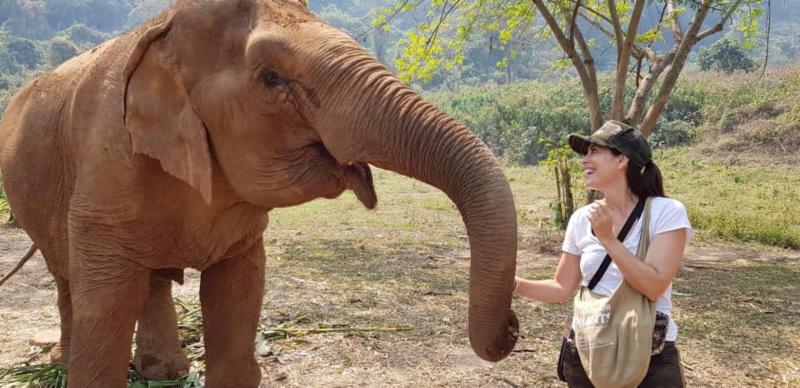
This creature could kill me with one kick of her very substantial hind leg. And the reason she is not doing it is partly (mostly) because I have fed her watermelon and bananas. She really likes the bananas. I know this not because she said so, but because after I’ve handed her a couple I start to walk down the path where my tour guide Ann is headed and the elephant follows me. This is what is supposed to happen. But I’m still surprised when Tad Dow’s wet trunk comes silently sniffing about my shoulders and arms. I am utterly charmed. And I am the first one on the tour to give up all my bananas. My visit to the Elephant Nature Park in Thailand was planned, but I had no idea that this miracle was coming—the pure joy that comes from trust.
As we walk across a vast flatland and up into the forest Ann tells us about the animals. These elephants are what we call in America “rescues.” They have been bought from owners who whose only method of controlling them was to “break their spirit,” she says—by beating them, chaining them up, and in at least one case stabbing the elephant in the eye. When they come to Elephant Nature Park they are often angry and do not trust humans. Many of them rock their bodies back-and-forth to self soothe when they first arrive. One older female was so upset when they took off her chains that they had to put them back on and then take them away little by little so that she could get accustomed to being without them. Many of them are malnourished and have physical ailments ranging from land mine wounds to broken hips and legs caused by the illegal logging industry. Some of them even become so distraught they step on their own trunks to suffocate themselves. They are traumatized. And as I look up at Tad Dow and hand her another banana my heart swells. She is just like me. She is in recovery.
I began my own journey 25 years ago when I stopped drinking in college. A year later I was in a car wreck and left the hospital with an array of prescriptions. It was another 8 years before I was willing to say yes to the help I deserved. Now I have been abstinent from mind-altering substances for 16 years. But in that time I learned that the deeper issues I faced required not only abstinence, but treatment. Determined to regain the joy I knew was my true nature, I did everything available to recover: I went to 12 step meetings, talk therapy, did EMDR for two years straight, went to Five Rhythms dance courses, Neo Tantra courses, learned to meditate and did it daily, read Pia Mellody, Brene Brown, and more, and I took improv classes every Tuesday night for my first four years. And it worked! I learned to self regulate. I had a strong social network. And I knew from my work in improv that I could trust the process.
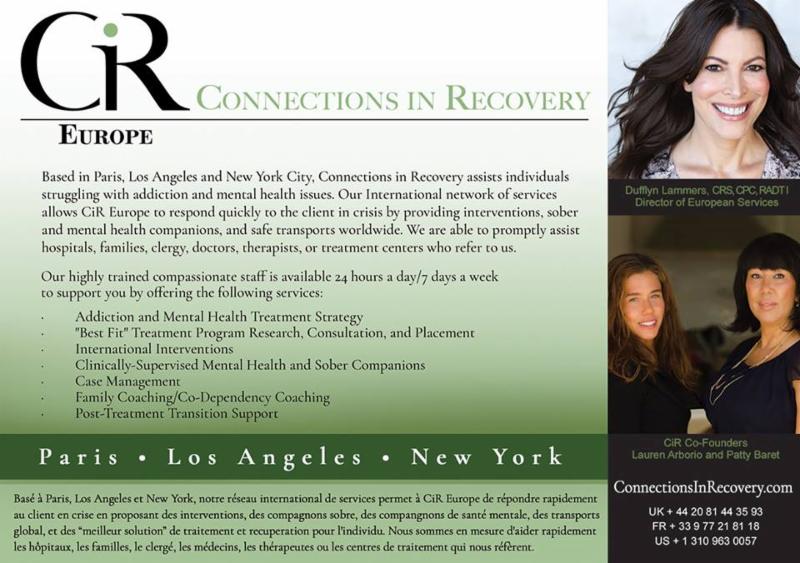
Now, I conduct workshops using creative writing and improv to teach resilience at treatment centers all over the world, including here in Thailand. I am the European Director of Services with Connections In Recovery. We help families and individuals get the help they need by providing treatment strategy and supportive services. I came to Thailand to visit a treatment center, in fact. A place not unlike the Elephant Nature Park, where humans are the “rescues.”
Over a vegetarian lunch, Ann tells us about how the males and females have to be seperated at Elephant Nature Park in order to prevent breeding. Likewise at this treatment center they are implementing gender-specific treatment so that those who come for recovery can focus solely on that. Our tour guide, Ann, tells us how the elephants form “family groups” where they communicate with their trunks and rumbling or trumpeting vocal sounds, they bathe and eat together. The females even go to the bathroom together. They keep each other company. They learn to trust the humans who care for them when they see another elephant leading the way. And they start to remember they are elephants when they roll in the mud or swim in the river. Ann says it was someone she calls “Our father” who created this place.
“Who is your father?” I ask Ann, confused.
“Our founder, Lek.” And the rest of the tour laughs along with me, admitting they too were wondering what all this had to do with Ann’s father and if there was some sort of cult going on. Again, not unlike the confusion that sometimes happens around support groups when people see how important they are to those in recovery and fear they are being introduced to a cult. Quite the opposite. This is a place where freedom lies.
Sangduen “Lek” Chailert, founder of the Elephant Nature Park whom we have seen in our introductory video on the ride out to this more remote village outside Chaing Mai, is a tiny woman with a vast objective. Chailert has devoted her life to the conservation of this endangered species. Since 1996, she has rescued 200 distressed elephants in Thailand and neighboring countries. Ann goes on to tell us how the young males are socialized by putting them with an older female called a “nanny” who will dote on him until he has been with her long enough to settle down and then he can be allowed into the larger community and joins a group. I’m struck by the similarities with treatment and recovery for addiction and mental health. Those of us who work in this field know the importance of groups and the therapeutic alliance— it is indispensable. It is key. It is the lifeblood of resilience. Trust is where it all begins. And once we have that, just like the elephant remembers to be an elephant, we remember who we are.
Now it is time to go down to the river where the elephants are waiting for us. We wade into the water again offering bananas. And then we splash buckets of water on our “Nellys”. This is my nickname for the elephants.
“They so hot,” Ann says, assuring us they like the water. So I dig deep into the river with my bucket and heave. My partner on the other side of Tad Dow, whom I cannot see, is also splashing and heaving. We are giving an elephant a bath. Which is surprisingly easier than giving a dog a bath in my experience. One of the trainers pitches in and soon we are all wet and laughing and Tad Dow is dripping from head to very big foot. When she is done she walks out of the river with her tiny tail switching behind her.
As our tour nears its end we drive out to see the baby elephants. One has been brought in from a forest where he caught his foot in a small animal trap. The local people use these traps for animals they intend to eat. But the elephant is not one of them. When they found him stuck in a trap after several days they called the Elephant Nature Park. His foot has been treated and bandaged and he is now with his “nanny.”
“He play hard,” Ann says. “But she looooouuuuve him. The other ones do that she would knock them down. He wild.”
It is still undetermined what will happen when the foot is healed. This elephant, though a baby, was not born here. One day he may be released back into the wild, but they haven’t tried that before. I know from experience that is the hard part. Transition.
Again I think of the treatment center. How challenging it is to go from this protected bubble, from this group, from this safe warm world back into the wild one out there. This is part of the work I do now. To walk with a client the same way I walk with the elephant. To gain their trust. And then to teach them to trust themselves. Sometimes it takes a person in recovery to reach a person in recovery. But someone has to go first.
Will this baby elephant leave his group and be released into the unknown?
“We see,” Ann says. This would be a first at the Elephant Nature Park. Maybe he will be the one, this young bull with the injured foot, whose name, Ann tells me, is Hope.