Since last year the NHS workforce plan has been ready.
It has been toted around Whitehall, people and organisations have been consulted. Big brains have cogitated. Nothing’s happened.
Apparently it’s all to do with HMT.
You might have been expecting, that now he’s the Chancellor, Jeremy Hunt, former Health Secretary, chair of the health select committee and campaigner of safer care...
... would’ve pulled the Treasury’s collective finger out and got something happening.
Even more so as he berated BoJo and friends for not allowing an amendment to the last health bill, to incorporate a statutory duty to have a biennial NHS workforce plan and a report to Parliament.
We know he is forgetful… he ‘forgot about a block of flats’, so I suppose, since he’s become Chancellor, it was easy for him to forget about the NHS workforce…
... particularly as now he has to find the money to pay for it.
Silly Boy has jumped on the bandwagon. Re-announcing yesterday that Labour is going to going to recruit…
‘...15,000 doctors a year and medical school places would be doubled.’
Medical school places are currently capped at 7,500 so Labour would have to lift the cap to 15,000… to get their fifteen thousand claim.
Jeremy Hunt says it costs £230,000 to train a doctor. Not true.
That figure includes repayable student loans, as well as grants to cover tuition fees, living costs and the cost of clinical placements.
So, £230k is not the cost to ‘the taxpayer'. Students have to repay the loans, regardless of whether they work for the NHS or not.
Of the £230,000 estimate;
£163,000 is paid in grants that the government won’t get back. These are paid to students and to hospitals and practices to cover the cost of clinical placements.
There is very little clarity about the actual cost of placements.
£64,300 comes in student loans. Just like all other student loans, covering tuition and living costs.
Graduates repay their loans once they earn £21,000, for new students.
All Dr graduates earn more than that.
HMT expects to get back at least 75-80% of tuition fee and maintenance loans, at worst.
Cost to the taxpayer… make it about £163,000.
That would mean the extra cost to a Labour exchequer… say £1,222,500,000, recurring.
Funded by ending non-dom status. I imagine most of the wealthy targets will be long-gone by the time Charmer moves in to Number Ten.
Bear in mind the training expansion would probably have to be phased-in, to allow the uni’s to get organised, say three years and it takes ten years to train a doctor…
...what lookslike a lot of money, when you spread it out, really isn’t….
... what looks like a quick fix, really isn't...
… what looks like a solution, really isn't.
... what looks like a policy is really just a headline.
Labour click-bait for lazy journalists and exploits a public that cannot be aware of the detail.
Doctors need nurses, diagnostics, kit, AHPs, social care, consumables, places to work, beds and just doubling the number of doctors takes no account of any of the additional recruitment and costs.
Neither of the impact technology and demographics will make, long before any new doctor turns up with a bright shiny new Littmann.
Apart from Labour’s promise not solving any of the our now-problems, there are six important things Silly Boy needs to get under his belt:
An analysis of the current workforce. Demographics, age, gender, skill sets and experience levels.
Demand based on factors such as trends in comparable work settings, industry movements, growth projections, changes in technology informing recruitment and retention strategies.
Supply of labour, based on retirement rates, turnover rates, availability of skilled workers, school leaver educational attainment, in what is now a global market.
Gaps, comparing the demand for labour with the supply of labour, additional training and recruitment strategies, training programmes, and retention initiatives.
UnderstandingCompetition Ratios for places and can they be eased, diverted or absorbed.
Reviews and measurements in a fluid working environment. Timelines and performance metrics.
The tricky bit is to assess the impact technology could have on how and where work is done. The cost, return on investment, implementation and procurement strategies.
Think near-patient tests and diagnostics. Remote monitoring, developments in video consultations and what ever is in the the pharma-pipeline.
Knee jerk policies are the last thing the NHS needs.
It needs a solid workforce plan.
There is one, detailed, specific and worked through.
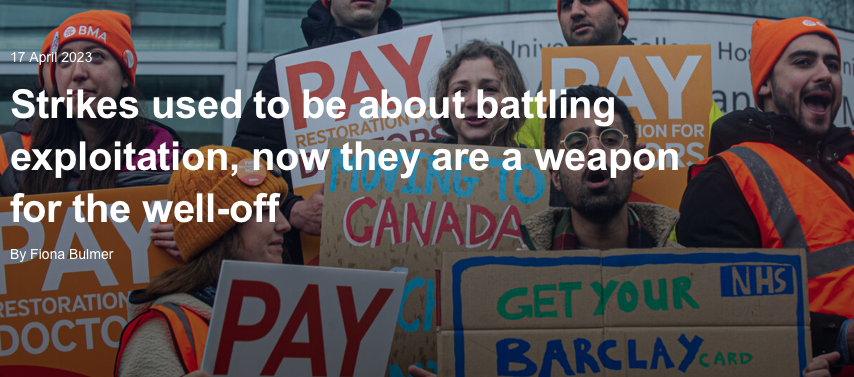
It is at the heart of safe staffing, patient safety, funding, the future of the NHS and the root cause of the strikes that no one wants…
... looking at the most recent ballot numbers, I’d guess, not even the majority of nurses.
We just need someone with the sense to publish it or the guts to leak it.
>> I'm hearing - The nursing press is claiming RCN strikes could continue until Christmas. They won't. It is highly likely nurses will vote against more strikes in the next ballot and anyway, the RCN will run out of money for strike pay, making it impossible for some low paid staff to strike.