|
|  |
| |
Hello
Welcome to the January edition of Emergency Management Solutions.
As I write this, we're being battered by a winter storm here in Ireland and the United States is wrestling with ice storms, freezing rain, and snow. In the US, we have also experienced the death of two citizens at the hands of ICE that has sparked an uproar across the nation and may well need to significant changes in the political landscape.
On slightly more upbeat note, the final manuscript for the next edition of my book is in the hands of my publisher. It's taken a year longer than expected but the result is a major update to previous chapters and the addition of four new ones. There's still a lot of work ahead before publication but I'll keep you updated.
In this month's featured articles, Tim Riecker explains why just using ICS does automatically mean success in disaster operations. Our guest contributor is Edie Schaffer, an experienced emergency manager, who offers insight into the latest update on FEMA Review Council. My own contribution offers a brief look at a new United Nations report on water scarcity and why we may be running out of time to deal with this critical issue.
Be well!
| | | |
Canton on Emergency Management
By Lucien G. Canton, CEM
| | |
How Close Are We To Water Bankruptcy?
Some years ago, I was presenting a seminar to an audience of local emergency managers. Part of my presentation was a discussion on the tendency of the public to focus on the “flavour of the month” disaster rather than on true risk. One of the examples I used was the focus on Y2K that we had recently experienced and the true versus perceived risks. One of the issues I discussed was water. During the discussion, I used a throw away line, “Water wars are coming; you heard it hear first.” I didn’t realize how prescient that statement was to become.
The reason I made that statement may have been subconscious. I had recently been reading William Ashworth’s book Nor Any Drop to Drink that discussed a looming water crisis. As a Californian, I’d also had experience frequent droughts, the worst at the time being in 2007-2009. The conference at which I was speaking was in 2009, so both were fresh in my mind.
| | |
© 2026 - Lucien G. Canton
Lucien Canton is a management consultant specializing in helping managers lead better in a crisis. He is the former Director of Emergency Services for San Francisco and the author of the best-selling Emergency Management: Concepts and Strategies for Effective Programs used as a textbook in many higher education courses.
| | |
The Contrarian Emergency Manager
By Timothy "Tim" Riecker, CEDP
| |
ICS Doesn’t Solve Incident Problems
Lately I’ve been seeing another uptick in people espousing use of the Incident Command System (ICS) as a solution to incident management problems which far exceed what ICS actually is or does. Time and again I read posts and comments speaking of ICS as if it is the only thing needed for successful incident management. It appears that people think that ICS will solve problems. It doesn’t. People solve problems. Use of ICS can facilitate some of that problem solving, but people are still required. ICS won’t dictate what the priorities are of any given incident. It won’t tell you who is in charge of the incident. What I’m seeing in many of these posts seems to indicate a continued misunderstanding of what ICS is and is not and a false sense of security that seems to go with that.
These kinds of statements take me back to a stakeholder interview I conducted about 12 years ago, several months after the area was struck by a major hurricane. I asked what needs they had to better prepare for future incidents and the response was something akin to ‘Oh, we’re totally prepared now that we’ve had ICS training’. Let that statement sink in for a moment. They had no concerns about the severe lack of emergency plans or resources for the jurisdiction. Even knowing that functional issues such as swift water rescue or mass care were serious areas for improvement from the hurricane response, he felt they were ready for whatever might come solely because of ICS training. The false sense of security is frightening and extremely concerning, especially since this statement came from the town’s fire chief.
| | |
© 2026 - Timothy Riecker, CEDP
Used with Permission
Tim Riecker is a founding member, partner and principal consultant with Emergency Preparedness Solutions, LLC, a private consulting firm serving government, businesses, and not for profit organizations in various aspects of emergency and disaster preparedness.
| |
| |
Guest Contributor
Edie Schaffer, JD, CEM, CA-PEM
| | | | |
Update on The FEMA Review Council
An interesting development on the FEMA Review Council, possibly because of media reminders that the Council was about to expire without publicly issuing its report. Today, Trump issued an order extending the Review Council until March 25, 2026. The order further empowers DHS Secretary Kristi Noem to perform the functions of the President under the Federal Advisory Committee Act as applicable to the Review Council. Continuance of the Federal Emergency Management Agency Review Council – The White House
Under the Federal Advisory Committee Act, the President may delegate responsibility to evaluate and to take appropriate action respecting all public recommendations made to the President by Presidential advisory committees. 5 USC § 1005(a). The Act also provides that within one year of a presidential advisory committee submitting a *public report* to the President, the President or their delegate must submit a report to Congress containing either proposals for action or reasons for inaction on the recommendations in the advisory committee’s public report. 5 USC § 1005(b). https://lnkd.in/gtqUgX6t
The extension’s language suggests that the Review Council will issue some kind of public report, and that Noem will be the one on the hook for implementing — or not implementing — the report’s recommendations. That way, when DHS continues its gutting of FEMA, Trump can blame his DHS Secretary for the calamitous outcomes.
| | |
© 2026 Edie Schaffer
Used with permission
Edie Schaffer, JD, CEM, CA-PEM is an an emergency planner, writer, researcher, and attorney. She served as a Program Specialist with the Santa Clara County Office of Emergency Management, and as an Emergency Planner with the San Francisco Department of Emergency Management (DEM). During the Covid crisis she served in the San Francisco Covid Command Center as a Logistics Section Personnel & Staffing Branch Director, then served as Manager of the San Francisco Department of Human Resources (DHR) Department Operations Center (DOC).
| | |
History's WORST Natural Disasters
An interesting survey of five historical disasters, some of which I've never heard. We can argue whether these were truly the "worst" and what metrics we should use in deciding this, but it is well presented and informative.
The five disasters covered are:
- The 1755 Lisbon Earthquake
- The 1833 Krakatoa Eruption
- The 1556 Shaanxi Earthquake
- The 1925 Tri-state Tornado
- The 1931 China Floods
| | | The National Preparedness Course Catalog is an online searchable catalog featuring a compilation of courses managed by the three primary FEMA training organizations: the Center for Domestic Preparedness (CDP), the National Disaster & Emergency Management University (NDEMU), and the National Training and Education Division (NTED). The National Preparedness Course Catalog features a wide range of course topics in multiple delivery modes to meet the increasing training needs of Federal, state, local, territorial, and tribal audiences. | | |
Conferences and Webinars
Operationalizing AI for Business Continuity Programs
FREE WEBINAR
February 4, 2026
1 PM Central Standard Time
AI is increasingly shaping how business continuity teams work. It can strengthen readiness, reduce manual effort, and support faster, more confident decisions during disruptions. By adopting and implementing AI, many continuity teams are turning static plans into usable data faster than ever before, surfacing gaps before they become failures, and making testing and improvement part of everyday operations instead of annual exercises. In this seminar, Fusion Risk Management will share a practical view of where AI is delivering value across business continuity programs today.
ADA National Network Learning Session:
Unleashing Service Animal Best Practices in Healthcare Settings
FREE WEBINAR
February 19, 2025
2:30 PM Eastern Time / 11:30 AM Pacific Time
The ADA sets clear rules for service animals, yet real-world application in healthcare is rarely one-size-fits-all. This session goes beyond the two allowable questions to examine policies, procedures, and practices across emergency, outpatient, inpatient, and long-term care settings. Through real-world scenarios, participants will explore rights and responsibilities to harness greater understanding of compliance with federal, state, and local laws.
RESCON New Orleans
March 9-11, 2026
New Orleans, Louisiana
This premier annual conference is the ultimate platform for professionals to delve into the practice of successful resilience and disaster management in our ever-evolving global environment. Based in New Orleans, this 3-day conference is designed to foster collaboration and ignite new ideas, ensuring participants leave with a fresh perspective and renewed motivation.
Disaster Recovery Journal Conference Spring 2026
March 15-18, 2026
Orlando, Florida
DRJ is the professional community for business continuity, disaster recovery, and operational resilience—education and conferences—equipping practitioners to reduce downtime, protect people, and prove ROI.
51st Annual Natural Hazards Workshop
June 14 - 17, 2026
Broomfield, Colorado
The Workshop brings together federal, state, and local mitigation and emergency management officials and planning professionals; representatives of nonprofit, private sector, and humanitarian organizations; hazards and disaster researchers; and others dedicated to alleviating the impacts of disasters."
74th Annual IAEM Conference and EMEX
November 6-12, 2026
Long Beach, California
Sponsored by the International Association of Emergency Managers, this conference provides a forum for current trends and topics, information about the latest tools and technology in emergency management and homeland security, and advance IAEM committee work.
| | |
Call for Papers/Proposals/Speakers
Call for Speakers
International Association of Emergency Managers Annual Conference
IAEM is now accepting breakout session proposals for the 74th Annual Conference & EMEX in Long Beach, California, Nov. 6-12, 2026.
Share your expertise, insights and lessons learned with colleagues across the emergency management field. Breakout sessions are a key part of the IAEM Annual Conference and provide practice, content-driven learning opportunities for attendees.
Proposal Requirements and Tips
- Step-by-step instructions for completing the online submission form are available in the Speaker Submission Guidance.
- Prospective speakers are encouraged to attend the webinar "Tips for a Successful Breakout Speaker Proposal" on Thursday, Jan. 15, at 2:00 p.m., where the Conference Committee will share guidance and answer questions.
Selection Criteria
- Proposals will be evaluated based on the following criteria:
- Overall quality of the submitted presentation.
- Speaker experience and qualifications related to the topic.
- Compelling story that will engage the audience.
- Alignment with the conference theme.
- Non-commercial, content-driven session with actionable takeaways.
Submission Deadline
Friday, February 13, 2026
Questions
If you have any questions, please contact IAEM Conference Director Julie Husk.
Call for Proposals
The Health and Extreme Weather Research Award Program
The Natural Hazards Center—with funding from the National Institutes of Health and the National Science Foundation—has launched the Health and Extreme Weather Research Award Program, which is designed to address gaps in knowledge about the health risks and consequences associated with wildfires, hurricanes, droughts, floods, extreme heat, and other extreme weather events. Findings from research supported by this program will help communities across the United States understand health risks and reduce harms associated with extreme weather.
The Natural Hazards Center is issuing a new call for proposals focused on Health and Extreme Weather. Funds will support awards in the amount of $10,000 to $50,000 each. Proposals will be accepted on a rolling basis until funds are expended.
All applicants are encouraged to watch the recorded Proposal Information Q&A Session to learn more about this funding opportunity.
Call for Papers
The Future of Emergency Management
The Journal of Emergency Management Editorial Review Board invites the submission of papers supporting a special issue titled: The Future of Emergency Management
The goal is to bring together a broad discussion by thought leaders across the field about the future of emergency management, its form, function, funding, leadership, and responsibilities. Based on the recent political realities, JEM is in a unique position to effectively reimagine the field for the next 25 years.
Emergency management is a highly complex, multi-faceted, and multi-tentacled field. That is confirmed by 108 topics in nine categories, including Overarching topics in emergency management, Organizational Frameworks, Organizational Development, Leadership, Workforce Development, Policy Implications, Funding Implications, Operations Management, Higher Education, and Professional Development. This special issue is focused on the broader field of emergency management.
JEM also wishes to present various and diverse opinions, research, and forward-looking papers that help retool and support the growth and professionalization of emergency management.
The finished issue may be considered a road map for the future of emergency management. JEM hopes that policymakers will utilize this special issue to retool the field.
JEM is seeking 3500-4500-word papers. Papers will go through a modified review process in an effort to share many papers on this timely topic. As they complete peer review, they will be published on the JEM website under the special issue.
Deadline and details are located at this link: Call for Papers - The Future of Emergency Management | Journal of Emergency Management
Artificial Intelligence in Emergency Management, Disaster Recovery, and the Broader Disaster Sciences
The Editors of the Journal of Emergency Management invite submissions for a special issue and educational programs on Artificial Intelligence (AI) in Emergency Management (EM), Disaster Recovery (DR), and the broader Disaster Sciences (DS). This special issue focuses on how AI can assist—not replace emergency managers, responders, and policy leaders by improving decision-making, resource coordination, and public communication while keeping people at the center of every response.
Tracks: (First two tracks are for the special issue.)
-
Research Track– Studies and analyses demonstrating practical or theoretical advances in AI for EM/DR/DS.
-
Applied Practitioner Track– Case studies, best practices, and implementation examples of AI tools in real operations, preparedness, mitigation, response, and recovery. Tools to access the latest science to improve planning and response.
- Educator Track– Course design, training methods, and academic strategies for teaching AI concepts to current and future emergency managers. Bringing forth the latest science and its practical applications in the field. If you are interested in participating, please send a short letter of interest to jem@pnpco.com specifying your area of interest/expertise and topics you wish to teach.
-
Repository & Book Project– JEM is establishing a permanent Learning Center and Repository for AI in EM/DR/DS to collect and share current research, case studies, data tools, and presentations. JEM is also recruiting authors for a book project on Artificial Intelligence in Emergency Management, Disaster Recovery, and broader Disaster Sciences. Contributors interested in writing a chapter or serving as a section editor should contact jem@pnpco.com.
Manuscript submissions deadline: March 15, 2026
More information: Artificial Intelligence in Emergency Management, Disaster Recovery and the Broader Disaster Sciences | Journal of Emergency Management
| |
Resources
Disasterology
This monthly newsletter is a list of disaster-related news articles, research, books, podcasts, and other things curated by Dr. Samantha Montano, author of Disasterology: Dispatches From The Frontlines of The Climate Crisis.
Disaster Researchers for Justice
Currently, there is no group of disaster scholars organized for the purpose of actively engaging with practitioners and policymakers. Nor is there an established channel for disaster scholars to voice their concerns over imminent hazards and failed disaster responses and recoveries. There is no centralized effort for scholars who wish to partner in solidarity with activist groups and networks, or to speak out with a united voice against all disaster-related injustices. Disaster Researchers for Justice (DRJ) is formed to address these needs. To achieve this DRJ seeks to serve as a space for global affinity groups aligned towards disaster justice.
Disaster Recovery Journal
DRJ is the industry’s largest resource for business continuity, disaster recovery, crisis communication, and risk management, reaching a global network of more than 138,000 professionals. Offering weekly webinars, the latest industry news, blogs, rules and regulations, podcasts, official mentoring program, a quarterly magazine, and two annual live conferences, DRJ is leading the way to keep professionals up-to-date and connected in an ever-changing world.
Emergency Management Network
Emergency Management Network is an independent media organization dedicated to unlocking the knowledge of experts for the public good. We publish trustworthy and informative content in multiple media formats by emergency management experts for the profession and the general public.
Journal of Emergency Management
The Journal of Emergency Management (JEM) is edited, written, and peer-reviewed by an internationally recognized team of the foremost, hands-on EM experts. They include top professionals from the public and private sectors who offer real-world experience and practical solutions and leading academics who provide perspective and analysis on the latest research and studies. Together, they bring you the most thorough, relevant, and useful source of information on emergency management.
Journal of Homeland Security and Emergency Management
The Journal of Homeland Security and Emergency Management (JHSEM) is an online journal that publishes original, innovative, and timely articles describing and assessing research and practice in the fields of domestic security and emergency management. JHSEM offers offers an Editor’s Choice free access article.
University of Colorado, Boulder Natural Hazards Center
The Natural Hazards Center remains committed to creating a center of gravity for the hazards and disaster community. We care deeply about facilitating scientific and practice-oriented connections because we recognize that we are all living at risk, we are all interconnected, and we all have a role to play in effectively responding to 21st century social and environmental challenges. Everything we do at the Center is informed by a justice and equity approach, and our core values are focused on our commitment to human dignity, collective well-being, scientific understanding, and sustainable hazards mitigation.
University of Delaware Disaster Research Center
The Disaster Research Center (DRC) is committed to advancing the state of the art in disaster research and its scientifically guided practice; educating the next generation of disaster science scholars and informed practitioners in the fields of disaster mitigation, preparedness, response, and recovery; and creating, gathering, and disseminating disaster knowledge in a dynamic and responsive way.
| | |
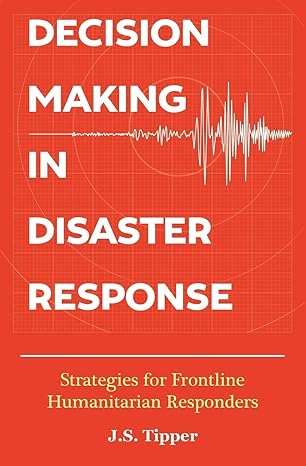
Decision Making in Disaster Response: Strategies for Frontline Humanitarian Responders
by J.S. Tipper
The aggressive armed militia member in front of you wants $50 before he’ll let you deliver your cargo of essential medicine to a war-torn town’s clinic. Your agency prohibits paying bribes. If you don’t pay him, people will almost certainly die. If you do pay him, you’re supporting the very people who are attacking the town.
What would you do?
Full of interactive stories that draw readers into the pressures of decision making, Decision Making in Disaster Response is a practical handbook that helps relief workers make effective choices under pressure. It develops their skills in making decisions when it really counts, and helps them make decisions that will save lives. The book’s strategies are applicable both to local emergency responders and international aid workers.
Whether you’re a student of disaster response preparing to work abroad, a veteran local Civil Defence volunteer, or simply want a highly-readable glimpse into the world of international relief work, you’ll be engrossed by the challenges in Decision Making in Disaster Response.
About the Author
John Tipper is the Director of Disaster Preparedness and Response for the Swedish NGO Operation Mercy. His involvement in disaster response has seen him spend extended periods of time in some of the world’s more troubled spots. He lived in South Sudan throughout its six year period of semi-autonomy, and has been based in the Middle East for the past four years. He is married with three children.
| | |
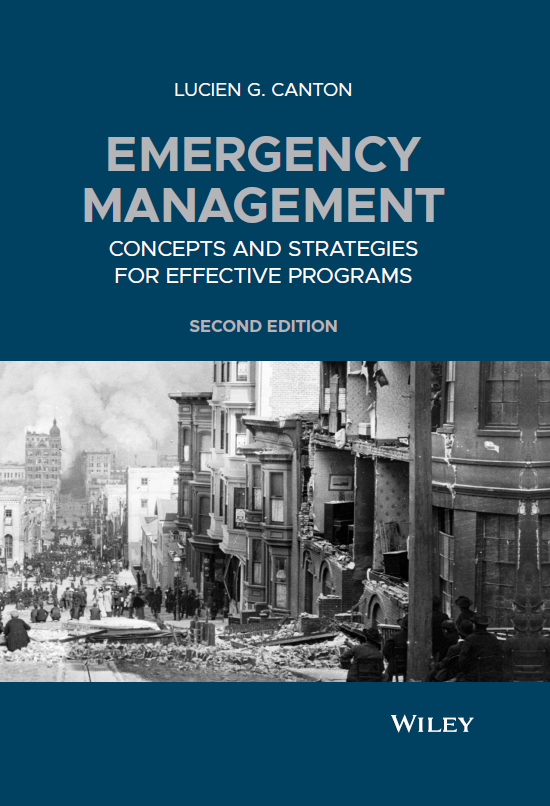
Emergency Management: Concepts and Strategies for Effective Programs
Second Edition
by Lucien G. Canton
This book looks at the larger context within which emergency management response occurs, and stresses the development of a program to address a wide range of issues. Not limited to traditional emergency response to natural disasters, it addresses a conceptual model capable of integrating multiple disciplines and dealing with unexpected emergencies.
| | | |
| | Looking for a speaker for your conference? I offer keynotes, seminars, workshops, and webinars, either in person or virtually. You can find more details and sample videos on my website. | | | |
|
©Lucien G. Canton 2026. All rights reserved.
You may reprint and excerpt this newsletter provided that you include my copyright, the source,
the author, and "reprinted with permission."
ISSN: 2334-590X
| | | | |