Dear Friends,
At its meeting on 6 October 2021, the Board of Directors of the Needham History Center & Museum voted unanimously in favor of the proposed plan to preserve and renovate the Emery Grover Building. Our mission is to preserve and teach the town’s history, in order to engage the community, inform current discussions, and develop future citizens. We value the Emery Grover as a unique historic asset, and an important part of the story of our town. The Needham History Center therefore supports Article 7 in the October Special Town Meeting Warrant, to Appropriate for Emery Grover Building Design.
The Emery Grover Building was built in 1898 as Needham’s first High School. Its location and design were an important town issue for several years. Needham at that time was in a transition from farmland to suburb, and from crafts to professions. In a time when formal schooling was rising in importance, Needham committed its energy and assets to a building that was appropriate for education, and that was a beautiful source of civic pride.
We are aware the Emery Grover Building will need significant upgrades to make it safe for its occupants and efficient in its use. These goals are not incompatible with historic preservation. Good preservation standards recognize that a working building must be maintained and updated, and that historically-sensitive upgrades promote both usability and long-term preservation.
The Emery Grover Building is the oldest surviving public building in Needham. In 1987, it was entered into the National Register of Historic Places. This is not an honor that is given often, or lightly. To qualify for the National Register, a building must retain its integrity of place and design, and must also be a significant asset to the town’s history and culture. The building is also registered in the Needham Historic Inventory and the Massachusetts Register of Historic Places.
The Emery Grover Building is not just another old building, or another tear-down. It is part of the Town's historical fabric and also is a gateway to our downtown, highly visible to both residents and visitors. It represents the town’s long-standing commitment to its education system. It is an embodiment of civic pride, and the optimism that Needham brought into the new 20th century. It is also relevant to our 21st century – historic preservation has proven positive economic and social benefits, and fosters the community identity that translates into community engagement at all levels. Please urge your Town Meeting representative to preserve this iconic asset to our town.
Respectfully,
|
|
Colleen Schaller
President, Needham History Center & Museum
|
|
Gloria Greis
Executive Director
|
|
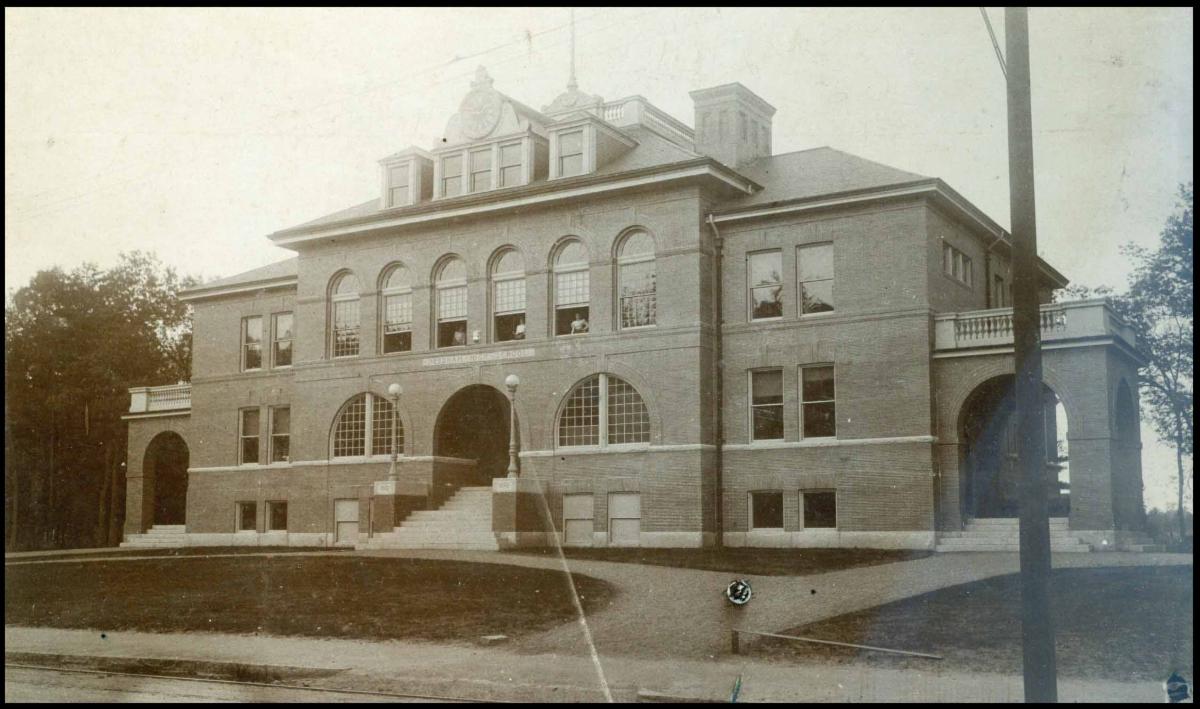
The Needham High School / Emery Grover Building, probably taken c. 1900, shortly after it was completed. The clock face above the entrance is now at the Needham History Center. |
|
An Italian Palazzo in the Center of Needham
Discussions in Needham about the need to expand education in by establishing a high school first began 1853, but it was not until 1864 that Town Meeting appointed a committee to look into the question. What the committee found was that state law already required each town to provide a high school, and that Needham was in default. Therefore, in March 1865 Town Meeting appropriated $2500 to establish two high schools, one in the eastern half of town and one in the western half (now Wellesley).
The new East High School opened in May 1865, in an upstairs room of the Kimball Primary School on School Street, sharing space with the fledgling Free Public Library; in the fall it moved to a rented room in Village Hall, above the general store and post office on Great Plain Avenue. In 1868, a committee was chosen by Town Meeting to look into the question of dedicated buildings for the two high schools, but the effort rapidly dwindled.
Finally, in 1896, the question became urgent, as the number of students was becoming much larger than the town’s makeshift arrangements could accommodate. Town Meeting appropriated $30,000 to purchase land and build a school. There was immediate disagreement in town over the school’s location. Residents of the Heights wanted the new high school to be in or at least near the Heights, while residents of the Center wanted it in the Great Plain. The town proposed either replacing the Kimball School on School Street to better accommodate both the grammar school and the high school, or adding a high school building to the site alongside the Kimball School. Neither faction liked this plan, since the Kimball was already deteriorating and possibly unsafe, and the growing high school classes needed more space.
Despite the disagreement over location, Town Meeting’s high school planning committee moved forward, contracting with architect Charles Bingham for a design of the building. Bingham was an important Boston-area architect, known for numerous private and public buildings, including townhouses on Beacon Hill and the Back Bay, railway stations, churches, and commercial blocks – most notably the State House Annex, the old YMCA Building on Boylston Street, the original Museum of Fine Arts in Copley Square, residential and commercial properties for the Hunnewell family, and several homes for John and Isabella Stewart Gardner.
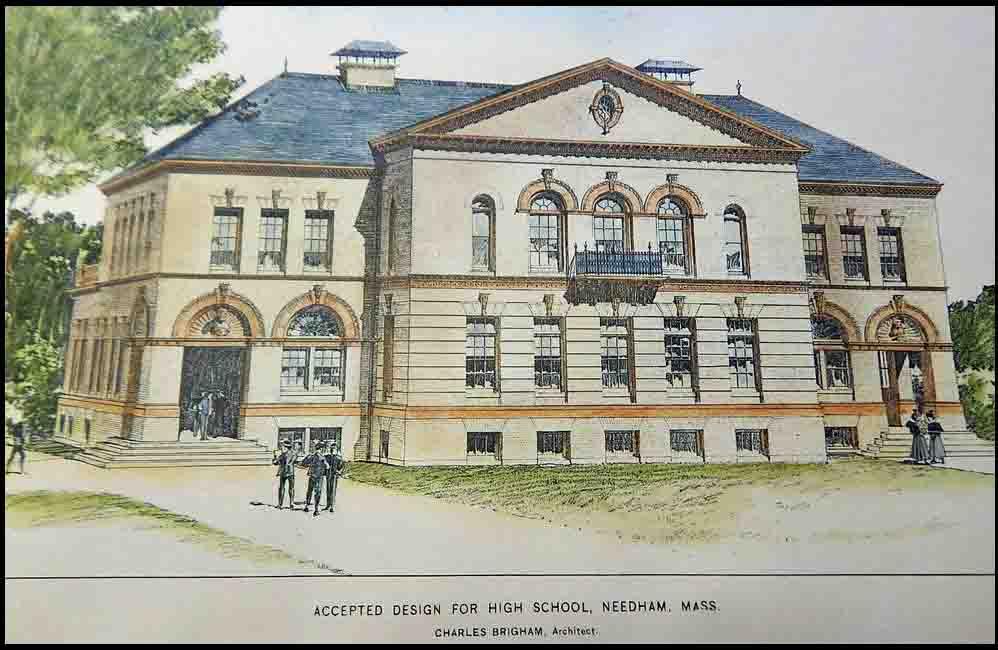
Brigham’s design was unique for Needham. The town was just making a (slow) transition away from Colonial architectural styles. The new high school was a Renaissance-Revival palazzo, with arched windows, decorative ironwork, and busts of philosophers over the arched doorways.
However, the ongoing disagreement over the location of the school held the project up. Then in 1897, local businessman John Moseley offered to resolve the location issue by giving the town a plot of land that he owned on Highland Avenue, between May Street and Oakland Avenue next to St. Joseph’s Church. The town accepted the offer, and a new committee was formed to carry the project forward.
The rendering of the accepted design for the Needham High School, made by Charles Bingham in 1896. Comparison of this image with the finished building shows how closely Whitman and Hood adhered to (even borrowed) Brigham’s design. The Brigham design had numerous decorative embellishments that were not included in the final Whitman and Hood building.
|
|
This new committee hired another architectural firm, Richard Percival Hood and Edward Payson Whitman, a brief partnership known mainly for Gothic-style school buildings in the Boston area. This led to a breach-of-contract suit by Bingham for $1000, who had not yet been paid for his work and design and the town ended up settling with Bingham for about $600 (Boston Globe, 7 December 1897, page 9). Bingham had a legitimate beef – though they claimed it as their own, a comparison of the Brigham design with the finished building shows that Whitman and Hood essentially commandeered Brigham’s design, simplifying the façade by reducing the decorative elements (and, presumably, the cost). When finished, it was praised as “unexcelled by any other high school building erected in Massachusetts for an equal amount of money."
The new high school opened in 1898. It served three grades of about 15 students each, with five classrooms, an auditorium, a laboratory, and a darkroom. However, it rapidly became too small as the student population continued to grow. By 1924, a companion building was built next to it (the Highland Avenue School), and by 1930, and new building was built on a new site – the current Needham High School.
The Italianate building was renamed the Emery Grover Building in 1935, in honor of a man who was a prominent MA judge, Town Moderator for 20 years, and a member of the School Committee for 20 years. For many years it served as overflow space for the Highland Avenue School and the High School. In the 1970s, it became the offices of the School Department, as it remains today.
The Emery Grover Building is Needham’s oldest public building and an iconic structure at the gateway to the downtown. It is listed in the Needham Historic Inventory, and the MA Register of Historic Places. It was accepted to the National Register of Historic Places in August 1987 on the basis of its characteristic architecture and the integrity of its original design. (It is noted, by the way, that the National Register document credits both Charles Bingham and Whitman and Hood as the architects).
Time has not been kind to the Emery Grover Building. Structural damage in the 1930s led to the closure of the top floor for public use. The space inside has been partitioned beyond recognition to accommodate the staff needs of a modern school system. And subsequent aging, deferred maintenance, and ill-advised replacements have diminished the appearance and safety of this once-beautiful structure.
So why consider renovating? Because, this is in fact the best option for the town. Despite the challenges, the Emery Grover is still usable and useful. Its location is ideal – in the center of town and near the other town offices – facilitating access for the public and the necessary communication between town officials. This location, just steps from both the bus and the commuter rail, is also important for families who might need to reach the building by public transportation. Renovation is also a cost-effective solution – especially since historic renovations are eligible to apply for Community Preservation funding. Renovating the Emery Grover is less expensive than trying to build on an alternate site like Hillside School (and dealing with its potential toxic groundwater issues), and even slightly less expensive (really!) than tearing it down and rebuilding. The possibility of selling the site has also been considered, but since the site is encumbered by a number of zoning and practical constraints, it does not have a market value that would contribute significantly to reducing the cost of the project.
The Emery Grover Building has been the gateway to Needham Center for 123 years. It represents the progress, optimism, and aspirations of our town as it entered the new millennium. Whatever the disagreements that attended its conception, the town was united in its belief and desire that the building should represent the best Needham had to offer – to its students, to its residents, and to the world beyond our town borders. We were proud that it was “unexcelled.” This unique and beautiful building can (and should!) be preserved, its site landscaped, and its appearance once again made something for us to be proud of – a unique historic landmark –an Italianate palazzo in the center of Needham.
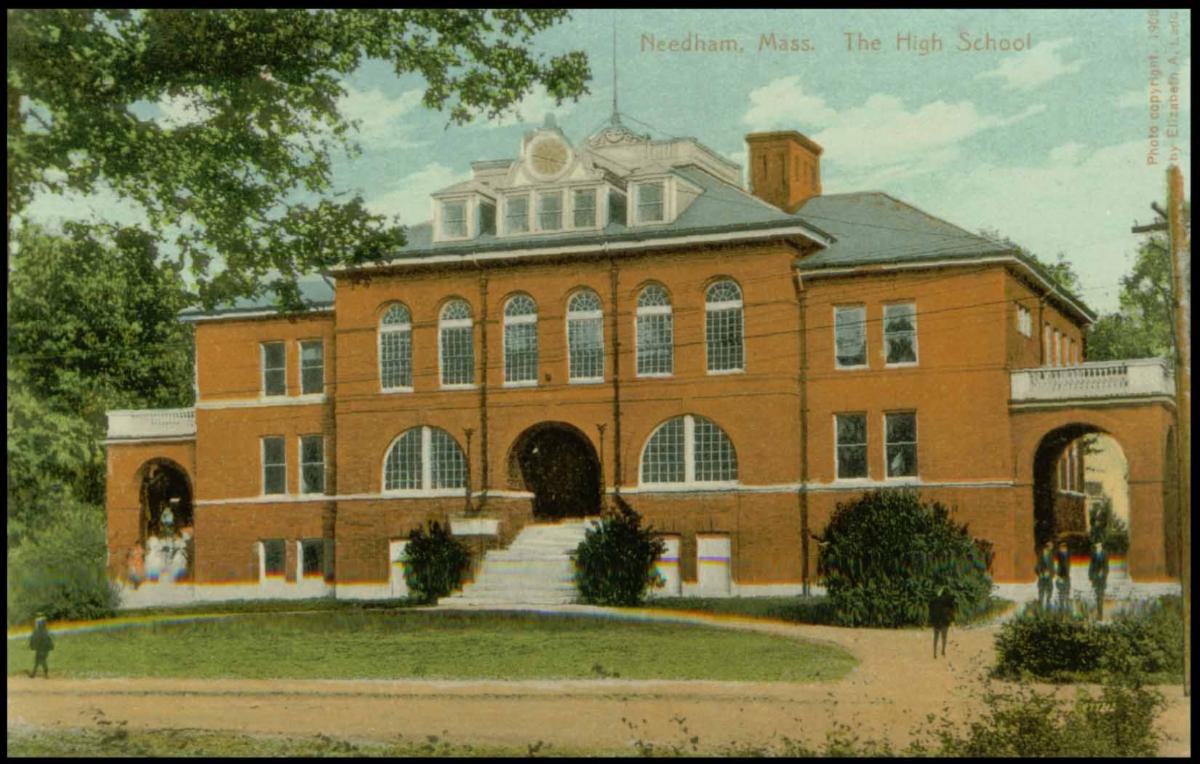
Color-lithograph postcard of the Needham High School / Emery Grover Building, photographed by Elizabeth Ladd in 1908. The cluster of students shows that the boys’ entrance was on the right, and the girls’ entrance was on the left.
|
|
The Needham History Center & Museum
781-455-8860 / www.needhamhistory.org
|
|
|
|
|
|
|