|
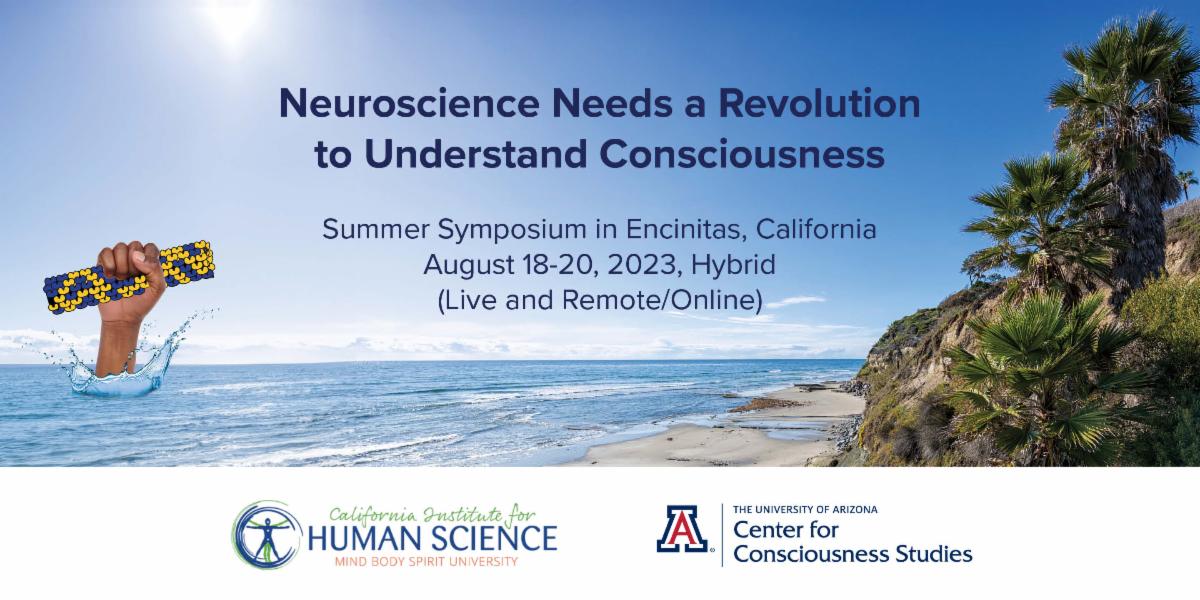
Neuroscience Needs a Revolution to Understand Consciousness
Summer Symposium
August 18-20, 2023
Encinitas, California
Hybrid Format, Live and remote/on-line
We view consciousness as the most important unsolved problem in science and philosophy today. Despite extraordinary advances in physics, chemistry, biology and details about the brain, consciousness, the essential aspect of human existence, remains a mystery. The advent of artificial intelligence ('AI') has supported the belief that the brain is a complex computer of simple neurons, each functioning algorithmically as an integrate-and-fire threshold logic device, as described by the 1950s Hodgkin-Huxley model neuron. Relevant signaling is attributed solely to membrane potentials on neuronal surfaces, with neurons, axonal firings and synaptic transmissions serving as fundamental 'bit-like' information units.
And yet single cell organisms like paramecium can swim, learn, find food and mates, and have sex, without synapses or higher-order networks. They do so by their internal microtubules, cylindrical polymers of the protein tubulin, capable of information processing in which states of a billion tubulins per neuron are fundamental units. Microtubules in all cells enact purposeful spatiotemporal activities, and in the brain, microtubules establish neuronal shape, create and regulate synapses, and are proposed to underlie memory, consciousness and cognition. Tubulin is the brain’s most prevalent protein, so the brain is largely made of microtubules, each with unique, high frequency vibrational and quantum optical properties from non-polar aromatic ring pathways.
Whereas membrane signaling occurs in slow frequencies (0 to 100 hertz, cycles per second), microtubules have been shown by Anirban Bandyopadhyay to have coherent self-similar resonance vibrational patterns repeating from kilohertz to megahertz, gigahertz and terahertz frequencies, including quantum vibrations.
The ‘Orch OR’ theory proposes consciousness depends on ‘orchestrated’ (‘Orch’) quantum state ‘objective reductions’ (‘Penrose OR’) in microtubules inside brain neurons connecting to the fine scale structure of spacetime geometry. Orch OR can account for cognitive binding, real-time conscious causal action (through non-computable Penrose OR and retroactivity), memory encoding, and the 'hard problem' of phenomenal experience. Consciousness as a non-local quantum process in spacetime geometry provides potentially plausible accounts for near-death and out-of-body experiences, pre-cognition, afterlife and reincarnation.
Presently, relevance to consciousness of megahertz, gigahertz and terahertz and quantum optical frequency processes in microtubules are testable. Experimental evidence shows that anti-depressants, psychedelics and general anesthetics (which selectively block consciousness) all act via microtubules.
Mainstream neuroscience theories of consciousness based on membrane-only ‘cartoon’ neurons are no different from current AI. These theories are an insult to the reality of what neurons actually are. Consideration of hierarchical resonance models extending inward, deeper and faster inside neurons to microtubule dynamics in health and disease offers therapeutic opportunities, e.g. terahertz (photons) and megahertz (ultrasound) for mental and cognitive disorders including Alzheimer’s, traumatic brain injury, depression, coma etc. Neuroscience needs a revolution to understand consciousness and treat its disorders.
Thomas Brophy, CIHS
Stuart Hameroff, CCS
|