|
As your state representative for House District 54, it's an honor to serve Bend and bring your voice to the State Capitol.
The 2025 session wrapped up with real progress on the issues that matter most to working Oregonians. In a time of growing uncertainty and economic pressure, House Democrats focused on making life more affordable, keeping communities safe, and ensuring that your government works smarter to deliver real results.
My office worked particularly hard to pass legislation that strengthens public safety and addresses the public defense crisis, and to lock down critical funding for Central Oregon. I also worked closely with my colleagues to improve access to behavioral healthcare.
We missed the opportunity to pass a transportation package that meets Oregonians’ needs with safer roads, stronger oversight, and modern funding tools. I’m frustrated, but I also know major policy efforts often take more than one try—including Oregon’s last transportation package in 2017. I will continue working with my colleagues to help find a path forward that works during our upcoming special session.
I remain committed to elevating the voices of everyday Oregonians as we make decisions in Salem. Representing Bend at the Capitol is a job I can’t do without your input, and I hope to see you at the upcoming Town Hall on Sunday, August 24th. I always welcome your thoughts, questions, or concerns, and I hope you’ll continue reaching out.
Sincerely,
| |
Sine Die
On Friday, June 27th around 11:15PM, the Oregon Legislature officially adjourned sine die (colloquially pronounced “sigh-knee dye”) a Latin phrase meaning “without a day.” That means that we do not have a set date for the next time we will meet. In other words: we wrapped up the 2025 legislative session.
The final stretch saw long days and late nights at the Capitol, but I’m proud to report that we passed critical legislation that will benefit communities across Oregon, including investments in mental health care, housing, and early education.
We are now in the interim, a period of continued policy work, community engagement, and preparation for the short session, which begins in February. At the end of the month, we will meet for a special session to ensure we have a transportation package that will help maintain our roads.
| | Delivering for Central Oregon | This session, we successfully made critical investments to meet the needs of our rapidly growing region. That includes a new pediatric mental health facility, finally bringing long-overdue care closer to home for families in crisis. We secured funding for CORE3, a state-of-the-art emergency coordination and public safety training center, to strengthen our regional response to disasters and emergencies. We supported rural job creation, expanded healthcare access including funding for the Mosaic Community Health expansion, and invested in the cultural centers that make our community unique, including the High Desert Museum. These projects reflect the needs of Central Oregonians today and help us build a stronger foundation for the future. | A Stronger Behavioral Health System | | |
I was proud to carry House Bill 2005, a transformative step forward for Oregon’s mental health and addiction care system. This bipartisan bill lays the foundation for an outcomes-focused approach that addresses treatment, housing, and workforce challenges. For too long, people in crisis have fallen through the cracks. HB 2005 helps us move forward in building a system that meets people with care and compassion, prior to crisis, not just after.
The challenges we face in mental health and addiction care are complex. Solutions will go beyond one policy or program, and must be comprehensive, sustained, and designed with stakeholder input. This bill recognizes that reality. It includes key reforms, such as new tools for community-based restoration, more appropriate timelines for treatment in the state hospital, and a sunset clause that serves as a deliberate reminder to return to this work.
I’m committed to staying engaged on this issue, not just this year, but for the long haul. That means continued work on housing, education, and public safety, because behavioral health doesn’t exist in a silo. It also means continuing to work across the aisle, with stakeholders, and community leaders to make the investment and policy changes needed to build a system that truly supports Oregonians.
Progress won’t be perfect, but HB 2005 moves us in the right direction, and I’m proud to be part of that work.
| | |
One of my personal priorities this session was continuing the work of preventing gun tragedies in our communities. Too many communities across our state, including our own, know what it means to learn that neighbors and loved ones have experienced gun violence. I regularly hear from my constituents who want to feel safer in their neighborhoods, schools, and gathering spaces, and who know that common-sense legislative changes can help.
This year, we passed Senate Bill 243, which bans the sale and possession of rapid-fire activators (like bump stocks and forced-reset triggers). These devices essentially turn semi-automatic firearms into fully automatic weapons, which have been banned in Oregon and across the United States for decades because of their deadly capacity.
Having grown up in a hunting family, I understand the practical and cultural significance that firearms play in the lives of many across our state. I always welcome discussion and feedback from anyone, regardless of political affiliation, who has knowledge and experience to share when it comes to proactive firearm safety. Nobody, however, needs to own a doctored automatic weapon. The work to decrease gun violence in our state is ongoing, but this legislation will save lives, and I'm grateful to everyone who had a hand in moving it forward.
| | Investing in Early Literacy | | |
In 2023, we passed the Early Literacy Success Initiative to ensure more Oregon students learn to read by third grade. This year, we built on that progress with House Bill 3040, helping make our state’s literacy investments more permanent, equitable, and sustainable.
We know that literacy unlocks opportunity. When a child becomes a confident reader, their world expands: they’re more likely to graduate, pursue higher education or career training, and participate fully in our economy and democracy. The ability to read fluently by third grade is one of the strongest predictors of long-term success, which is what makes these early interventions so vital.
HB 3040 supports:
- High-contact tutoring for students who need targeted support
- Summer learning programs to prevent learning loss
- Evidence-based reading instruction for students in grades K–5
Research shows that investments in early learning pay dividends for years to come, both for students and for our state as a whole. By ensuring every child, regardless of their zip code, has access to quality reading instruction, we’re building a stronger, more just future for Oregon.
I believe every child deserves the chance to become a confident reader, and with this legislation, we’re making that a reality for more young learners across the state.
| | Addressing Oregon's Public Defense Crisis | | |
At the start of my legal career, I worked as a public defender. Providing people with their constitutionally protected right to a competent legal defense was a tremendous responsibility, and the experience is part of the reason why I decided to become a state legislator. Frequently my clients were facing significant consequences, during moments of crisis in their lives, and oftentimes the only person at their side in the courtroom was me.
Preserving the constitutional right to adequate representation in court is a fundamental role of the government, and in Oregon, we are addressing some of the hurdles that have hindered that access. I worked closely with colleagues on both sides of the aisle to pass House Bill 2614 this session, which provides better oversight to our Public Defense Commission to ensure that every Oregonian charged with a crime has access to a public defender.
My commitment to solving this crisis doesn’t end with the passage of this bill. I believe that it is a shared responsibility to find areas for improvement and make sure we have a system that is fair and just.
| | Bill Passes with Promise for Victim Services | | |
I’m proud to share that House Bill 3816 passed both chambers of the Oregon Legislature, marking a major step forward for crime victim services across our state. At its core, HB 3816 ensures that when restitution is collected from someone found guilty of a crime, a portion of payments owed to insurance companies will now help fund vital support services for survivors.
Here’s how it works: When a crime results in damage and the insurance company covers part of the repair, the court can later order the offender to repay both the victim and the insurer – this is restitution. Under the new law, when that restitution is collected for insurance companies, 50% will now go to the Oregon Department of Justice to support programs like sexual assault nurse examiners, domestic violence shelters, child advocacy centers, and emergency housing for survivors.
Individuals harmed by a crime often have no choice but to rely on the criminal justice system for financial relief, whereas large insurance corporations have entire legal teams to recover their losses. HB 3816 is an example of thoughtful policy that ensures our public resources help people who need them most. It’s a small shift with big potential: more consistent funding for frontline services that help survivors heal and rebuild their lives.
| | |
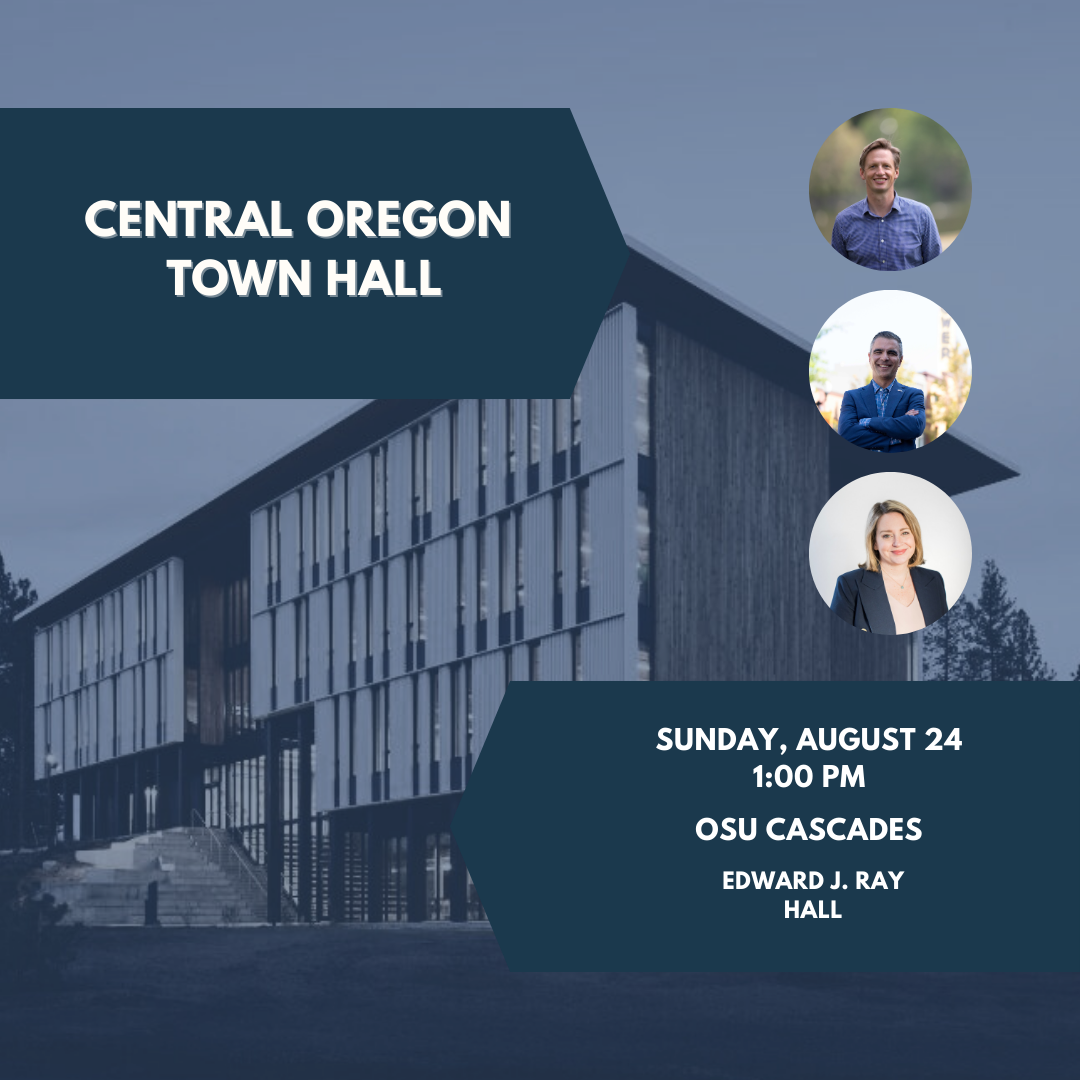
Please join us for our joint Central Oregon Town Hall in August. Representative Levy, Senator Broadman, and I will discuss our work this past legislative session and get input about your priorities for 2026.
When: 1:00 PM, Sunday, August 24th
Where: OSU Cascades, Edward J. Ray Hall Atrium
RSVP for the Town Hall here!
| | Staying Safe this Fire Season | | |
Keep your family and community safe by being proactive this fire season! Central Oregon is already under Stage 1 fire restrictions, prohibiting open fires like wood stoves or charcoal on public lands. At home, follow the Oregon Defensive Space guidelines: clear needles and debris from gutters and rooms, trim lower branches, and keep firewood and other combustibles at least 30 feet away from structures. For more information, check out Bend’s “Own Your Zone” guide.
Get to know your neighbors while improving your wildfire resilience by creating a Firewise or FireFree community. These programs encourage neighbors to collectively organize by scheduling clean-ups, reducing shared fuel loads, and developing coordinated evacuation plans. We already have over 40 recognized sites like these in Bend! Our community is special, and when we come together, we can be better stewards of our environment.
| | |
If you need more information or have any questions,
please feel free to contact my office.
Jason Kropf (he/him), State Representative, House District 54
rep.jasonkropf@oregonlegislature.gov
| | | | |