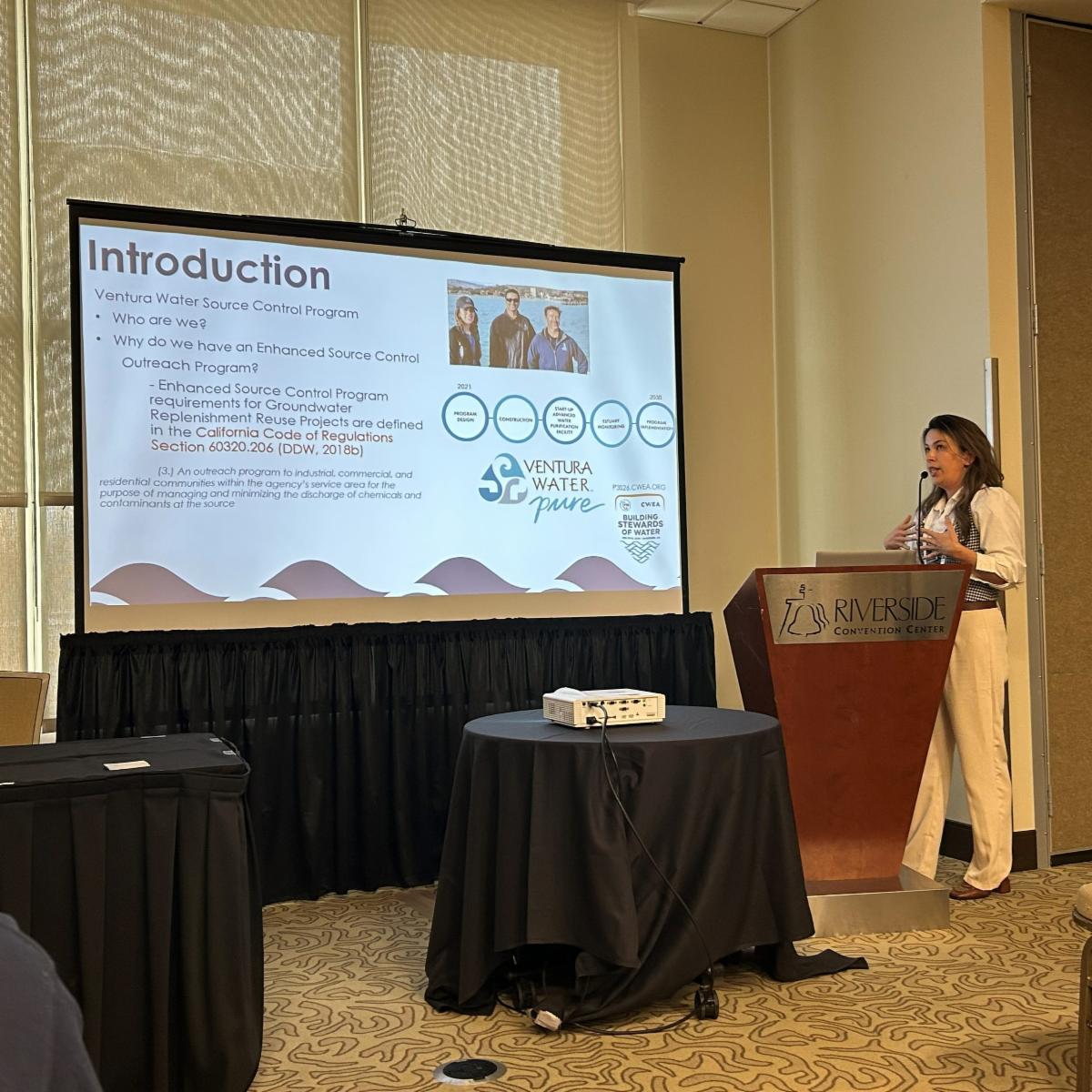
Senior Environmental Compliance Inspector, Baylie Martinez discusses elements of effective public outreach for communicating the importance of Environmental Source Control, at the CWEA's 2026 Pretreatment, Pollution Prevention, and Stormwater conference, held this month.

General Manager's Message

Thank you for taking the time to read this newsletter. We use this newsletter to tell you about what projects are active, give updates on policy and regulation, and to share about the incredible, and fun, things we are doing. One of those fun things is the Student Art Calendar Contest where we ask our school-age residents to send in their art related to water and environmental conservation, and city employees vote on which images to put in the calendar. It is so inspiring to see the artistic expression from the hearts of our future generations.


Another inspiring activity with Ventura Water is the chance to talk about our successful programs with other agencies and industry peers. Baylie Martinez, Senior Environmental Compliance Inspector, presented at the recent California Water Environmental Association (CWEA) conference (see above). Coming up, staff will be participating in the California WaterReuse Symposium in Los Angeles, discussing how our potable reuse program, VenturaWaterPure, was developed and what challenges we have been overcoming.


We are moving ahead on many important projects this year, such as the Eastside to Midtown Waterline Project we highlight below. The wastewater facility upgrade—Membrane Bioreactor and Ultraviolet Light—has been approved and construction is underway. Stay up to date with our progress on our website and in future newsletters.


Respectfully,


Gina Dorrington

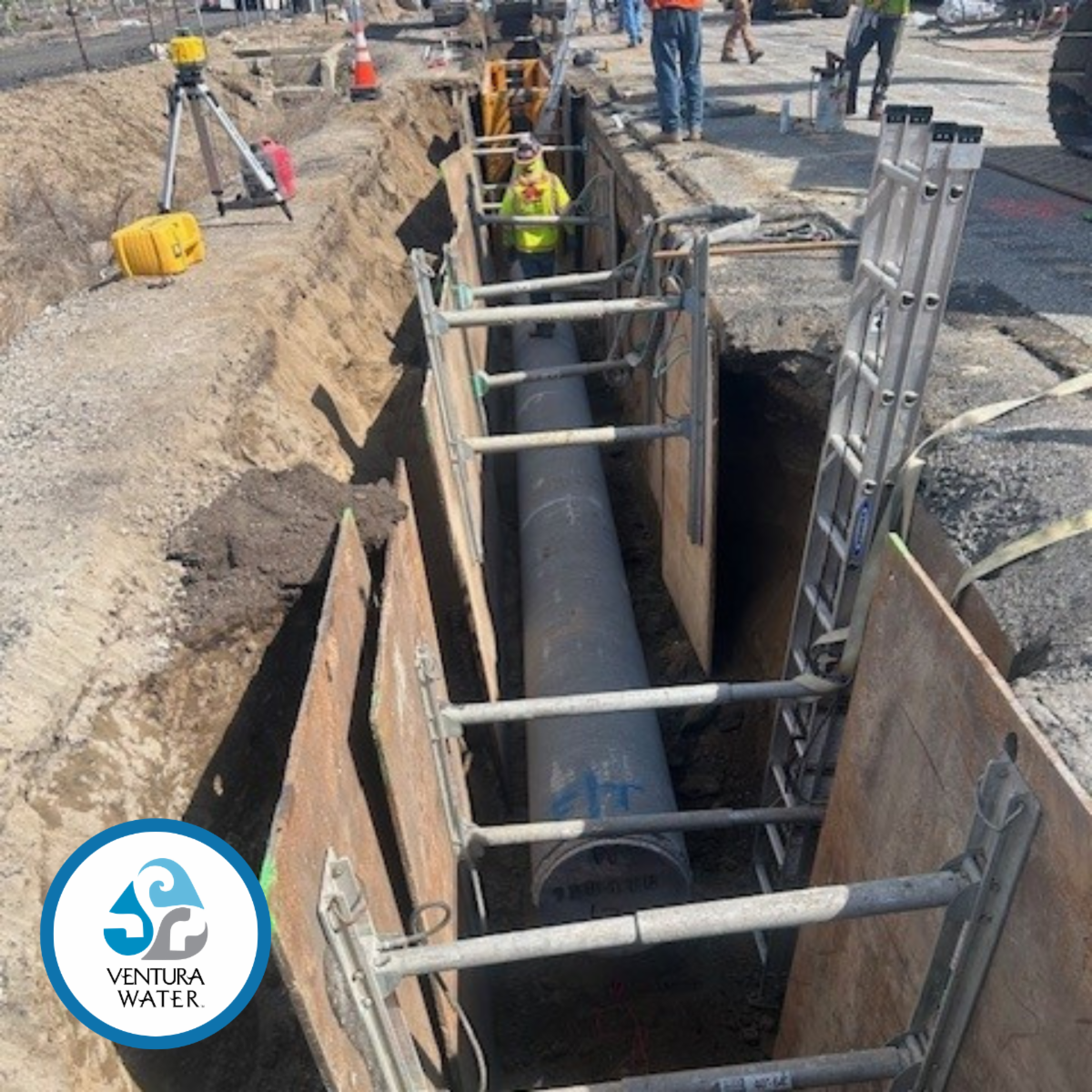
The first segment of the Eastside to Midtown Interconnect Project, designed to improve water reliability, started construction this month.

Your Water Rates at Work:

Eastside to Midtown Interconnect Project

The Eastside to Midtown Waterline Interconnect Project kicked off this month. This major infrastructure project will be upgrading waterlines along Foothill and Kimball Roads to improve water reliability and strengthen the City's overall water delivery system. It is the second phase of constructing new transmission pipelines that will provide a physical connection to transport water from the east end of the City into the midtown area. Work includes installing approximately 8,500 linear feet of new underground water pipeline along Foothill Road, as well as building a new Pressure Reducing Valve (PRV) station at the Bailey Treatment Plant.


Residents should expect road closures and/or delays during work hours along Foothill Rd. Phase 1 will include the roadway from Petit Ave. to N. Saticoy Ave. Residents may check ongoing construction updates, traffic impacts and schedule changes throughout the project on the project webpage.


Where: Foothill Road from Kimball Road to Elizabeth Road, and Kimball Road from Telegraph Road to Foothill Road.


When: February 2026-January 2027


Work hours: Monday through Friday, 7:00a.m.-4:00p.m. (excluding holidays)


Project Contact: Jason Dane, City of Ventura Construction Manager, (805) 677-3953, jdane@cityofventura.ca.gov

Lead and Copper Rule Revisions (LCRR)

Last month we began a series on “Water Regs”, the regulations water suppliers must follow that are meant to protect Earth’s environment. In late 2024, Ventura Water completed compliance with the most recent regulations regarding the presence of lead in water service connections.


Lead is a heavy metal found in nature at very low purity and constitutes about 0.002% of the Earth’s crust. Because it is very flexible, durable, and low cost, pure or nearly pure lead has been used in plumbing systems as far back in history as ancient Rome. By the 1800s lead was the most common type of water delivery pipe in the U.S. By 1900, 40 of the 50 largest U.S. cities had mandated or recommended lead pipes for service connections. After WWII copper began replacing lead, however the existing infrastructure remained in place for decades. According to the EPA, most lead service lines were installed prior to 1950. Modern piping is largely cross-linked polyethylene (PEX) and polyvinyl chloride (PVC) tubing.


The effects of lead exposure on human health were recognized in the 1900s. Research showed that young children are particularly vulnerable to lead poisoning—including damage to the central and peripheral nervous system, and learning disabilities. Exposure is most dangerous when lead is breathed in or swallowed, with service lines being the greatest source of lead in water. Localized awareness of these dangers persisted through the 1920s, although the lead industry continued to promote its use.


Passed in 1974, the Safe Drinking Water Act (SDWA) is the primary federal law protecting public health by regulating the nation's public drinking water supply. Through amendments to the SDWA, lead in new pipe was controlled or banned in 1986. In 2021, the EPA strengthened protections with its final ruling on additions to the SDWA. The Lead and Copper Rule Revisions (LCRR) requires more rigorous testing of drinking water, and for community water systems (CWS) to take action to protect people from lead exposure in water. By October 2024, CSWs were required to conduct an inventory to determine the material in water service connections, and proactively replace any identified lead service lines. In addition, the rule improves communication within communities to be better informed; about the risk of lead in drinking water, the location of any lead pipes, and plans for replacing them. 


Ventura Water staff created a workplan that was presented to and approved by the State Water Resources Control Board (SWRCB), the body mandated to ensure compliance with EPA requirements in California. First, the 31,726 citywide water service connections were mapped in a GIS (geographical information system). Next, historic engineering records were reviewed to identify installed water connection materials. This review verified connections of non-lead pipe materials and thereby reduced the number to be further investigated—by 19,123 domestic services on the utility side, and 8,548 on the customer side. Ventura Water field crews inspected the remaining service connections using a pre-approved stratified random sampling methodology giving a 95% confidence level. City properties were divided into nine categories by decade of construction, plus one category for buildings constructed prior to 1900 and one for the WWII era. Field crews inspected select meter boxes in all categories and identified the materials on both sides of the service connection and when possible, at the nearest hose bib. Staff then performed a “scratch test”—when lead pipe is scratched the underlying surface is shiny and silver.


The City’s Lead Service Line Inventory, completed in August 2024, confirmed that no lead water service lines were found within the city. Therefore, the remainder of the mandates of the LCRR—replacement of service pipes and ongoing monitoring are not required. Ventura Water presented the final program to the Water Commission on August 26, 2024, and it was approved by the Division of Drinking Water at SWRCB prior to the October 16, 2024, deadline. To aid customers with more information regarding the City of Ventura’s service line inventory, an ArcGIS Hub Site was created. This site is accessible through the City’s website and has informational links to the EPA’s guides on the LCRR, our Consumer Confidence Report, and the City’s homepage. It includes a live interactive map that allows customers to see the status of their service connection and will be updated as needed during normal operations to include service line replacements, repairs, and capital improvement projects. 

Calling All K-5 Student Artists!

Ventura Water is excited to collaborate with Public Works' Environmental Sustainability Division on our 3rd Student Art Calendar Contest! This program aligns with California Public Schools Next Generation Science

Standards and encourages kingergarten-5th grade students to contemplate several environmental topics—from composting to protecting our local water resources—in a creative way.


Because of such enthusiastic student participation for our last contest, this year we will honor twice as many artists with a 2027-2028 calendar! Ventura schools recently received details and submission forms, also available on our website. Entries must be submitted by April 24, 2026, and will be collected from campuses or may be turned in at the City Maintenance Yard building lobby, 336 Sanjon Rd., during regular business hours.

The Water Commission is an advisory group that makes recommendations to the City Council on water resource and wastewater issues. There is currently one position open to serve as a non-professional commissioner. Interested residents can view more information here.


The Water Commission meets every fourth Monday of the month. The next Water Commission Meeting will be held on Monday, March 23, 2026, at 5:30 p.m. The public is invited to join us in-person at the Ventura City Hall, Community Meeting Room, Second Floor.


Click here for meeting agendas and more information.

Employment Opportunities

Facebook  Twitter  Youtube  Instagram