- Get Engaged
- We Want to Hear from You!
- Greening Randall Library
- Let's Create a Pollinator Pathway in Stow
- Open Position for Green Advisory Committee
- PFAS Legislation
- Drought Bill Needed More Than Ever
| |
Achieving our sustainability goals is up to each of us. Consider participating through these local groups and activities.
| | We Want to Hear from You! | | The Energize Stow newsletter strives to provide you with practical information you can use to make Stow a more sustainable community. We would love to hear from you about what you would be interested in reading or learning about. Please email us at GreenAdvisory@stow-ma.gov with your ideas. Thank you! | | |
With the renovation of Randall Library now complete, one notable feature has yet to be highlighted. The renovated library is a green building with a high performance building envelope as well as the elimination of fossil fuels.
The Library Building Committee embraced the town’s sustainability goals by specifying that the renovation would discontinue the use of natural gas and use an all electric HVAC system (Heating, Ventilization, and Air Conditioning). The result is a comfortable and healthy interior space that reduces annual operating costs and nearly entirely eliminates the generation of greenhouse gas. It is projected that heating and cooling costs will be reduced by over $4,000 annually while greenhouse gas generation will be reduced by over 90% - 27 tons of CO2 per year.
The town received significant financial support for the electrification of the library. Stow was awarded a $500,000 Green Communities grant and a $33,000 Mass Save incentive covering most of the cost of the new HVAC system..
| | |
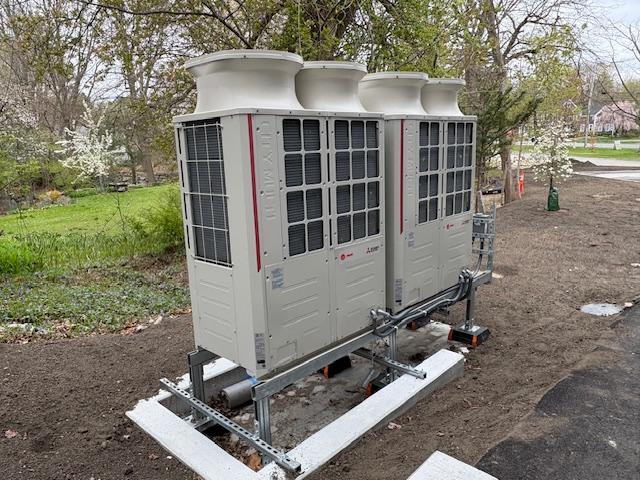
The heat pumps on the side of the building, shown in the picture on the right are the only visible signs of the electrified library.
This project continues Stow’s progress as a sustainable community. Last year, Stow was one of the first communities to be designated a Climate Leader under the new state program and the town was honored to be selected as the state’s Leading By Example community.
| | | |
Let's Create a Pollinator Pathway in Stow
| | |
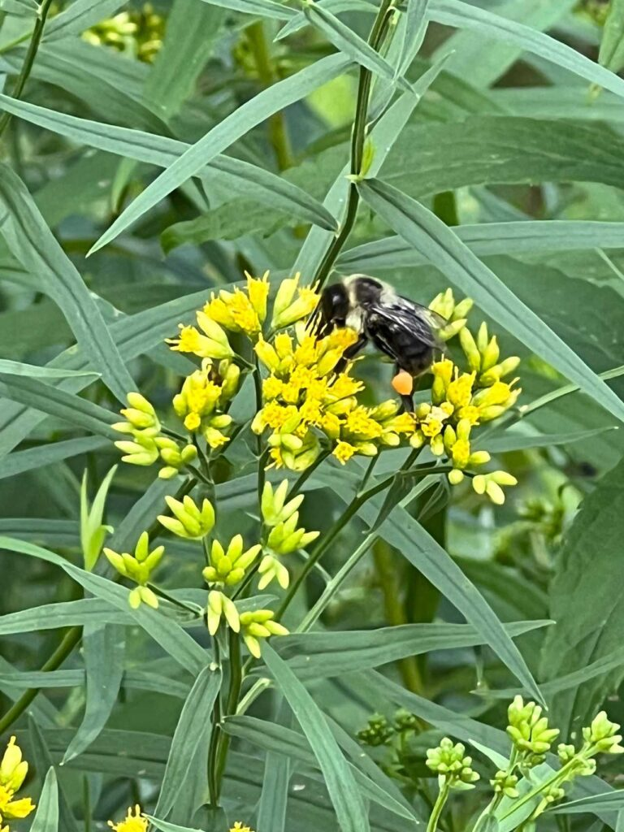
Pollinator pathways are “pathways” or “corridors” of native plant gardens that enable pollinators to find the habitats, plants, and mates they require. Locations planted with New England natives need to be close enough to each other for pollinators to easily travel from site-to-site.
Stow is just getting started at creating pollinator pathways. A pollinator pathway can include both public and private lands. Stops along the pathway can be a garden box, a grassy strip alongside a road, a garden in your yard, a patch of native shrubs or trees, or a meadow.
| | | |
The more native gardens we create, the healthier our town environment will be for pollinating insects. An additional bonus to having a pollinator pathway in Stow is that more pollinators mean more birds. More pollinating plants equals more seeds for birds and wildlife to eat. More birds equal less ticks and mosquitos.
Why is this important? According to the Center for Biological Diversity, more than half of North America’s 4000 native bee species are in decline, with 1 in 4 species at risk of extinction. The decreased pollinator population, including other species besides bees, has impact on animals that feed on them, such as birds, amphibians, and small mammals, as well as impacts on our food supply.
Twenty-four towns in Massachusetts have already created designated pollinator pathways. These include Amesbury, Amherst, Andover, Boston, Brookline, Cape Cod, Dover, Groton, Groveland, Ipswich, Lexington, Marblehead, Monterey, Town of North Andover, Oxford, Pepperell, Plymouth, Salem, Sherborn, Shirley, Somerville, Wellesley, Westborough, and Weymouth.
We will let you know in future articles how you can be involved. Let us know if interested contact Sharon Brownfield (sharonbrownfield@gmail.com).
| | Open Position for Green Advisory Committee | | |
Heading into the new fiscal year, there is an opening for an At-Large member of the Green Advisory Committee (GAC). GAC appointments are for one year - through June 30th 2027. The GAC is responsible for developing programs and projects to foster energy conservation, renewable energy generation and sustainable planning. The GAC also developed and oversees Stow’s Climate Action Plan. The GAC’s work for the town has included..
- Adoption of the Specialized Energy Code for new construction.
- Designation as a Climate Leader including access to a $1,000,000 “building accelerator” grant.
| | |
- Adoption of a plastic bag reduction bylaw.
- Award of a $500,000 Green Communities Building Decarbonization grant for Randall Library.
- Jointly with the Sustainable Stow volunteer group, publish the monthly Energize Stow newsletter and maintain the Energize Stow website.
Stow has been making progress as a sustainable community. If you would like to help, you can find out more on Stow’s GAC webpage or contact the GAC at GreenAdvisory@stow-ma.gov.
| | |
Stow has several known PFAS‑related sites, including the Massachusetts Firefighting Academy facility and the former Fire Station. PFAS chemicals, often called “forever chemicals,” build up in our bodies and environment because they don’t break down. They’re linked to health problems such as cancer, immune system impacts, and developmental issues in children. PFAS can move through soil and water, contaminating drinking water and local ecosystems. Taking steps now to limit PFAS use and clean up existing contamination helps protect our community’s health and reduces long‑term environmental and financial costs.
In the current legislative session, there are identical House and Senate bills to address the PFAS problem. These are H.4870 and S.3034 - An Act to protect Massachusetts public health from PFAS. The House version of the bill was introduced by our representative, Kate Hogan. This bill will broadly address PFAS through education, remediation, and regulation. It would ban PFAS from selected product categories, including food packaging, cookware, furnishings, and children’s products. The bill would also strengthen protections for our groundwater, surface water, drinking water, and private wells. A Fact Sheet for the bill is here.
Both the House and Senate versions of the bill have progressed. The House version is currently in the Joint Committee on Health Care Financing. You can support the bill by emailing the chairs of the committee - senator Cindy F. Friedman (Cindy.Friedman@masenate.gov) and representative John J. Lawn (John.Lawn@mahouse.gov) as well as representative Kate Hogan (Kate.Hogan@mahouse.gov).
| | Drought Bill Needed More Than Ever | | |
You may know that the state remains in a drought. What you may not have heard is that the Mass Secretary of Energy and Environmental Affairs (“EEA”) found that our drought has worsened and declared our region now be in a Level 3 Critical Drought. See: https://www.mass.gov/info-details/drought-status.
This drought began two years ago, in August 2024, and recent rain has done little to change the situation.
According to the state’s Drought Management Plan, a Level 3 Critical Drought is a very serious drought. It means that the water table in our river basin is dangerously low. And that means that our private wells are at risk of failing. Even where a well does not completely fail, a common result can be water production that is silty, cloudy, or has excess iron and manganese.
When a private well fails at a home in Stow, it leaves the residents without water to drink and unable to flush toilets or bathe. Because this is considered to be a public health emergency, the Board of Health will likely condemn such a dwelling and force the occupants to move until water can be restored.
Under the state Drought Management Plan, cities and towns in a Level 3 Critical Drought should now implement stringent restrictions on “nonessential outdoor water use.” This means, among other things, no car washing, no filling of swimming pools, and no watering of lawns. There are exceptions for food production and to meet core business functions.
These restrictions, however, are currently only recommendations coming from the Secretary of EEA. As a result, many cities and towns do not implement them. And this is the problem a new Drought Bill is seeking to address. This legislation would give the legal authority to order water conservation measures, including limits on nonessential outdoor water use. The state Senate incorporated the Drought Bill into the Environmental Bond Bill ("Mass Ready Act"), which is now pending in the House. The House may vote on this bill during the first week of June.
The challenge for Stow and many other towns relying on private well water is enforcement. Many homeowners assume that if their own well is working, then things are fine. What they don’t recognize is that our wells tap into a shared aquifer. If you water your lawn every day, you are using a shared, and now increasingly scarce, resource. Your water use could impact your neighbor’s well. Meanwhile, local health boards have little to help them with enforcement. This bill could help local boards by creating a public understanding of our mutual responsibility. It will take public education as well as enforcement to protect our shared resource.
If passed, drought legislation in the MassReady act will provide municipalities with data-based guidance for non-essential water use that is regionally-and drought-level specific.
Please write Rep. Kate Hogan (Kate.Hogan@mahouse.gov) and
Senator Jamie Eldridge (James.Eldridge@masenate.gov) to express your support for this measure. (And pray for rain!)
Rick Lent and Allan Fierce
| | | | |