2026 Drought Bulletin

July 15, 2026 | Issue 4

Every Drop Counts: Okanagan Faces Continued Water Stress Heading into Peak Summer Heat

The Okanagan continues to experience drought conditions that have created serious water scarcity challenges for many of our communities. Lake levels, streamflows, and groundwater supplies are all showing signs of significant drought stress.


Local utilities enact early-season water restrictions


Forecasts indicate the summer ahead is likely to be hot and dry, so conservation and careful water management is critical to preserve water supplies for the rest of the summer season. A few Okanagan utilities have already implemented major restrictions for both agricultural and residential users. This includes Stage 3 level water restrictions imposed in communities in the North and Central Okanagan.


It is more important than ever that all sectors work together to conserve what we can so that our water supply lasts. Every drop counts.

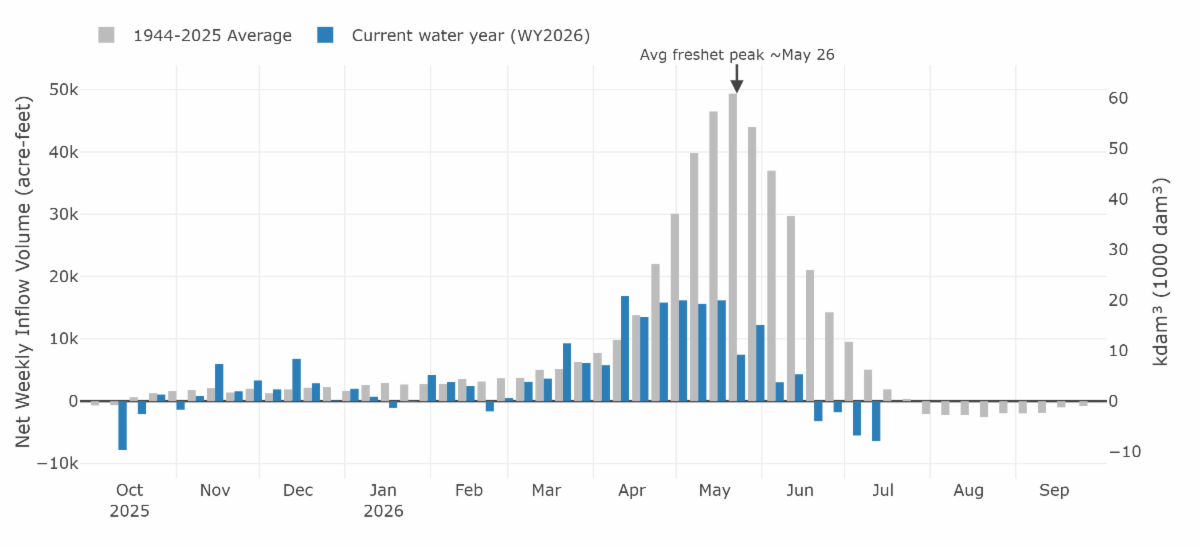
Figure 1: Weekly Net inflows in acre-feet to Okanagan Lake as of July 15, 2026 vs the 1944-2025 average. Data from Water Survey of Canada stations 08NM083 (Okanagan Lake at Kelowna) and 08NM050 (Okanagan River at Penticton).

Okanagan Lake has only received 1/3 the usual spring recharge this year

  • The level of Okanagan Lake on July 1 is the lowest the lake has been since 1992. 
  • Each week, we can estimate whether Okanagan Lake is gaining or losing water by comparing how much the lake level changes with how much water is leaving through the Penticton dam.
  • The lake gains water through snowmelt, streams, rainfall, and inflows from groundwater exchange. The lake loses water through evaporation, water diverted for use, groundwater seepage, and releases at the Penticton dam.
  • The gain or loss of water in the lake is called the net inflow and is represented in the graph above.
  • When the lake gains more water than it loses, the bars point upward. When it loses more water than it gains, the bars point downward. The blue bars in the graph above show what happened this year, while the grey bars show the long-term average.
  • Normally, spring snowmelt produces a large surge of water (freshet) between April and June. The graph above highlights just how much smaller and earlier this year's freshet was.
  • The seasonal drawdown of Okanagan Lake (downward bars) typically begins in early July. This year, it began in early June, nearly a month earlier than normal.
  • Low water flows are common in summer, but it is concerning to see these conditions occurring this early in the season.


Groundwater observation wells show Okanagan groundwater supplies under stress

  • Nearly half of the provincial groundwater observation wells are reporting at their lowest levels ever recorded for this time of year (14 of 31 wells on July 14). Another ten of those wells are reporting ‘below normal’ or ‘much below normal’ (below the 25th percentile).
  • Groundwater conditions vary considerably from one aquifer to another because differences in geology, recharge, and water use affect how each aquifer responds to drought. As a result, conditions at one observation well may not reflect conditions elsewhere, making local monitoring important.

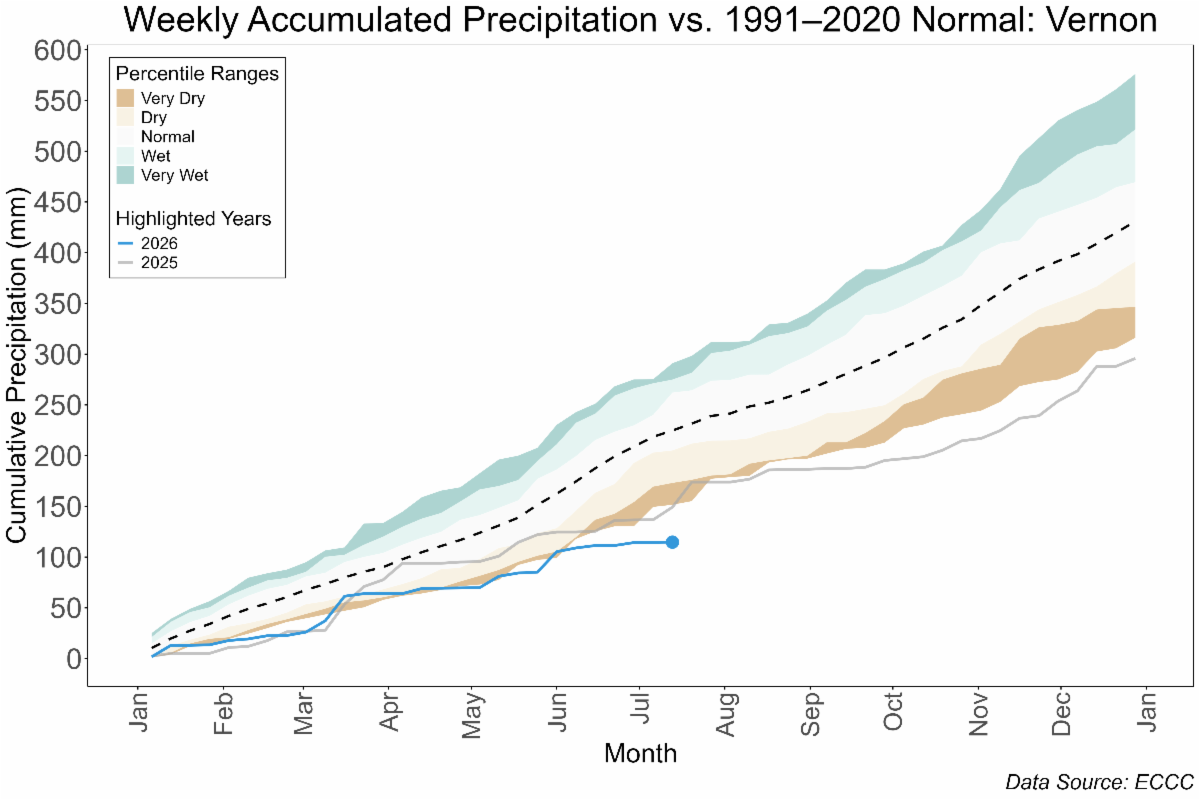
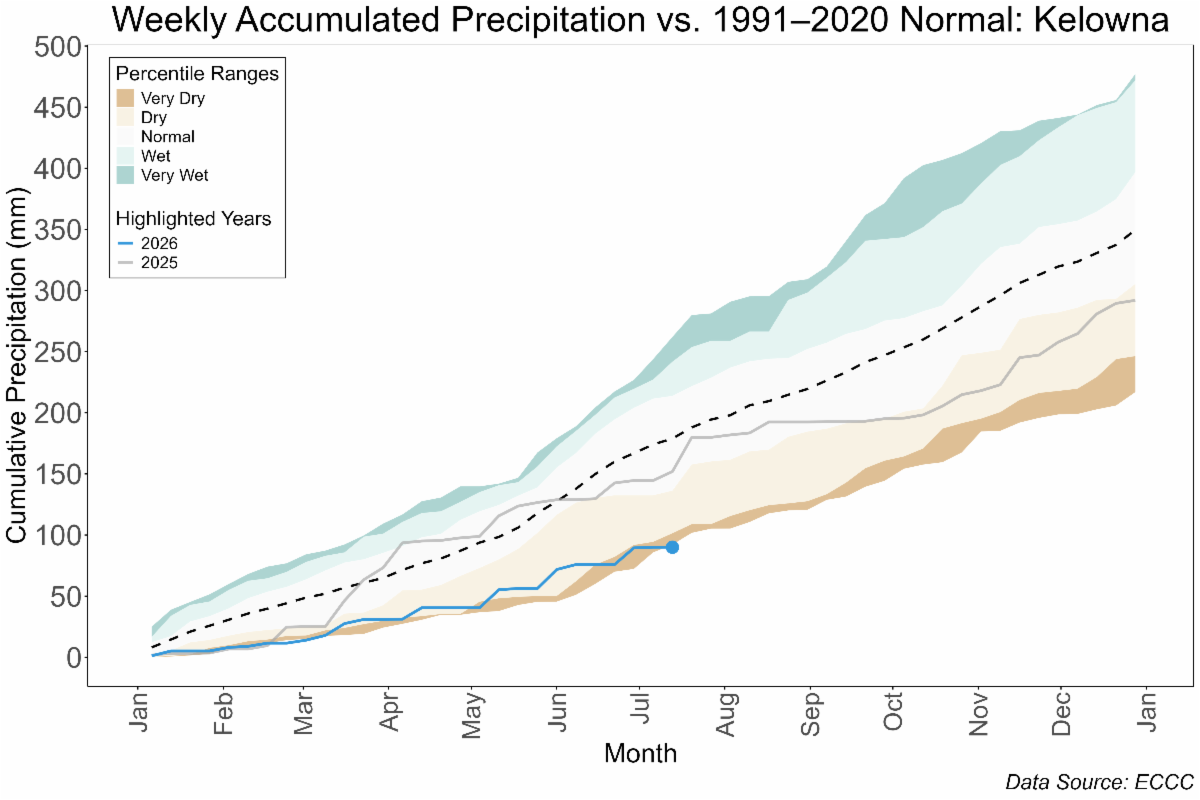
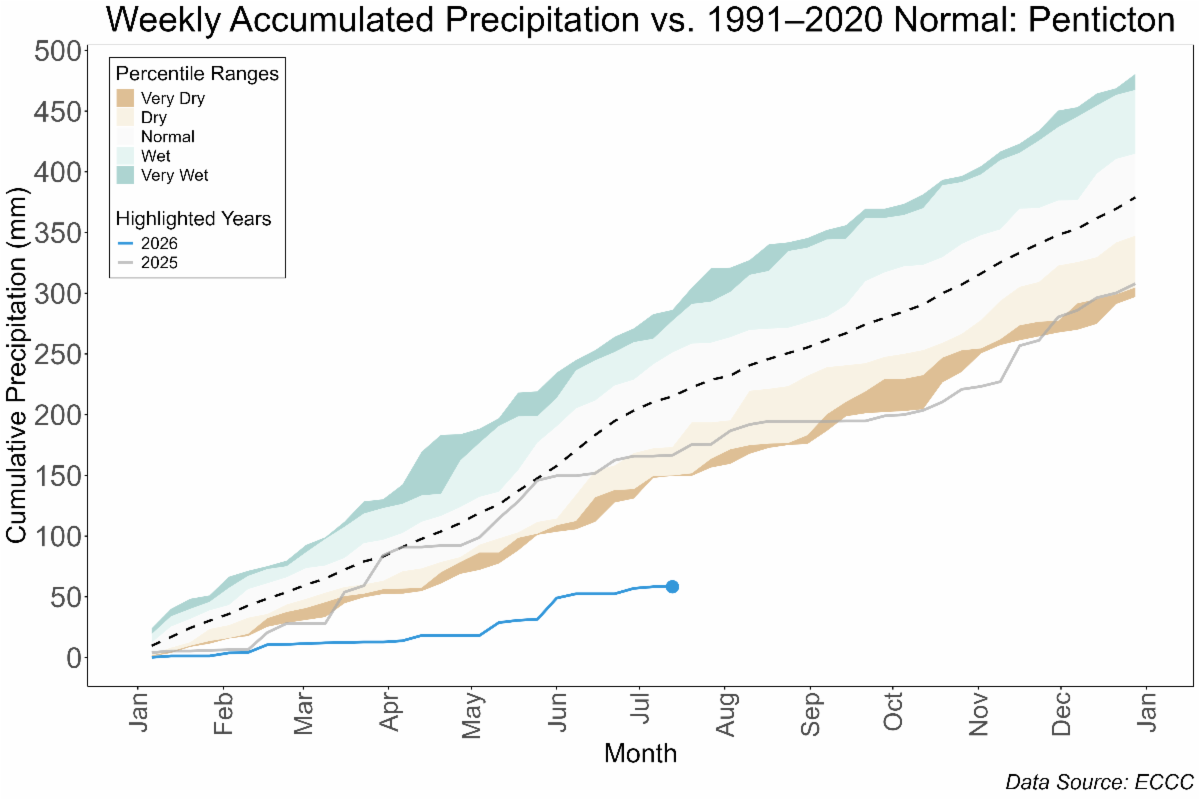
Figure 2: Total accumulated precipitation in the Okanagan as of July 15, 2026, compared to 1991 to 2020 range. Data retrieved from Environment and Climate Change Canada.

Spring precipitation far below normal, temperatures above normal and rising

  • June precipitation was well below the 30-year average across the valley, continuing a long-term dry trend. At this point in the year, every city has received less than half the precipitation normally expected at this time of year — Penticton is especially dry.
  • There has not been any significant rainfall in July
  • While extreme heat has not been widespread so far, consistently warm weather has contributed to dry conditions. June was warmer than normal overall.
  • Seasonal forecasts suggest temperatures from July through September will likely be above normal, with El Niño conditions expected to contribute to warmer, drier weather.

Look to your water provider and follow their restrictions this summer


Water restrictions are not set lightly, and water providers must ensure the current supply can last through the season. Water scarcity challenges are expected to worsen as temperatures are forecast to rise above seasonal norms, which will increase evaporation and water demand. It is unlikely that the Okanagan will receive enough precipitation to significantly reduce water scarcity challenges this summer.


Even with careful water management, some communities are not able to meet all the normal water demands of their families, farms, ecosystems and fish, and firefighting this season.


The severity of conditions will vary between communities depending on their water source and system, and it is important that residents follow the water restrictions set by their local provider.


Please see the list below for your local water restrictions, or a full list is available at MakeWaterWork.ca

Location

Current watering restrictions

Learn more

Greater Vernon Area

Stage 3 — Reservoirs are VERY LOW and conditions are EXTREMELY DRY. Lawn Watering And Filling Of Private Pools Not Permitted.

Visit the Greater Vernon Water Restrictions page here.

City of Armstrong

Stage 2 — Up to two days a week as per your address, automated sprinklers only between 10 p.m. and 6 a.m. on permitted days.

Visit the City of Armstrong Water Conservation page here.

Kelowna

Stage 1 or 2 — Varied stages depending on the Water Utility, please visit the link to learn more.

Visit the City of Kelowna Water Restrictions page here.

Lake Country

Modified Stage 2 — Automated and manual irrigation permitted twice per week based on address, automated sprinklers only between midnight and 6 a.m. on permitted days.

Visit the District of Lake Country's Water Conservation Page here.

West Kelowna

Stage 3 — Outdoor watering is only permitted once per week as per your address, automated sprinklers only between midnight and 6 a.m. on permitted days, no watering between 11 a.m. and 6 p.m.

Visit the City of West Kelowna's Watering Regulations and Conservation Page here.

Westbank First Nation

Stage 2 — Up to two days a week as per your address, automated sprinklers only between midnight and 6 a.m. on permitted days, no watering between 10 a.m. and 7 p.m.

Visit the Westbank First Nation Watering Regulations page here.

Peachland

Stage 3 — Even numbered addresses water Saturday, odd numbered addresses water Sunday, no watering between 10 a.m. and 7 p.m.

Visit the District of Peachland's Conserving Water Page here.

Summerland

Stage 1 — Up to three days a week as per your address.

Visit the District of Summerland's Water Restrictions page here.

Penticton

Stage 2 — Up to two days a week as per your address, automated sprinklers only between midnight and 6 a.m. on permitted days.

Visit the City of Penticton's Water Restrictions page here.

Osoyoos

Stage 2 — Up to two days a week as per your address, automated sprinklers only between midnight and 4 a.m. on permitted days.

Visit the City of Osoyoos Water Restrictions page here.

RDNO

Varied stages depending on the Water Utility, please visit the link to learn more.

Visit the RDNO's Water Restrictions page here.

RDCO

Stage 2 — Up to two days a week as per your address.

Visit the RDCO's Water Systems Page here.

RDOS

Varied stages depending on the Water Utility, please visit the link to learn more.

Visit the RDOS' Water Restrictions page here.

Take the Pledge - Kelowna currently in the lead!


The competition is on to Take the Pledge, get a change to win $1,000 in yard upgrades and snag Community Champion bragging rights.


Encourage residents, colleagues, friends, family and more to Take the Pledge in your community!

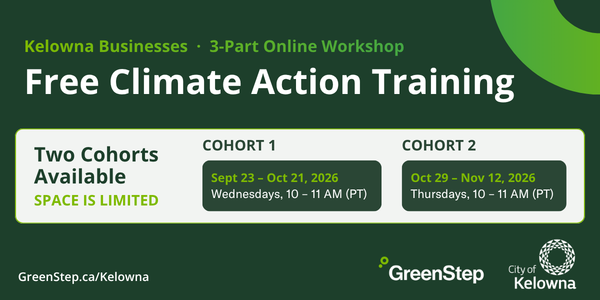
Running a business in Kelowna? This one's for you. 

The Climate Action Program is a free, 3-session online training that helps local businesses cut costs, reduce waste, and build a practical sustainability plan with expert coaching included.


No experience needed. Two cohorts available starting in September and October.


Register now before your spot is gone: greenstep.ca/climate-action-training-kelowna

Facebook  Instagram  LinkedIn  Web