October 2021|Volume 9, Issue 4 |
|
EVIDENCE IN ACTION
A quarterly research brief from the
Center on Trauma and Children
|
|
Group Cognitive Processing Therapy with Adolescent Female Survivors of Commercial Sexual Exploitation in Cambodia |
|
Clemans, T.A., White, K.L., Fuessel-Hermann, D., Bryan, C.J., and Resick, P.A. (2021). Acceptability, Feasibility, and Preliminary Effectiveness of Group Cognitive Processing Therapy with Female Adolescent Survivors of Commercial Sexual Exploitation in Cambodia. Journal of Child and Adolescent Trauma. Advanced online publication. https://doi.org/10.1007/s40653-021-00405-6
|
|
It might surprise people that human trafficking is the second-largest criminal industry in the world and encompasses a wide range of crimes, abuse, and forms of exploitation.[1] One of these is the commercial sexual exploitation of children (CSEC), which involves the sexual abuse or exploitation of a child for the financial benefit of another person or in exchange for anything of value.[2] Considered the fastest growing form of human trafficking, an estimated 1.8 million children are involved though the secrecy inherent to the sex trade industry makes an accurate estimate very difficult.[3] When the subject comes up in the media, narratives typically focus on the rescue and the crimes/criminals, leaving out an important question: What happens to the children who have survived these types of traumatic experiences and what forms of support do they need?
Unfortunately, there no studies at present that focus on adolescent survivors of CSEC who are struggling with PTSD and/or other mental illnesses who reside in developing or lower-middle income countries. One of the most empirically supported treatments for adults with PTSD is cognitive processing therapy (CPT).[i] CPT focuses on helping individuals identify and begin to modify their rigid beliefs (referred to as “stuck points”)[4] that interfere with the process of recovering from trauma, helping them reach a more balanced perspective. Long-term follow-up studies have been promising with adult sexual assault survivors continuing to demonstrate positive effects 10 years posttreatment.[5]
Considering the possible benefits, a pilot study was developed to determine if CPT could be a feasible, safe, and effective treatment for adolescent survivors of CSEC.
|
|
The Study
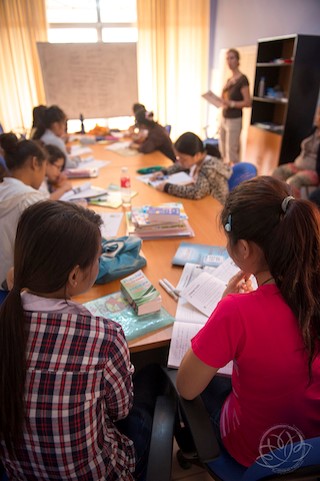
This study involved collaboration with a non-governmental organization (NGO) in Phnom Penh, Cambodia that provides residential services and treatment to female adolescent survivors of CSEC. Interviews were conducted with an interpreter (Khmer was the primary language of all the participants and multiple steps were taken to ensure all translations were checked thoroughly and repeatedly). Ultimately, thirteen adolescent girls residing at the NGO (ages 14-19) were enrolled in the study. They all met criteria for a full or partial diagnosis of PTSD and engaged in 10 sessions of group CPT. To measure the efficacy of the treatment, there were baseline measures taken of PTSD, depression symptoms, suicidal and non-suicidal ideation and behaviors which were repeated weekly, one week and three months following the study. In addition, the acceptability of the intervention was measured using a client satisfaction measure and group attendance.
The CPT groups were led by a research psychologist with extensive training and clinical experience with individual and group CPT in the US; counseling staff at the NGO acted as interpreters and all were trained in CPT before the study began. All psychometrics and treatment manuals were professionally translated into Khmer. The 10-session group treatment focused on education about CPT and trauma, understanding the connection between thoughts, feelings, and behavior, writing about the meaning of traumatic experiences (i.e., why the trauma occurred), identification of stuck points, completing written exercises challenging stuck points and in the final phase writing a second time about the reasons their traumatic experiences occurred.
|
|
Findings
Results indicate the developmentally and culturally modified version of CPT with this group of adolescents was acceptable, feasible, and safe. Despite adolescents in this study experiencing suicidal ideation (53.8%) and suicidal behaviors (38.5%) prior to receiving CPT, there were no occurrences of suicidal or self-injurious behavior during the study and at follow-up three months later only one participant reported suicidal ideation. There was also a significant decline in both PTSD and depression symptom severity. At the three-month follow up, the majority of the participants continued to have a clinically significant reduction in PTSD symptoms, and three-fourths had clinically significant reductions in depression symptoms.
Participant satisfaction with the CPT group intervention was high based on a Khmer version of a questionnaire that measures client satisfaction. The feasibility of the treatment was also good based on an overall attendance rate of 93.3% across the three groups.
These results suggest that an existing evidence-based trauma-focused treatment, such as CPT, can safely be conducted with adolescents even when the increased risk for suicidality exists before the initiation of treatment. This study fills a critical gap in the literature regarding our understanding of the psychological needs of female youth exposed to commercial sexual exploitation in low-middle-income countries.
|
|
-When an adolescent with CSEC is identified, clinicians could consider the use of individual or group CPT.
-CPT may need to be modified based on cultural background, language needs and reading level.
|
|
-Clinicians should strive to support NGOs that work with survivors of CSEC and educate them about CPT as a potential treatment option for their clients.
[1] U.S. Department of State, 2019
[2] Institute of Medicine and National Research Council, 2013
[3] Macy & Johns, 2011; Kiss, Pocock, & Zimmerman, 2015; Roby, 2005
[4] Resick et. al, 2007
[5] Resick, Williams, Suvak, Monson, & Graudus, 2012
[i] International Society for Traumatic Stress Studies, 2018, American Psychological Association, 2017; Department of Veterans Affairs & Department of Defense, 2017; National Institute for Health and Care Excellence, 2018
|
|
|
|
|
|
|
|