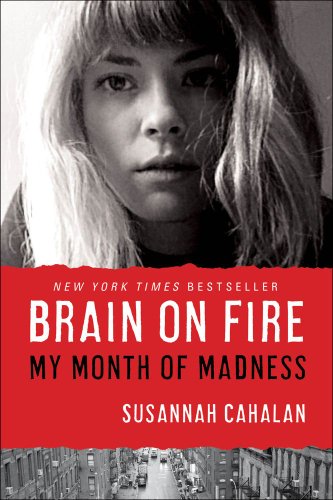
Susannah, I know this is a strange question to ask, but are you "glad" you went through this experience? What have you learned about yourself, the disease and the way to approach an experience as monumental as this one?
Not a strange question at all! It's one I think about a lot. I can say without hesitation that when I look back on that experience - now through the lens of having written about it - I see it as a positive one. Yes, it was hellish. Yes, it robbed me of a year of my life. But in the end, going through this has made me a more significant person, for lack of a better phrase. I have a purpose and a mission of sorts. And I have an appreciation of how fragile our hold on life is. And instead of paralyzing me, it really gets me to enjoy the moments. Am I starting to sound cheesy? I hope not. But I can say now that looking back from the other side of recovery, I consider that terrible disease a gift especially because of all the incredible reactions by readers.
When reading Brain on Fire, I was vaguely reminded of Dalton Trumbo's Johnny Got His Gun. Though the circumstances are completely different, the concept of being "trapped" in one's body felt familiar. I can't imagine not being able to communicate in the way you want to, the things you know that are there.
Being "trapped" in your body must be in the top 10 of most torturous experiences. I recall, early on in my recovery, feeling as if my lips and my head were disconnected. Nothing would come out and the harder I tried, the worse it would get. It was like being trapped in your skull and all you can do is smile blandly and get through it. The real fear was I would always be that way, trapped in my own body. That fear wasn't as extreme as the terror I felt while hallucinating during the height of my illness; it was more low-level than that, but it was perhaps more frightening because I thought I was going to be like this forever.
Speaking of communication, given this experience and your background as a reporter, has the concept of communication and language changed for you in some way now? Is it something you value more or approach in new ways?
Another great question, and one I hadn't really heard before. My experience reporting this story and living through "darkness" when my memory was severely impaired, I'm now even more fully aware of how malleable and faulty memory truly is. As a reporter, you know this when you're taught to report out all sides of an issue. But now I know at a fundamental level (the flight risk band!) how impossible it is to get at the black or white "truth" of a matter.
What makes it even more unsettling is that every time we call upon a memory, we destroy it. So that means our fondest memories, the ones we think about the most, might in fact be the most unreliable. If this doesn't make you a little uneasy, I don't know what would.


Your book begins as an intensely personal portrayal of your experiences getting sick. Towards the end, however, it broadens a bit and poses some tough questions regarding medical practice today: that we're operating under a faulty system that tends to treat patients as more of a number instead of a person. What can we do to improve here, so that survivors aren't necessarily thought of as just "lucky"?
Awareness is the number one answer to this. If doctors are aware that this disease exists and understand how it presents, then they will undoubtedly miss less patients. Another goal is to establish a standard of care that would remove most of the "luck" from recovery, too. I've encountered too many cases where a person gets the diagnosis (the hardest part!) and then does not receive proper treatment. This enrages me. So I've been working with a terrific non-profit called the Autoimmune Encephalitis Alliance to address these issues. Check out their terrific website here.
Besides medical literature, were there any books you read to help you get in the mindset for this particular project?
Yes! A wonderful, slim volume that taught me the value of "shitty first drafts" is The Modern Library Writer's Workshop by Stephen Koch. What a lovely little book that should be required for all writers.
In terms of memoirs, a few stand out for me: The Diving Bell and The Butterfly taught me how to write an illness memoir with humor; A Journey Round My Skull taught me how to approach my brain biopsy scene; and The Year of Magical Thinking taught me how great a memoir can be.
And finally, I have to know: will you write again?
Yes, I've been bitten by the book bug and desperately want to return to it. I'm working on a few possibilities now, but still searching, so if you have any ideas...