|
Dear Presidents’ Alliance Member,
In this week’s Member Update:
- Trump Administration Expands Travel Ban to 38 Countries, Restricting Entry for More International Students & Scholars
- Prepare Your Noncitizen Students for Post-Graduate Employment-Based Pathways
- ICYMI: Watch Recent Webinars & Access Resources
- Make an End-of-Year Gift That Sustains Our Impact
- Immigration in Brief
- Top Reads
| | |
Trump Administration Expands Travel Ban to 38 Countries, Restricting Entry for More International Students and Scholars
On December 16th, the Trump administration announced a major expansion of its travel ban, imposing full or partial entry restrictions on visa applicants from 38 countries and the Palestinian territory. While some exceptions apply for lawful permanent residents, existing visa holders, diplomats, and limited special categories, both the full and partial bans explicitly block international students and scholars (F-1, J-1, and M-1 visa applicants) from all the impacted countries who are outside the U.S. and do not currently hold a valid visa. As of December 2025, SEVIS data shows approximately 57,746 international students from those countries. The ban will likely also impact scholars and numerous other campus members and their families.
Full entry bans now apply to nationals of 19 countries:
- the 12 original countries — Afghanistan, Burma, Chad, Republic of the Congo, Equatorial Guinea, Eritrea, Haiti, Iran, Libya, Somalia, Sudan, and Yemen;
- 5 newly added countries — Burkina Faso, Mali, Niger, South Sudan, and Syria along with the Palestinian territory; and
- 2 countries that were previously subject to partial restrictions — Laos and Sierra Leone.
Partial restrictions are imposed on another 19 countries:
- Continuing partial entry bans for 4 of the 7 originally restricted countries — Burundi, Cuba, Togo, and Venezuela.
- Addition of 15 more — Angola, Antigua and Barbuda, Benin, Côte d’Ivoire, Dominica, Gabon, The Gambia, Malawi, Mauritania, Nigeria, Senegal, Tanzania, Tonga, Zambia, and Zimbabwe.
- Partial ban on Turkmenistan has been lifted.
This expansion builds on the June 2025 travel ban, which already barred access to F-1, J-1, and M-1 visas for students and scholars from 19 countries through full and partial travel bans. The administration’s justification for the expansion relies on selective and highly unreliable visa overstay data, including records where DHS systems failed to confirm departures and mistakenly labeled compliant students as overstays. The expanded travel ban is expected to create further disruption and uncertainty for international education, deterring students and scholars from choosing the United States and ultimately undermining the country’s global standing and economic competitiveness.
| | |
Prepare Your Noncitizen Students for Post-Graduate Employment-Based Pathways
As campuses near the end of the semester, many noncitizen students in temporary or precarious immigration statuses are considering their immigration options post-graduation. Regardless of their program completion dates, you can connect students now with trustworthy, comprehensive resources on existing employment-based immigration pathways via the Legal Pathways that Work (LPTW) resource hub. Below is a sampling of the many resources and tools available to help you and your students navigate both preparation for and conversations around work visas.
| |
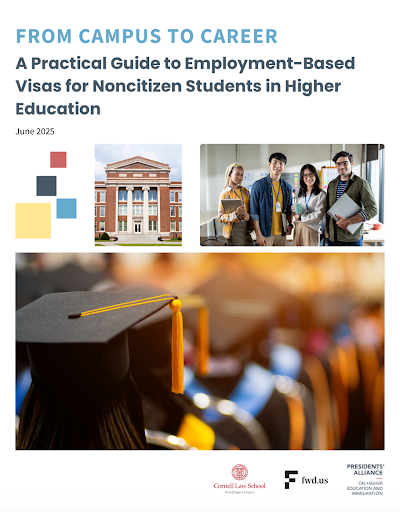
From Campus to Career: A Practical Guide to Employment-Based Visas for Noncitizen Students in Higher Education
Students and higher education professionals navigating nonimmigrant and immigrant employment-based visa options after graduation can refer to our guide developed in partnership with FWD.us and Path2Papers. It provides clear guidance on what students can do during their academic journeys, especially early on, to strengthen their eligibility upon entering the workforce.
| | |
Free Legal Consultations for Students & Graduates in Precarious Statuses Residing in Texas
The Legal Pathways that Work (LPTW) initiative is also offering free virtual legal consultations to current students and graduates meeting the following criteria:
-
Reside in Texas;
-
Be a Dreamer (with or without DACA), Temporary Protected Status (TPS) recipient, or Humanitarian Parolee; AND
-
Hold an associate degree or higher, OR be currently enrolled in an undergraduate program.
| | |
Consultations focus on employment-based visa options and include screening for all potential pathways to lawful status.
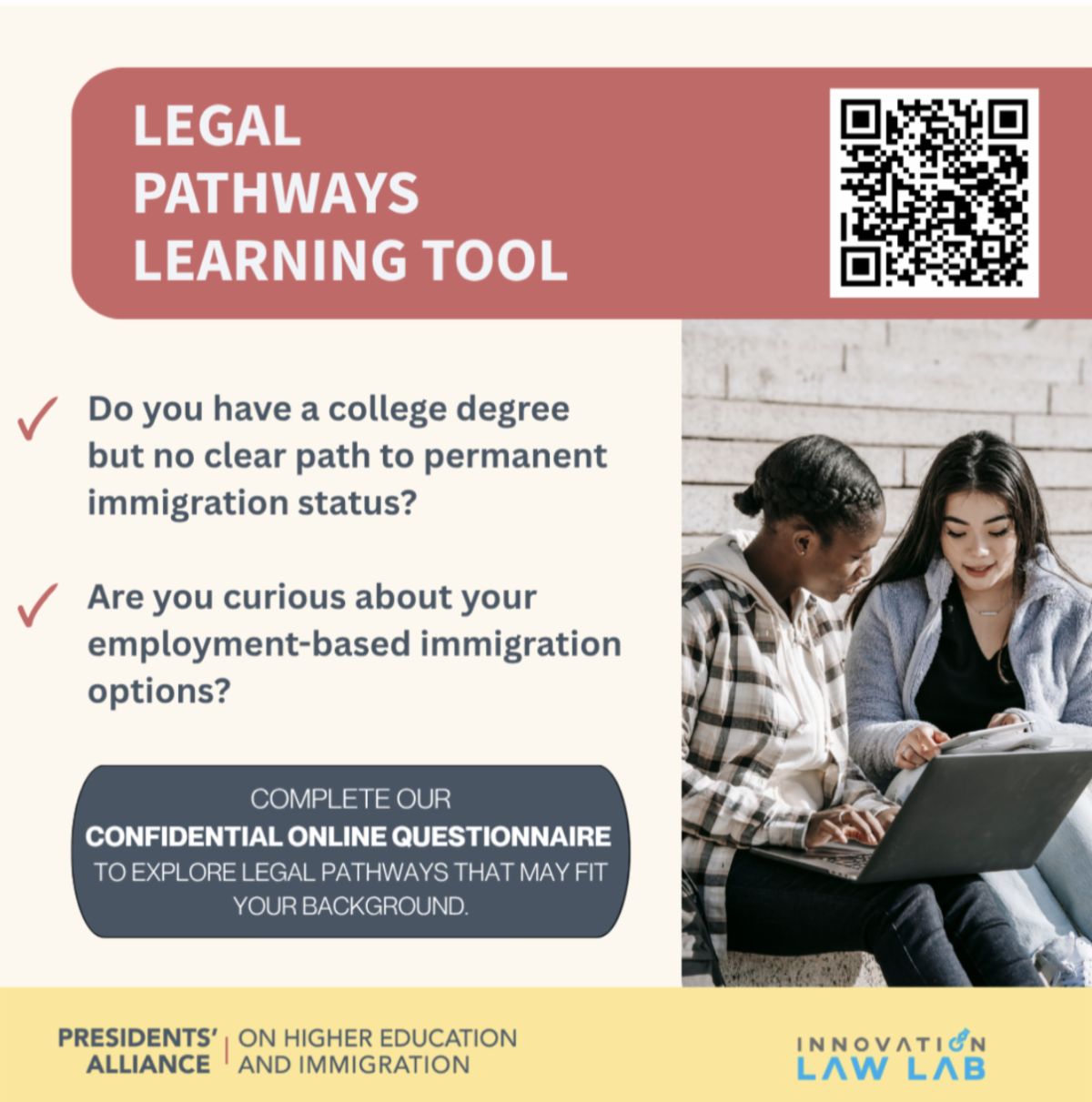
How It Works: Eligible students and graduates should first complete our Legal Pathways Learning Tool – a confidential online questionnaire developed by immigration legal experts. It helps users explore possible employment-based pathways and determine next steps. Those who meet our program criteria will then have access to the legal consultation request form.
| | Please Note: Due to our program’s limited capacity, we are currently unable to offer free legal consultations to enrolled undergraduate students outside of Texas, international students, those with pending or approved green cards, or individuals seeking advice outside of employment-based immigration. | |
|
ICYMI: Watch Recent Webinars & Access Resources
If you missed any of our webinars over the past few months—or would like to revisit them—you can watch the recordings and explore the shared resources at the links below. These sessions offer timely guidance, policy updates, and practical strategies to help campuses support undocumented, refugee, and international students amid a rapidly evolving immigration landscape.
| |
Make an End-of-Year Gift That Sustains and Grows Our Impact
As we close out the year, you can still partner with the Presidents’ Alliance by making an end-of-year gift. Your support powers our ability to deliver urgent guidance, policy analysis, research, and practical resources for campuses, faculty, staff, and students navigating unprecedented challenges to higher education access.
Your contribution helps keep these tools free and accessible nationwide, and it strengthens our work as we head into 2026. All gifts are tax-deductible.
| | |
Immigration in Brief
-
The U.S. Chamber of Commerce and the Association of American Universities (AAU) have filed their reply to the Trump administration’s defense of the president’s $100,000 H-1B visa fee. A hearing is scheduled for December 19 at 10 am in Washington, D.C. In their compelling and well-done reply, the plaintiffs reject the government’s arguments and argue that the president lacks the authority to impose fees on the H-1B program, as Congress holds responsibility for the design and governance of this visa category. In addition, 20 states have filed their own lawsuit against the Administration’s $100,000 H-1B visa fee.
-
The Department of Homeland Security (DHS) announced termination of Temporary Protected Status (TPS) for Ethiopia, stressing that Ethiopian nationals ineligible for any other immigration status must depart the United States within 60 days by February 12, 2026. There are over 4,500 TPS holders from Ethiopia in the United States.
-
DHS also terminated the Family Reunification Parole program that allows immigrants seeking legal status in the U.S. to join their relatives already in the country who have sponsored their applications. The termination will impact immigrants from Colombia, Cuba, Ecuador, Guatemala, Haiti, Honduras, and El Salvador.
-
A federal judge in California issued a ruling blocking the deployment of National Guard troops to Los Angeles. The judge expressed deep concerns about the Trump administration’s practices in California, questioning the legal rationale for the deployment and rebuking the administration’s attempt to extend federal authority over state National Guards.
| | |
Thank you for your support and engagement.
The Presidents’ Alliance Team
| | | | |