|
In this month's newsletter we discuss our newest Focus Group research with everyday Canadian investors. It provides deeper insights into their experiences when investing their hard-earned savings. We also discuss the Canadian Securities Administrators' (CSA) proposal to make recommendations from the Ombudsman for Banking Services and Investments (OBSI) binding on dealer firms. After more than 10 years of talking, Canadians may finally get a complaint-handling system that is balanced and fair. It will be up to government, however, to make it a reality. Finally, we provide an update on the recent decision to approve the Canadian Investment Regulatory Organization (CIRO) as a credentialing body under Ontario’s title protection framework, and the need to level the playing field for those calling themselves “financial advisors.” Read more…
| |
Expanding FAIR Canada’s Investor Research | |
|
In our Year in Review newsletter last month, FAIR Canada’s priorities for 2024 include expanding our investor-centric research work and developing a body of research that helps to inform and support public policy choices and decision-making.
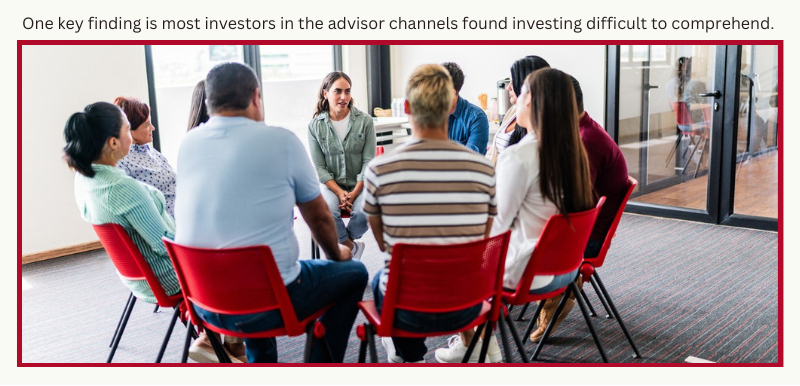
As part of this initiative, we were pleased to publish the results of a recent set of Investor Focus Groups that were held late in 2023. We assembled eight focus groups that explored the views and attitudes of investors in four different channels: do-it-yourself (DIY) investors; investors working with advisors at full-brokerage firms; investors working with independent advisors; and investors who invest through their bank branch.
| |
|
The results revealed that many investors working with an advisor are not that interested or engaged in the process and, as result, defer heavily to their advisors to make important decisions for them. In addition, investors not only told us they struggle to understand the investment products being recommended, they also struggled to understand what type of advisor they were working with, or even how their advisor was being paid.
The report helps us to better understand the perspectives and concerns of retail investors. One key finding is that most investors in the advisor channels found investing difficult to comprehend. So, it is no surprise there was a tendency to blindly trust whatever their advisors tell them. This exposes them to potential risks and makes them more vulnerable to bad advice.
Comparatively speaking, we also learned that many DIY investors seem more comfortable and knowledgeable about how to invest. Having said that, some DIY investors did not seem to appreciate the amount of risk they were taking on. FAIR Canada intends to delve deeper into these issues in our next survey. Look for our new DIY investor report this spring!
You can read the full Investor Focus Groups report at FAIRCanada.ca and follow us on X (formerly Twitter), or LinkedIn for our #InvestorsToldUs campaign.
| |
Prioritizing Binding Decisions for Investor Complaints | |
By granting OBSI binding authority, the CSA seeks to promote accountability involving firms whose clients have legitimate complaints, while enhancing investor confidence in the dispute resolution process. | |
|
In addition to binding, the CSA proposal would give investors and firms the ability to seek an internal review of OBSI’s final recommendations. Importantly, it does not include a right of appeal to an external body, which would unfairly tilt the balance in favour of dealer firms. We believe this strikes the right chord between procedural fairness and bringing closure to the dispute. The final binding decisions would also be enforceable as court orders, strengthening the system overall.
By granting OBSI binding authority, the CSA seeks to promote accountability involving firms whose clients have legitimate complaints, while enhancing investor confidence in the dispute resolution process. Additionally, firms would be prohibited from using the term “ombudsman” to refer to their internal complaints process. This will help address investor confusion.
| Furthermore, the CSA’s clarification regarding a firm’s duty to cooperate with OBSI signals a commitment to streamlining the resolution process and upholding the integrity of financial services. | |
The CSA’s proposed framework requires provincial governments to pass enabling legislation to formalize OBSI’s authority. To date, Saskatchewan introduced the needed legislation, with Bill 150, and we applaud Saskatchewan’s leadership on this initiative. We urge other governments to follow Saskatchewan’s lead and introduce similar legislation to make binding authority a reality.
As the comment period on the CSA proposal closes on February 28, stakeholders have an opportunity to provide feedback and shape the final regulatory landscape. FAIR Canada and a broad coalition of consumer advocates will be submitting a detailed comment letter in support of the proposal.
With the potential to significantly improve investor protection and promote fair and transparent dispute resolution practices, the proposed framework represents a positive step forward for the Canadian securities market.
| |
CIRO Becomes an Approved Credentialing Body for Financial Advisors | |
CIRO was recently approved by the Financial Services Regulatory Authority (FSRA) as a credentialing body under Ontario’s title protection regime. This means that individuals approved by CIRO in the following categories will now be able to use the title financial advisor:
- Registered Representative
- Mutual Fund Dealing Representative
- Portfolio Manager, and
- Associate Portfolio Manager
| |
We know from our research on job titles that the vast majority (92%) of Canadian investors expect a financial advisor to be proficient in all core areas of personal finance. Similarly, 92% agree job titles should make it clear what the title holder is licensed to provide advice about. Allowing mutual fund dealing representatives, registered representatives, and portfolio managers to all use the same title diminishes the clarity that investors are clearly telling us they want and need.
While CIRO’s members are subject to higher levels of regulation and oversight than members of other credentialing bodies, the fact remains they are still only qualified to give advice about investments—and some are just salespeople.
FSRA is reviewing its current approach to title protection and it will introduce changes to ensure that the framework delivers on its consumer protection promise. More work is required to better align the framework with consumer expectations.
| |
OSC Profiles of Retirement | |
A recent survey by the Ontario Securities Commission explored how well Canadians aged 50 and above are prepared for retirement. Profiles of Retirement revealed insights into the expectations of retirees and those approaching retirement. Although many retirees felt financially secure, a significant proportion are in a financially vulnerable position.
Fifteen percent considered their financial situation poor, and 32% found their monthly expenses higher than expected. When compared to retirees, people who have not retired yet have lower savings and higher debt, posing challenges to a comfortable retirement. Some common concerns for both retirees and pre-retirees were high inflation rates, running out of money during retirement, and high housing and rental costs.
| |
Throughout the year, FAIR Canada submits many comment letters on various important policy and regulatory matters that have an impact on investors. Read more about our investor advocacy work. | |
|
Do you have feedback on our newsletter or suggestions for topics you’d like us to write about? Your input is valuable and will help us improve our newsletter content for loyal subscribers like you. Please email us at info@faircanada.ca with your comments and/or suggestions.
| |
|
Remember to follow us on LinkedIn and X (formerly Twitter)!
To learn more about our advocacy for investors, visit FAIRCanada.ca
| |
To learn about investor rights, subscribe to our newsletter.
| |
If you have any questions, contact us.
| |
Follow us on social media.
| | | | |