March 24, 2026

Explosives-Sniffing K-9s
Keep Spring Training Safe

by Laura L. Sullivan, Public Relations Specialist

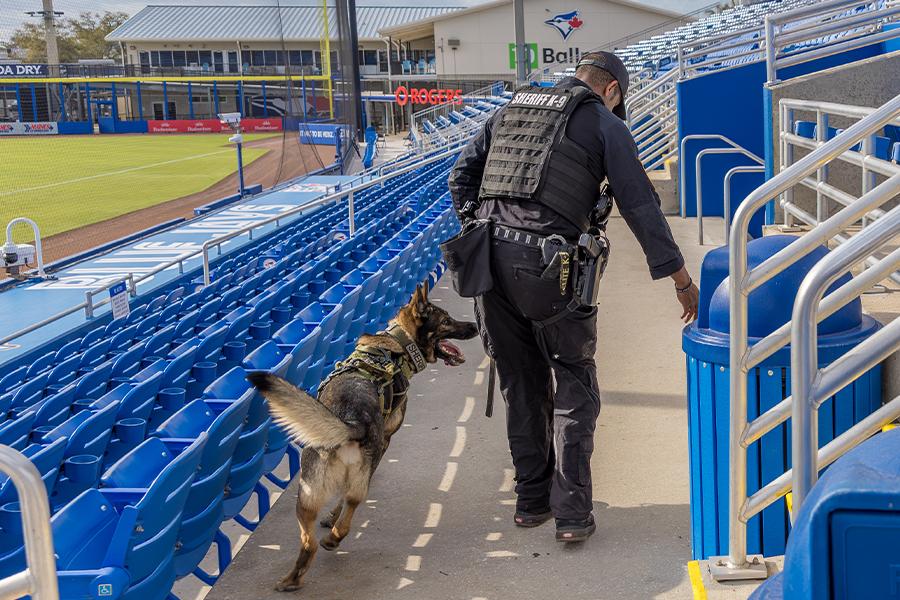
Spring training is in full swing and when the Blue Jays play at Dunedin’s TD Ballpark, the Pinellas County Sheriff’s Office Canine Unit is making sure that players, staff, and baseball fans are safe. Recently, Corporal Paul Martin with K-9 Guinness and Deputy Dom Brissett with K-9 Voodoo swept the ballpark before a game to make sure there were no explosive devices.


“By MLB rules we have to sweep all the games before they start,” said Deputy Brissett. “We do sweeps at all sorts of public events – Grand Prix, Tampa Air Show, Gasparilla.” If there is a large crowd gathered or a dignitary visiting the area, it’s a safe bet that law enforcement officers are using dogs specially trained to detect explosives to search the area.


At PCSO, all of the “pointy-eared dogs” – German shepherds, Belgian Malinois, Dutch shepherds, and mixes of those breeds – are trained first in apprehension, then in one of two specialties. Some become narcotics specialists, sniffing out drugs. Others learn to find the components that are used in explosives. (Our “floppy-eared dogs” such as the bloodhounds don’t train for apprehension, just for scent tracking.)


The dogs train on six families of scents, which lets them identify the approximately 19,000 different explosives formulas. “They’re smelling for multiple scents,” Deputy Brissett said. “To make an operable explosive you need several things.” The dogs don’t smell the bomb per se, but rather individual components that make up the bomb. They might pick up on smells from detonation cord, or ammonium nitrate.


Handlers watch their dogs very closely, looking for the telltale signs that they’ve hit on an odor. The first sign could be their head snapping sharply back in the direction of the scent. It’s very important that when they detect an odor, they give a passive alert. It would be a bad idea for them to jump or paw at explosives. “If the scent is at nose level or higher he’ll come to a sit, if it is lower he goes to a down,” Deputy Brissett said. During one of the trainings the dogs go through, the FBI will come over and they’ll train on peroxide-based explosives. In a real-life situation, those explosives are so volatile that if the dog knocked it over it would go off.


If the dog alerts, the next step is to verify. Just because the dogs hit on the right scent doesn’t mean it is necessarily part of something dangerous. “He will also detect legal items,” Deputy Brissett said. “For example black powder – you can legally own black powder. They’ll alert on fireworks. And there are odors from harmless things that smell like bomb components.” After a dog alerts, the second dog will also sweep. If it also alerts on the same area, the handlers will begin the next steps, which will begin with visually examining the area from a distance. If they have reason for suspicion, next steps might be an evacuation, or call to a nearby bomb squad. The closest are with the Tampa Police Department or the Hillsborough County Sheriff’s Office.


Two deputies and their K-9 partners will work a sweep, because the search is physically exhausting to the dogs. In fact, the handlers say that an explosives sweep can be even more tiring than chasing a suspect. Even in mild temperatures they have to watch their dog closely for signs of heat exhaustion. The dogs don’t want to quit, and will push themselves too hard if their handlers don’t step in and make them rest. A sweep of TD Ballpark takes the team about an hour, with the dogs switching out halfway through. The amount of time a sweep takes varies depending on the complexity of the setting and the event they’re preparing for.


Keeping fans safe is a high priority for the MLB and for the sheriff’s office. Deputies work off duty details during the game, assigned to positions inside the stadium and outside for traffic control. One K-9 team stays on site for the entire game but the dog isn’t out unless there is an issue. Most large sporting events are going to involve the same precautions.

The explosives dogs train all the time, and conduct frequent searches, but so far Voodoo has been lucky enough not to find a real explosive threat. “Let’s keep it that way!” Deputy Brissett said.


Don’t Get Carried Away By a Courier Scam

by Laura L. Sullivan, Public Relations Specialist

There’s a scam that’s been exploding lately. In the first two months of 2026 alone, the Pinellas County Sheriff’s Office (PCSO) has documented 12 courier scam cases, with a total financial loss of more than $1.6 million. Courier scams come in several different varieties, but the common thread involves scammers impersonating couriers. They may pretend to be international couriers such as FedEx or DHL Express, or local courier services. Either way, they are after your money and personal information, and might even be using you as a cover for other crimes.


In some of these scams, you get an alert through email or text that you’ve missed a delivery. Even if you’re not expecting a package, you’re excited that you’re getting a surprise present or a prize, and you follow their link to provide your information for redelivery. The website looks legitimate, and you fill out the form. But wait, there’s a nominal redelivery or customs fee. It might be only 99-cents, so you enter your credit card information. That’s all the scammer needs, and before you know it, you’ve been charged thousands of dollars by the scammers.


Some scammers even skip the link and just show up at your door with a package. The outside makes it look like a luxury item – maybe wine or jewelry, something hard to resist – and you just have to scan your credit card to claim it. They might give you a variety of reasons – a small delivery fee, or even just to identify yourself. They might tell you that you won’t be charged, they just need to verify they’re delivering it to the right person. But whatever is in the package is worthless, and your credit card gets charged to its maximum.


Others using a courier scam claim to be from your bank. Your card has been used by organized crime, and they have to collect it for evidence. A courier will be coming by to collect your card for their investigation. They might ask you to help with their fraud investigation by withdrawing a large sum of money and handing it over to the courier. That may sound ridiculous to you now that you’re reading it, but these fraudsters are master manipulators who can make people believe their story.


There can be multiple layers to courier scams. After you discover that your card is compromised and you complain to the fake courier service, they may connect you with their fraud department, an investigator, or a lawyer. The only problem is these people are also part of the criminal enterprise and will double down on ways to get your information and money.


Scammers might be using you to help them steal expensive goods. Even as they are stealing your personal information and credit card or banking information, they may have used someone else’s stolen credit card to buy luxury items. When you give them your information, they use it to complete the authentication steps on that purchase. Not only are they taking your money, they are making you an unwitting accessory to a crime.


To keep yourself safe, don’t click on links, even when they offer something tempting like a present or a prize. If you don’t already know a package is coming, it’s probably a scam.


Don’t pay anything for a package you didn’t order. Even if the amount is small, any charge paid to a scammer opens the door for them to take as much as they want. Legitimate courier companies don’t charge a redelivery fee.


Scammers need you to act fast and keep secrets. If they tell you that you have to act immediately, it is a scam. If they don’t want you to tell family or friends, or insist that you stay on the phone with them so you can’t verify anything, it’s a scam.


There is no investigation conducted by law enforcement, a bank, or any other institution that will require you to hand over cash, gift cards, or anything else of value. If anyone asks you to hand over anything to a courier, refuse.


If you are contacted in any way by a fraudster, your best bet is to ignore them, delete the message or hang up, and not engage in any conversation. If you’ve given them any personal information, alert your bank, change your passwords, and contact law enforcement. If you think you’ve been scammed, call the PCSO non-emergency line at 727-582-6200.


Facebook  X  Instagram  LinkedIn  YouTube