E M P L O Y E E
•
S P O T L I G H T
By
Noor Sheikh
|
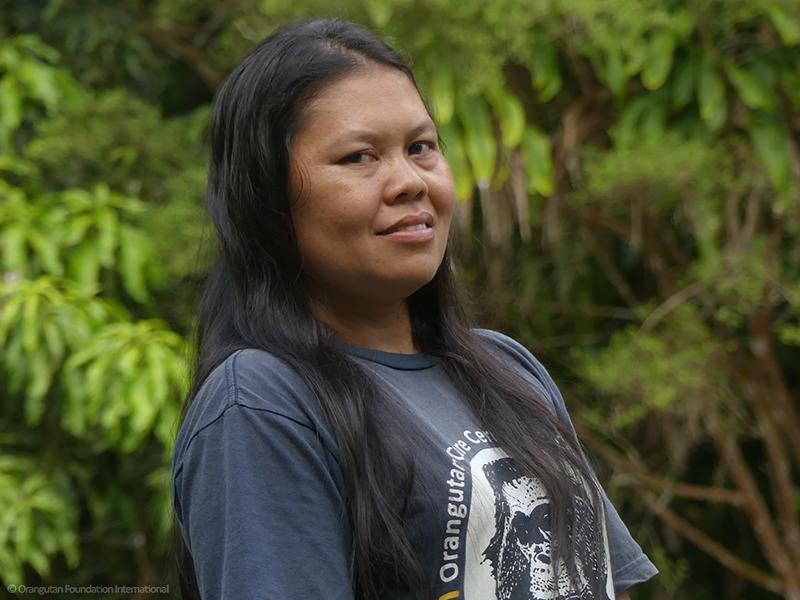
We all know that person around the office. Always on the go, they move like a phantom through the corridors; rewarding us with a bright smile before disappearing into the ether. This month we snatch a rare moment with Ibu Sumi, OFI’s very own friendly and busy staff member.
Ibu Sumi is the Deputy Manager at OFI’s Orangutan Care Center and Quarantine (OCCQ), and a self-proclaimed “freelancer”. “Oh this and that” she says modestly, when pressed for her exact job description. “This and that” hardly begins to cover the breadth of her work. Ibu Sumi is important to OFI’s day-to-day activities. One only has to glance at the mountains of coconuts, bananas, and other fruits and vegetables that arrive at the gates every day, waiting to be distributed, to know that it takes a skilled, experienced logistician to feed hundreds of hungry primates and humans. Ibu Sumi’s connection to OFI runs deep and wide. It is a cause close to her heart, and the fact that a number of her family members support the organization through various jobs is a source of comfort.
|
“I am working for the orangutans. For the future, I am very hopeful that every single orangutan can be in the wild. And none are in captivity.”
|
There is a relaxed and tranquil air about Ibu Sumi, belying the heap of work she must organize each week. Her long black hair is always swept back in a tidy ponytail; her fingernails are neat and short. She looks younger than she is. Everything about her suggests quiet efficiency and attention to detail. Where does her orderly touch reach? “Everywhere” she laughs, gesturing widely. She ensures that OFI's numerous forest sites have the supplies they need. OFI camps dotting the banks of the black water Sekonyer River depend on Ibu Sumi for their resources. For the more isolated orangutan release sites and forest guard posts, a shipment from Ibu Sumi comes every week or two and feels like a delivery from a long-lost family member.
What binds this curious, energetic Dayak woman to an orangutan care center? “Sometimes I think it’s funny,” she concedes, “but I am very interested in orangutans and their lives. I really love orangutans.” Her career path became obvious when she was a volunteer, when an infant orangutan was rescued and brought to OFI’s care center when Ibu Sumi herself was very young. Little Montana, a partially disabled orangutan infant, charmed Ibu Sumi. Her actual words are that Montana “made [her] in love,” as if a spell beyond her control had been cast upon her. (Montana is now a fully cheekpadded flanged adult male).
Ibu Sumi started working at OFI in July 1995. She was accepted as a volunteer at OFI when on holiday from high school. She took her tenure seriously and her bond to OFI became more apparent when she moved away from Kalimantan, to study English. “People thought, if I went away for University, I would change my mind. But it just made me miss orangutans even more. In Yogyakarta I would go to the zoo. I would ask the keeper hopefully, ‘are there any orangutans here?’ If I saw orangutans, it would make me happy. My friends would joke ‘ahhhh you are missing your family.’ They were right, I was there every Sunday,” she says affably.
|
O R A N G U T A N
•
O F
•
T H E
•
M O N T H
By
Philip Stubley
|
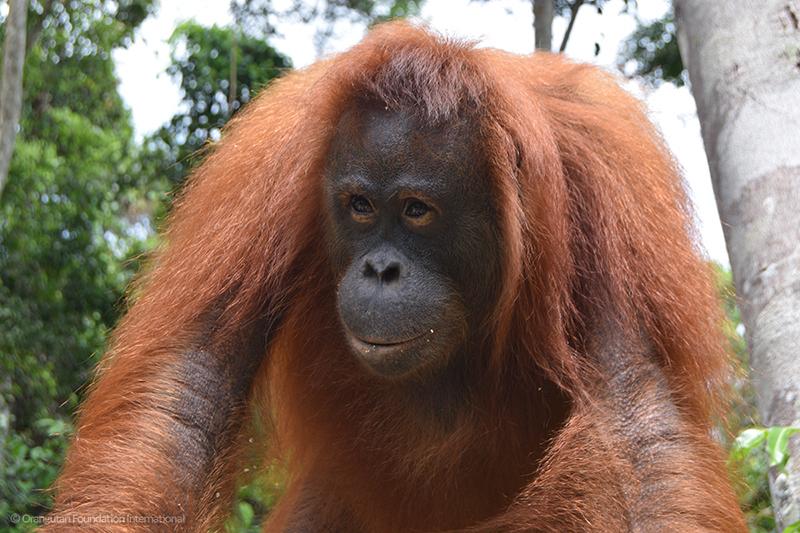
At the Orangutan Care Center and Quarantine (OCCQ) in Central Indonesian Borneo, OFI (Orangutan Foundation International) staff provide milk for the older orangutans in OFI’s care. Caregiver Ibu Tuti always looks forward to her encounters with orangutan Robina or “cantik (beautiful) Robina” as she calls her. Indeed a beauty, Robina’s light ginger locks are long and flowing. Her pale coloured lips and eyelids bring out her dark, enchanting eyes.
Robina has come a long way since arriving at the OFI Care Center when she was around 5 years old. Even at such a young age, she was already strong and uncooperative with the Care Center’s veterinarians when they tried to examine her. She initially suffered a cough and bouts of lethargy. Eventually after treatment, Robina bounced back, fully ready to take on her new life.
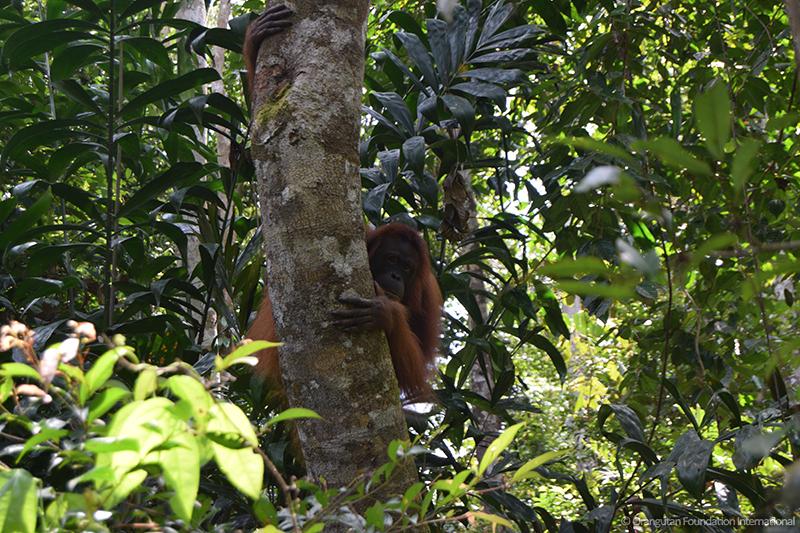
Robina has always enjoyed her daily trips to the Learning Forest. And now she is nearing the time when she will be released into the wild. During forest school, Robina sets out amongst her peers, clambering together in one tree, sometimes up to four at a time. Robina will even let younger orangutans use her as a makeshift branch bridge as they climb over her! She enjoys spending time with Marsha and also wrestling with Lumley with whom she occasionally shares a sleeping enclosure. Not all orangutans get along though! Uci makes it her business to chase Robina off when she sees her. But no great loss, as Robina can take a hint and is happier amongst the trees anyway, propping herself between two branches or wrapping herself around a thick old tree as she gazes into the canopy.
|
Spending some time on the boardwalk as she contemplates where to go next, Robina stays mentally active before initiating her next round of exercise. She gracefully uses her body weight to make thinner trees sway to her bidding, as she travels to the next tree. This seems to amuse her greatly as she leads caregiver Pak Manto on a merry dance around the Learning Forest. She is fascinated by the stems of tree branches, pulling them apart so she can chew on the succulent innards. She moves on climbing up and down tree trunks in search of ants with a keen eye. She is always on the hunt for new nests. She often ends her adventures in forest school with big red biting ants crawling on her hands.
|
F R I E N D
•
O F
•
O F I
By
Noor
Sheikh
|
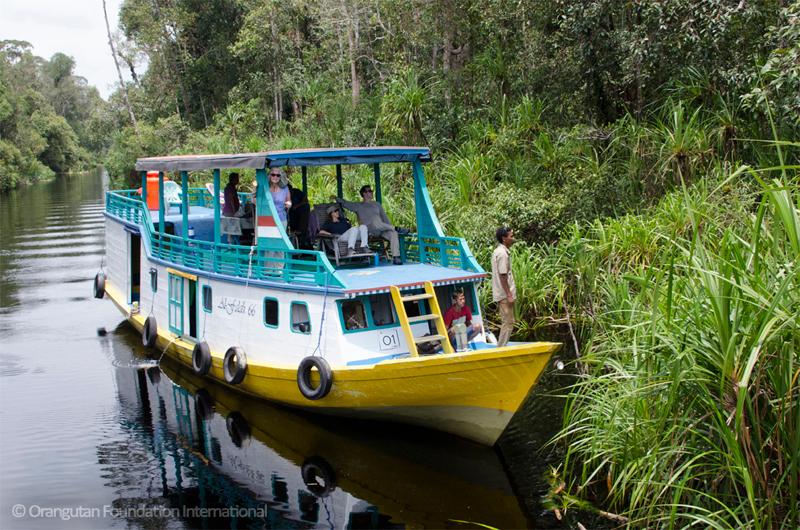
Irene Spencer means business. “Everyone have a seat cushion?” trills her distinct east-coast American accent. Irene is directing guests to various vehicles under a lightening Bornean sky. In general she is concerned about her guests’ comfort. Today specifically, it is the comfort of their behinds. “It’s a bumpy ride,” she states, “but you won’t forget it!”
Twice a year, travelers collect in a spacious hotel lobby in Central Kalimantan, bleary-eyed from travelling from all corners of the world. Yet the tang of excitement is always unmistakable on these mornings. The Orangutan Foundation International (OFI) Eco Tours are now in full swing, and Irene is ready.
Meeting Ms. Spencer is an experience unto itself. Her upright stance and deliberate movements recall a dormant volcano – languid but with activity bubbling just beneath the surface. Her blonde flowing hair and twinkling gaze draw the eye. Irene has the easy air of someone who has done this many times before. In other words, she is just the type of person you want guiding you through the twisting swamp forests of Central Borneo. Unsurprisingly, she has crisscrossed the globe long before frequent flyer miles were an international obsession. To date, she has visited 140 countries and has been in the travel business for 28 years. “I always had wanderlust,” she says “My father was an armchair traveller, but my mother always wanted to know what was around the corner. When she was 92, she went on a cruise to Alaska. She was interested in the world. I think I inherited that from her.”
|
|
B E A R
•
O F
•
T H E
•
M O N T H
By Philip Stubley
|
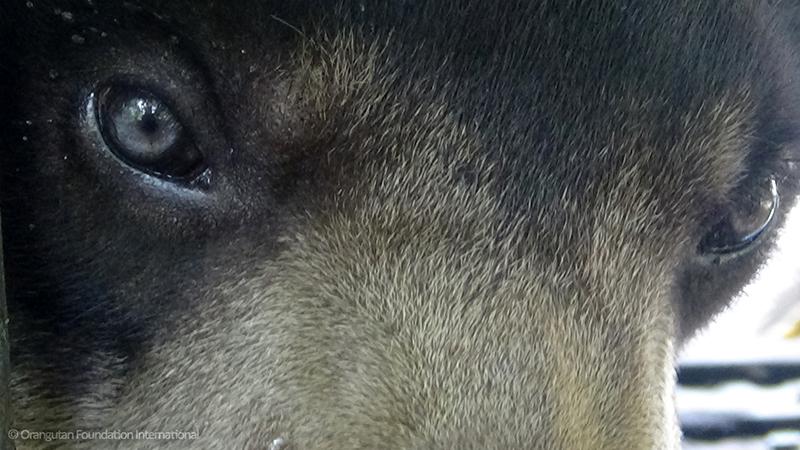
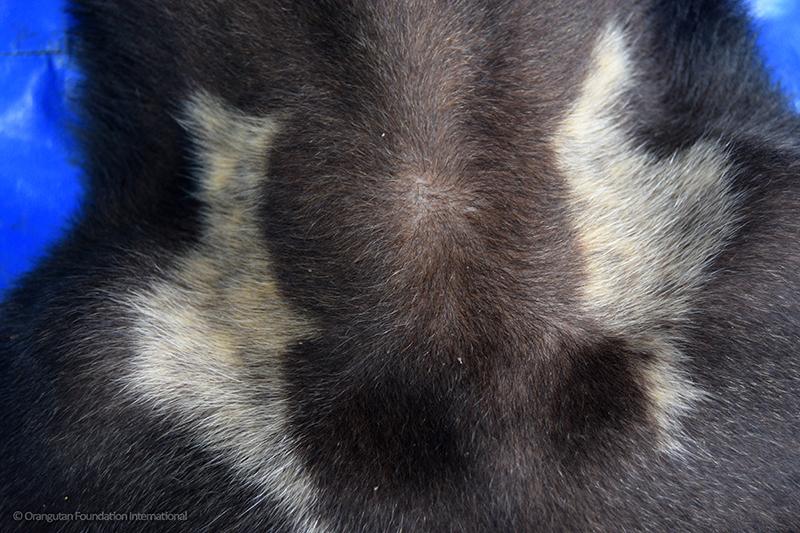
Among the young and innocent animals that arrive at Orangutan Foundation International’s (OFI) Orangutan Care Center and Quarantine (OCCQ) in Central Indonesian Borneo (Kalimantan Tengah) desperately in need of care are not only orangutans but also sun bears. Chico the bear is a comparatively new arrival at OFI's Care Center. This young juvenile’s distinctive sun bear chest patch is divided in two, resembling birds winging their way toward each other. Were it not for OFI, Chico would have remained a captive removed from the wild, forced down a path not of his own choosing.
|
Chico was rescued from Jakarta. Ibu Ismutia spotted Chico in a tiny cage at Pantai Mutiara harbour. After sharing her discovery over Twitter, it wasn’t long before word reached Jakarta Animal Aid Network (JAAN) and the Jakarta Forestry Department as well as OFI's President, Dr. Biruté Mary Galdikas. They stepped in to liberate Chico and deliver him into the care of OFI in May of 2017.
Upon arrival, he was malnourished and required extra food to bring him up to a healthy weight. He exhibited the trauma of being removed from his mother too young, continuously suckling his paw as a form of self-comfort. When using this coping mechanism, Chico emitted a low soothing hum, like a small engine. Sun bear cubs typically stay with their mothers for the first 18 months of life. Young cubs depend on their mothers for everything, from milk to affection and security. This sense of security is ripped away when cubs are separated from their mothers too early.
|
OFI recently partnered with The Dodo to help them kick off their venture into 360° videos. Showcasing a day in the life at the Care Center, Forest School in 360° offers an immersive viewing experience never before captured at OFI’s Care Center in Central Kalimantan (Indonesian Borneo).
|
TO VIEW:
On your smartphone:
Pan and rotate your device to watch the 360° video from different angles.
On your computer:
The viewing angle is changed by dragging with the mouse.
|
D O N A T E
Thank you for your support!
|
Thank you for your continued support of Orangutan Foundation International! OFI is a 501(c)3 charity that relies on our supporters to continue important work protecting wild orangutan populations, rain forests, and wildlife in Indonesia.
|
Enjoy these stories? Know someone else who would, too? Please share "Eyes on the Forest" with your friends and family!
|
Learn more about OFI & our work on our website.
|
|