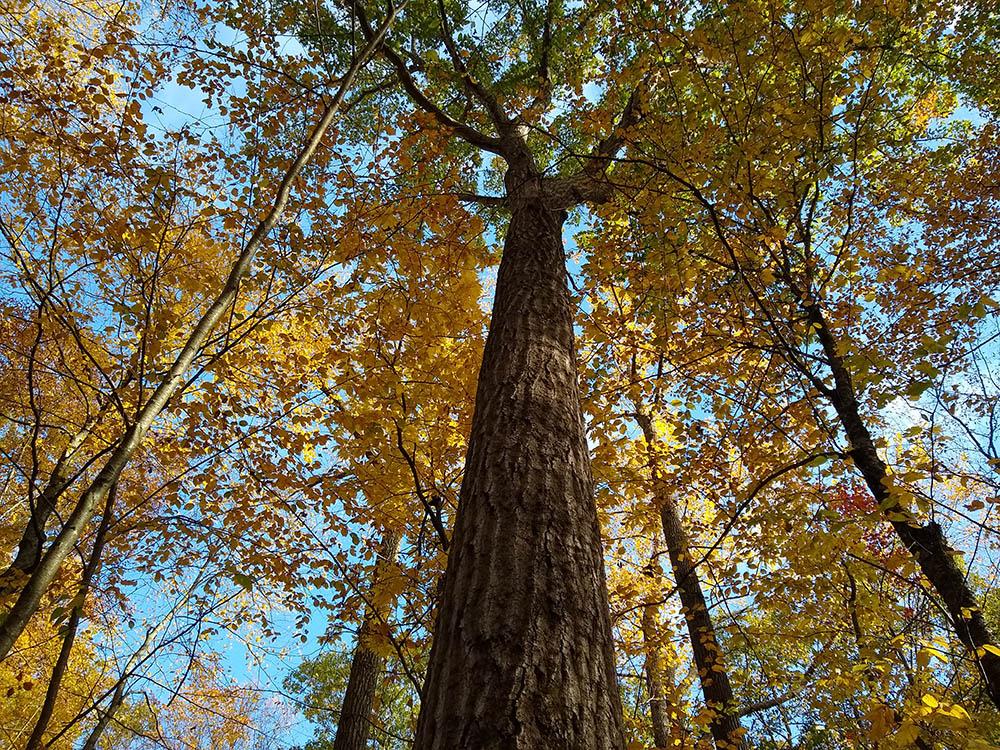
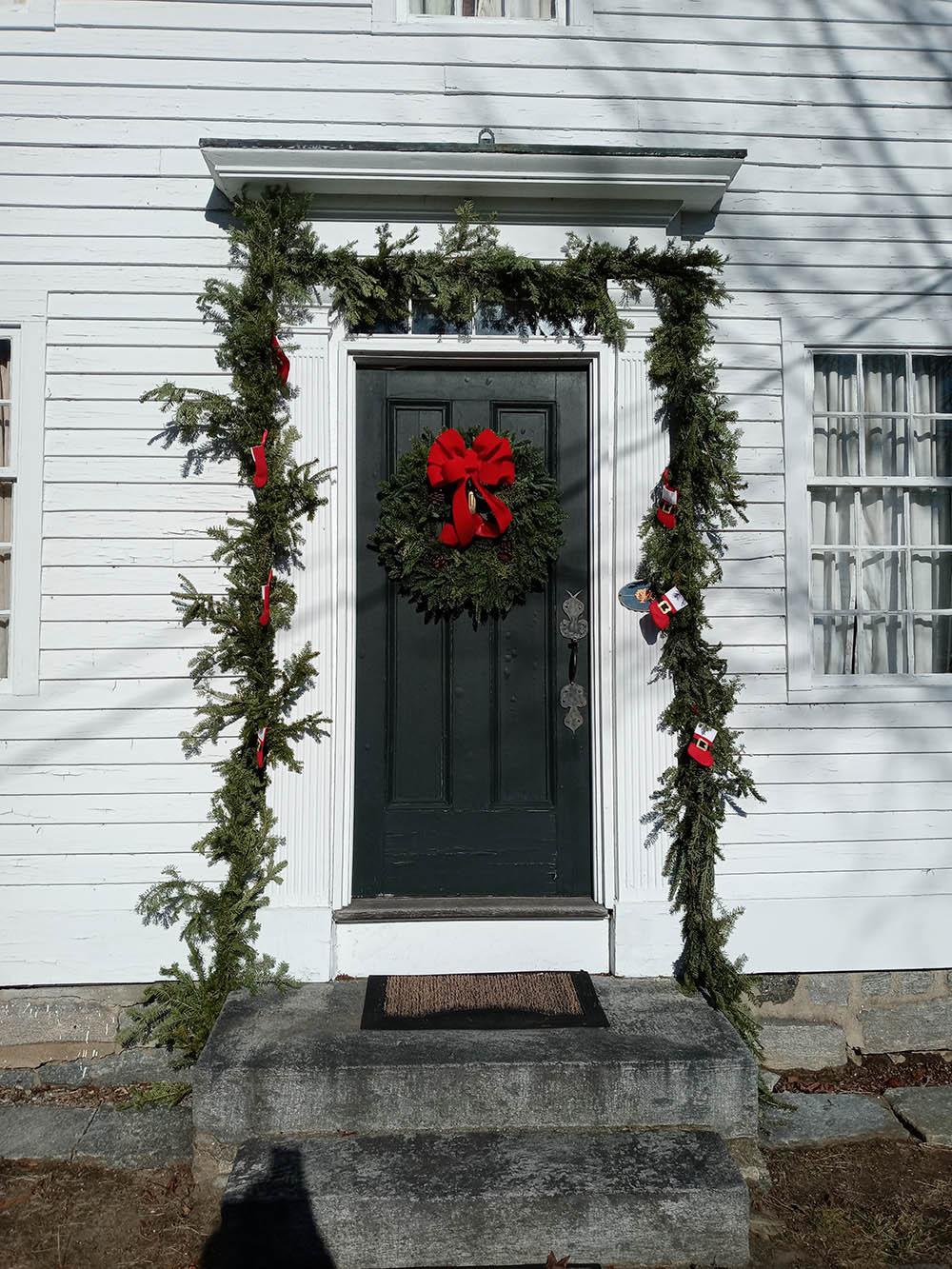
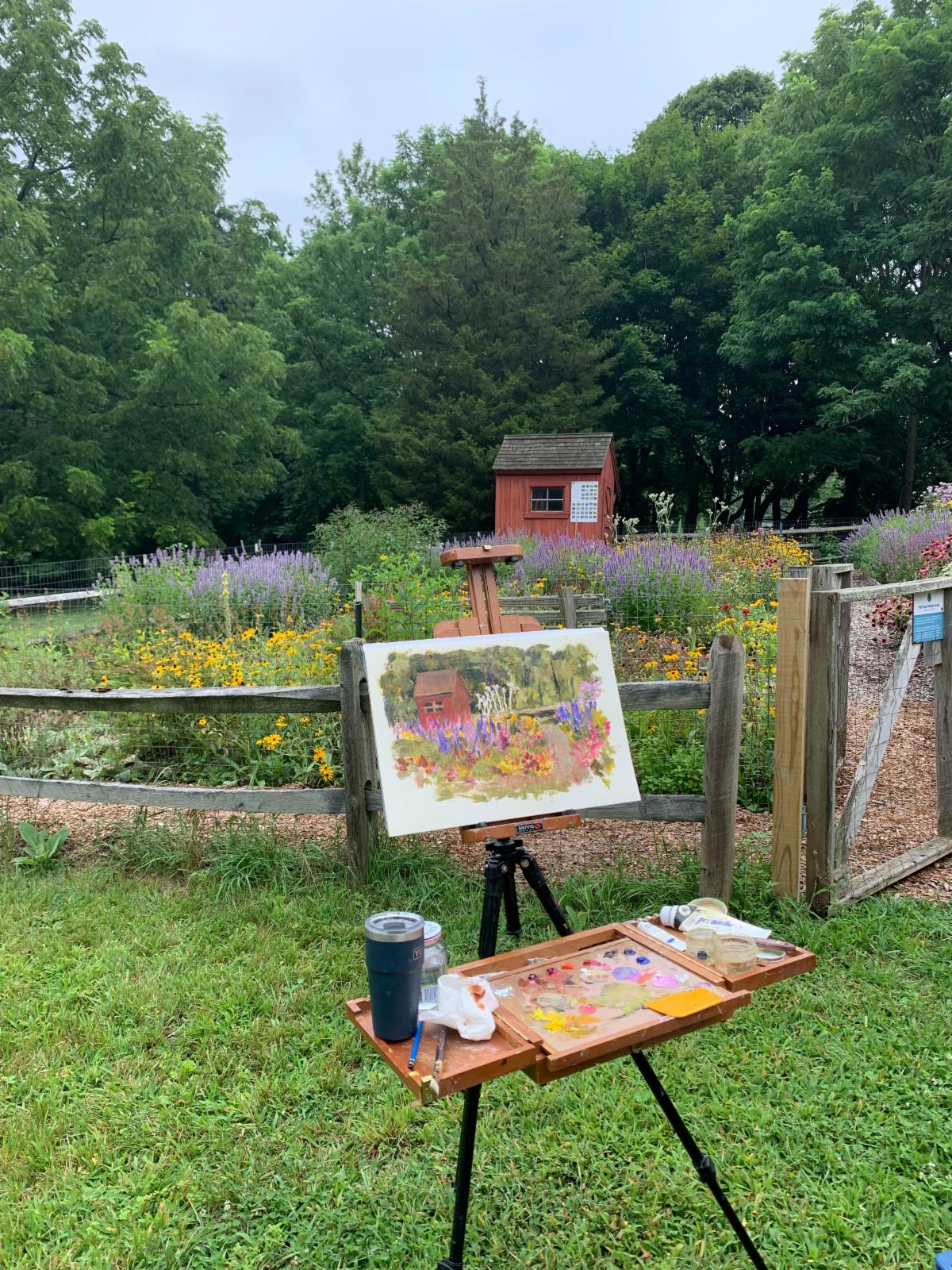
In New England, each season is a treasure! We may enjoy one more than another, but would we appreciate our fortune if it was always 75 degrees? My dahlias are exploding, and my asters are just now starting to pop. Last fall my grandchildren threw all the pumpkins from the front of the house into the field past the goat pen, only to discover over 50 little pumpkins poking their orange heads out this past weekend. It is hard to believe that before too long we will be putting our gardens to bed.
Please look at the picture on the banner above! It is real and only one the many spectacular sites we visited in August on the FGCCT trip to the Canadian Rockies and Glacier National Park. My friend Jeanne Joyce shot this picture at Lake Louise and agreed I could share it with all of you. Anyone who has not taken advantage of the fabulous trips Kathy Lindroth and her committee have planned is missing a great opportunity. Some trips are just a few nights via bus travel and others take us to Europe and beyond. My husband and I have visited the National Parks of the Southwest, Alaska and this year, the Canadian Rockies, with FGCCT and have enjoyed new friendships. Next year Jim and I will add the Best of English Gardens and the Chelsea Flower Show to our travel plans!
We have been encouraged to reduce our lawns with meadows and of course, more trees. Check out this conversation about lawns. The skit will bring a few chuckles but is very true! Please remember to “leave the leaves” — mulch them into your lawn, or use them as mulch to protect your perennials and tender roots.
|
|
|
|
|
|
Thank you for all the invitations I have received to visit your club meetings and celebrations. Getting to hear about all the wonderful projects and plans is exciting. We are not only seeing an increase in membership throughout the state, but we are also welcoming new clubs that see the advantage to belonging to The Federated Garden Clubs of CT, Inc.!!
In Friendship,
|
|
|
|
Hello Gardeners!
Penny Pines / Plant -A-Tree
Our President’s Project is still going strong thanks to your continued support. The NGC, in partnership with the US Forest Service, has re-branded Penny Pines to Plant-A-Tree. I will publish further updates when the NGC finalizes their plans.
The Greenfield Garden Club in Fairfield has sent in their donation to NGC this summer.
Please continue to email me with your club's plans, ideas, and contributions.
— Carmelina Villani, FGCCT President's Project Chair
|
|
|
|
Upcoming Events — Mark Your Calendars! |
|
|
|
|
|
|
Awards Luncheon Offers Inspiration, Vendors, and a Special
Scholarship Fundraiser in Memory of Ginni Donovan
Inspiration. Stimulation. Friendship. Fun. Crafts. Mouth-watering food. Those are some of the benefits the Federation can offer you at the 95th annual Awards Luncheon on Wednesday, Oct. 16 at the Aqua Turf Club in Plantsville.
|
|
|
|
If your club needs ideas for projects or is curious about how the best of the best do things, you will gain inspiration from others being recognized for accomplishing great things. And if you have questions about your garden or want to renew a friendship with a gardener from another town, you will have time to visit.
And you will have time to shop with our vendors just in time for the holidays!
Our vendors this year include new ones such as Ballek’s Garden Center of East Haddam, Joli Lily, a jewelry vendor who is going to offer us deep discounts, and Artemisia’s Nest, nature-inspired décor. Some of our favorites will be there, too, including Vivid Cottage, Foxglove Soap, Garden Gate Pottery, JBJ Fiber Art, Proud Peacock, Floral Fantasies, Prairie Blossom Silver, Red Gems, Sport Hill Honey Farm and TJJ Sews. Some of our newer vendors include Willow Tree Pottery, The Ocean Alchemist (sea glass jewelry), Heaven and Earth handmade baskets, and a previous vendor, Pope’s Pots.
|
|
|
|
A Special Vendor to Honor Ginni Donovan
Our very special vendor this year will be the Suburban Garden Club, which will be selling tools and other items from the collection of the late Ginni Donovan, a Master Gardener from Cheshire, to raise money for a scholarship in her honor. She died in February. “Ginni was an extremely creative, imaginative and highly skilled designer who won numerous state and national awards for her floral designs and botanical arts creations,” said Susan Dillman. Well-known throughout the Federation, Ginni competed in the annual flower shows in Connecticut, Boston, Rhode Island, and Newport, winning blue ribbons in all of them. She also won many best-in-class awards. Several of her designs have been featured in the National Garden Club Visions of Beauty Calendar. In 2020, she was awarded the coveted national Helen Hull Calendar Flower Arranger of the Year Award.
Ginni’s husband, Chad, has donated her tools, supplies, and containers, as well as some of the orchids and unusual tropical plants she grew in her conservatory, to benefit the scholarship fund.
Registration for the luncheon is open now. Our tablescapes will focus on the season, as will our menu. As anyone who has eaten at the Aqua Turf knows, the food and the service are excellent. Doors open at 8:30; plan to arrive by 9 a.m.
|
|
|
|
-
Autumn Chicken — Chicken breast lightly breaded and topped with a combination of roasted butternut squash and dried cranberries. Served with cranberry molasses demi-glace.
-
Pork Loin Pinwheel — Roasted pork loin filled with a sauté of baby spinach and prosciutto, rolled, sliced, and served as a pinwheel. Topped with red wine and rosemary demi-glace. GF
-
Pan Seared Salmon — A fillet seared with a whole grain mustard, honey-ginger glaze. GF
-
Vegetarian Eggplant Parmigiana — Thinly sliced eggplant batter dipped and layered with a zesty marinara sauce and mozzarella cheese. GF.
Reservations are online only and will be open until October 8 at 5 pm sharp!
|
|
|
|
The fall luncheon price remains $45 and is usually sold out, so don’t delay. Seating is being assigned early on a first come, first served basis, so it is important to register early |
|
|
|
Former Presidents' Pins will be available at the October 16 Awards Luncheon.
Please bring $33 in cash or a check made out to "FGCCT"
They will available at Table 2.
|
|
|
|
FGCCT Flower Show School - Course 2 of 4
FGCCT Flower Show School Course 2 will be held on October 5 (on Zoom), and October 9-11, 2024, in person.
The courses may be taken in any order and are structured to meet the following goals and purpose:
- To teach and accredit prospective flower show judges and to provide opportunities for Accredited Judges to expand their knowledge and remain in good standing.
- To create increased interest and knowledge in horticulture and design for all garden club members whether or not they are seeking to become NGC Accredited Flower Show Judges
- To provide greater understanding of standards of exhibiting and judging of a Standard Flower Show as clarified in the Handbook for Flower Shows, Revised 2017.
- To promote flower shows of highest quality and educational value
Horticulture subjects will be cacti, succulents and evergreen branches. The design subject is tables and petites.
Remember Flower Show School is NOT just for judges!
|
|
|
|
Regional Roundtables are happening — Register soon! |
|
|
|
Club Boards of Directors and Committee Chairs: Have you ever wanted to speak to your counterparts in nearby Clubs? You’re in luck! The Federation is holding five Regional Roundtables in 2024. So far the events held in Waterford, Westport, Wethersfield and Simsbury have been a tremendous success!
Comments from attendees:
“This was great! Really liked connecting with other local Clubs.”
“Thank you! So many good ideas! I learned a lot!”
“ I didn’t know there were so many resources from The Federation.”
“Sharing membership challenges was helpful.”
The next Regional Roundtable will be on November 7th, from 9:30 am – 12:30 pm at Camp Cockipanne, 291 Beach Street, Goshen, CT. FGCCT Board Members will moderate your exchange of information and ideas on topics, including:
Membership • Fundraising • Finances & Insurance • Programs & Events
Social Media & Promotion • FGCCT Resources • and more
|
|
|
|
NGC "Membership Mondays" are Back! |
Newly reformatted!
"Membership Mondays"
Presented by the National Garden Clubs, Inc.
Membership/Leadership Committee
Beginning October 7 at 1:00 pm EDT on ZOOM
and the first Monday/month thereafter except for December
|
|
|
|
|
NOTE! Registration Deadline Extended to October 10, 2024! |
|
|
|
Record Retention
Generally tax records should be kept for 3-4 years — longer only if there might be risk in the ways you've recognized income or expenses, unlikely for a tax-exempt organization. If you own property (real Estate or valuable silver or similar artifacts), you should keep records forever. In our workshop for treasurers, we suggested keeping annual copies of financial reports or other reports outlining the activities of the club for historical purposes — routine monthly minutes of meetings, financial reports, etc. don't need to be kept very long, say 2 or 3 years, unless there were important decisions made about the structure of the club or decisions to buy or sell valuable items — those should be kept longer.
|
|
|
|
What is a CERT-119 form? Do I also need to supply a copy of our Tax Exempt Permit?
CERT-119 is the form to provide your vendor to seek tax exempt status; with that, you'll need a letter of good standing from FGCCT and a copy of our determination letter from the IRS since you're tax-exempt under our umbrella.
The state of CT no longer issues Tax Exempt certificates, but if you happen to have one (or the number assigned to it) you can use that instead of the letter.
You may find it helpful to register for our upcoming Financial Tips Workshop on Oct 22 (2:00 pm - 3:30 pm) or Oct 29 (6:00 pm - 7:30 pm). Watch your inbox for registration information.
—MaryAnn Lynn, FGCCT Assistant Treasurer
|
|
|
|
Grow to Show (at the 2025 Connecticut Flower Show!)
This year the Connecticut Flower and Garden show, with the theme “Signs of Spring,” will be held February 20-23, 2025, at the Connecticut Convention Center in Hartford. Our Horticulture Division, “The Lunar Calendar,” has 85 classes ranging from cactus to miniature arboreal specimens, so there is truly a place for almost everything green or growing.
Since most horticulture entries must be in the exhibitor’s possession for a minimum of 90 days, you’ll need to make any purchases by mid-November. And remember, the public may enter the horticulture division so encourage your green thumb owning family and friends to enter their prized specimens.
Registration is available online at CT Flower Show and you will be able to register unlimited entries with a single entry of your demographic data. Entries will be accepted until 11:59 PM February 14, 2025 and there is no penalty for withdrawing your entry should you determine it not to be “show worthy.”
Pre-registered horticulture can be brought to the show on Tuesday, February 18 from 12 noon until 7 pm and Wednesday, February 19 from 8 am to 10 am. There is no walk-in horticulture registration on Wednesday.
— Patricia Dray, FGCCT Judges Council Co-Chair
|
|
|
|
FGCCT Announces 2024 Scholarship Recipients
The Federation’s Scholarship Committee is happy to announce that two impressive students have each been awarded a 2024 FGCCT scholarship. It’s always a pleasure to review the credentials of scholars who are studying toward a degree in the field that means so much to our members.
Mia Forgione of Easton, CT, graduated with honors from Southern Connecticut State University with a degree in biology and political science. She is an outstanding student with an interest in the impact of climate change on electoral politics. Among Mia’s published works in a peer reviewed journal was her examination of how the use of salt on roads in winter affected amphibian health (mainly the wood frog). This fall she will begin studying for her master’s degree in Yale University’s School of the Environment majoring in Environmental Management. Mia’s occupational objective after graduation is to be a Climate/Environmental Change Policy Analyst. In this role she would assess and model the impacts of climate change and mitigate the effects on human/natural systems.
Kyra Brennan of Chester, CT, is a rising senior at The University of Maine. She is enrolled in the School of Forest Resources and is majoring in Park, Recreation and Tourism. For several years Kyra has been truly inspired by our country’s natural beauty following visits to five national parks. In May during a field course to Acadia National Park she met with a variety of people who help run the park including rangers, maintenance workers, Friends of Acadia and more and became aware of how very much it takes to keep the park running. Through her studies Kyra has learned the importance of outdoor recreation from socio-cultural benefits to economic ones. She is looking forward to a career working for the State or National Park Service and helping people enjoy outdoor recreation.
We are sure both young women will have a positive impact on our environment.
— Carole Fromer. FGCCT Scholarship Committee Chair
|
|
|
|
Connecticut Life Memberships |
|
|
|
Is your club looking for a special way to recognize an individual's accomplishments and dedication to your club? Honor them with a Connecticut Life Membership in The Federated Garden Clubs of Connecticut, Inc. Life Memberships may be given by a garden club or an individual. This October, we will welcome our 800th Lifetime Member!
This prestigious honor is often presented at a special celebration, such as your club’s annual luncheon. The honoree will receive a Life Member pin, a letter of congratulations describing their achievements, and a Life Membership Card, signed by The Federation President. Want to make the presentation an event? Our President, 1st and 2nd Vice Presidents love to visit clubs and are honored to present the award in person.
More information to apply for a CT Life Membership can be found here.
|
|
|
|
FGCCT Public Relations Awards Application is January 1, 2025
“Public relations (PR) is the practice of managing and disseminating information from… an organization
(such as a …nonprofit organization) to the public, created to influence, educate, and build
an interest in that organization.”
While you are excited about attending the Annual Awards Meeting and Luncheon at Aqua Turf this fall, please remember that you only have until the end of 2024 to submit your applications for Public Relations Awards for this year’s activities. The submissions will be reviewed the beginning of January, 2025 and must be sent to linda.kaplan@ctgardenclubs.org no later than Jan. 1. 2025. No submissions after that date will be accepted.
Applications include Digital Media Presentations, Membership Awareness (Brochures, Rack Cards, Bookmarks, etc.); Social Media (Facebook/ Instagram) and/or Website; Publications (Newsletters, Other Informative Publications) and the observance of National Garden Club Week (the first week in June.)
**Reminder: You lose 4 to 6 pts on an application if you do not have NGC, NEGC and FGCCT prominently displayed.
Each nomination requires a FGCCT Awards Application along with a copy of the attachment for each submission. Please send each submission to Linda Kaplan, Public Relations Chair, and cc the FGCCT Awards Chair.
Please refer to the Awards Section at the FGCCT Website for information and clarification. If you still have questions after reading the Awards Manual, you may contact the Awards Chair for further clarification.
Linda Kaplan – Public Relations Chair
|
|
|
|
A New Addition to the NGC Youth Contests |
2024 Youth Essay Contest (New!)
Theme: "Is Recycling Plastics the Answer to Our Plastic Disposal Problem?"
New this year is the NGC Youth Essay Contest, open to students in the 9th - 12th grade. Essayists submit a 600-700 word essay addressing the theme to their local garden club for judging. Local clubs electronically submit their winning essays (1 per grade level) to the FGCCT Youth Chair before January 15, 2025, for judging at the state level. State level winners are sent to the regional level for judging.
Rules and Guidelines for the new contest can be found here.
— Kandra Houston, FGCCT Youth Activities Chair
|
|
|
|
|
|
Upcoming Tours —
Get on the Interest List!
Tour status and details about our Travel Program are found on the FGCCT website under the "Tours" heading in the "Events" tab.
You will find a wealth of information there, including tour brochures and registration information.
Tours in the planning stage for 2025 include:
New Hampshire Foraging and Fall Fun Fall 2025
Greece Land and Sea October 2025
Preplanning for 2026 includes:
Galapagos and Ecuador January 2026
Join the Interest List for a specific tour that is in the planning stages and be among the first to get the brochure by emailing tours@ctgardenclubs.org. There is no obligation, but please name the tour you are interested in. If a tour is sold out, please do not hesitate to join the wait list!
|
|
|
|
FGCCT Berkshire Gardens Day Trip
Tri-Councils of CT
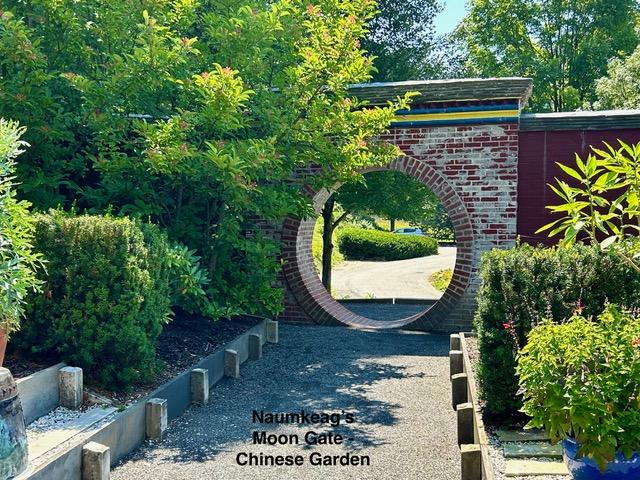
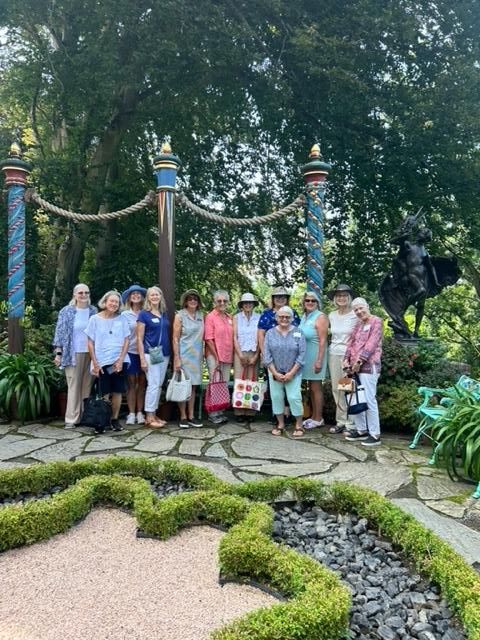
On August 5, 28 of us gathered for a bus trip to visit Massachusett’s two beautiful gardens in the Berkshires: Naumkeag and The Mount. We were there to admire the beauty of the gardens, the architecture of the homes — built during the “Gilded Age” — and learn the history about this period in time. Naumkeag and the Mount reflect the opulence of the era, but in very different ways.
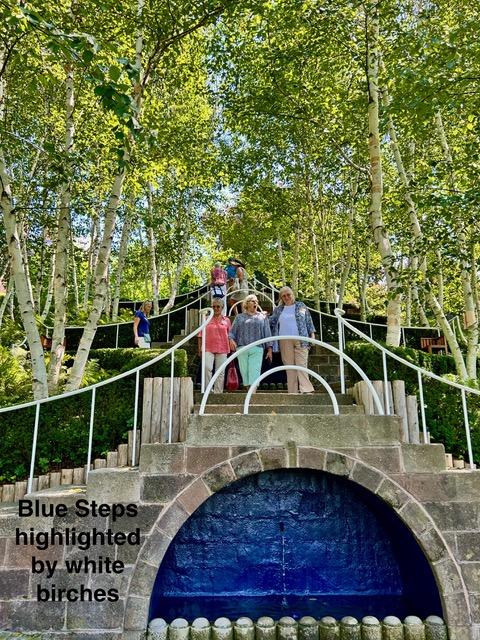
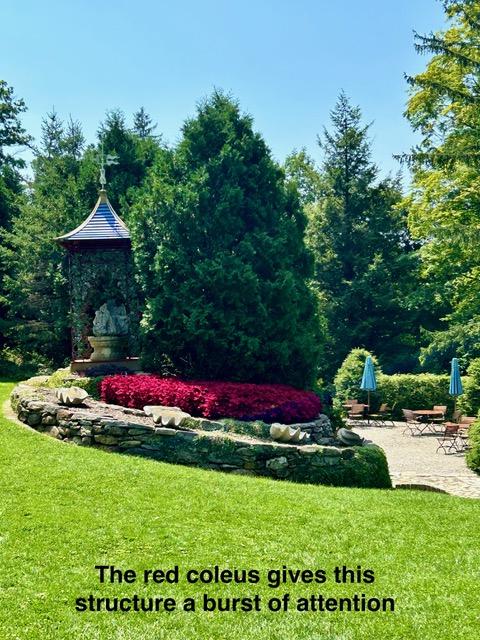
Naumkeag was built as a compound for an active family that appreciated nature and enjoyed being outdoors. The planned gardens are less formal and meant to incorporate the natural beauty of the site and the long vistas of the Berkshire Mountains. There are formal elements in the plantings, such as an allée of trees, various pavilions and a staircase designed within a birch stand that is world famous today. Whimsical elements lend a more relaxed feeling to the property.
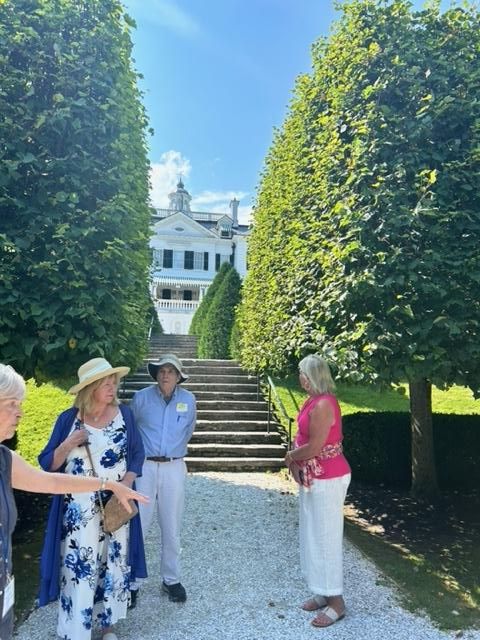
The Mount (home to author, designer, and humanitarian Edith Wharton) is more formal and opulent. As with Naumkeag, the house is located at the highest elevation in the property to enjoy views of a lake and the mountains beyond. A walled French and Italian Garden are laid out below, on either side of the house, and connected by an allée of pleached Linden trees. They can be enjoyed from the terrace of the home, where we gathered for lunch prior to our guided tour of the grand 47-room home.
The scale at The Mount was grander, but both properties were uniquely beautiful. It inspired and energized us to get back to our own gardens and perhaps incorporate an element that particularly appealed to us. For me, it’s a very scaled down version of a white astilbe garden, surrounded by a low boxwood hedge, with a white climbing hydrangea behind it, on my brick garage wall. Does this sound familiar? It was part of the Italian garden at the Mount. We witnessed a moment in time. While most of us cannot live in this style, it can affect how we design our own gardens and appreciate the natural beauty all around us.
—Millie C. Legenhausen, Garden Club of New Haven
|
|
|
|
— Susan Laursen, FGCCT Landscape Design Council Chair |
|
|
|
Beyond the Name (Chokeberries)
By Renee Marsh, FGCCT Horticulture Chair
|
|
|
|
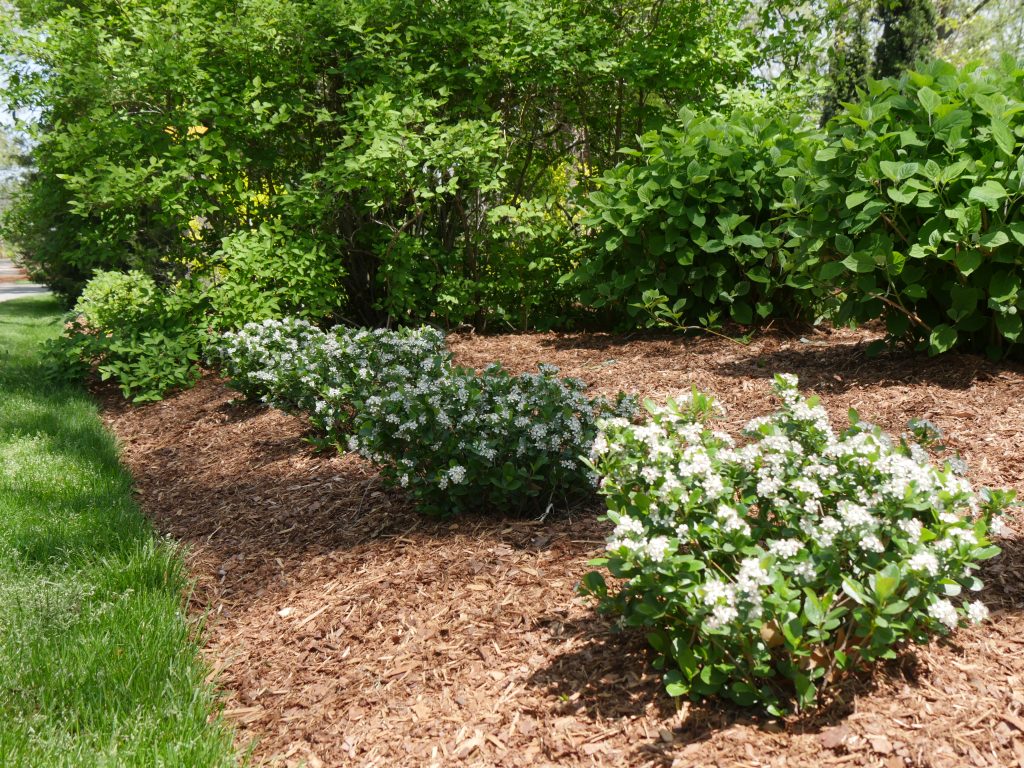
In the days before marketing, branding and patents, folks named plants for a key characteristic like looks, where it grew, uses or what it did to us and our livestock. The European settlers got particularly creative when it came to North American natives: dog hobble, dog bane, skunk cabbage, boneset, spiderwort and bladderwort. Not an asset for a plant trying to promote itself as a charming garden plant. So it is for poor chokeberry, forever haunted by the astringency of its fruit which, if eaten raw, will indeed make a mouth pucker and possibly bring on a coughing fit.
Chokeberries, or Aronia, are deciduous shrubs in the rose family (Rosaceae). Native to eastern North America, there are three species: Aronia melanocarpa (black chokeberry), A. arbutifolia (red chokeberry) and A. prunifolia (purple chokeberry). Chokeberry should not be confused with Chokecherry, the common name for our native Prunus virginiana, which is a distantly related shrub/small tree.
Aronia is resilient. It adapts to a variety of soil types and though it prefers moist, well-drained soil, it will tolerate wetter conditions. Drought-tolerant once established, it still would appreciate some water during dry periods, especially young plants. Full sun is best for flowering and berry production, but it will tolerate partial shade. Aronia is generally resistant to pests and diseases but can occasionally be bothered by aphids, caterpillars, and fungal diseases. It is, after all, in the rose family.
|
|
|
|
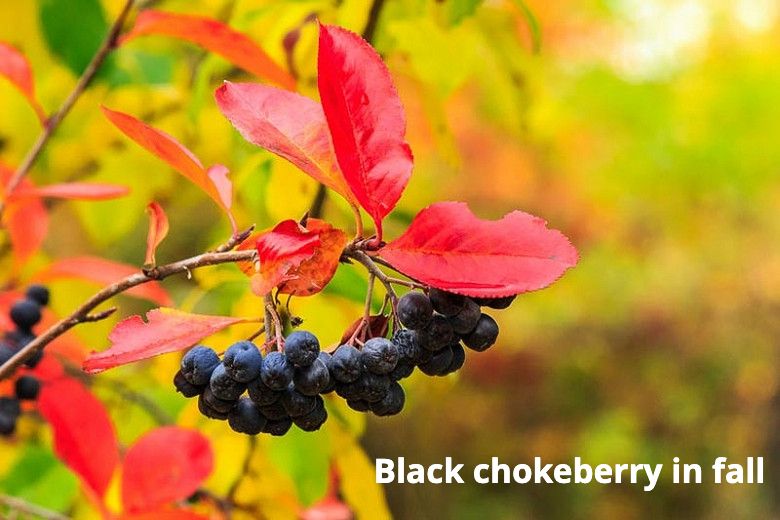
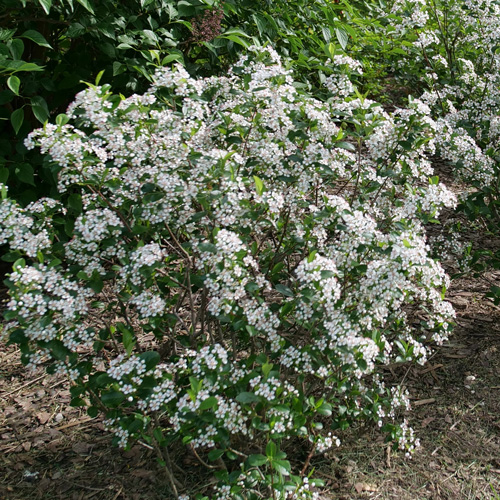
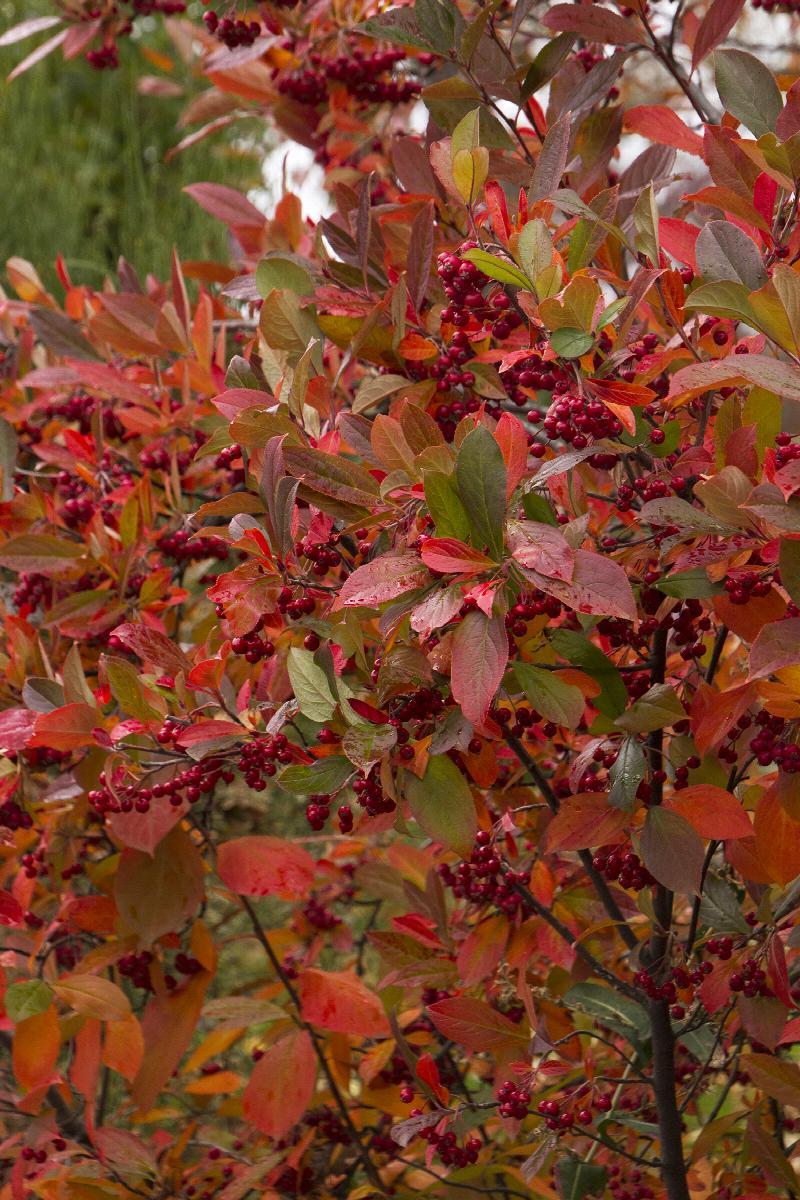
In the spring it has clusters of scented white flowers which mature into shiny red or black berries in late summer.Aronia berries are considered a “super food”: rich in anthocyanins and a good source of vitamin C, vitamin K, manganese, and other essential nutrients. They are used in juices, jams, wines, teas, and antioxidant health supplements. Aronia has even found its way to Central Europe, where it is grown as a crop. Then, as a finale, the glossy dark green leaves turn vibrant shades of red, orange, and purple in the fall, providing stunning autumn color. |
|
|
|
Black Chokeberry
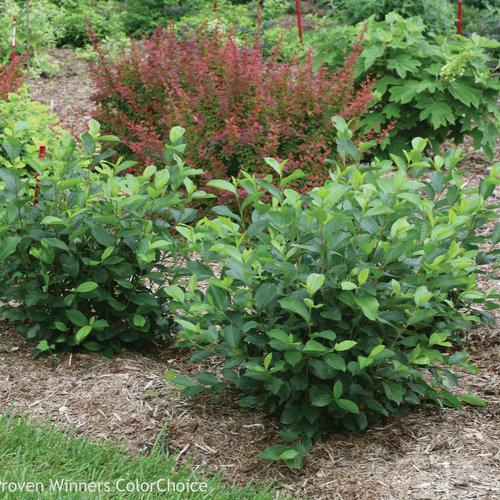
Black chokeberry has become the darling of the plant world. You know you’ve made it when you are listed in Proven Winners with cute trade names. First there is 'Low Scape Mound', a dwarf cultivar with a compact, mounded growth habit, ideal for groundcover and borders. It reaches about 1 to 2 feet in height and spreads to 2 to 3 feet wide. Its patent name is ‘UCONNAM165’ as it came from the breeding program of Dr. Mark Brand at the University of Connecticut.
Then there is ‘Low Scape Hedger', a more upright cultivar (‘UCONNAM166’) designed for use as a hedge or vertical accent. It grows to about 3 to 5 feet in height with a spread of 2 to 3 feet, perfect for creating a low-maintenance, colorful hedge or screen.
|
|
|
|
And, too cute for words is 'Ground Hug', another low-growing cultivar (‘UCONNAM012’) but this one spreads more aggressively, making it an excellent groundcover. It grows about 1 to 1.5 feet in height and spreads 2 to 3 feet wide. This makes it particularly useful for covering large areas, erosion control, and stabilizing slopes. A new addition to the family is the larger (4 feet high and wide) ‘Low Scape Snowfire®’. In the spring it is “snowed under with blooms” and in the fall “blazes red and orange.” Got to love those marketing folks.
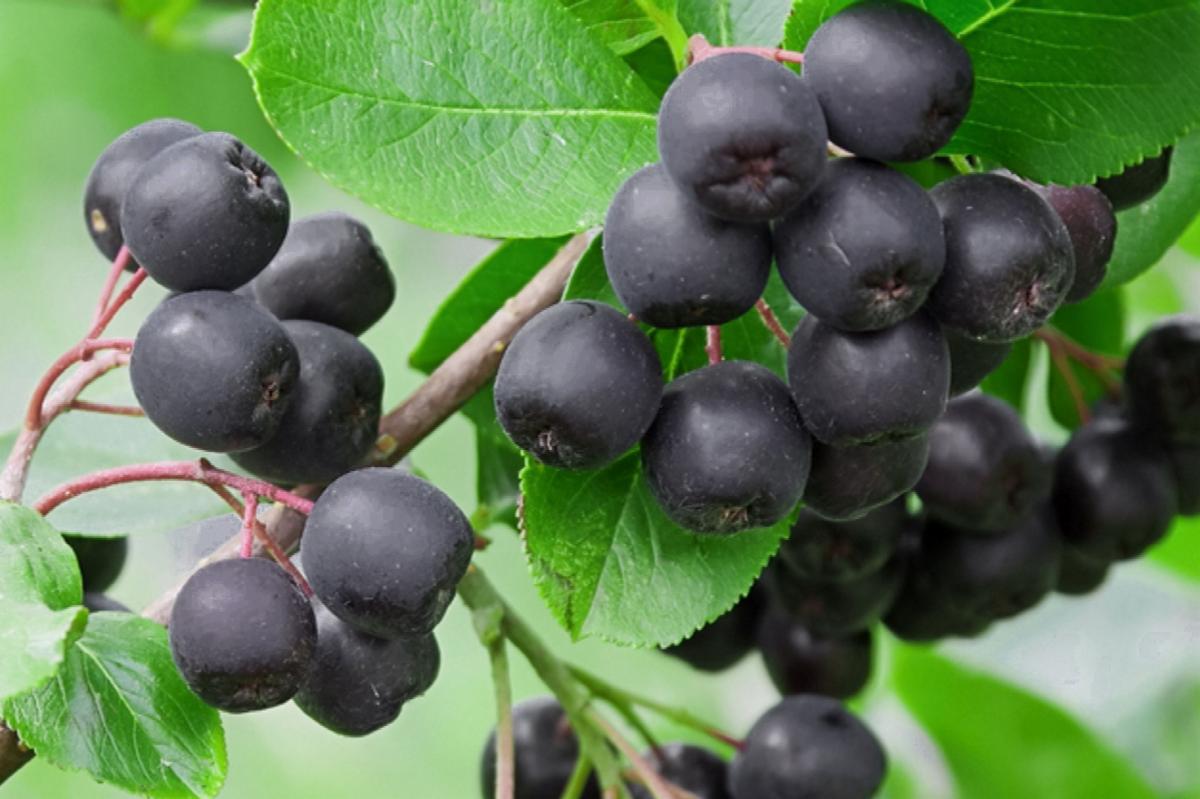
Larger still is 'Viking' (pictured below), a cultivar selected for its vigorous growth, heavy fruit yield, and sweeter berries. This Aronia reaches about 3 to 6 feet tall and is the perfect choice for those looking for a crop in addition to a pretty plant.
|
|
|
|
|
|
Red Chokeberry
'Brilliantissima' is one of the most celebrated cultivars of Red Chokeberry, prized for its outstanding ornamental qualities and considered a great improvement over the straight species. It has a dense, rounded growth habit and at 6 to 8 feet in high and wide, works in many garden settings including borders, hedges, and standalone. The combination of scarlet foliage and red berries makes it a standout in the autumn. The berries are also less astringent than those of Black Chokeberry if you are bold enough to eat them raw. Birds like blue jays, cardinals, chickadees, cedar waxwings and thrashers view chokeberries as a late-season food source, so the berries will hang around for a bit. (Lesson learned, watch what the birds eat.)
Purple Chokeberry
And lastly there is Purple Chokeberry, which is considered a naturally occurring hybrid between black and red chokeberry. It grows 6 to 8 feet tall and has characteristics of both parents but with dark purple berries. It is used less in landscapes but you may find it hanging out in moist woodlands, wetlands, and meadows.
|
|
|
|
So, yes, you can have it all: flowers for pollinators, fall drama to your landscape, berries for songbirds and little critters, and a superfood for you. Chokeberries rule — don’t let the name fool you. |
|
|
|
Not All Trees Are Created Equal
By Holly Kocet, FGCCT Conservation Chair and member of the Garden Club of Newtown
|
|
|
|
When choosing trees for your property, the decision between native and non-native trees should not be taken lightly. The true value of a tree is for the vital role it plays in maintaining ecological balance, not solely as a decorative element in the landscape. Because native trees naturally occur in a specific geographic region or ecoregion, they are well-suited to the local climate and soils. And, having co-evolved with our native fauna, this relationship is critical. According to a study by Burghardt et al, 2010, properties landscaped with native plants support significantly more caterpillars and birds than properties dominated by non-native vegetation.
Keystone Plants
Native trees and plants with the highest value for supporting pollinators, birds and other wildlife are considered “keystone plants.” Just as the keystone of an archway holds all the other stones in place to secure the structure’s integrity, keystone plants are critical to the food web and in maintaining healthy communities. For many wildlife species, keystone plants are absolutely essential for completing their life cycles.
There are two types of keystone plants: (1) those plants needed to feed butterfly and moth caterpillars and (2) plants that provide for specialist bees, whose young require specific flower pollen. These plants, whether supporting caterpillars or specialist bees, are often referred to as “host plants.”
Here in the Northeast, we have an abundance of trees native to our region. While all natives are important for providing natural sources of food, shelter and nesting sites, keystone plants have specialized relationships with animal pollinators who are discerning about their food choices. Some plants provide for both caterpillars and bees and are particularly beneficial. When planting to support pollinators, birds and other wildlife, researchers recommend adding keystone plants to your landscape.
|
|
|
|
Entomologist Dr. Doug Tallamy and his research team at the University of Delaware have ranked trees for their ability to support butterfly and moth caterpillars. Topping the list for supporting caterpillars are our native oaks that host 534 caterpillar species, including Hairstreak butterflies. Willows and cherries come in at a close second, hosting over 450 species, including caterpillars of such butterflies as the Mourning Cloak, Viceroy and Eastern Tiger Swallowtail. Moths are often undervalued for the beneficial roles they play. They are an important food source for many wildlife species and especially birds, both as adults and as caterpillars. This is likely the reason moth populations far outnumber butterflies. Baby birds are fed caterpillars almost exclusively because they are easily digestible and nutritious. It should also be noted that moths are pollinators of the “night shift” for many plants with light-colored and fragrant flowers, such as primrose.
Work by Pollinator Conservationist Jarrod Fowler has focused on pollen specialist bees and the key plants that support them. These bees develop over time from egg to adult and their emergence coincides with a plant’s bloom. Early emerging bee specialists include Cellophane and Mining bees, who emerge in spring and seek out dogwood, maple, and willows as well as woodland flowers. While specialist bee populations are small, every bee species includes specialists who seek out specific plant pollen in order to feed their young. And while many trees such as Oak, Birch and Walnut are wind-pollinated and don’t require animal pollination for reproduction, they do attract bees interested in collecting their pollen for provisioning brood cells.
“We are replacing native plants with [non-native] alien species at an alarming rate, especially in the suburban garden on which our wildlife increasingly depends.”
– Douglas J. Tallamy, Bringing Nature Home
|
|
|
|
Many Introduced Trees are Harmful to Native Plants and Animals
Norway Maple (Acer platanoides) is simply the worst tree one could choose to plant. Scientific evidence shows that this tree is undermining the health of regional forests. Norway maple leafs out earlier than our native maples, giving it a huge competitive advantage for light, water and nutrients. Large abundant seeds are easily spread by wind and willingly sprout in both sun and shade. Roots produce toxic chemicals that prohibit understory plant growth, especially for spring ephemerals. Norway maple does not support insect or bird populations and is not part of the food web. Invasive qualities, along with excessive use in our landscapes, make Norway maple a significant threat to Northeastern woodlands. Alternatives include native Maple, Oak, Elm, Tulip tree and Sweetgum.
Callery or Bradford Pear (Pyrus calleryana) is another overly-planted tree that escapes landscapes and invades natural places and disturbed areas. It is often chosen for its uniform look with tight upturned branches. However, this characteristic form is a weakness of the species, making it susceptible to wind and weather damage. White blossoms in early spring are very short-lived and also emit an unpleasant odor. Callery Pear escapes cultivation to creates dense thickets. In this way, it prevents establishment of native woodland vegetation. It does not support wildlife. Good alternatives include our native Alternate-leaved and Flowering Dogwoods, Redbud, and Shadbush. Callery Pear will be banned from sale in Connecticut in October 2027.
Kousa Dogwood (Cornus kousa) is often recommended as an alternative to Flowering Dogwood for its disease resistance. How ironic that the Kousa Dogwood, indigenous to Asia, is likely responsible for bringing the anthracnose (fungus), which has attacked our native dogwoods, to America. Kousa is known to harbor the fungus without any visible signs. Genetic research suggests the pathogen is a 20th century introduction with pattern of spread originating from our east and west coast seaports. No small coincidence that the timing of fungus’ appearance corresponds to the arrival of the Asian Kousa dogwood in America.
While Kousa berries are too large for most birds to swallow, our native dogwoods provide nutritious berries for many songbirds. A few birds can tolerate Kousa’s large fruits, which accounts for spread into natural areas. Many beautiful native trees, including Hawthorn and Sweetbay Magnolia, do provide for wildlife and are good alternatives.
Purple-Osier Willow (Salix purpurea) was originally planted along streams for erosion control but falls short in its support of terrestrial and aquatic food webs. Conversely, our native willows are host plants for butterflies such as Viceroy, Mourning Cloak and over four hundred additional species. Weeping Willow (Salix x penduline/Salix sepulcralis), while not a highly aggressive plant limited to moist areas, it has invaded wet meadows and roadsides in several states. Native alternatives are Black Willow, Pussy Willow and Shining Willow.
There is little doubt among scientists and conservationists that the choices we make in our landscapes affect local ecosystems and our overall environment. More important than ever, landscapes must be multi-functional. They can allow for artistic expression and be a source of natural beauty while providing for wildlife. Butterflies and moth caterpillars and specialist bee populations are most at risk because of their dependence on particular (host) plant(s) for their survival. Keystone plants are essential for supporting these “specialists.” We need to rethink the necessity of planting introduced ornamental trees not only because they fail to support pollinators, birds and other wildlife in our landscapes, but because many of them continue to invade our forests and woodlands, destroying the native flora on which wildlife depends.
Clearly, not all trees are created equal.
|
|
|
|
SPOTLIGHT on our FGCCT Affiliates! |
|
|
|
|
|
|
Essex Historical Society
|
|
|
|
Welcome FGCCT's newest Affiliate, the Essex Historical Society!
|
|
|
|
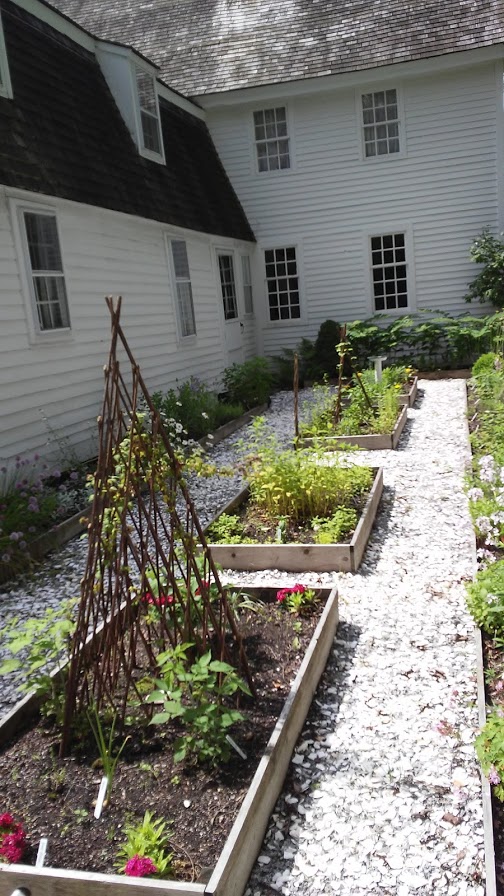
Essex Historical Society’s (EHS) Board of Directors, volunteers and staff are committed to an active, collaborative approach to provide access to local history for lifelong learners. Essex’s only historic house museum, Pratt House, is located on a beautifully landscaped meadow, on two acres containing a historic kitchen garden featuring plants used in 18th century cooking and medicine as well as a collaborative pollinator garden, part of the Pollinator Pathways Northeast. The State of Connecticut awarded EHS a major grant in 2023 to upgrade Pratt House’s visitor services in preparation for the US 250th anniversary in 2026.
EHS’s offices and library at the Hills Academy History Center welcome in-person and online visitors, as Collections volunteers steward 7,000+ objects and images, while answering hundreds of research questions annually. EHS offers a variety of public programming, including group tours, community events and activities in the town’s three villages, working with over 30 collaborators in any given year. This includes our popular Winter Lecture Series, community parades, summer camp programs and group tours, just to name a few.
In 2023, our seven-year Follow the Falls partnership with Essex Land Trust culminated in the release of our richly illustrated 90-page book on the historic and environmental significance of Ivoryton, a company village in Essex, whose factories produced piano keyboard and ivory novelties.
|
EHS made 800 student interactions this academic year by providing hands-on history programming to grades 4, 5 and 6 at Essex Elementary School. We teach students through the safe handling of reproduction and period objects from our collections. Students complete their year with an age-appropriate field trip to our sites or learn through interactive walking tours.
On Saturday, December 7, 2024, EHS brings back the popular Essex Holiday House Tour after a five-year hiatus.
Engage with EHS at one of our programs, through our social media outlets or through our website, essexhistory.org to learn how we can bring history to you.
|
|
Essex Land Trust maintains the collaborative pollinator garden at Pratt House.
|
Pratt House’s kitchen garden features plants used in early American cooking and medicine.
|
|
|
|
"Club Corner" is a place for clubs to showcase exceptional or notable club achievements and activities. Has your club done something unique (or uniquely successful?) that you'd like to share? Visit "Club Corner" on the FGCCT website for more news from clubs! (Note that this area is NOT for upcoming events—you can post those on the FGCCT Club Calendar.)
Send high-resolution photos, along with a writeup (200 words or less, please) and photo captions, to CFNewsManager@ctgardenclubs.org to be considered for inclusion. Please ensure that you have appropriate permissions for all photos. We reserve the right to edit copy and select photos for inclusion.
|
|
|
|
Featured Club: The Mystic Garden Club |
|
|
|
Celebrating a Centennial in Mystic!
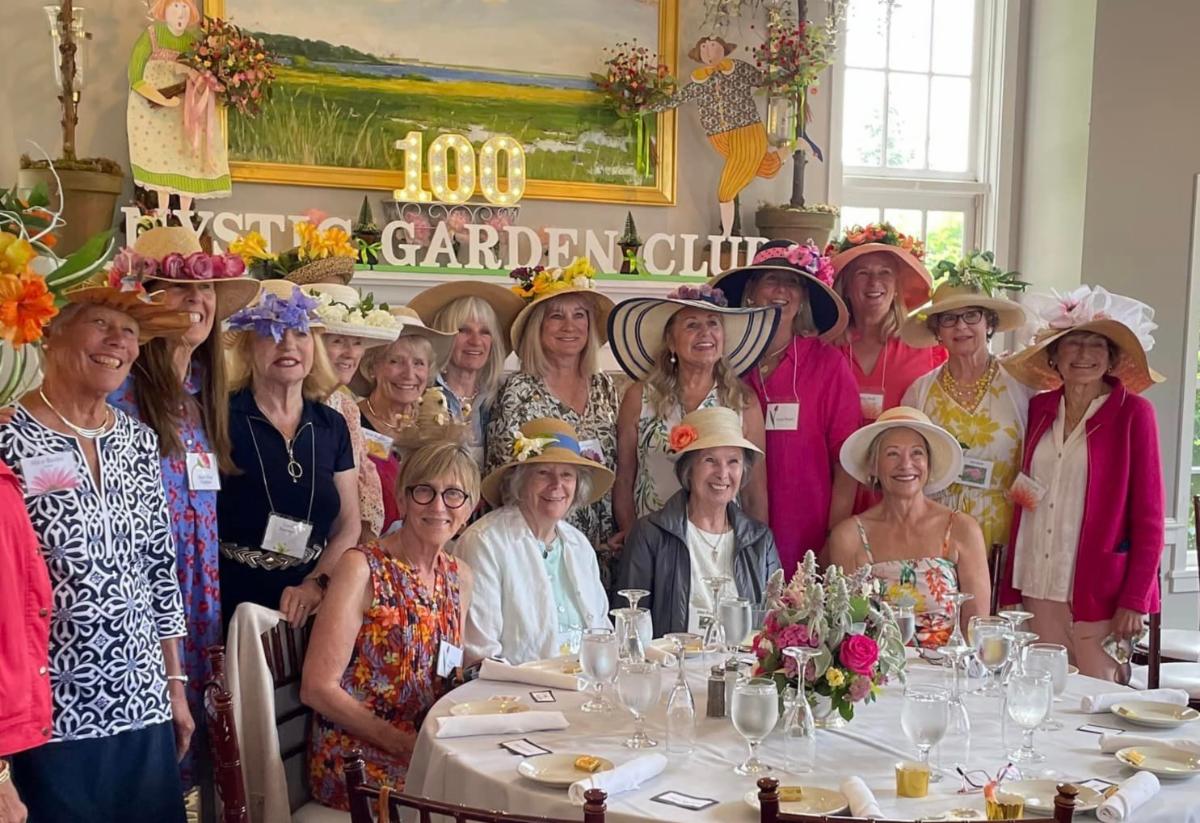
The Mystic Garden Club is among our wonderful club’s celebrating a Centennial in 2024.
The club has an inspiring history of good environmental stewardship, civic beautification and education. Their first flower show was held in 1930 at the Mystic & Noank Library and since then, they have held many flower shows and house and garden tours, winning numerous State, and National awards. Profits from their shows have helped to landscape Williams Beach, the Mystic Depot, Mystic Community Center, Mystic Art Association, Portersville Academy, Mystic River Homes, Mystic & Noank Library and the Chester Latham Store in Noank.
|
|
|
|
Many of the club's early projects are continued by dedicated members to this day, including a shelf of gardening books at the Library along with providing plants for the Mystic & Noank Library Fair, a Garden Therapy program at a local nursing home with monthly horticulture or flower arranging sessions with the residents, planter boxes in downtown Mystic and arrangements for the house tours sponsored by the Mystic River Historical Society. All these activities are still supported by the Garden Club with their annual fundraisers. Since 1979, the club has donated over $450,000.00 to various organizations. The club’s signature project has been the Denison Pequotsepos Nature Center, originally founded as the Pequot Wildlife Sanctuary. The Center has been the recipient of more than $178,000 in grants and gifts over the course of the Mystic Garden Club’s history.
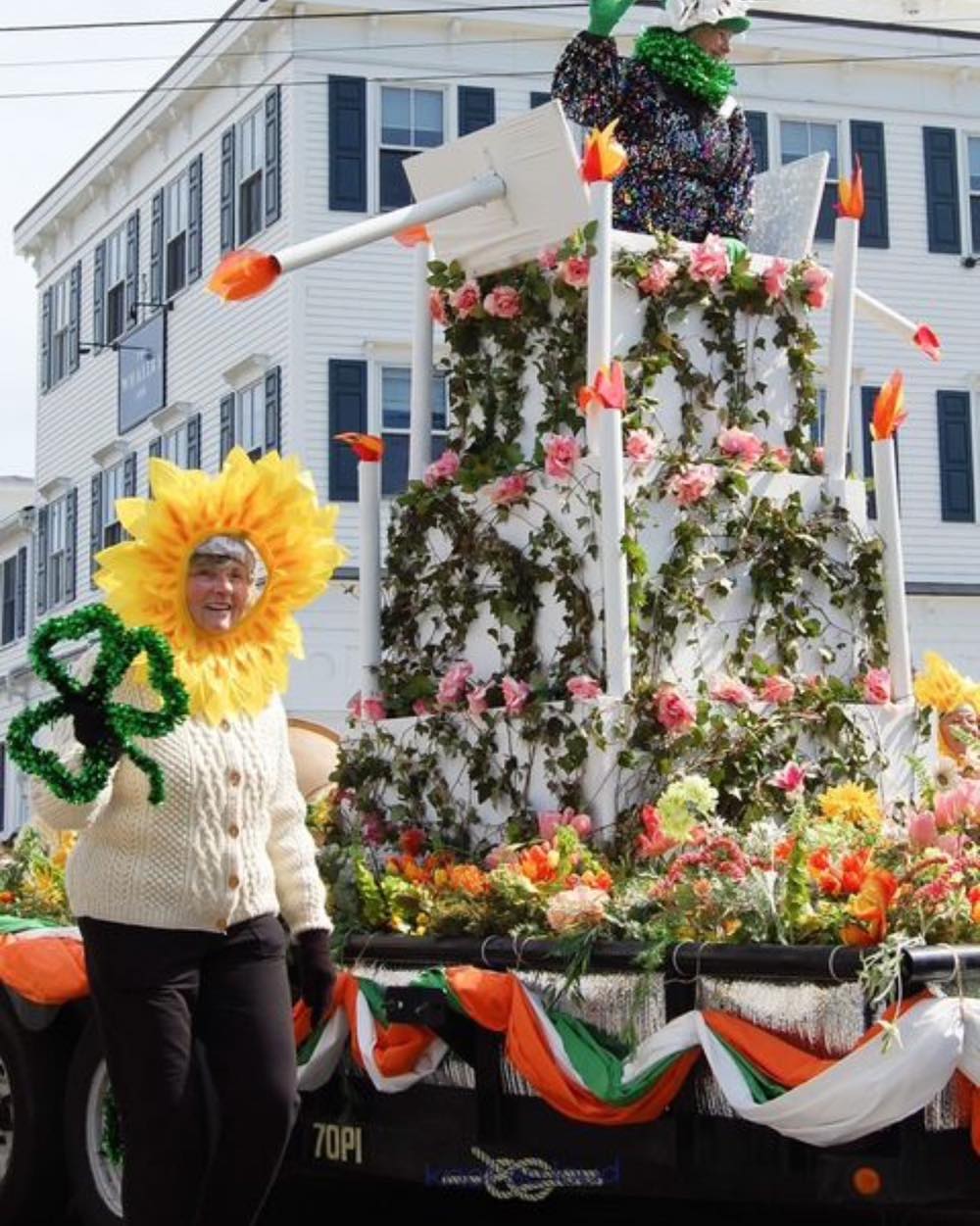
The club celebrated their 100th birthday in June with a festive party and provided a colorful float for Mystic’s Irish Day Parade, winning “Best Float.”
Mystic’s membership includes one accredited Landscape Design Judge, nine Master Gardeners, two Advanced MGs and one National Daffodil Judge and they are well positioned for another 100 years.
At right (top)
celebrating at the Mystic Irish Day Parade
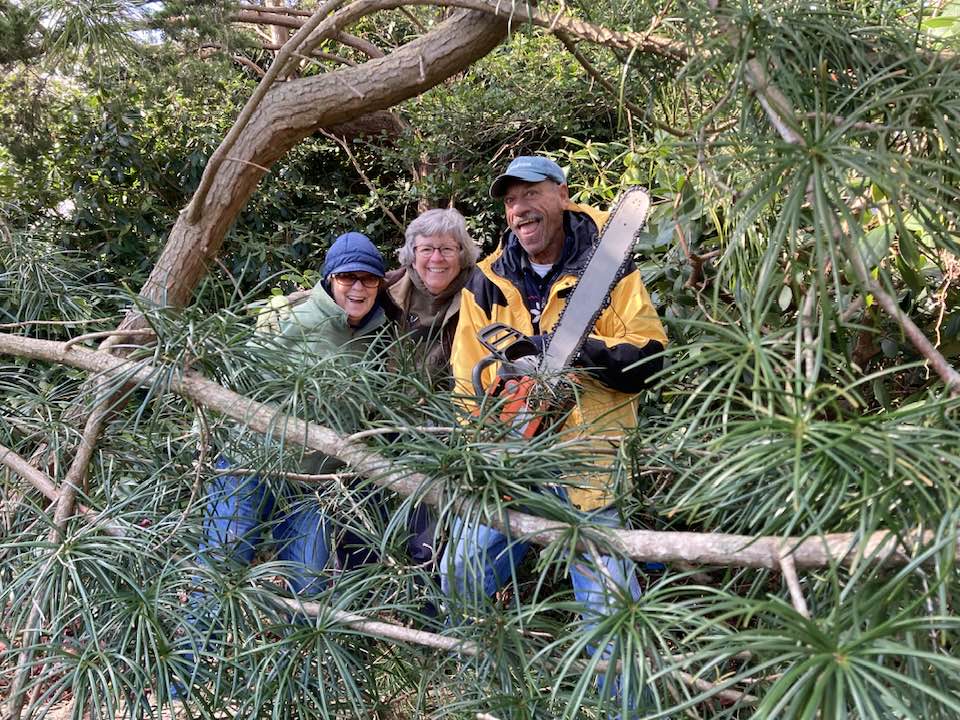
and (bottom right) cutting greens for the club's Greens Sale
|
|
|
|
|
|
|
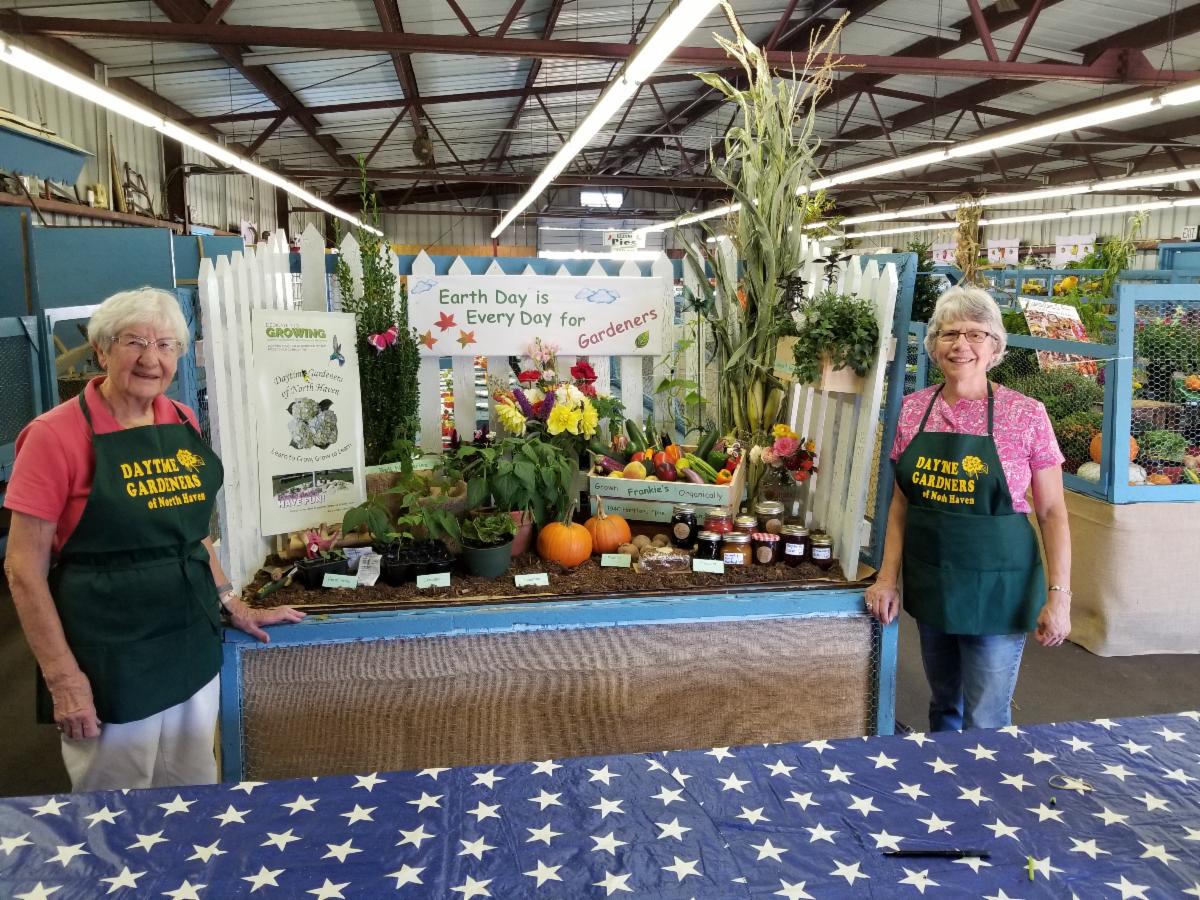
Daytime Gardeners Go to the Fair!
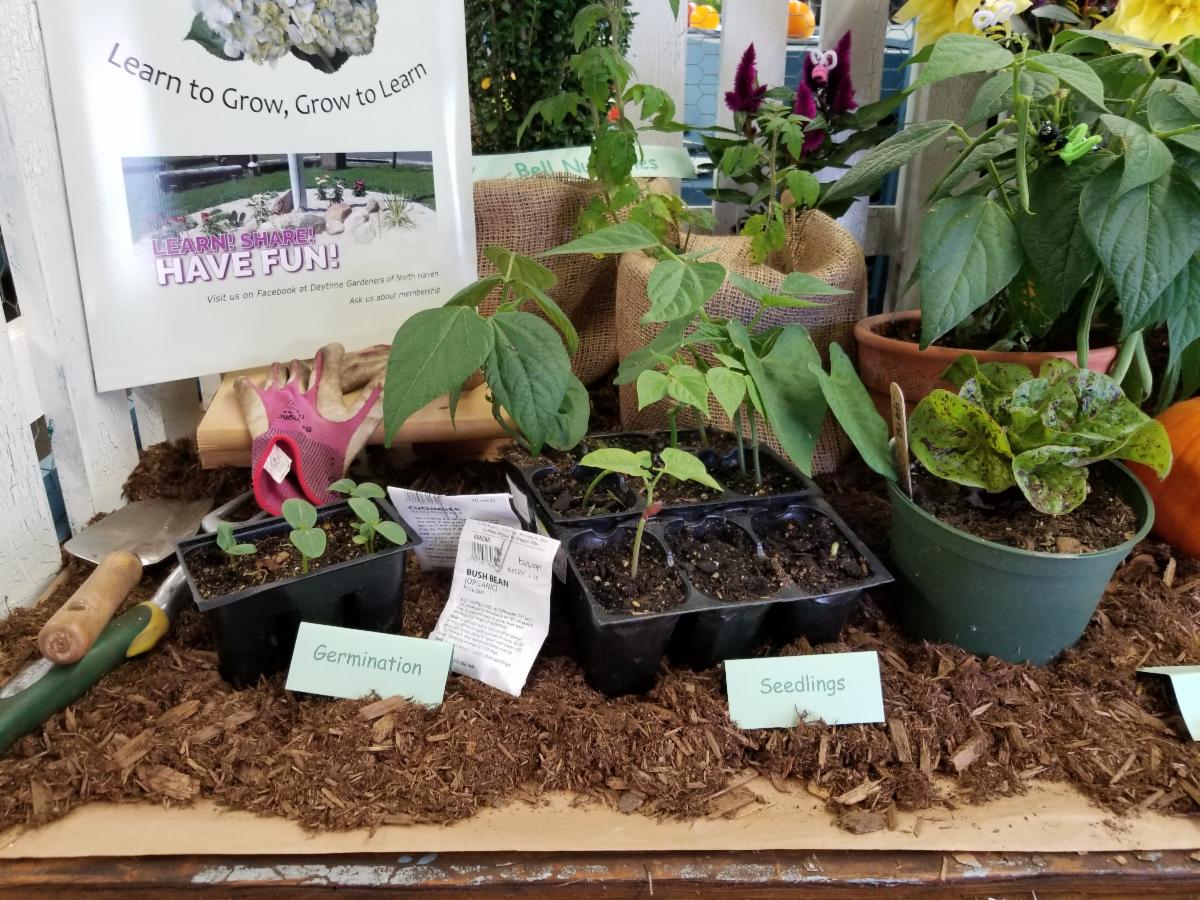
The Daytime Gardeners of North Haven provided an educational exhibit for the North Haven Fair from September 5 through September 8, 2024. Club members prepared a display to illustrate the progression from the germination of seeds to seedling growth, pollination, harvest of produce, and the final product that might be made from the plants.
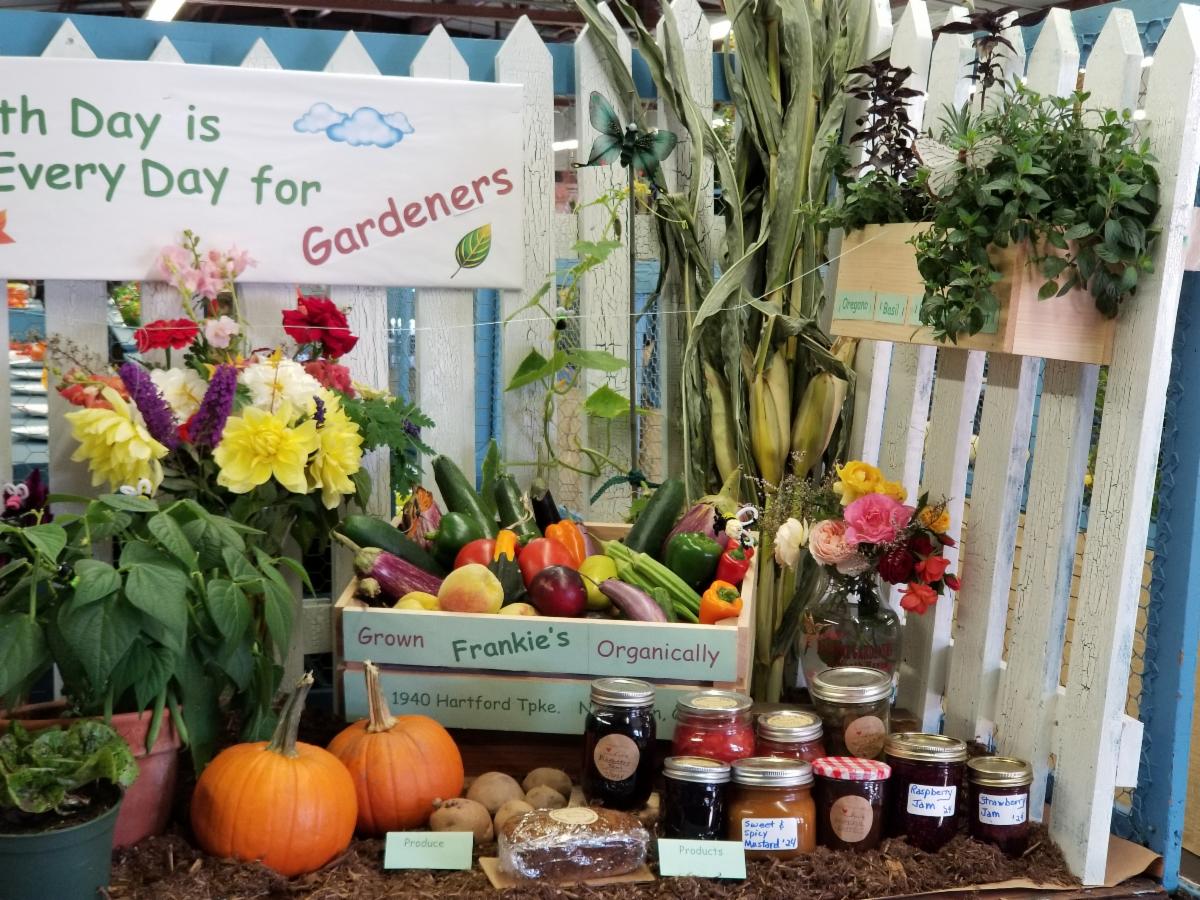
The display progressed from the sprouting bean seeds in a seed tray, to a tray of seedling beans, to a bean plant with beans ready to pick. Crafted bees and butterflies fluttered about the display to demonstrate pollinators, which are so important in the process. A box was filled with harvested produce including, zucchini, eggplant, cucumbers, tomatoes, okra, peppers of various kinds, peaches, and plums. Herbs were growing on a window box hung on the white picket fence and bouquets of flowers decorated the area. The final products included a variety of canned goods such as stewed tomatoes, tomato juice, jams, pickles, and a loaf of zucchini bread.
The Daytime Gardeners are grateful for the contributions of small pumpkins, a sky pencil holly, and a flowering celosia from Bell Nurseries. Frankie Muzio kindly contributed some of his organically grown fruits and vegetables for our harvest box. The Fair was a wonderful event for North Haven and our members enjoyed creating this educational exhibit to share with the community.
Individual members of our garden club also contributed entries in several of the fair exhibits, including vegetables, breads, cookies, flowers, and woodworking. Four first place ribbons, two second place, and two third place ribbons were won.
If you enjoy gardening and activities associated with plants and nature, please contact the club to learn more about membership. Our Facebook page shows many of our projects and provides notices of our upcoming meetings which are open to the public.
|
|
|
|
Donations to FGCCT's Scholarship Fund; Healing, Therapy and Senior Gardening Fund; and World Gardening Fund |
|
|
|
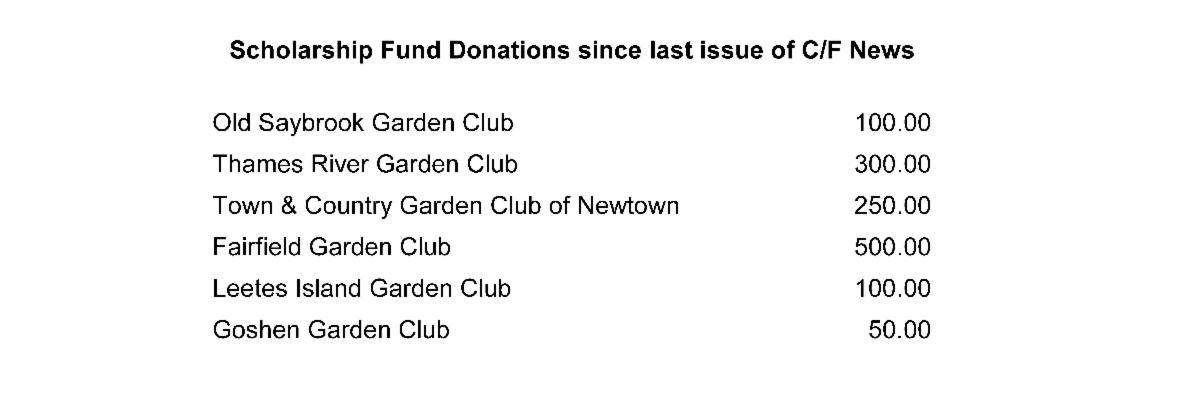
We thank the following Garden Clubs for their recent donations to the FGCCT Scholarship Fund.* For almost 40 years, the Federation has awarded scholarships to college and university students who major in Agronomy, Botany, City Planning, Conservation, Environmental Studies, Floriculture, Forestry, Horticulture, Land Management, Landscape Design, Plant Pathology, or allied subjects. We welcome donations of any size. Our appeal is ongoing to give all of our clubs the opportunity to make a contribution in the amount of their choosing.
|
|
|
|
Please send all Scholarship Fund donation checks to the appropriate chair (see below). Make checks out to "FGCCT" with the appropriate Fund listed on the memo line.
*Please note that due to the deadline for articles and information for the CFNews, some donations may not be received and deposited in time to be included in the bi-monthly donation acknowledgement, but will be included in the next issue of our newsletter.
PLEASE MAIL CHECKS TO:
|
|
|
|
For World Gardening & Healing, Therapy and Senior Gardening:
The Federated Garden Clubs of CT, Inc.
Attention: Rosemary Bonaguide
PO Box 902
Wallingford, CT 06492
|
|
For FGCCT Scholarship Fund:
The Federated Garden Clubs of CT, Inc.
Attention: Carole Fromer
PO Box 902
Wallingford, CT 06492
|
|
|
|
Follow us on Facebook and Instagram!
FGCCT is on Facebook and Instagram and we love to post your news and photos! Please send upcoming events, club activities, civic projects, milestones, and hort tips. Include photos and a brief writeup of the news your club would like to share. The best format is text in an email with jpg photos attached. Take active photos showing members at work or showcasing beautiful gardens, flowers, and plants (please name the flower if it is a hort only photo). Let’s follow each other! Send submissions to social@ctgardenclubs.org
|
|
|
|
Just a reminder …
Please send all correspondence to the new FGCCT office:
The Federated Garden Clubs of CT, Inc.
P.O. Box 902
Wallingford, CT 06492
Did you recently elect new officers? Email their names and contact information to us at office@ctgardenclubs.org so they will receive Federation correspondence. If you need assistance, please contact FGCCT Office Administrator Joan Lenart at office@ctgardenclubs.org or by phone at 203-488-5528 on Mondays and Wednesdays, from 10 am to 2 pm.
|
|
|
|
Deadline to submit articles/photos, ads and calendar events for the December 2024 / January 2025 issue of the CFNews is November 10, 2024. Please submit to:
|
|
|
|
ARTICLES/PHOTOS
Martha (Marty) Sherman
ADVERTISING
|
|
|
|
|
Reminder from NGC: The National Gardener is ONLINE (and free!)
The official publication of the National Garden Clubs, The National Gardener, appears quarterly, and features articles of interest to environmentalists, gardeners, landscapers, floral designers, educators and photographers. Subscribe here.
|
|
|
|
|
|
|
State, Regional &
National Events
|
|
|
|
|
|
|
|