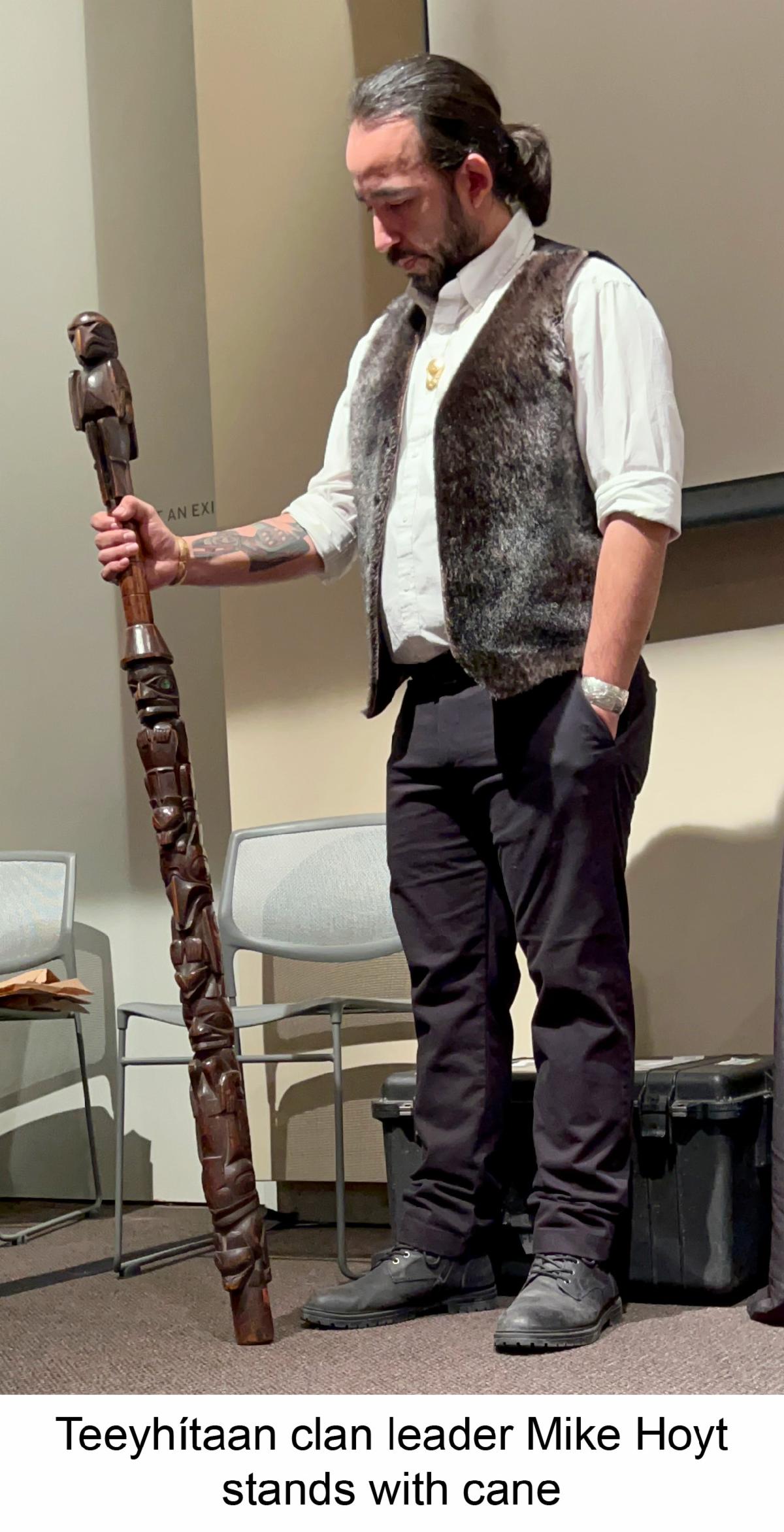
Teeyhítaan clan leader Mike Hoyt (Gáshxh) witnessed the repatriation ceremony. “I’m grateful for the work Tlingit & Haida does to bring our at.óow home,” said Hoyt. “It’s the return of our ancestors—their voices, stories and names. That strengthens us and reinvigorates us, as a community. Kadashaan was, to me, a legendary figure. He was a teacher who passed along so many of our stories to Tom Ukas and William Paul, just to name a few. He worked with numerous ethnographers. His work is prolific. To have this staff, which is connected to him, helps us to honor his work. It’s also serendipitous. Wrangell Cooperative Association has funds to carve totem poles in Wrangell and brought together elders, clan leaders and representatives. One of the totems decided a priority was the one based off this staff. So, to have it returning home now, is perfect.”
Kevin Callahan (Gaalgé), who is Chaak (Eagle) of the Naanya.aayí clan, was also present and “balanced the ceremony,” reminding everyone of the recently repatriated Chief Shakes Killerwhale Staff of the Naanya.aayí clan as “holding hands once again.”
The Aankháawu Woodzakaa will be taken back to Wrangell, Alaska and stored at the museum.
Tlingit & Haida’s Cultural Resources program repatriates objects of cultural patrimony, sacred objects, funerary objects and human remains in accordance with the Native American Graves Protection and Repatriation Act (NAGPRA) of 1990 and the National Museum of the American Indian (NMAI) Act of 1989. The Cultural Resources program works with tribes to submit claims to museums for the return of cultural objects, assisting tribes and individuals in identifying cultural objects, family trees, memorial parties, and clan identification.
For more information on the cane, contact Tlingit & Haida's Cultural Resources program at NLR@tlingitandhaida.gov or 907.463.7186.