|
30 August 2026 (Rhodes, Greece) - When the legendary country musician Dolly Parton died last week at the age of 80 after a brief battle with cancer, there was tsunami of tributes. Our boss, Gregory Bufithis, wrote how her book giving charity for children inspired the creation of his own charity.
Parton, who was born into a poor farming family in Locust Ridge, Tennessee, in 1946, became a singer and performer during her early childhood, and earned ten competitive Grammy Awards during her career.
But she also left a mark on science, public health and education. She donated to medical centres, vaccine research and disaster relief. One of the most famous animals in science was named after her: Dolly the sheep, the first mammal cloned from an adult cell.
Scientists around the world paid tribute to Parton following the news of her death. Catherine Heymans, an astronomer at the University of Edinburgh, UK, said:
“Dolly provided the soundtrack for my PhD, and is gratefully acknowledged in my thesis as a key contributor! She was the very best of us: we should all strive to be more like Dolly (rhinestones and all)".
Tedros Ghebreyesus, director-general of the World Health Organization, wrote:
“Today is a sad day as we mourn an exceptional artist, a true champion of kindness, and ambassador of science and public health. Most people do not know the great contributions she made to public health”.
Others reflected on how Parton wielded her fame for good. Gaurav Kansagara, a cell biologist at the Institute for Stem Cell Science and Regenerative Medicine in Bengaluru, India, wrote:
“Few celebrities use their influence to support science so meaningfully as did Dolly Parton”.
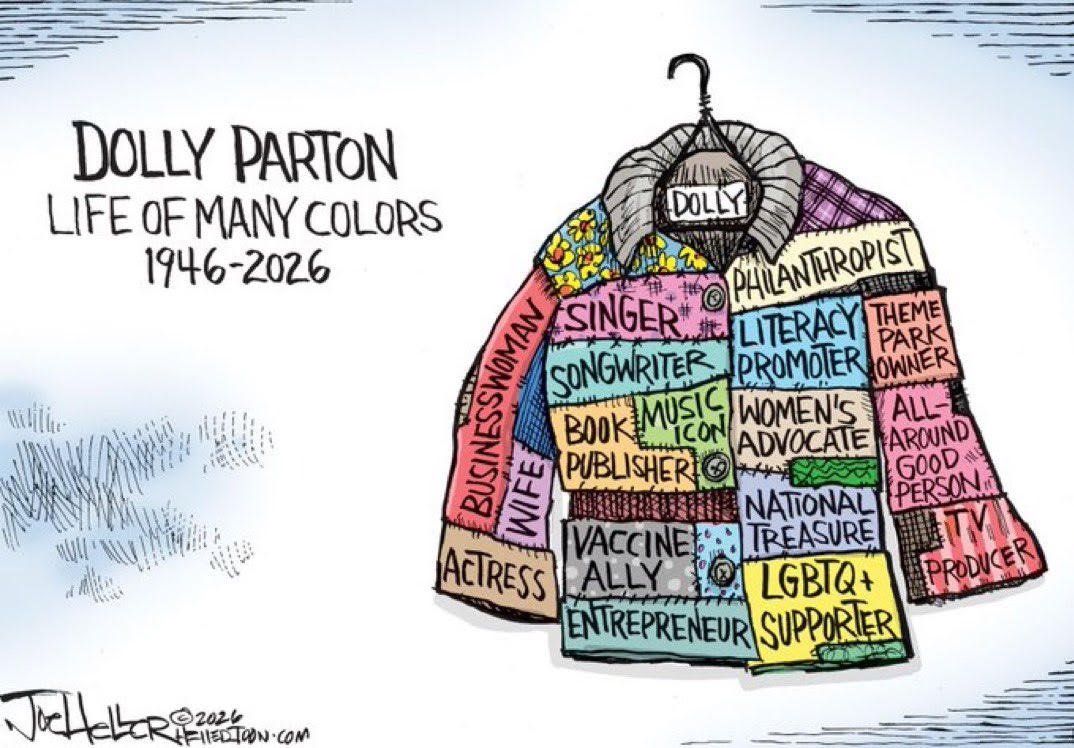
There is so much I can write about her contributions. Let me note what I think are the 5 biggest ways Dolly Parton contributed to science.
Research funder
One of Parton’s longest-lasting influences on science is her part in creating one of the major vaccines against SARS-CoV-2, the virus that causes COVID-19. In March 2020, Parton gave US$1 million to Vanderbilt University Medical Center (VUMC) in Nashville, Tennessee, which created the Dolly Parton COVID-19 Research Fund.
According to Mark Denison, a Vanderbilt paediatrician and infectious-disease researcher, the money helped to fund the “critical” early stages of research into a then-experimental messenger RNA vaccine eventually produced by Moderna, a biotechnology firm based in Cambridge, Massachusetts. The fund is acknowledged in the first published report of a phase I trial of the vaccine, which appeared in The New England Journal of Medicine in July 20201.
And she could have made it as an investment and it would have earned a whopping return. But she made it as charitable contribution.
At least 37 research papers credit the Dolly Parton COVID-19 Research Fund with support, according to the Dimensions database which is considered the Bible in tracking these types of things.
Encouraging vaccinations
Parton’s advocacy for COVID-19 vaccines didn’t stop at funding research. In March 2021, Parton was filmed while receiving a dose at the VUMC, encouraging others to do the same. Referring to her hit song "Jolene" she quipped:
“I’m old enough to get it, and I’m smart enough to get it. I might rework my hit ‘Jolene’ to include the words, 'vaccine, vaccine, vaccine, vaccine, I’m begging of you please don’t hesitate'. What do you think?"
Neil Stone, a clinician and infectious-disease researcher at University College London, reposted the video on X after her death, calling Parton a “legend”:
“She was a great philanthropist, donating a million dollars to Covid vaccine research which went on to save many lives”.
Many doctors said Parton getting immunized publicly provided a very real "shot of hope", reassuring many that getting the vaccine was best for them and their families. They said 1000s of people who were reluctant to get vaccinated changed their minds after seeing Dolly do it and talk about it. One doctor said:
“Dolly Parton created a connection between public health and the average person".
Public health
Parton’s philanthropy extended to a wealth of causes. In 1994, she contributed a version of the song ‘You Gotta Be My Baby’ to the charity album Red Hot + Country, which was produced to raise money to fight HIV/AIDS.
In her home county of Sevier, Tennessee, she raised $500,000 at a benefit concert for LeConte Medical Center, which opened in 2010 with a dedicated Dolly Parton Center for Women’s Services.
She also donated $5 million to paediatric infectious-disease research at Vanderbilt, and this past February, East Tennessee Children’s Hospital in Knoxville was renamed Dolly Parton Children’s Hospital after an undisclosed “generational and transforming” gift said to be $25 million, funding a new paediatric residency program, rural telehealth and specialist recruitment. Wrote Carlie Trott, a social psychologist at the University of Cincinnati, Ohio"
“Dolly Parton chose not to be a billionaire, which she easily could have been. She never forgot what it means to be in need, what to give back to the world after you've made it”.
The Imagination Library
Greg covered this in his post, but I also think Parton’s greatest contribution might have been through her Imagination Library program. Inspired by her father, who couldn’t read, Parton started the initiative in 1995 to provide free books to kids from birth until age five. Since then, the Imagination LIbrary has expanded to five countries, mailing more than 330 million free books to date.
Beyond promoting childhood literacy, the effort has offered researchers a sort of natural experiment to study the effects of early reading. Kids participating in the program read more often and for longer than their peers, and were also better prepared for kindergarten. Parton said her father may have been prouder of the Imagination Library than the entirety of her career, and her family has requested donations be made there in lieu of flowers.
And what she said nails the biggest point:
“If your actions create a legacy that inspires others to dream more, learn more, do more, and become more, then, you are an excellent leader. I hope I aided somebody to become a scientist, an explorer, a thinker".
A muse to science
Dolly Parton has served as an unexpected but deeply impactful muse, role model, and benefactor to the scientific community, bridging the gap between pop culture and rigorous research. As I noted above, her authenticity, generosity, and cultural footprint have directly shaped and inspired multiple scientific breakthroughs and disciplines.
This past week scientific bodies globally - including the World Health Organization (WHO) - celebrated her legacy as a true champion of science. In a WHO podcast this week, speakers noted:
-
For many researchers, particularly women in STEM, Parton serves as a profound symbol of authentic identity. Historically, women in scientific fields have faced pressure to suppress their femininity to be taken seriously. Scientists like those sharing their journeys on Instagram platforms credit Dolly Parton as the ultimate muse for remaining unapologetically authentic, fashionable, and whimsical while conducting serious laboratory or astrophysics work. Her famous quote, "Find out who you are and do it on purpose" has become a guiding philosophy for scientists navigating rigid academic spaces.
- In 1996, history was made when researchers at the Roslin Institute successfully created Dolly the Sheep, the world's first mammal cloned from an adult cell. Because the sheep was cloned using a cell taken from a mammary gland, the male scientists cheekily chose to name the animal after Parton in reference to her famous figure.
Rather than taking offense to the potentially crude origin, Parton handled the situation with her trademark wit and grace, publicly stating she was "flattered" to be associated with such a monumental scientific leap.
-
Botanists and geologists have frequently turned to Dolly Parton as an explicit muse when cataloging new discoveries, particularly in her native Appalachian region. In 2015, researchers named a newly discovered Appalachian lichen species after her to honor her inspiring trajectory from humble mountain roots to international stardom: Dollyphyton boucotii. In 2019, paleontologists named a 460-million-year-old fossilized moss species found in Tennessee rock deposits near her Dollywood theme park in her honor.
- Parton’s literacy program, the Imagination Library, noted above, has also turned her into a muse for behavioral and social scientists. By mailing millions of free books monthly to children worldwide, her program has served as the foundation for numerous peer-reviewed studies tracking early literacy rates. Science researchers and educational scientists actively study the program's data to prove how "The Dolly Parton Effect" directly correlates with higher reading engagement and stronger linguistic skills before children ever enter a classroom.
Two last stories to share:
-
A few days ago it was revealed that while Parton was secretly and quietly battling cancer she didn't want to say anything about it, and instead had re-recorded "Light Of A Clear Blue Morning" as a multi-genre powerhouse single featuring her "girl gang" which consisted of her goddaughter Miley Cyrus, plus Lainey Wilson, Reba McEntire, and Queen Latifah - part of an album to support a pediatric cancer research project.
It is her last known recording and it was released 2 months ago.
She had written the song in 1977 during one of the most painful turning points of her life - an emotionally difficult time. It had become an iconic, deeply personal anthem.
Dolly was driving home through a massive rainstorm. As she reached her house, the storm suddenly stopped, the clouds parted, and the sun broke through - inspiring the central metaphor of a fresh start.
She had recorded the song multiple times across her career and thought it the perfect song for a charity album to support her ongoing efforts to help support pediatric cancer research.
-
Yesterday, Dolly Parton's younger sister Stella Parton shared a moving tribute to her sister, revealing that Dolly offered to receive experimental cancer drugs “in the hope of helping others in the future”, knowing they would not be of much help to her - an act of kindness and generosity that extended until the end of her life.
|