|
Continuing efforts to increase efficiency and reduce costs
As budget deliberations continue, we continue to highlight ongoing efforts across city departments to find creative ways to deliver quality services more efficiently and at lower costs to taxpayers. The previous edition of the Budget Revealed newsletter provided some examples of recent cost-saving initiatives undertaken by city staff. Additional initiatives aimed at fiscal responsibility and sustainability will continue to be presented here each week throughout the budget process. Implementing careful spending controls and identifying opportunities to streamline operations require diligence and collaboration across all areas of city government.
J. Michael Joyal, Jr.
City Manager
| |
Dover enhances efficiency in water and sewer systems for significant savings
The City of Dover's Community Services undertakes a proactive approach to managing its substantial annual electricity expenditure of over $1 million associated with its public drinking water and sanitary sewer systems. A 1% improvement in system efficiency translates into $10,000 in savings, highlighting the value of even minor enhancements.
Through collaboration with Process Energy Services, LLC, and funded entirely by grants from the NH Department of Environmental Services and the NH Office of Energy and Planning, the city has focused on optimizing the wastewater treatment plant (WWTP). Over the past decade, this initiative has achieved a 10% reduction in the electricity required to treat 1 million gallons of sanitary waste. This efficiency gain, resulting from operational adjustments and the adoption of high-efficiency equipment, such as LED lighting and optimized aeration blower outputs, has led to estimated annual savings of over $50,000.
The city is extending this successful model to its public drinking water system, with Process Energy Services set to conduct energy audits across all key components. With $375,000 estimated annual electricity usage for 11 water supply wells, upcoming aquifer management plans aim to identify the most cost-effective well points, balancing capacity safety and cost efficiency.
Additionally, Dover's 23 sewer pump stations have been assessed by Wright-Pierce under an NHDES Asset Management Grant to verify equipment operation and efficiency. This evaluation is crucial for rotating centrifugal pumps, which degrade over time. By maintaining optimal pump performance through regular monitoring and timely updates to pump assemblies, Dover aims to achieve up to 10% savings on electricity consumption for FY2025, emphasizing the city's commitment to cost-effective environmental stewardship.
| |
|
Efficient meeting scheduling leads to cost savings for Fire and Rescue
Dover Fire and Rescue has strategically restructured its fire officers' meetings, shifting from monthly to bi-monthly occurrences, effectively reducing the frequency of meetings that necessitate overtime pay. Based on fiscal year 2023 data, each meeting requiring overtime resulted in costs of $1,617. This adjustment, even by conservative estimates accounting for only four paid meetings annually, led to a yearly reduction of $7,279, excluding additional financial burdens such as retirement benefits or payroll taxes.
Furthermore, the department has enhanced the value of these gatherings by transitioning from routine status updates to sessions focused on training and development for both the fire company and chief officers. This shift not only optimizes the use of time and resources but also contributes to the professional growth of the fire officers. Entering its second year, this revised meeting strategy is projected to yield a conservative total savings of $19,000 over the two fiscal years, underscoring the department's commitment to fiscal responsibility while enhancing operational efficiency and staff development.
| |
Enhanced case management and verification saves costs for Dover Welfare | |
|
The city's Welfare Department has implemented a strategic approach to case management and client verification, leading to significant cost savings for the city. By adopting a more meticulous case management process, the department delves into the underlying reasons clients seek assistance, setting specific conditions for continued support. This approach not only addresses immediate needs but also encourages clients towards self-sufficiency, reducing long-term dependency on welfare services.
Furthermore, the department's rigorous verification of client information ensures that financial assistance is provided only when genuinely needed, preventing unnecessary expenditure. This scrutiny and follow-up mean resources are allocated more efficiently, safeguarding city funds while supporting those in real need. These measures reflect the city's commitment to responsible fiscal management and the effective delivery of social services.
Cost savings achieved through outsourced minute-taking
The city has discovered cost efficiencies by outsourcing the minute-taking responsibilities for the Conservation Commission, Planning Board, and Zoning Board. This approach is more economical per hour than having staff members draft those minutes. By utilizing a specialized minute taker, the city leverages expert efficiency and cost-effectiveness, ensuring accurate and timely documentation of meetings without the higher expense associated with staff allocation. This strategy optimizes resources and allows staff members to focus on other critical tasks, enhancing overall productivity and cost savings.
| |
|
City of Dover
Community Profile
| |
|
The role of the city's governing boards
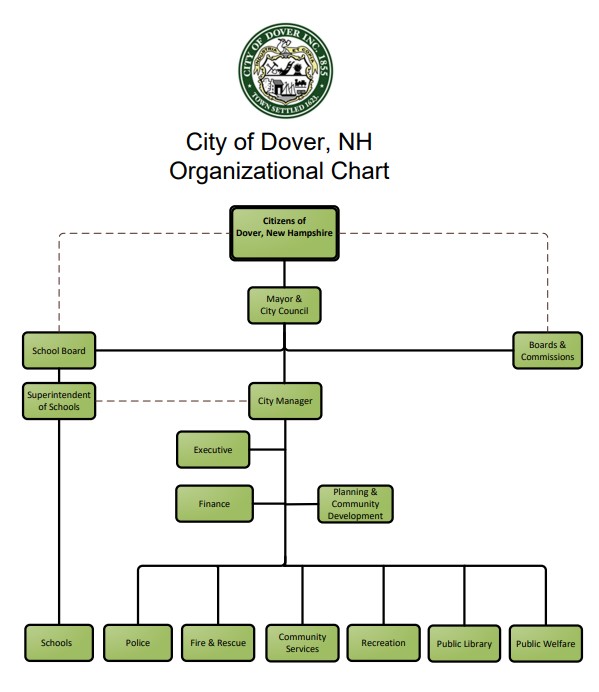
The City Council, consisting of nine members, is the legislative body elected in nonpartisan elections every two years. There is one representative from each of the six wards, two members elected at large, and a Mayor. The City Council is the governing body of the City of Dover. It adopts the budget, the six-year Capital Improvement Program, and authorizes contracts and bonding. It also sets policies for city government, hires and supervises the City Manager, and appoints members to city boards, committees and commissions, except for the School Board.
The City of Dover is empowered by state statute to levy property taxes on real property located within its boundaries to fund operations.
The Dover School Department is a dependent school district, meaning the City Council has bottom-line appropriation authority for the School Department's budget. The seven-member Dover School Board is elected in nonpartisan elections every two years, with one representative from each of the six wards and one elected at large. The School Board has the authority to allocate and move appropriations within its budget.
The role of city administration
Administrative functions are carried out by the City Manager. The City Manager is responsible for carrying out the policies and ordinances of the City Council, compliance with state and federal laws, overseeing the day-to-day operations of the government, appointing the heads of the various departments, negotiating with the various labor bargaining units of the city and making recommendations to the City Council on various issues.
Administrative functions of the dependent School Department are carried out by the School Board. The Board is responsible for carrying out policies and procedures, compliance with state and federal laws, overseeing the day-to-day operations of the dependent Dover School District, negotiating with the various bargaining units, making appointments of school personnel, establishing curriculum, and addressing various issues.
| |
Want to know more? In addition to the online resource for this fiscal year's budget, check out Budget Revealed for more information about the budget process, including previous budgets, insight into the budget cycle, and additional multimedia content.
Click on the image below to view:
| | | | |