|
Facing Life's Challenges:
Are We "Doing" or Just "Trying"?
| | |
Amy's teacher asked her to try picking up her pencil off of the desk. Amy complied and picked it up. "No, Amy, I said try to pick it up; you picked it up." Puzzled, Amy complied again. "No, try to pick it up." Two more repetitions of the directive and compliance followed. Finally, the teacher intervened: "There is no 'try'; you either pick it up or you don't. "Trying" focuses on the effort and potential for failure; "doing" focuses on the action and the execution."
It seems so clear, yet how often we mix and confuse these two action potentials. When faced with challenges or difficulties, do we find ourselves figuratively spinning our gears against obstacles, searching for solutions or resolution? "TRYING" focuses on the effort and potential for failure, while "DOING" focuses on the action and the execution.
| |
THE CORE DIFFERENCE:
"Trying" implies a struggle against an obstacle, a lack of certainty, or a rehearsal. It leaves the door open for excuses if things go wrong. Trying is designed to let us "off the hook." We don't have to succeed, and we don't have to fail. We don't really do anything. That is languishing, NOT flourishing. The primary problem with "trying" is that it subconsciously creates a psychological safety net for failure. When we say we will try to do something, we're explicitly acknowledging that failure is a highly likely outcome, which limits our personal commitment and dampens our execution. "Trying" signals an attempt with built-in hesitation, leaving the door open for excuses when things go wrong.
“Doing” implies direct engagement, commitment, and presence. It focuses entirely on executing the task regardless of how difficult it may be. It calls for accountability and intention. It holds missteps and failures as information and a need for adjustment in the task at hand. It is dedicated to a full commitment to the execution and completion. It develops repeatable habits, making the outcome inevitable over time.
| |
|
MINDSET AND LANGUAGE
This is what trying looks like:
-
"I'm trying to be a better parent, caregiver, daughter, or son."
- "I'm trying to quit gossiping." "I'm trying to shed a few pounds."
- "I'm trying to exercise more.
- "I'm trying to quit smoking."
This is what doing looks like:
- "I'm listening to my children (or care receiver) before I start talking."
- "I'm speaking about any person as if they are present with me."
- "I'm experimenting with eating more whole foods and less sugar.
- "I'm practicing getting up earlier and going for a morning walk."
- "I'm consulting with my doctor about nicotine replacement strategies.
From a linguistic viewpoint, it is helpful to distinguish between "internal vs. external control." Linguistically, "I am trying to lose weight" positions the weight loss as an external adversary that you are battling. As opposed to "I eat lots of vegetables and I walk daily," which internalizes control, focusing strictly on verbs you can completely own.
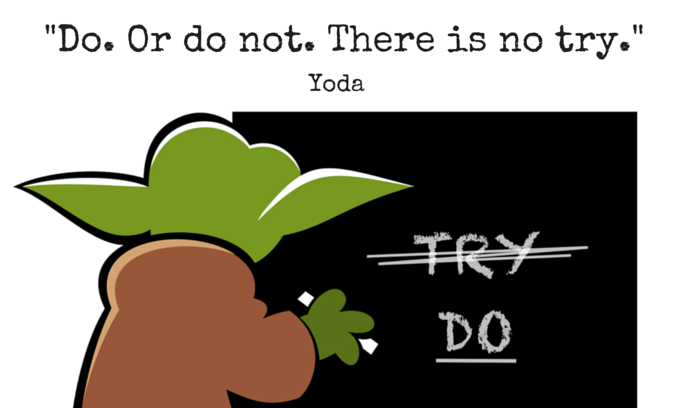
It is helpful to remember the Yoda Principle: "Do or do not. There is no try." "Try" introduces a third, ambiguous linguistic zone between success and failure. Removing "try" forces a binary choice that demands clarity of intent.
| |
Trying is not doing:
It may sound like we're splitting hairs to draw such a distinction between the words "try" and "do," but as behavioral economist Keith Chin has shown, "Our language affects our behaviors. If we change the manner in which we talk about something," writes Michael J. Formica, MS, MA, EdM, in a Psychology Today blog, "then we change our belief system, the way that we think about that thing, and in changing our belief system, we can change our entire system of consciousness. For Michael says, "How you speak about "trying" and "doing" can affect your belief about the ability to achieve or not achieve your objective."
To try is not to do; it is actually an attempt to struggle, to strive, to seek, or sometimes merely to wish or daydream about it. To do is to have the intention and attention required to complete the task at hand. "
The element of fear should not be overlooked as the dynamic motivating "trying." What would we have to give up for the dynamic of commitment (doing) to replace the safety net of trying while avoiding accountability for the outcome? If we fail while "trying," we can comfort ourselves by saying, "At least I tried." Ego protected, the "trying" effort is acknowledged.
Yet we deprive ourselves of the satisfaction of follow-through and accomplishment that can only be attained by courage, focus, and willingness to follow through during difficult and challenging times. The "can-do" self-acknowledgement has been withheld from us.
| |
FEAR OF DOING:
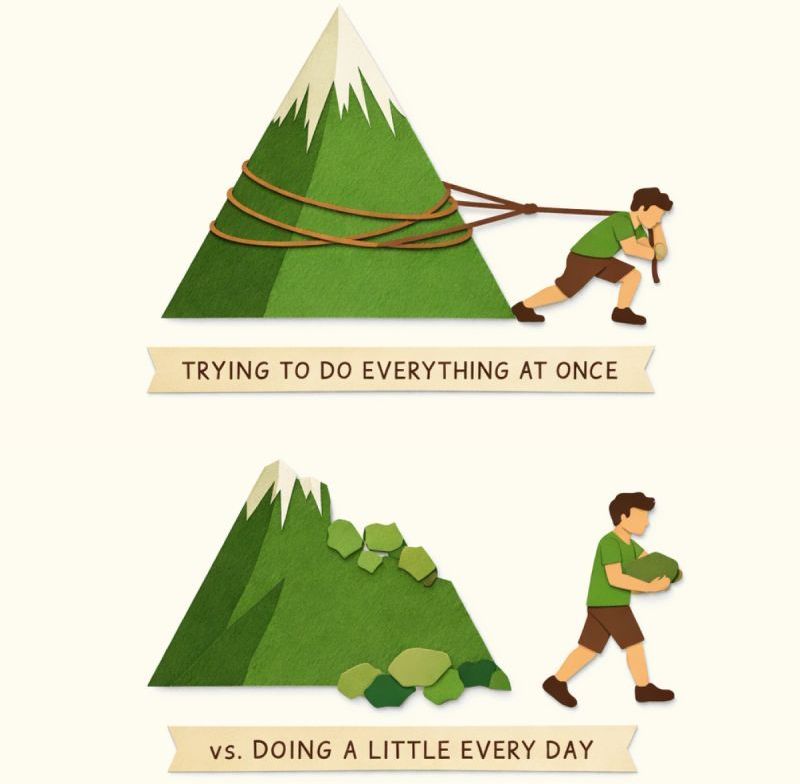
To eliminate the fear of doing, use small steps to sneak past the amygdala—that part of the brain that controls our response to fear. Simply thinking about making a major change even if it's a change for the better can set up a reaction in the amygdala. However, by stating our intentions to do so in small incremental steps, we can progress without setting off warning signals and sending our brains and our bodies into fight or flight. "Trying" uses mental energy to worry about outcomes, obstacles, and whether success is possible. It is often passive, like "trying to fall asleep." It already has potential failure trapped in its sight.
So when you change your "I'll try" into "I do," state them in terms of making small improvements. That way you can eliminate the "try" word, plus you deal with the fear of reaction you were perhaps suppressing by using the "I'll try" mindset. Let us also include the fear factor embedded in success: "What will they expect of me now?" Fear of success can cause us to subconsciously gravitate toward failure. Ultimately, we must be willing to take a deep breath and remember to feel the fear and do it anyway.
As a teenager, my brother tried an experiment on my trusting little-sister soul: he played with the power of suggestion. With closed eyes, I was convinced that my pre-teen stick arms could hold up his beefy weight as a steel bridge. Sure enough, I succeeded, and he fell to the floor. I often recall that dubious feat when faced with a challenge I'd rather not tackle. Within each of us is a stick-armed little one who can move mountains or ward off a bully. Or just calmly take good care of someone who is presently dancing on our last good nerve.
THE HIGHEST FORM OF MOTIVATION IS NOT DRIVEN BY REWARD OR FEAR, BUT BY MEANING AND CHOICE.
Nike says, "JUST DO IT!"
or
"THERE'S DOUBT IN TRYING. JUST DO IT!"
- TOBA BETA
| | |
— Karen Kelleher, MA
Family Caregiver Support Coordinator at DayBreak
| |
Upcoming Events & Workshops 📣 | |
Join Our Community of Care 💜
| | Your support helps DayBreak provide vital services that reduce isolation and help seniors live with dignity and connection. Be the change. Spread the love. Change a life. | | |
If you know an elder in need of our care and coordination services, or a caregiver seeking support, please encourage them to reach out to us at:
510-834-8314
| | | | |