March 25, 2024

In this issue:


  • Provost's Message: Student Engagement
  • Title IX Statement, Mandatory Reporting, & Resources
  • Roster Verification & Engagement Alert Form
  • Mid-Semester Advising Checklist (Lab Faculty)
  • New Resource: Big 10 Assessment Walkthrough
  • Reminder: CU Writing Tutors Available!

Quick Resources

3/18/24 Newsletter

Use this platform to share your work, connect with other CU Faculty, and spread the word on events, resources, and opportunities. Use this form to add to the CU Faculty Newsletter.

Provost's Message

Welcome Back CU Faculty!


I hope Term 2 is off to a good start. While the semester break can provide renewed energy for some, it can also be a time that interrupts the flow of learning for others and can shake student engagement. For CU staff, our work to support student engagement is continuous throughout the year with some additional attention at the beginning of each term. In order to effectively advance student engagement, we need your participation.


What’s Student Engagement and Why Does it Matter at CU?

Student engagement is expressed through a range of behaviors including active interaction with course materials, completing assignments, posting and responding to discussion board prompts, and consistent participation in the course. Although “attendance” is important. It is just one aspect of student engagement. At CU, we look at student engagement in a holistic manner, with an eye toward all of the ways that students might be supported to increase their connection to course content, to their peers, and to their faculty. We do this because we believe there is an important relationship between student engagement and students having a sense of belonging.


What CU Faculty Do To Support Student Engagement?

A significant body of research suggests that faculty who have a student-centered approach increase opportunities for student engagement, which in turn supports positive learning outcomes and academic success. There is also evidence that student engagement results in increased student attention and focus in the learning process and enhances critical thinking. 


Here are some specific things you can do to support student engagement:


  • Recognize that student engagement is not just on the student. As faculty, we have a responsibility to create an environment where active engagement is not only possible but is desired by students.
  • Talk with your students about how much you value their engagement. You can also let students know that they matter and their perspectives enhance the learning experience for everyone.
  • Be intentional about community-building in your course. Relationships matters and peer accountability can contribute to student engagement.
  • Check-in with students regularly. Use one-on-one meetings as an opportunity to develop a rapport with students and get to know what they care about. This also signals that you care about them.
  • Pay attention to student’s engagement in your course in Moodle. Are they active? If not, reach out to them right away. You might be the first faculty member in their educational experience who cared enough to reach out to them. It shows that you care. P.S. Don’t wait until weeks have passed to reach out.
  • Complete your Weekly Engagement Report in Moodle. It helps CU staff identify student engagement issues across courses so we can better support students.


Thank you for your commitment to CU students and the deep care that you bring to the learning experience of students.

Sincerely,

Sylvia

Title IX, Mandatory Reporting, & Resources

For purposes of Title IX reporting, CU faculty and staff members are considered “responsible employees.” This means College Unbound faculty and staff members are required to report instances of sexual misconduct, including harassment and sexual violence that come to their attention to the Title IX Coordinator. Making a report to the Title IX Coordinator is your obligation, meets the College’s goal of providing members of our community with supportive resources they might need, and enables the College to obtain a more accurate picture of the pervasiveness of gender-based violence in the CU community...


An important exception to the above reporting requirement exists for academic work. Disclosures that are shared as a relevant part of an academic project, class discussion, or course assignment, are not required to be disclosed to the College’s Title IX Coordinator.


Please read the full statement via the link below, which includes more information about Title IX and Mandatory Reporting at CU, as well as some further resources.

CU's Title IX Statement

Updates

Roster Verification & Sending Engagement Alerts


We will be introducing a new Form for Lab and Instructional Faculty to initiate an alert when a student on a course roster has not attended class and has not been in touch with faculty for 2 or more consecutive weeks.


At the beginning of a term, the Engagement Alert Form will be used as a Roster Verification to ensure that students are participating in the classes on their schedules before the session drop date. The drop date for Spring Session 2 is April 7th, 2024.


If you teach a Spring Session 2 course, after week-2 and week-3, please use the Engagement Alert Form to promptly alert CU administrative staff if a student has not attended class, submitted work, or been responsive to instructor communications.


This Engagement Alert Form can continue to be used when a student stops participating in a course at any point during the Semester. If you are teaching a Session 3 (16-week) course, and a student has not engaged or been responsive to communications, please fill out the form to alert Academic and Student Support staff.

Engagement Alert Form

Mid-Semester Advising Checklist - Lab Faculty


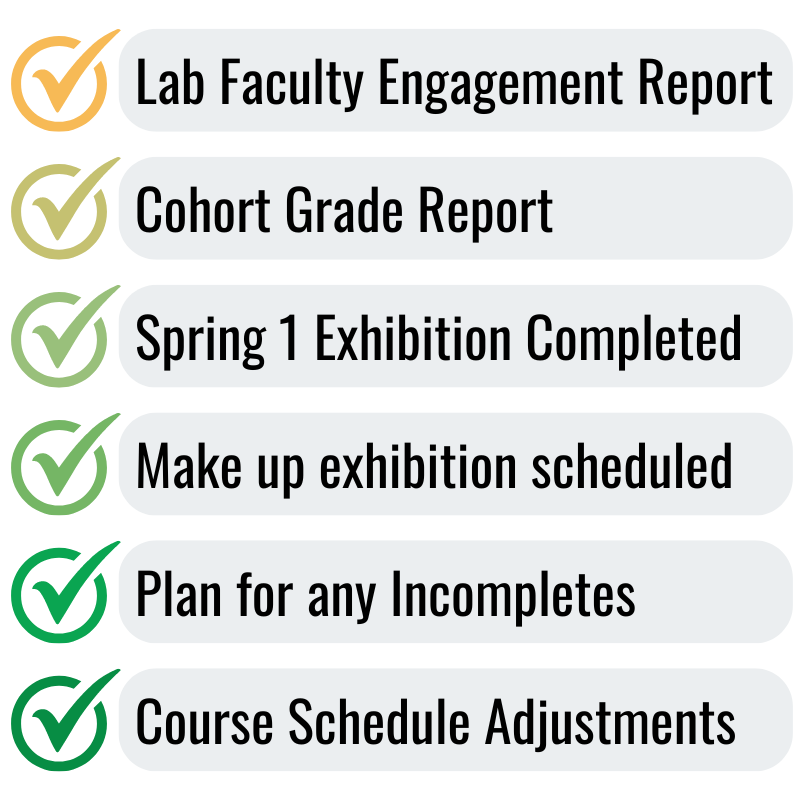
Lab Faculty have received a mid-semester advising checklist to support check-ins with students. Lab Faculty and students should review current academic status a this moment in the Semester.


The Guide and Checklist linked below provides an overview of the resources to help with check-ins, and information about Incompletes and Pre-Registration Planning for Summer & Fall.

Mid-Semester Advising Guide

New Resource: Big 10 assessment how-to


This new resource will be helpful for Lab Faculty and Assessment Specialists, who assess Big 10 portfolios.


We have created a video walkthrough (7min) of the Big 10 Assessment process. If you are Lab Faculty and have any questions about assessing Big 10 portfolios, please reach out to the LIP office at Big10@collegeunbound.edu.

Big 10 Assessment Walkthrough

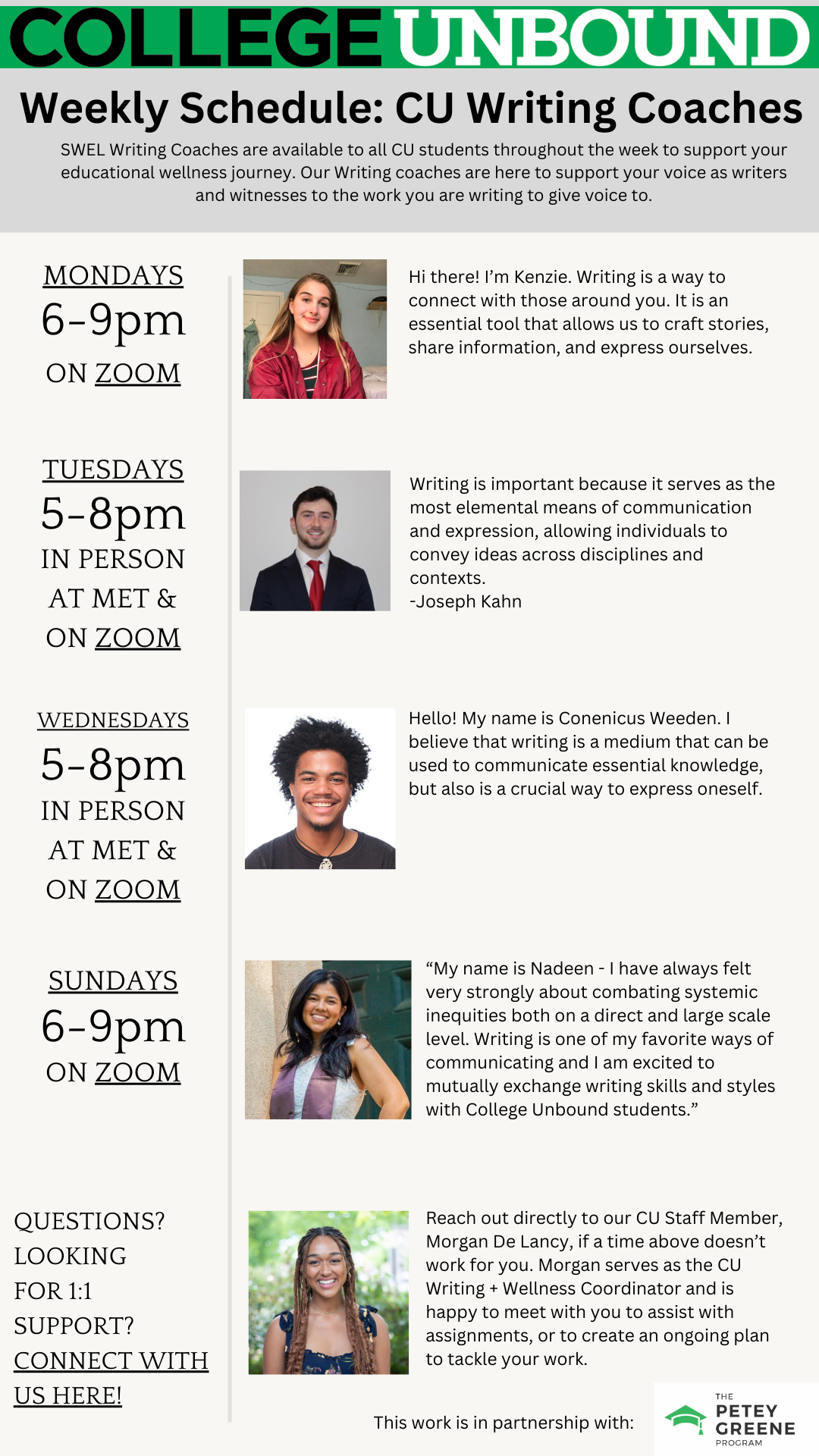
Reminder: CU Writing Coaches Available to Students!

Sincerely,


All of Us at College Unbound, including:

Sylvia Spears

Provost & VP for Lifelong Learning


Karen Casper

Assistant Provost for Administration and Planning


Aubrey Schabowsky

Director of Educator Preparation, TA2BA Program


Deborah Kronenberg

Assistant Dean of Curricular Integration


David Bromley

Director of CU Philadelphia/New Jersey


Sage Morgan-Hubbard

Director of Workplace & World Lab Learning

Lance Eaton

Director of Faculty Development & Innovation


Elizabeth Colon

Director of Learning in Public


Melina Kuchinov

Assistant Director of CU Philadelphia/New Jersey


Michael Reaves

Director of Alumni & Career Services


Nikki Andrews

Registrar


Matthew Sutherland

Assistant Registrar


Hanna Lichtenstein

Administrative Assistant, Lifelong Learning

Facebook  Instagram  LinkedIn  Twitter