January 22, 2024

In this issue:


  • Provost's Message
  • Appreciative Inquiry in giving student feedback
  • Artificial Intelligence Tool Usage Policy
  • Student Engagement
  • Important Reminders for Faculty

Quick Resources

1/9/24 Newsletter

Provost's Message

Greetings CU Faculty,


Our goal is to create a beloved community. And this will require a qualitative change in our souls as well as a quantitative change in our lives.”

Martin Luther King, Jr.


What an exciting time it is at CU. No matter how many semester launches I have witnessed in the course of my career in higher education, I continue to find myself in awe of the liveliness that the start of a new semester brings. It is as if the window flew open on a windy day, bringing a swirl of fresh energy and vitality. 


In the midst of all of this renewed energy, I am reminded of how we come together. New students gingerly make their way into the CU community. New faculty step with hope into relationships with CU students. And returning students, staff, and faculty are drawn together in hugs and celebration of what has been accomplished and what is yet to come. This is a kind of magic that can only be found in the context of a community of care. I thank CU Faculty for all of the ways that you spread an ethic of care across the College. 


I also want to offer a special shout-out to the Lifelong Learning team  - Aubrey Schabowsky, Deborah Kronenberg, Hanna Lichtenstein, Karen Casper, Lance Eaton, Lizz Colon, Melina Kuchinov, Matthew Spencer-Sutherland, Michael Reaves, Nikki Andrews, and Sage Morgan-Hubbard - for the important but often invisible work they do in support of CU faculty and students. I C U and appreciate you. 


As we move into the semester, let us all continue to embrace an ethic of care and a shared commitment to manifesting the Beloved Community.


Sincerely,

Sylvia

Faculty Tools

Giving student feedback and perspective through Appreciative Inquiry


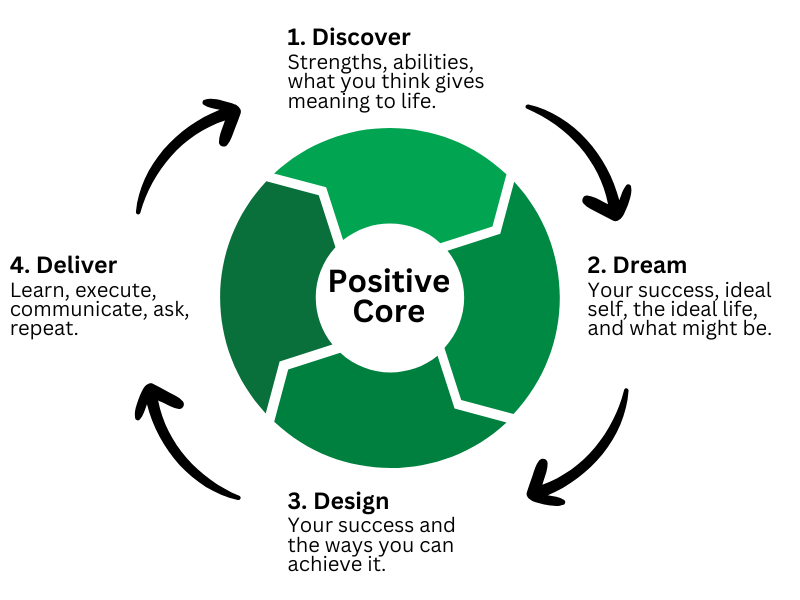
What if we shared perspective and feedback with the positive first? What if our lens was that of appreciation more than looking to find holes or gaps within an argument? This is the power of Appreciative Inquiry. It helps us find the beauty and best in things before going into critique.


Appreciative Inquiry is an approach to organizational development, focusing on positive change through a 4-D cycle: Discovery, Dream, Design, Delivery.

Utilizing appreciative inquiry with students is crucial to fostering a positive and empowering learning environment. Focusing on strengths, achievements, and what works well enhances motivation, collaboration, and overall student engagement in the educational process.


So how can you begin to use Appreciative Inquiry with your students this semester? Here are ten potential questions that you can use in 1-1 meetings with students or in your assignments:


  1. What aspects of our learning environment do you find most inspiring and motivating?
  2. Can you share a memorable experience in this class where you felt fully engaged and excited to learn?
  3. How have your classmates positively influenced your learning journey?
  4. Reflect on a time when you overcame a challenge. What strengths did you tap into during that experience?
  5. What goals do you have for your personal growth in this subject, and how can we support your progress?
  6. In what ways can we build on our past successes to make this learning experience even more fulfilling for everyone?
  7. Describe a moment when you felt a strong sense of collaboration and teamwork with your peers.
  8. How can we leverage your unique talents and interests to enhance the overall learning dynamic?
  9. Share a project or assignment where you felt your creativity made a significant impact. How can we replicate that success?
  10. What learning activities bring you the most joy and satisfaction, and how can we incorporate more of them into our lessons?


Some of you might already be using Appreciative Inquiry or already know of it. Please share your thoughts and additional questions or suggestions with us in Lifelong Learning!

We want this to be a place of open dialogue and learning best practices and tools together. Feel free to write to Sage at Sage.Morgan-Hubbard@collegeunbound.edu to continue this conversation.

Learn more about Appreciative Inquiry here.

New Faculty Resource Site


We have been working on a CU Faculty Resource Site - a new in-construction hub for Faculty resources. We are doing a soft launch of the site to gather feedback and make it available as we continue to build.

Share your teaching tips, tools, and stories for the next Faculty Newsletter

Use this form to share

Policy Update

Artificial Intelligence Tool Usage Interim Policy


We know that students have been occasionally using generative AI (such as ChatGPT and the like) in their course work.  


Please review our temporary policy and our advice to faculty. If you have additional questions, please feel free to reach out to Lance Eaton for additional ideas and approaches.  

Reminders

Student Engagement


Student engagement is a critical component of student success. Engagement or attendance takes on different meanings in synchronous and asynchronous courses but communication is important in all formats, especially in the first weeks of every session.


All CU Faculty should use the Semester Engagement module in their Moodle course(s) to report weekly engagement for their students no later than the following Monday morning. Please include comments for any students marked as unexcused absence, not engaged or engaged but needs follow up. Information on how to report this information in Moodle can be found on the Faculty Resource Site here.

Important reminders for Lab Faculty


CU Lab classes are scheduled for three full hours. This time is critical for the CU curriculum, as well as accreditation and learning purposes. Please make sure that you start on time and stay the entire time. Your students and the entire College Unbound staff thank you for your cooperation and understanding!

Lab Faculty Role & Responsibilities

Important reminders for Instructional Faculty


Keep in Touch with Lab Faculty

Throughout the course as students show signs of doing great or indicating they need help or are struggling, be sure to reach out to their Lab Faculty.  Keeping Lab faculty informed about the highs and lows of our students is crucial in supporting their success and their learning.  


How to find a student’s Lab Faculty

  1. Log into Campus Cafe/MyCU
  2. Select "Choose one" in the middle of the screen
  3. Select the current semester
  4. Select Roster
  5. Select the 3 dots to the left of the student's name
  6. Select Contact Info
  7. On this page, you'll see student's personal contact info and lab faculty
  8. If no Lab Faculty is listed, then reach out to Karen Casper (karen.casper@collegeunbound.edu).

Sincerely,


All of Us at College Unbound, including:

Sylvia Spears

Provost & VP for Lifelong Learning


Karen Casper

Assistant Provost for Administration and Planning


Aubrey Schabowsky

Director of Educator Preparation, TA2BA Program


Deborah Kronenberg

Assistant Dean of Curricular Integration


David Bromley

Director of CU Philadelphia/New Jersey


Sage Morgan-Hubbard

Director of Workplace & World Lab Learning

Lance Eaton

Director of Faculty Development & Innovation


Elizabeth Colon

Director of Learning in Public


Melina Kuchinov

Assistant Director of CU Philadelphia/New Jersey


Michael Reaves

Director of Alumni & Career Services


Nikki Andrews

Registrar


Matthew Sutherland

Assistant Registrar


Hanna Lichtenstein

Administrative Assistant, Lifelong Learning

Facebook  Instagram  LinkedIn  Twitter