|
Dear friends and alumni,
Preparing for an expected winter of discontent with federal environmental policy, we in the Environmental Law Clinic feel lucky to be in California, and at UC Berkeley, where forward motion will remain possible! We’re also grateful that many of our projects involve capacity building for the long term. Read on to see how even as we engage in the traditional clinic work of filing lawsuits and training students in client representation, we’re working to support the growth and ambition of environmental law clinics abroad; to help concerned citizens transform planetary worry into action through a novel e-platform connecting environmental activists to environmental filmmakers; and to generate and disseminate academic research that can help defend environmental regulations from attack, and even, support their expansion.
We’re deeply grateful for your support, and send all good holidays wishes. In the ever-more-apt words of poet Wendell Berry: “Be joyful though you have considered all the facts.”
| |
|
Claudia Polsky
Director, Environmental Law Clinic
| |
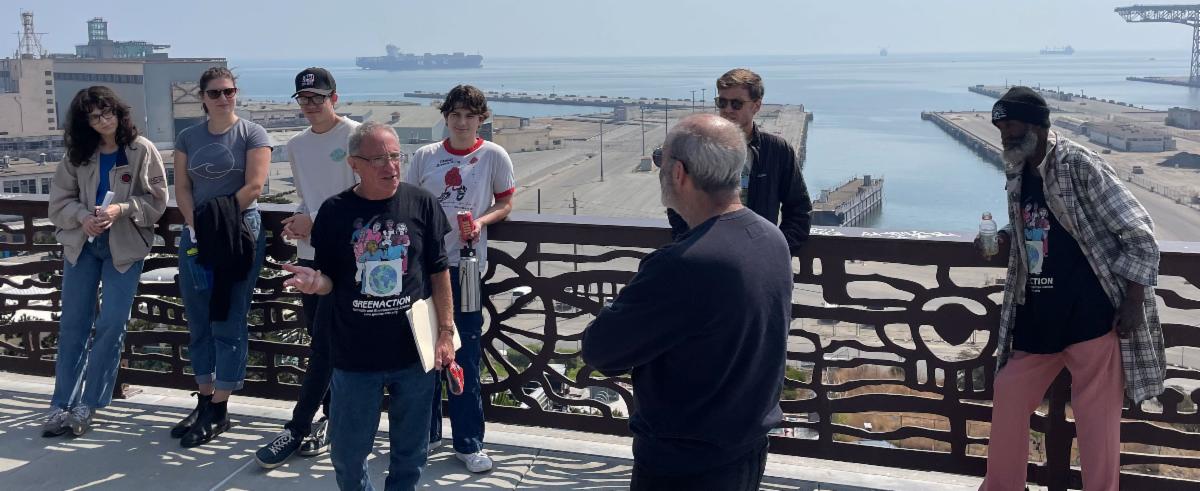
Bradley Angel, executive director of client Greenaction for Health and Environmental Justice (with folder), and community organizer Leaotis Martin (far right) talk to Supervising Attorney Steve Castleman (back to camera) and ELC students (left to right) Jordan Barton '25, Ellie Rubinstein '25, Will Reynolds, '25, Ryan Laws '25, and Connor Hughes '25 about radioactive contamination at the Hunters Point Naval Shipyard in San Francisco. | |
ELC lawsuit over Naval site cleanup in S.F. yields early results | |
|
In June, ELC filed a lawsuit on behalf of the environmental group Greenaction for Health and Environmental Justice, alleging that the Navy and EPA have dangerously botched the radiological cleanup at San Francisco’s only Superfund site, the Hunters Point Naval Shipyard. The filing, which alleges multiple violations of the Comprehensive Environmental Response, Compensation, and Liability Act (CERCLA), culminates an investigation ELC conducted across three semesters. The suit seeks a court order requiring that the Navy and EPA do a proper cleanup.
The radiological cleanup, which took roughly a decade, was marred by fraud committed by the Navy’s contractor, Tetra Tech, EC, Inc., and serious quality assurance and quality control deficiencies. This forced the Navy to discard all Tetra Tech’s work and initiate a retesting program. Although Greenaction fought to have 100% of the contractor’s work redone, the Navy and EPA agreed to screen only one-third of the previously “remediated” soil. They further committed to do 100% soil screening if the one-third rescreening found contamination. Contamination was, in fact, found in all three of the parcels undergoing retesting so far, but prior to ELC’s court filing, the Navy refused to fulfill its commitment to complete retesting.
Greenaction has already scored a significant victory: since our lawsuit was filed, the Navy has agreed to 100% soil retesting in two of the three parcels at issue. ELC continues to pursue full retesting on the third parcel.
The suit also alleges the Navy failed to live up to its obligation to demonstrate, through formal reviews every five years, that the cleanup protects human health and the environment. It alleges the Navy adopted impermissibly lax radiological cleanup standards and has refused to update them in its last two five-year reviews, as required by CERCLA. The fight continues; stay tuned!
| |
Visiting scholar studies ELC as model for future environmental clinic in Türkiye | |
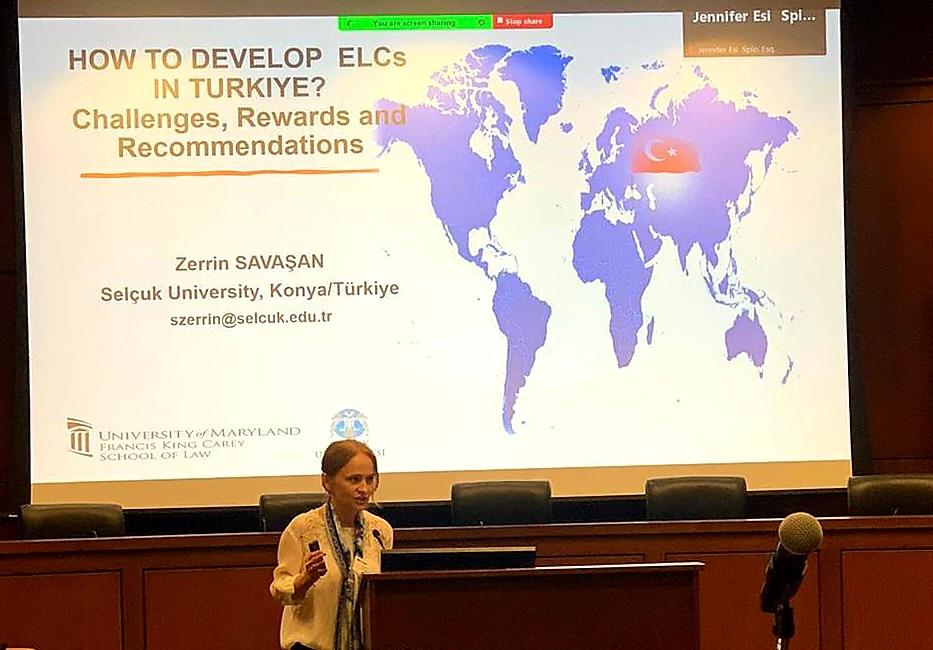
Zerrin Savaşan from Selçuk University presenting on how to develop environmental law clinics in Türkiye. | |
This fall, Turkish legal academic Zerrin Savaşan from Selçuk University has introduced something brand new to her country’s legal academy: a course in practical lawyering skills for environmental advocates that she intends as a first step towards establishing the nation’s first environmental law clinic. In a collaboration two years in the planning, Zerrin spent the spring 2024 semester in the Bay Area observing ELC’s classroom instruction and project team meetings; interviewing our staff and students; and learning how environmental law clinics fit into the advocacy ecosystem. Zerrin ultimately presented her vision for a Turkish environmental law clinic at an international conference of environmental law clinicians in Maryland. Zerrin writes of her time with us: My research was based on observation and active participation in the activities of the Berkeley ELC. The clinic not only helped me learn about the clinical education system and its functioning, and make findings that could shed light on the establishment of ELCs in Türkiye; it also helped me understand the feelings and views of the people I met (students, clinicians, community members). Seeing that students so enjoyed the course, while also learning, was consistent with the motto Enjoy, Engage, Learn (ELE) that I base my courses on; I see how right I was to be at Berkeley for this work. ELC staff stood by me as friends and colleagues and helped me in many matters, from scholarship to housing accommodations. Without the Director’s endless patience, determination, and encouragement, I would have long ago given up on this valuable work. My new course in Türkiye has more than 80 enrolled students, including both law students and members of nonprofit organizations! Thank you, ELC. | |
Collaboration with environmental filmmaker aims to channel outrage into action | |
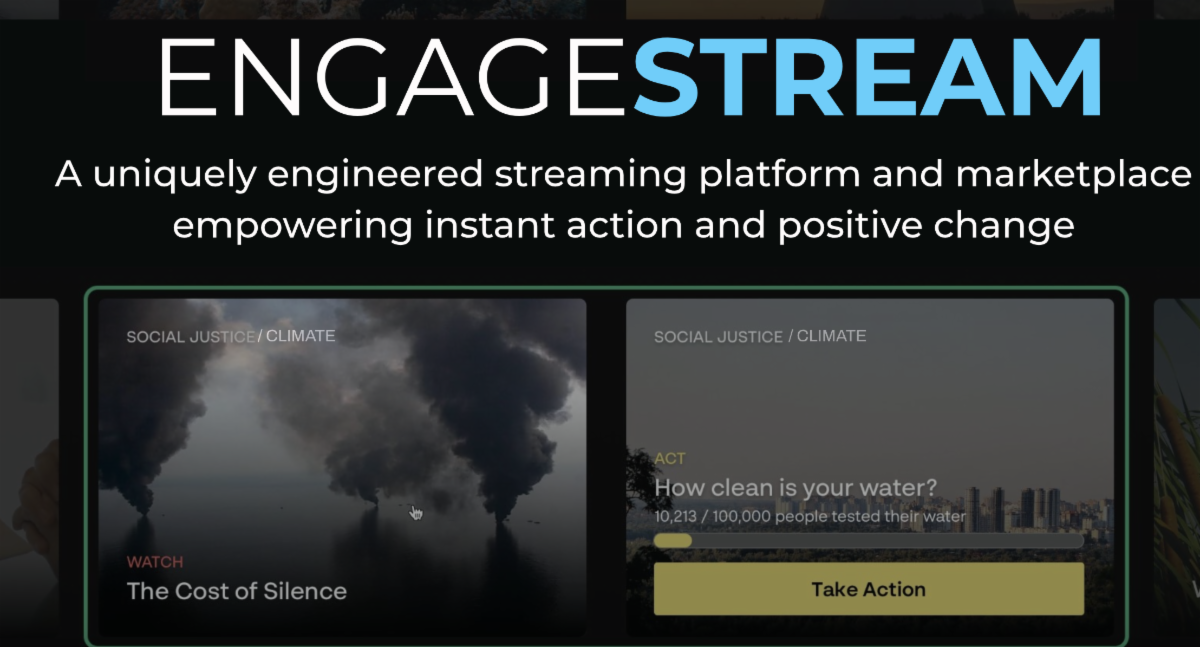
Pandemic movie theater closures deprived documentary filmmaker Mark Manning of a commercial venue for his Sundance-award-winning film about the human health toll of the BP Deepwater Horizon Oil Spill, The Cost of Silence. Pondering his options, he decided to go big rather than go home. Watching the moral outrage his film had provoked among viewers at its early screenings, Mark wondered how to take the audience’s energy and direct it to relevant advocacy activity. From this question came the notion of a virtual impact platform that would connect viewers of issue films with concrete actions they could take to advance the underlying advocacy causes. Mark hopes to launch his EngageStream platform in Spring 2025; the concept is previewed here. ELC has brainstormed with Mark about this venture; helped raise funds to support platform development; and begun to envision how ELC clients and students could add advocacy ideas to the mix. | |
ELC hosts Global Day of Action event on PFAS | |
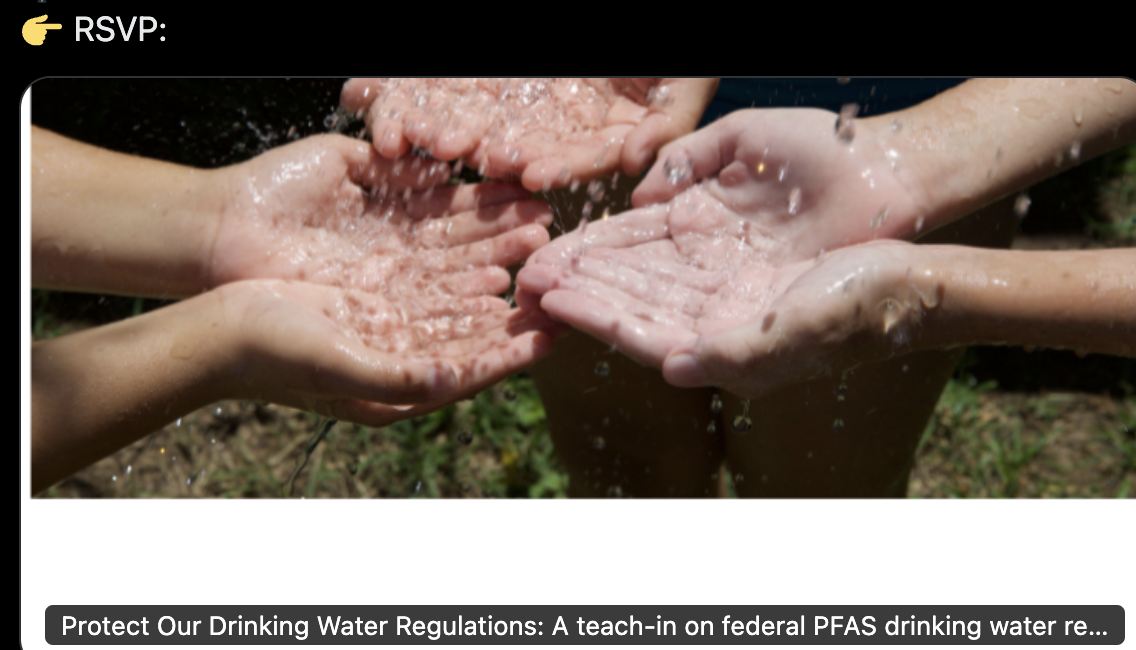
In November, ELC joined a Global Day of Action by environmental law clinics worldwide, organized by the University of York in England. Consistent with this year’s theme of Water, ELC hosted a discussion led by leaders of community group and ELC client Clean Cape Fear (CCF) for JD, LLM, and undergraduate students that focused on protecting federal drinking water standards for PFAS. CCF has been a leader in the fight against the Chemours’ corporation’s pollution of North Carolina’s drinking water with these chemicals, and helped to generate the public pressure culminating in EPA’s issuance of the first enforceable federal drinking water standards for several PFAS last spring. Earlier this fall, as a result of CCF’s and ELC’s work to bring domestic PFAS contamination to the attention of the UN Human Rights Council, the UN Special Rapporteur on Toxics and Human Rights lauded CCF co-founder Emily Donovan as a human rights defender, and invited her to speak at a side event at the UN General Assembly. In recent weeks, CCF and ELC have been asked to provide guidance to a law clinic in France that hopes to emulate our UN strategy to address that country’s PFAS contamination. | |
ELC alumnae become UC Berkeley colleagues | |
|
The hardest part of each clinic semester is saying goodbye to the students we’ve come to love, as we release them to other courses or to graduation. That makes it particularly gratifying when former students stay near, by immediately becoming Berkeley Law colleagues! We’re accordingly thrilled that ELC alumna Linda Gordon (JD ‘23) has become the inaugural Climate Justice Program Manager at the UC Berkeley Human Rights Center, and ELC alumna Chloé Smith (LLM ‘24) has become a Climate Change Research Fellow at UC Berkeley’s Center for Law, Energy, and the Environment; both will continue to work on issues connected to the passions they manifested in ELC.
| |
|
While the clinic hums this academic year under the able direction of staff attorney Steve Castleman, the Director’s sabbatical is providing an opportunity for policy-relevant research and writing. As example, this recently published study on toxic chemicals biomonitored by the federal Centers for Disease Control, co-authored with scientific collaborators at the UC Berkeley School of Public Health and the Silent Spring Institute in Massachusetts, reveals that Californians generally have lower levels of toxic chemicals in their bodies than the rest of the U.S. population. We attribute this encouraging outcome to our state’s more stringent environmental regulations. The Guardian, the LA Times, and the business magazine Fast Company have all taken note. We hope that despite current political headwinds, such pieces can help make the case for preserving and strengthening environmental regulations.
| |
Clinical Program releases 2023-2024 annual report | |
|
Last year, 225 students enrolled in our 14 clinics, collaborating with faculty, staff, and clients to advance justice in the East Bay, nationally, and globally. Please take a look at the Clinical Program’s annual report to learn more.
| |
Thank you for supporting our work! | | | | |