|
LEGACY CAPITAL ADVISORS LLC
Chris Schiefer, CFP®
Investment Advisor Representative
732 W Market Street
Tiffin, OH 44883
419-448-0545
800-589-9740
Chris@lcadvisorsllc.com
www.legacycapitaladvisorsllc.com
| | |
As the leaves change and the air turns crisp, we welcome the fall season with gratitude for the
trust you place in us. We’re excited for the opportunities this new season holds and happy to
be on this journey with you.
$ Money Matters $
| |
Boomer Homeownership and Retirement
With the youngest baby boomers turning 60 in 2024, a survey from mortgage agency Freddie Mac looked at the
relationship of boomer homeownership to retirement and aging. Here are some of the findings. All percentages
apply to baby boomers (born 1946 to 1964), who hold about half the nation's home equity, amounting to more
than $17 trillion.
| | Will You Pay a Medicare Surcharge? | | |
Medicare is a federal program that provides health insurance to retired individuals, regardless of their medical condition, and certain younger people with disabilities or end-stage renal disease. Medicare has several parts, many of which include a premium cost based on your tax filing status and income. If your income is high, in some cases you may be subject to a premium surcharge called the income-related monthly adjustment amount (IRMAA).
What does Medicare cover?
Medicare coverage consists of two main parts: Medicare Part A (hospital insurance) and Medicare Part B (medical insurance). These parts together are known as Original Medicare. A third part, Medicare Part C (Medicare Advantage), covers all Part A and Part B services and may provide additional services. A fourth part, Medicare Part D, offers prescription drug coverage that can help you handle the rising costs of prescriptions.
What does Medicare cost?
Most people age 65 or older who are citizens or permanent residents of the United States are eligible for Medicare Part A without paying a monthly premium.
Although Medicare Part B is optional, most people sign up for it. If you want to join a Medicare Advantage plan, you'll need to enroll in both Parts A and B. And Medicare Part B is never free — you'll pay a monthly premium for it, even if you are eligible for premium-free Medicare Part
A. If you delay starting Part B or Part D after age 65, you may also be subject to a surcharge unless you continue to work and are covered by a workplace health plan.
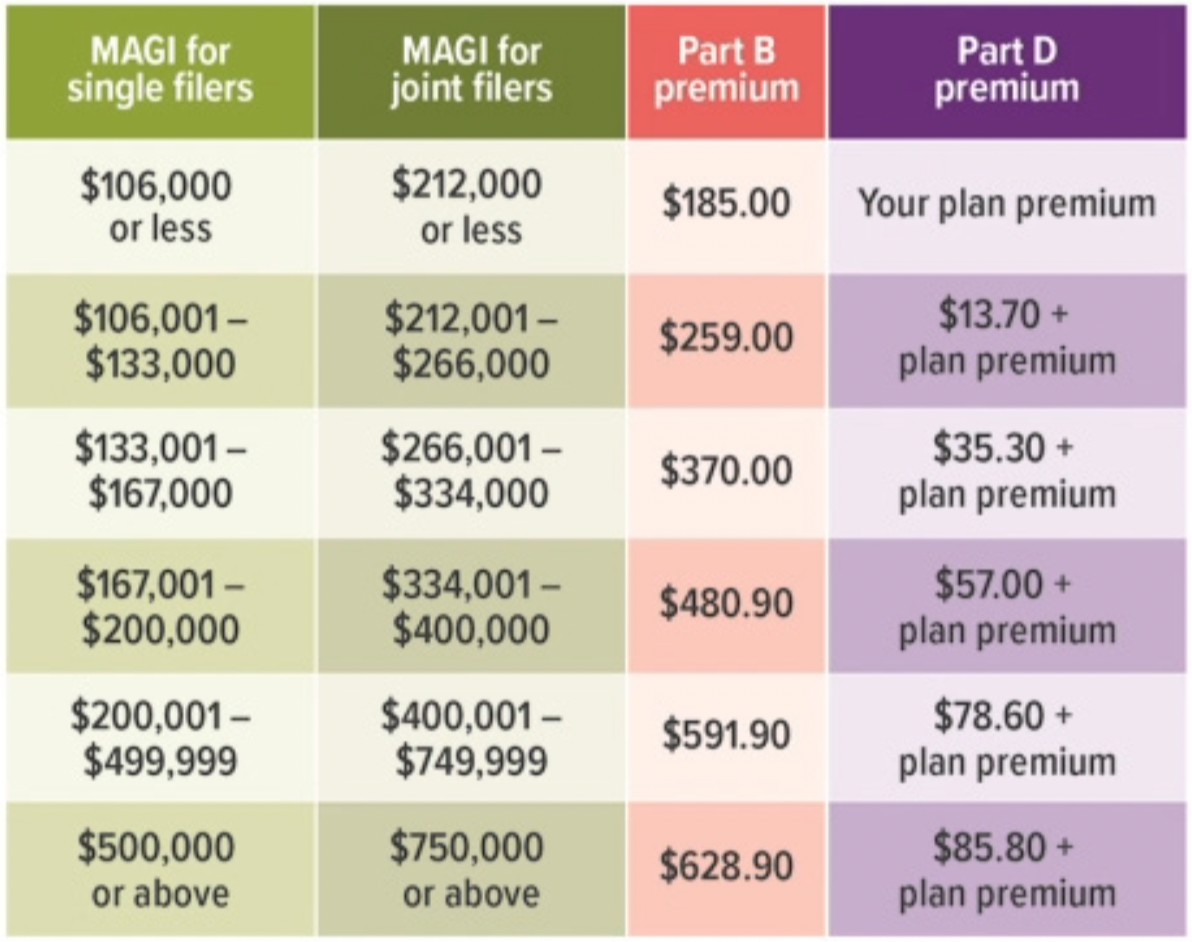
The standard Part B premium is $185.00 in 2025. However, premiums for Part B and Part D can vary based on income levels. If your modified adjusted gross income (MAGI) as reported on your federal income tax return from two years ago is above a certain amount, you'll pay the standard premium plus the IRMAA surcharge. You'll receive a notice from the Social Security Administration if you're subject to IRMAA.
| |
The table shows what you'll pay per month in 2025 based on your tax filing status and income: | Premiums for 2025 are based on MAGI for the 2023 tax year. Source: Centers for Medicare & Medicaid Services, 2024 | |
What can you do to lower your income?
Most people may see a decline in their income once they retire. However, high-income Medicare recipients may want to lower their income to help reduce the potential premium surcharges. Here are some ideas:
- Put off transactions that could increase income, such as the sale of real estate or stocks.
- Defer distributions from tax-qualified accounts such as IRAs and 401(k)s as long as possible.
- Rethink the timing of converting IRA funds to a Roth IRA to avoid increased taxable income.
Since your income is based on information from two years ago, it may subsequently change, or you may experience a life-changing event (as defined by the SSA) that causes a reduction in your income. Report income changes to the SSA as soon as possible.
You'll need to provide documentation verifying the event and your reduction in income. Visit https://www.ssa.gov/benefits for more information.
Get help
Navigating Medicare programs and their costs can be tricky. You might consider consulting with an appropriately qualified professional for help.
| | Tax and Spending Bill Signed into Law | | | | |
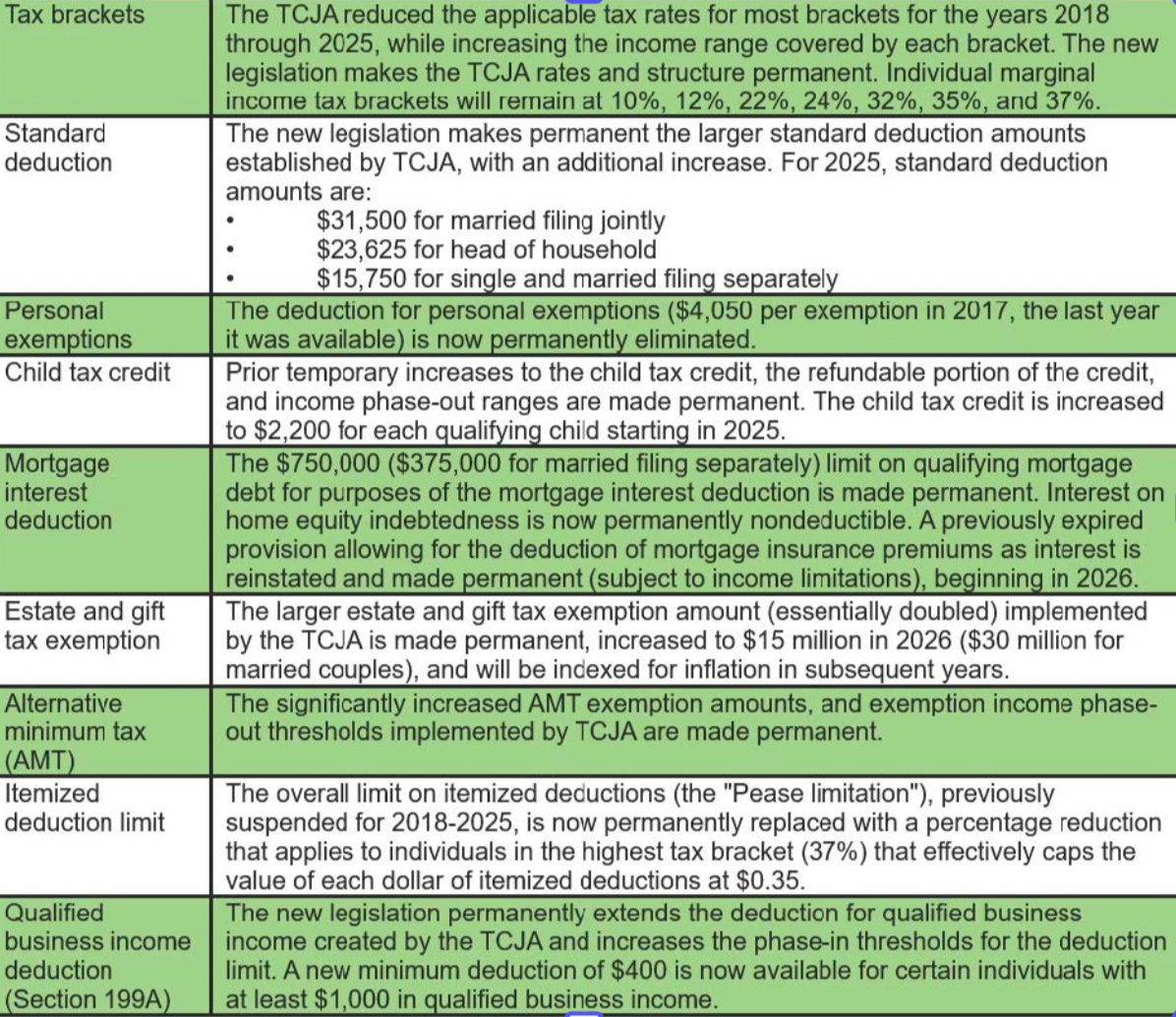
President Trump signed into law the One Big Beautiful Bill Act (OBBBA) on July 4, 2025, after months of deliberation in the House and Senate. The legislation includes multiple tax provisions that will guide individuals, business owners, and investors in planning their finances for many years to come. It makes permanent most of the 2017 Tax Cuts and Jobs Act (TCJA) tax provisions that were set to expire this year, while delivering some new deductions and changes.
Expiring provisions that are now permanent
| | |
Existing provisions with material changes
The One Big Beautiful Bill Act also makes some significant changes to other provisions, some temporary but others permanent. Two of the changes that received significant coverage leading up to passage and enactment include a temporary increase in the limit on allowable state and local tax (SALT) deductions and the rollback of existing energy tax incentives.
State and local tax (SALT) deduction
The new legislation temporarily increases the cap on the state and local tax deduction from $10,000 to $40,000. This increased cap is retroactively effective for 2025. The $40,000 cap will increase to $40,400 in 2026 and by 1% for each of the following three years.
The cap is reduced for those with modified adjusted gross incomes exceeding $500,000 (tax year 2025, adjusted for inflation in subsequent years), but the limit is never reduced below $10,000.
In 2030, the cap will return to $10,000.
Repeal and phase-out of clean energy credits
The new legislation significantly rolls back energy-related tax incentives. Provisions include:
- The Clean Vehicle Credit (IRC Section 30D), the Previously Owned Clean Vehicle Credit (IRC Section 25E), and the Qualified Commercial Clean Vehicles Credit (IRC Section 45W) are eliminated effective for vehicles acquired after September 30, 2025. The Energy Efficient Home Improvement Credit (IRC Section 25C) and the Residential Clean Energy Credit (IRC Section 25D) are repealed for property placed in service after December 31, 2025.
- The New Energy Efficient Home Credit (IRC Section 45L) will expire on June 30, 2026; the credit cannot be claimed for homes acquired after that date.
- The Alternative Fuel Vehicle Refueling Property Credit (IRC Section 30C) will not be available for property placed in service after June 30, 2026.
| | |
Gambling losses
The new law changes the treatment of gambling losses, effective as of 2026. Before the legislation, individuals could deduct 100% of their gambling losses against winnings (the deduction could never exceed the amount of gambling winnings); now, a new cap limits deductions to 90%.
Bonus depreciation and Section 179 expensing
Prior to this legislation, the additional first-year "bonus" depreciation was being phased out, with the maximum deduction dropping to 40% by 2025. The new legislation permanently establishes a 100% additional first-year depreciation deduction for qualifying property, allowing businesses to deduct the full cost of such property immediately. The 100% additional first-year depreciation deduction is available for property acquired after January 19, 2025.
Effective for property placed in service in 2025, the legislation also increases the limit for expensing under IRC Section 179 from $1 million (indexed for inflation) to $2.5 million, and it increases the phase-out threshold from $2.5 million (indexed for inflation) to $4 million.
New provisions
The One Big Beautiful Bill Act also contains multiple new tax deductions that are intended to represent a step toward fulfilling campaign promises made to end taxes on Social Security, tips, and overtime. These new deductions are temporary, but other changes, like allowing individuals who do not itemize deductions to deduct some amount of qualifying charitable contributions, are permanent.
Deduction for seniors
Effective for tax years 2025–2028, the legislation creates a new $6,000 deduction for qualifying individuals who reach the age of 65 during the year. The deduction begins to phase out when modified adjusted gross income exceeds $75,000 ($150,000 for married filing jointly).
Tip income deduction ("no tax on tips")
Effective for tax years 2025–2028, for the first time, tip-based workers can deduct a portion of their cash tips for federal income tax purposes. Individuals who receive qualified cash tips in occupations that customarily received tips prior to January 1, 2025, may exclude up to $25,000 in reported tip income from their federal taxable income. A married couple filing a joint return may each deduct up to $25,000. The deduction phases out at a modified adjusted gross income of $150,000 for single filers and $300,000 for joint filers. This provision applies to a broad range of service occupations, including restaurant staff, hairstylists, and hospitality workers.
Overtime deduction ("no tax on overtime")
A new temporary deduction of up to $12,500 ($25,000 if married filing jointly) is established for qualified overtime compensation.
The deduction is phased out for individuals with a modified adjusted gross income of over $150,000 ($300,000 if married filing jointly). The deduction is reduced by $100 for each $1,000 of modified adjusted gross income exceeding the threshold. To claim the deduction, a Social Security number must be provided. The deduction is available for tax years 2025–2028.
Investment accounts for children ("Trump accounts")
A new tax-deferred account for children under the age of 18 is created, effective January 1, 2026. With limited exceptions, up to
$5,000 in total can be contributed to an account annually (the $5,000 amount is indexed for inflation). Parents, relatives, and employers, as well as certain taxable, nonprofit, and government organizations, may make contributions. Contributions are not tax-deductible. For children born between 2025 and 2028, the federal government will contribute $1,000 per child into eligible
accounts. Distributions generally cannot be made from the account prior to the account holder reaching the age of 18, and there are restrictions, limitations, and tax consequences that govern how and when account funds can be used. To have an account, a child must be a U.S. citizen and have a Social Security number.
Charitable deduction for non-itemizers
The legislation reinstates a tax provision that was previously effective for tax year 2021. A deduction for qualifying charitable contributions is now permanently established for individuals who do not itemize deductions. The deduction is capped at $1,000 ($2,000 for married filing jointly). Contributions must be made in cash to a public charity and meet other specific requirements. This deduction is available starting in tax year 2026.
Car loan interest deduction ("no tax on car loan interest")
For tax years 2025–2028, interest paid on car loans is now deductible for certain buyers. Beginning in 2025, taxpayers who purchase qualifying new vehicles assembled in the United States for personal use may deduct up to $10,000 in loan interest annually. The deduction is phased out at higher incomes, starting at a modified adjusted gross income of $100,000 (single filers) or $200,000 (joint filers).
There's more …
The One Big Beautiful Bill Act includes broad and sweeping changes that will have a profound impact. While income and estate tax provisions are highlighted here, the legislation also makes fundamental changes impacting areas such as health care, immigration, and border security. There are also additional tax changes made by the legislation that are not mentioned in this summary. Additional information and details will be available in the coming weeks and months. As always, if you have questions about how these changes affect your specific situation, consider consulting a tax professional.
Securities offered through Registered Representatives of Cambridge Investment Research, Inc., a broker-dealer, member FINRA/SIPC. Advisory services offered through Cambridge Investment Research Advisors, Inc.,
a Registered Investment Advisor. Legacy Capital Advisors LLC and Cambridge are not affiliated
| | Checking in with Chris$$$$$$$$$$$$$$$$$$$ | | |
The past three months have brought about significant changes across economic, geopolitical, and technological landscapes. Let's take a closer look at each of these areas and explore where we're headed:
Economic: The economy remains resilient, even amidst a higher interest rate environment
Housing: The housing market remains constrained by interest rates that are still too high for the current stage of the economic cycle. Housing starts have declined significantly from their highs earlier this year, and homebuilders are offering substantial incentives to move inventory. The existing home market has shifted in favor of buyers, with nearly 40% of listings seeing price reductions within just 30 days. Despite this, the average home price has reached an all-time high of nearly $435,000.
Mortgage rates on 30-year loans dropped to a near one-year low following weaker-than-expected employment data, which also pushed down yields on 10- to 30-year maturities and lifted prices for gold, silver, and other hard assets. While consumers are still spending, the pace has slowed, and spending patterns are shifting in new directions.
Retail; Discount retailers such as Dollar Stores, Wal-Mart, Costco, and Ollie’s posted double-digit sales growth this quarter as consumers across all income levels continue seeking bargains. High-end retailers are also performing well, while mid-tier chains—like Target—experienced the sharpest sales declines. Macy’s reported notably improved results, as years of store closures have finally translated into higher profitability.
Tariffs remain an economic wild card, with their ultimate impact on inflation still unclear. Currently, the cost burden appears to be shared roughly equally among manufacturers, importers, and end consumers.
Artificial Intelligence Growth – AI is expected to become a major economic tailwind, driving accelerated growth in 2026 and 2027. Tech giants such as Amazon, Alphabet, Meta, Microsoft, and Oracle are investing hundreds of billions of dollars in data centers across the country. Mentions of AI initiatives in company quarterly reports have tripled since 2022, and roughly 25% of all IT job postings now list
AI-related skills as a requirement.
Power; The surge in data center construction is also fueling growth in the power generation sector. GE Vernova, Modine Manufacturing, Constellation Energy, Oklo, are racing as fast as they can get permits to increase production. Power companies are requesting emergency rate increases to deal with the buildout and transmission issues. We as a country have underbuilt our electrical grid for more than 60 years, and they are all trying to play catch up.
Are we spending too much? I would say no. We need to run toward the “fire,” not away from it. The country that leads in developing AI and power generation will dominate the global economy for the next 50 years or more. This is not a repeat of the “Dot-Com” bubble of 2000, when companies rushed to buy anything tied to Y2K. That era was about hardware, connectivity, and information. The AI era,
by contrast, is about gaining knowledge at an unprecedentedly low cost.
| |
The major hyperscalers are already highly profitable and are accelerating their investments to win the AI race. Google, for example, recently announced plans to boost its 2026 capital budget from $85 billion to $115 billion, with many other tech giants making similar moves this quarter. We likely haven’t even seen the biggest winners of the AI revolution yet—they are only now emerging.
Companies such as CoreWeave, Circle, Roblox, Uber, and numerous software-as-a-service firms are well-positioned to become the next major beneficiaries of AI-driven productivity.
Eras of Productivity – Few periods in history have offered as much potential for productivity and profit as we see today. GDP growth could accelerate to 4% within the next two years as supply chain and tariff challenges ease and new data centers come online. Technology is advancing at a remarkable pace, with tools like GROK, ChatGPT, and Perplexity reshaping entire industries in just months. Companies worldwide are rapidly integrating AI into their daily operations, and as they experience lower costs and higher output, they are dedicating even more resources to employee training and the adoption of agentic AI.
Labor – Initially, we may see some layoffs as companies adopt new technologies that require less human capital. Similar to the Dot-Com era, this period of disruption is likely to be followed by the creation of new, higher-paying and more in-demand opportunities once the transition settles.
Economists are now beginning to factor AI into their models, accounting for the productivity and efficiency gains it is expected to generate. The fields likely to benefit first include law, software development, and other tasks traditionally handled by entry-level and high-wage technical roles.
Employment levels are expected to stabilize over the coming months and then rise significantly as the effects of the legislation passed in July begin to take hold.
The economy does look like it will be slowing down throughout the rest of the year and then reaccelerate into the new year and beyond.
The Federal Reserve – At their annual policy meeting in Jackson Hole, Wyoming, the Fed signaled plans to shift toward a less restrictive stance—essentially, to begin cutting interest rates. The first cut is expected in September, followed by another in November or December. They indicated a longer- term goal of reducing rates from the current 4.25%–4.5% range to around 3%–3.25% by the end of 2026—just ahead of the midterm elections. Fed Chair Jerome Powell and the President continue to clash over the direction of interest rate policy, with both standing firm on their opposing views.
Geopolitical – There’s almost too much happening globally to fully cover here…
Russia continues to express interest in peace talks with Ukraine while simultaneously escalating its bombing campaigns and overall war efforts. China publicly states a desire for stronger ties with the U.S., yet continues forging alliances with countries traditionally opposed to U.S. interests. Meanwhile, India is still purchasing Russian oil at about $50 per barrel from unmarked ships without transponders to avoid detection of embargoed shipments.
On a positive note, the U.S. has reached new tariff agreements with several countries, and that situation is gradually improving. China remains the largest holdout, seemingly betting it can simply wait out the current administration’s tariff policies—a strategy consistent with its long history of
exercising patience with its economic adversaries.
| | |
Autos – U.S. automakers reported impressive profits for the spring quarter, driven primarily by strong SUV and truck sales. In response, many are scaling back investments in EVs and batteries while reintroducing V8 engines in select larger vehicles.
Stocks Potentially Likely to Benefit from Upcoming Interest Rate Cuts
Housing Stocks:
Home Depot | Lowe’s | Pulte Group | DR Horton | Lennar | Redfin
Finance Stocks:
Wells Fargo | Capital One | Fifth Third | Huntington
Brokerage Firms:
Goldman Sachs | JP Morgan | Morgan Stanley
Quantum Computing: The Next Technological Frontier Top 5 Stocks:
IonQ | D-Wave | Alphabet (GOOG) | Microsoft | Nvidia
Wishing you a fall season as colorful and bright as the leaves!
| | | | |