Upcoming Events & Workshops
- Third Annual Student Advocacy Workshop
- Dyslexia Dash 5k Run, Walk & Roll Fundraiser
- 2027 Symposium
| |
Third Annual Student Advocacy Workshop
Saturday, September 26, 2026
Park Academy | Lake Oswego
9AM - 4PM
| |
|
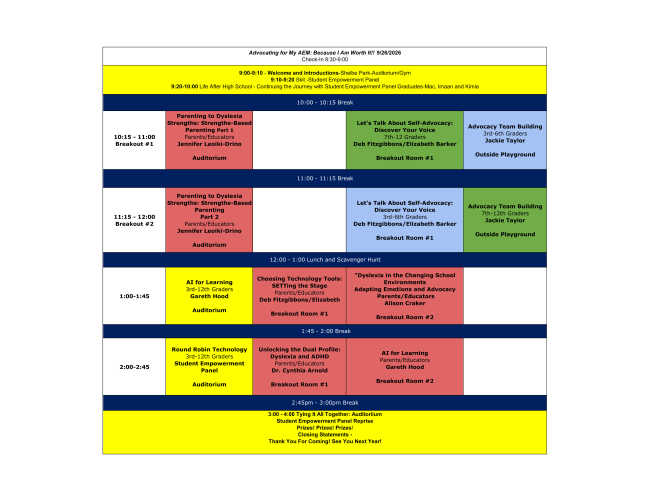
*I'm sorry I made a mistake on our earlier newsletter. *See Corrected Agenda with the Afternoon Sessions Included - Danielle Thompson
Excitement is building for our Third Annual Student Advocacy Workshop, led by Shelbe Park and the IDA-Oregon Student Empowerment Team.
We are also excited to welcome former Student Empowerment members as our opening speakers!
We'll have prize giveaways and lots of fun and community-building.
Parents, teachers, tutors, and students will have different sessions to attend and team-building fun.
| | |
Saturday, September 26, 2026
Park Academy | Lake Oswego
_______________________________
| |
_____________________________
Cost ranges from $40-50
Lunch is included
| | | | |
Dyslexia Dash 5k Run, Walk & Roll Fundraiser
October, 2026
| | |
2027 Symposium
*Saturday, February 20, 2027
University of Portland
| |
We are excited to begin planning for Symposium 2027! *Our tentative date will be Saturday, February 20, 2027, at the University of Portland, featuring Dr. Anita Archer and Dr. Ronda Fritz who will present, "All Students Deserve Reading and Writing Competency: Research-Based Teaching Practices that Make a Difference."
Recognizing that many school districts may be facing additional budget cuts, the IDA-Oregon Board is exploring ways to reduce ticket prices and make the symposium more accessible to educators and other school personnel. We will share additional information, including registration details and ticket prices, as plans are finalized.
| |
Resources
Understanding Oral Language: The Foundation for Reading
| | |
Oral language is the ability to understand and use spoken language. It includes:
- Listening comprehension
- Vocabulary
- Grammar and sentence structure
- Word retrieval
- Organizing and expressing ideas
- Retelling and sequencing
- Making inferences
- Social or pragmatic communication
Oral comprehension is one part of oral language. It specifically refers to understanding what is heard. Oral language is broader because it includes both:
- Receptive language: understanding spoken language
- Expressive language: using spoken language to communicate
__________________________________________
What does oral-language weakness look like?
A student may:
- Have difficulty following multistep directions
- Give short, vague, or disorganized answers
- Struggle to find the right word
- Use immature grammar or incomplete sentences
- Have difficulty retelling a story in order
- Leave out important information
- Struggle to explain how or why something happened
- Understand individual words but miss the overall message
- Have difficulty making inferences
- Read words accurately but be unable to explain what was read
| | How are oral-language weaknesses treated? | | |
Area of weakness
Vocabulary
Sentence comprehension
Word retrieval
Narrative language
Sequencing
Listening comprehension
Expressive organization
Inferencing
Social language
| |  | |
Explicit treatment
Teach word meanings, categories, synonyms, attributes, multiple meanings, and their use in sentences
Teach grammar, sentence structure, conjunctions, pronouns, and complex sentences
Practice naming, categorizing, describing, associating, and retrieving words from clues.
Teach character, setting, problem, actions, consequences, and resolution.
Use visual organizers and explicit first–next–then–finally language.
Read short passages aloud and teach students to visualize, identify the main idea, recall details, infer, and summarize.
Model complete responses and provide sentence frames, visual supports, and guided retelling.
Explicitly connect what was said with background knowledge to determine what was implied.
Practice conversational turn-taking, perspective-taking, nonliteral language, and adjusting language to the situation.
| | When deficits are persistent or substantial, a speech-language pathologist should evaluate receptive language, expressive language, vocabulary, syntax, narrative language, word retrieval, and pragmatic language. If decoding or phonological weaknesses also exist, combine oral-language therapy with explicit, structured literacy instruction. | | |
Decoding Is Not the Same as Understanding
Dyslexia may involve more than difficulty reading words. New research found that many students with dyslexia struggled with the complex vocabulary, sentence structures, and narrative language expected at their grade level—even when they did not have a diagnosed language disorder.
Students may decode words accurately and fluently but still struggle to understand complex academic language.
A student may be able to read the words on the page yet have difficulty understanding:
- Complex or lengthy sentences
- Abstract and unfamiliar vocabulary
- Multiple-meaning words
- Cause-and-effect relationships
- Comparisons and implied meanings
- The language used in textbooks, assignments, and tests
This is why reading assessment should look beyond word recognition and decoding. Strong decoding skills do not always mean that a student fully understands what they are reading.
According to the published abstract, 94%–100% of the students lacked the expected complex sentence structures, and 82%–100% did not use complex vocabulary at curriculum-expected levels.
Petersen, D.B., Stout, G.H., Konishi-Therkildsen, A. et al. Examining complex academic language in children with dyslexia: a comparative analysis with curriculum standards. Ann. of Dyslexia 76, 279–303 (2026). https://doi.org/10.1007/s11881-025-00357-8
| |
Could Oral Language Be Affecting the Student’s Learning?
Consider these practical questions:
- Can the student repeat increasingly complex sentences?
- Can the student follow multistep oral directions?
- Can the student retell a story in a clear, logical sequence?
- Does the student understand complex classroom vocabulary?
- Can the student explain relationships such as cause and effect?
- Does the student’s comprehension decline as sentences become longer or more complex?
- These questions are not a formal assessment or diagnostic tool. However, consistent difficulty in several areas may indicate that the student would benefit from additional oral-language screening or evaluation by a qualified professional.
The questions about multistep directions and comprehension declining with longer sentences are reasonable classroom observations, but they should not be presented as a checklist taken directly from one study. They are practical questions informed by the broader research.
These questions draw on research published in the 2026 Annals of Dyslexia special issue, “Language Abilities in Persons with Dyslexia.”
| | |
Dyslexia Facts: Did You Know?
Dyslexia is more than reversing letters.
It primarily affects the development of accurate and fluent word reading and spelling. Letter reversals alone do not identify dyslexia.
Dyslexia is not related to intelligence.
Individuals with dyslexia can have strong reasoning, creativity, knowledge, and problem-solving abilities while experiencing significant difficulty learning to read and spell.
Dyslexia looks different from person to person.
The type and severity of difficulty vary. A student’s needs may also change as reading and academic-language demands increase.
Dyslexia and oral-language difficulties can occur together.
Some students with dyslexia also have difficulty with vocabulary, sentence structure, listening comprehension, or organizing spoken language.
Reading words and understanding language are related but distinct skills.
Effective reading comprehension depends on both recognizing written words and understanding the language those words communicate.
Early identification and appropriate instruction matter.
Explicit, systematic instruction—provided early and matched to the student’s needs—can significantly improve reading and spelling development.
Many students with dyslexia may have weaknesses in complex academic language—even when they do not have a diagnosed developmental language disorder.
A 2026 study found substantial difficulty with narrative organization, complex sentence structures, and academic vocabulary among students with dyslexia in grades 1–6. This supports looking beyond word reading when evaluating students’ literacy needs.
Petersen, D.B., Stout, G.H., Konishi-Therkildsen, A. et al. Examining complex academic language in children with dyslexia: a comparative analysis with curriculum standards. Ann. of Dyslexia 76, 279–303 (2026). https://doi.org/10.1007/s11881-025-00357-8
| | Parent Support & Advocacy | |
You Know Your Child Best
Parents and caregivers are essential members of their child’s educational team. If your child is struggling with reading, spelling, writing, or language comprehension, don't wait for the difficulties to become severe before asking for help.
Steps parents can take:
- Document your concerns and collect examples of your child’s work.
- Ask the teacher what skills have been assessed and what the results show.
- Request information about the instruction and intervention your child is receiving.
- Ask how progress is being measured and how often you will receive updates.
- Put requests for screening, evaluation, or additional support in writing.
- Ask whether difficulties with oral language, attention, or comprehension may also be affecting learning.
- Keep copies of evaluations, progress reports, emails, and intervention plans.
- Seek an outside evaluation or professional guidance when you need additional information.
You do not have to become an expert before advocating for your child. Ask questions, request explanations in plain language, and keep the conversation going until you understand your child’s needs and the plan to address them.
A helpful question to ask:
“What does the data show, what support is being provided, and how will we know whether it is working?”
| | Structured Literacy Highlights | |
Explicit, Systematic, and Cumulative Instruction
Structured Literacy teaches the structure of spoken and written language in a clear, carefully planned sequence. Skills are taught directly, practiced with guidance, and reviewed frequently so that students can build new learning on a secure foundation.
What does this look like during instruction?
- The teacher clearly explains and models a new skill.
- Skills are introduced in a logical sequence, from simpler to more complex.
- Previously taught concepts are reviewed regularly.
- Students practice reading and spelling—not reading alone.
- Instruction includes both real and nonsense words to confirm that students apply the pattern rather than rely on memorization.
- Teachers provide immediate, specific corrective feedback.
- Student performance determines when to review, reteach, or move forward.
Structured Literacy addresses the interconnected components of language, including phonology, sound–symbol relationships, syllable patterns, morphology, syntax, semantics, reading comprehension, and written expression.
Why It Matters
Students with dyslexia need instruction that makes language patterns visible and understandable. They should not be expected to discover these patterns independently. Explicit, systematic, cumulative instruction provides the repetition, structure, and guided practice necessary to develop accurate, increasingly automatic reading and spelling skills.
Ask yourself:
Can the student explain the pattern, read it accurately, spell it accurately, and apply it to unfamiliar words?
| |
Looking Beyond Word Reading
Dyslexia is commonly associated with difficulty reading and spelling words, but emerging research highlights the importance of also examining oral and academic language.
A 2026 study of 183 students with dyslexia in grades 1–6 examined their ability to understand and produce complex language through narrative retelling. Many students demonstrated difficulty meeting grade-level expectations in three important areas:
- Organizing and retelling a narrative
- Producing complex sentence structures
- Using sophisticated academic vocabulary
These weaknesses were found even among students without a diagnosed developmental language disorder.
The findings remind educators and families that a complete understanding of a student’s literacy needs should extend beyond word reading. Oral-language screening and targeted intervention may be needed when a student has difficulty understanding complex sentences, using academic vocabulary, organizing ideas, or explaining information clearly.
The takeaway: A student’s ability to read individual words does not fully reflect the language skills needed for comprehension and academic success.
Source: Petersen, D. B., Stout, G. H., Konishi-Therkildsen, A., Hancock, N., Lettich, C., & Hogan, T. (2026). “Examining Complex Academic Language in Children with Dyslexia: A Comparative Analysis with Curriculum Standards.” Annals of Dyslexia, 76, 279–303.
| |
Community Stories
Call for Contributions
| |
Your Stories, Your Voices
We want to hear from you! Whether you’re an educator with a breakthrough strategy, a parent proud of your child’s progress, or someone with dyslexia sharing your journey, your story matters. Please submit your ideas, experiences, or questions for experts, and help us shape future editions of our newsletter.
We believe the best ideas come from our community! We invite parents, educators, and students to share personal success stories, effective teaching strategies, and burning questions with our experts. Whether celebrating a reading breakthrough or seeking advice on challenges, your voice matters.
-
Share a Story: Send us a 300–500 word account of a recent success or learning milestone.
-
Ask an Expert: Submit your question about dyslexia research or classroom interventions.
-
Suggest a Topic: What would you like to learn more about in our following newsletter?
Send all submissions to:
info@orbida.org
Deadline: March 15 for the spring issue
Be sure to include your name, location, and any relevant permissions if you’re sharing photos or student experiences. We can’t wait to hear from you and look forward to spotlighting your stories in our next edition!
| | Connect with Our Community! | | |
Join the monthly discussion group, run by and for dyslexic adults. Join from anywhere in the world!
| | Student Empowerment Group | |
Join the IDA-Oregon Student Empowerment Group. Monthly zoom meetings and in-person gatherings.
| | | | |