Looking Ahead: Trident’s Growing Footprint in
the La Ronge Gold Belt
|
| |
The fall 2025 drilling at Contact Lake has given Trident one of its clearest views yet of how the gold system extends beyond the areas mined in the 1990s.
The first three drill holes, especially CL25003, show that the mineralized zones continue deeper and farther than earlier work suggested. These results are now helping shape the next phase of drilling planned for this winter.
If you have been following Trident from the beginning, you’ve seen how the company has been steadily building a stronger geological picture across its projects. If you are newer to the story, earlier newsletters are available here (newsletter 1, newsletter 2, newsletter 3) and news releases are available on our website.
This edition focuses on two things:
- the updated mineral resource estimates across four deposits in the La Ronge Gold Belt, and
- how the recent drill results at Contact Lake are guiding the upcoming winter program.
The overall drill plan at Contact Lake has been expanded from 5,000 metres to over 6,500 metres across 18–20 holes, giving the team the room it needs to follow the trends revealed so far.
| | |
A Bigger Story in the Belt: Updated Mineral Resource Estimates
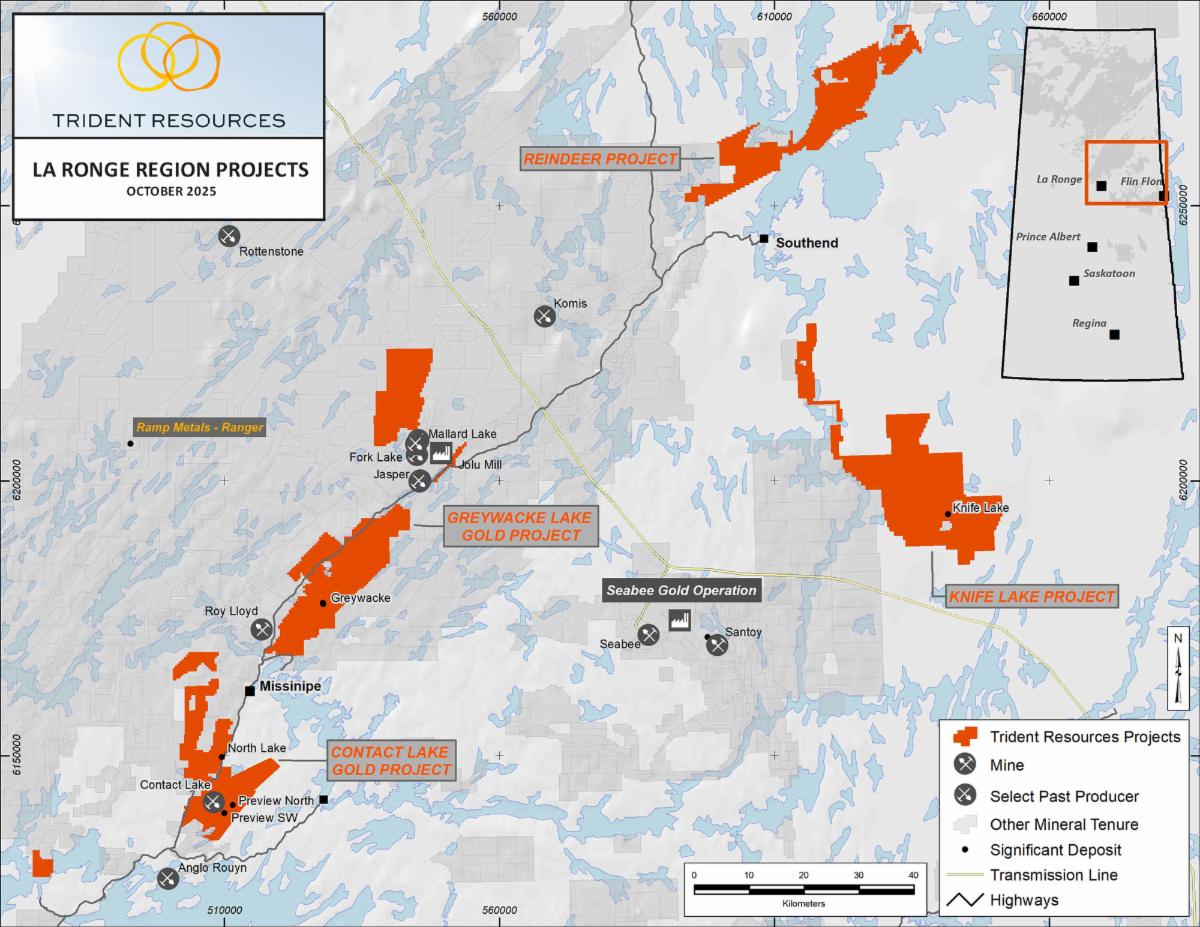
On November 24, 2025, Trident announced updated Mineral Resource Estimates for four gold deposits in the La Ronge Gold Belt: Preview SW, Preview North, North Lake, and Greywacke.
These new estimates show:
- an 18% increase in Indicated gold ounces, now totaling 896,500 ounces, and
- a 190% increase in Inferred gold ounces, now totaling 1,129,600 ounces,
all calculated at a gold price of US$2,600 per ounce and with an effective date of November 6, 2025.
In simple terms, Trident now hosts:
- just under 0.9 million ounces of Indicated resources, and
-
about 1.1 million ounces of Inferred resources
across these four deposits.
All of these deposits are 100% owned by Trident and are located within the same prolific but still under-explored La Ronge Gold Belt in northern Saskatchewan.
Importantly, Contact Lake is not yet included in these resource numbers, even though a 6,838 m drill program has just been completed there and only 3 of 19 holes have been reported to date.
Taken together, the updated resources and the ongoing work at Contact Lake suggest that Trident is building a multi-deposit story in a single, highly prospective belt.
|
What the Fall Drilling Showed at Contact Lake
Within this broader context, Contact Lake remains the centre of near-term activity.
The first three holes of the 2025 drill program (746 metres of the 6,838 metres completed) showed that:
- High-grade gold zones are present in the footwall, below the main shear zone
- mineralization extends toward and under the lake, and
- several areas below the old mine workings remain open and untested.
The standout hole, CL25003, intersected a wide zone of gold starting around 121 metres downhole, confirming high-grade gold mineralization in the footwall below the Bakos shear zone.
These results give the team a clear roadmap for the winter drill program.
| |
Winter Drill Program: Three Main Priorities
The winter campaign is designed to build directly on the fall results and to use frozen-lake access to reach new positions for drilling. It will build upon the 6,838m fall program and seek to expand mineralization along strike and down-dip of the main zone mineralization.
1. Follow the Newly Identified Deeper Zone
The fall drilling confirmed a lower mineralized horizon below the main shear zone that hosted much of the historical mining.
This winter, drilling will test:
- The extents of the high-grade footwall mineralization and
- whether it ties into mineralization closer to the lake.
2. Test the Area Under the Lake (BK-3)
With drill pads placed on ice and on land close to the shoreline, the team will finally be able to drill the space between the historic mine workings and the BK-3 Zone, which lies beneath the lake.
This work will:
- Assess the potential for gold mineralization outboard of the historical mine infrastructure, and
- help define the full length of the mineralized corridor, which extends for roughly 1.2 kilometres.
3. Look Below the Old Mine Levels
Earlier mining at Contact Lake stopped at relatively shallow depths, leaving some areas below the lowest workings untested.
This winter, drilling will:
- probe below those old mine levels, and
- look for extensions of the high-grade zones identified in the fall program.
| |
Why This Matters Going Into 2026
The combination of:
gives Trident a stronger base to build on as it moves into 2026.
The expanded 6,500+ metre / 18–20 hole program at Contact Lake is designed to:
- refine the geological model,
- support future resource updates, and
- provide valuable down-hole structural orientation data that will help inform future drill programs.
The fall results have set the direction.
The winter drill program is about testing that direction on the ground, step by step.
| | |
With updated resources across four deposits and new insights from fall drilling at Contact Lake, Trident enters the winter season with clarity and momentum.
The upcoming drill program will help define the deeper zones, test under-lake extensions, and follow up on areas left untested historically, moving the company closer to understanding the full scale of its opportunity in the La Ronge Gold Belt.
| | Trading Symbols: TSX-V: ROCK | OTCQB: TRDTF | |
Disclaimer
This communication has been prepared and distributed by a third party that has been compensated for its services. It is intended for informational purposes only and does not constitute an offer to sell or a solicitation of an offer to buy any securities of Trident Resources Corp. (“Trident”).
The information contained herein is based on publicly available materials and news releases issued by the company. Readers are encouraged to review Trident’s continuous disclosure documents, including technical reports filed under National Instrument 43-101 (NI 43-101), available on SEDAR+ (www.sedarplus.ca).
Any reference to historical mineral resources, exploration targets, or potential quantities and grades is conceptual in nature and should not be interpreted as current mineral resources or reserves. Exploration results are preliminary and subject to verification and further work.
Forward-looking statements in this communication are subject to known and unknown risks, uncertainties, and other factors that may cause actual results to differ materially from those expressed or implied. Such statements reflect management’s current beliefs, based on information available at the time, and are provided for the purpose of conveying Trident’s present expectations. There can be no assurance that such statements will prove accurate.
Investors should conduct their own due diligence and consult a licensed investment advisor before making any investment decision.
| | | | |