|
Below you will find news updates and upcoming deadlines. If you are interested, click on the link for more information.
*For questions contact Alicia McCarthy at 360.942.7370 or alicia@wastatedairy.com.*
| |
|
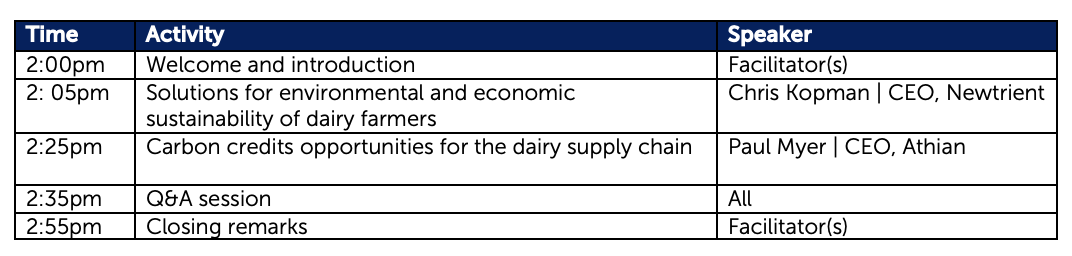
Upcoming Webinar: Solutions for Environmental and Economic Sustainability of Dairy Farmers
Join the Dairy Farmers of Washington for a special webinar where we explore how dairy farmers can make a positive impact on the environment while improving their bottom line.
Date: November 29th, 2023
Time: 2:00 pm - 3:00 pm
Discover how Newtrient, a leader in the dairy industry, offers practical and budget-friendly solutions. Learn about their technologies that help farmers manage nutrients, care for water and soil, and even turn manure into value. We'll also dive into the world of carbon credits with Athian, exploring opportunities for farmers to earn extra income while being environmentally conscious.
Webinar Schedule:
| |
|
Washington Farm Bureau Asks Lawmakers To Settle Ag Fuel Dispute
The Washington Farm Bureau is urging state lawmakers to address a multi-million-dollar dispute with the Department of Ecology over a tax exemption for fuels used for agricultural purposes and transporting agricultural products on public highways.
The bureau contends the state’s 2021 Climate Commitment Act, which seeks to reduce greenhouse gas emissions, includes a five-year exemption from its cap-and-trade program for emissions from diesel fuels used in farming and hauling agricultural products by truck.
But in developing regulations, Ecology instead created “an arbitrary exemption process inconsistent with its statutory obligations,” the farm bureau and Washington Trucking Associations alleged in a lawsuit filed in September in Thurston County Superior Court.
The two organizations contend that the CCA-imposed charges, implemented in January, have increased ag-related diesel costs between 45 cents and 70 cents per gallon, resulting in an estimated $74 million increase in fuel prices “that should be exempt.” They are seeking an administrative law review of the provision, and restitution. A trial setting date is scheduled Jan. 12.
| |
|
USDA to Provide More Than $3 Billion to Commodity and Specialty Crop Producers Impacted by 2022 Natural Disasters Disaster Set-Aside Program for Farm Loan Borrowers
Farm Service Agency (FSA) borrowers with farms located in designated primary or contiguous disaster areas who are unable to make their scheduled FSA loan payments should consider the Disaster Set-Aside (DSA) program.
DSA is available to producers who suffered losses as a result of a natural disaster and relieves immediate and temporary financial stress. FSA is authorized to consider setting aside the portion of a payment/s needed for the operation to continue on a viable scale. Borrowers must have at least two years left on the term of their loan in order to qualify.
Borrowers have eight months from the date of the disaster designation to submit a complete application. The application must include a written request for DSA signed by all parties liable for the debt along with production records and financial history for the operating year in which the disaster occurred. FSA may request additional information from the borrower in order to determine eligibility.
All farm loans must be current or less than 90 days past due at the time the DSA application is complete. Borrowers may not set aside more than one installment on each loan.
The amount set-aside, including interest accrued on the principal portion of the set-aside, is due on or before the final due date of the loan.
For more information, contact your loan staff based out of the Spokane County USDA Service Center at (509) 381-6734 or visit fsa.usda.gov.
| |
|
Dairy farmers generate renewable energy
To help manage the manure, the California Department of Food and Agriculture provides funds to California dairy farms to install dairy digesters, a technology that can break down manure and produce methane (a form of renewable energy). The digesters provide additional benefits such as capturing greenhouse gases while improving the nutrient value of manure and water quality.
Pramod Pandey, UC Cooperative Extension specialist in the School of Veterinary Medicine Extension at UC Davis, has been studying dairy digesters for over 20 years to understand the conversion of manure into renewable energy. He also is trying to determine the effects of anaerobic processes (in low-oxygen conditions) on dairy manure quality, biogas production and the environment.
Between 2015 and 2022, CDFA supported approximately 133 dairy digester projects in California, with grants of more than $200 million to various dairy farms. For dietary components that cannot be completely digested by a cow's stomach, dairy digesters use a variety of bacteria to break down the manure under anaerobic conditions. This provides an option for sustainable waste treatment. The process not only reduces greenhouse gas emissions by capturing the gases released from manure, but also produces renewable energy in the form of biogas, which can be used as an alternative fuel for cars to further bring down greenhouse gas emissions. In addition, the dairy digester helps reduce odor and pathogens that pose a risk to human health.
| |
|
Dairy Margin Coverage Program Provides Critical Support for Dairy Operations
August milk margin triggered the eighth consecutive DMC payment
The August milk margin triggered the eighth consecutive payment for dairy producers who obtained Dairy Margin Coverage (DMC) for the 2023 program year. August’s income over feed margin is $6.46 per hundredweight (cwt.) with projected DMC payments totaling $120 million. To date, including the projected August payments, dairy producers have received more than $1.2 billion in much needed economic support for 2023 and margin forecasts indicate the likelihood of more to come before the end of the calendar year.
DMC is a voluntary risk management program administered by USDA’s Farm Service Agency (FSA) that offers protection to dairy producers when the difference between the all-milk price and the average feed price (the margin) falls below a certain dollar amount selected by the producer.
Additional Dairy Assistance
DMC complements other assistance available to dairy producers, including the Milk Loss Program (MLP) and the Organic Dairy Marketing Assistance Program (ODMAP).
MLP covers milk that was dumped or removed, without compensation, from the commercial milk market due to qualifying weather events and the consequences of those weather events that inhibited delivery or storage of milk (e.g., power outages, impassable roads, infrastructure losses, etc.) during calendar years 2020, 2021 and 2022.
| |
|
It's Not to Late to Apply for Cost Share for Organic Certification
As part of USDA’s broader effort to support organic producers and in response to stakeholder feedback, this year the Farm Service Agency increased the cost share amount under the Organic Certification Cost Share Program (OCCSP), which helps organic producers cover organic certification costs, to the maximum amount allowed by statute. Specifically, FSA will cover up to 75% of costs associated with organic certification, up to $750 for crops, wild crops, livestock, and processing/handling. OCCSP will cover costs incurred from Oct. 1, 2022, through Sept. 30, 2023.
FSA began accepting applications for OCCSP Monday, May 15. Applications are due Nov. 2, 2023. Late-filed applications may be accepted through Feb. 2, 2024 on a first-come, first-serve basis as long as funding remains available.
To apply, producers and handlers should contact the FSA at their local USDA Service Center. As part of completing the OCCSP application, producers and handlers will need to provide documentation of their organic certification and eligible expenses. Organic producers and handlers may also apply for OCCSP through participating state departments of agriculture.
FSA is also accepting applications from state departments of agriculture to administer OCCSP. FSA will post a synopsis of the funding opportunity on grants.gov and will send more information to all eligible state departments of agriculture. Additional details can be found on the OCCSP webpage. More information about these initiatives and more can be found at farmers.gov/organic-transition-initiative.
| |
|
Compost Reimbursement Program
The Washington State Department of Agriculture’s Compost Reimbursement Program (established under RCW 15.04.420) NOW OPEN. To apply, submit an eligibility application here: https://arcg.is/18PP5L. Responses will be processed on a first come, first served basis until we reach our participation limit. After which time, the survey will close unless more applications are considered later this year.
For participating farms, the program will pay up to 50% of the cost to obtain, transport, and spread eligible compost, not to exceed $10,000, per farm per fiscal year. For incurred costs to be found eligible, compost must be purchased from a compost facility with a solid waste handling permit (map found here).
If found eligible to participate in the program, the following steps must be completed before compost is transported and applied, to qualify for reimbursement:
- Sign the Grant Agreement Contract within 60 days of receipt. For farms on leased land, landowner permission and signature will be required.
- Complete the Crop & Field Survey.
- Collect a soil sample prior to compost application.
Once each of the above steps are completed, participating farms can submit a reimbursement application to our Plant Inspection Services & Certification Electronic System (PISCES). This application will include itemized costs, a brief description of how each item was used, and an invoice, receipt or other documentation associated with that cost.
For more information on this program, please visit bit.ly/wsdacompost. If you have any questions regarding the application and review process, please contact compost@agr.wa.gov or (360) 890-0625.
| |
|
Rural Energy For America Program
The program provides guaranteed loan financing and grant funding to agricultural producers and rural small businesses for renewable energy systems or to make energy efficiency improvements. Agricultural producers may also apply for new energy efficient equipment and new system loans for agricultural production and processing.
How may the funds be used?
Funds may be used for the purchase and installation of renewable energy systems, such as:
- Biomass (for example: biodiesel and ethanol, anaerobic digesters, and solid fuels).
- Geothermal for electric generation or direct use.
- Hydropower below 30 megawatts.
- Hydrogen.
- Small and large wind generation.
- Small and large solar generation.
- Ocean (tidal, current, thermal) generation.
Funds may also be used for the purchase, installation and construction of energy efficiency improvements, such as:
- High efficiency heating, ventilation and air conditioning systems (HVAC).
- Insulation.
- Lighting.
- Cooling or refrigeration units.
- Doors and windows.
- Electric, solar or gravity pumps for sprinkler pivots.
- Switching from a diesel to electric irrigation motor.
- Replacement of energy-inefficient equipment.
Energy Efficiency Improvement applications must contain an Energy Audit, or Energy Assessment (depending on Total Project Costs) that complies with Appendix A to RD Instructions 4280-B
Agricultural producers may also use guaranteed loan funds to install energy efficient equipment and systems for agricultural production or processing.
Funding for the USDA's Rural Energy for America Program (REAP) Grant program has increased tenfold and they are now offering to pay for 50% of the cost to install a solar system. When one adds a 30% to 40% Federal Tax Credit and in many cases an Energy Trust incentive too, the simple payback on solar can be about a year. Perhaps more importantly, each net $1 invested should save $20 plus on future power bills.
| | |
|
For additional resources, visit the Washington State Dairy Federation website and click on "Resources". This is a password protected page so you will need to enter the password before you're able to view the list of resources. Please do not share this password with anyone outside the dairy community.
Password: Farm Resources
|
| | | | |