Volume 2: It's All Relative Potency

FasTrain Website

FasTrain Course Registration

Free Bioassay Month Newsletter

It’s All Relative Potency


Earlier this week we delved into the why of potency assays, but what about the “suitable for intended use” statement everyone throws around in impressive tones, even if the statement is somewhat ambiguous.


Specifically, what does “suitable for intended use” mean for a potency assay designed to ensure that the current batch of manufactured product is comparable to the clinical batch previously demonstrated to be effective in patients?


The central consideration here is relative potency: how can we confidently establish that each manufactured batch exhibits equivalent potency to the original clinical material?

Relative Potency and Batch Comparisons


The question at hand is not whether the absolute quantity of drug substance administered is consistent across batches, but rather whether the biological activity of each constant dose aligns with prior batches at the same dose.


This necessitates the comparison of one batch to another.

In Volume 1 we previously discussed how specific bioassays should directly link to your product’s mechanism of action (MoA). You must now demonstrate that the current batch matches the potency of earlier batches, which involves comparing the dose-response curves of different batches.

Example: Reduced Relative Potency


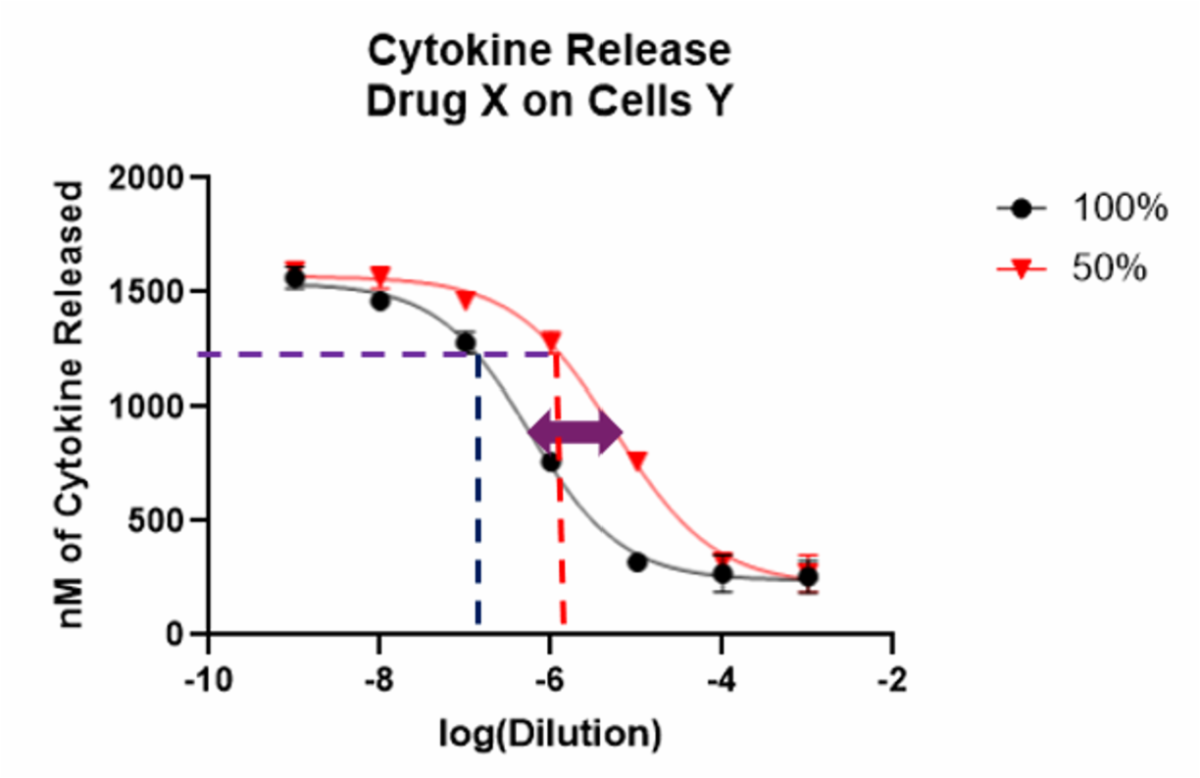
For instance, consider two product batches that induce target cells to release a particular cytokine. If one batch demonstrates only 50% of the potency of the original reference batch, it will require twice the amount of drug to achieve the same cytokine response.

How Relative Potency Is Determined


The core calculation involves determining the ratio of drug required to elicit a defined biological effect—such as the midpoint value between the upper and lower asymptotes of a dose-response curve—which reflects the relative strength of the two preparations.

When Dose-Response Curves Differ


There are additional important considerations, which we will address next week in Volume 3.


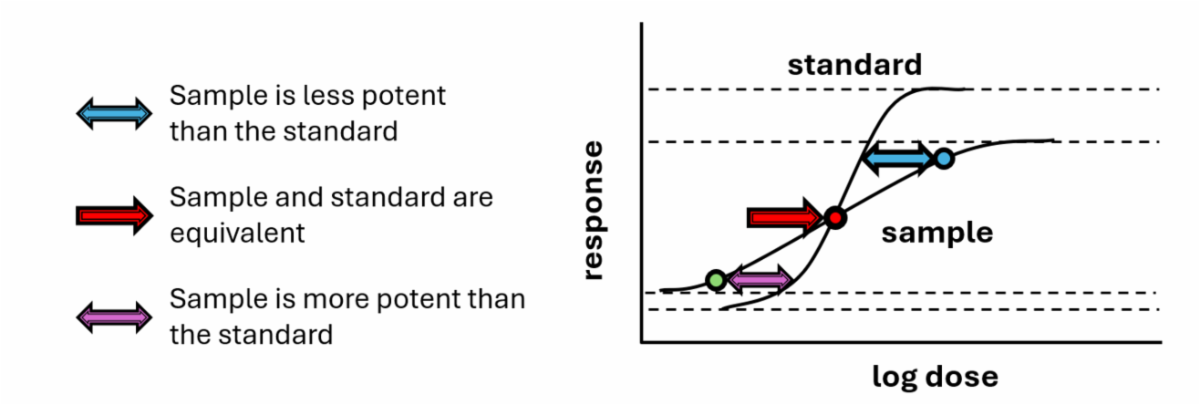
In the example below, the dose-response profiles of the two batches differ significantly (as may occur with autologous cell therapy products).

Note that the sample batch may measure as equivalent, hypo-, or hyper-potent depending on the comparison point within the curve.

Why This Matters


In such cases, the assay is clearly “unsuitable for its intended use.”


This problem leads directly to our upcoming discussion:


Volume 3: Why consistency across batches is essential


Newsletter Information

Newsletters to Come

  • Volume 3: Comparing Dose-Response Curves
  • Volume 4: Finding Your Critical Reagents
  • Volume 5: Using Statistical Tools to Accelerate Development
  • Volume 6: Modern Approaches to Bioassay Validation
  • Volume 7: Monitoring the Bioassay
  • Volume 8: The Audit of Bioassays
  • Volume 9: Lessons Learned Throughout the Month


Have Questions?

This is an interactive newsletter!


We want to hear your burning bioassay questions.


Send your questions to

Dr. Laureen Little (laureen.little@fastraincourses.com) and she and our team of instructors will answer them in the coming newsletters.

If you ever miss a volume or want to revisit key points from previous issues, we will be updating the Bioassay Month page throughout the series.

Interested in FasTrain Bioassay Courses?

Explore the full list of bioassay courses we offer.


Potency Bioassays Development & Validation


CMC Relative Potency Analytical Methods: A Technical Deep Dive


Introduction to Statistics for Potency Bioassays


Statistical Method in Bioassay


Cell Culture and Cell-Based Assays