Volume 5: Utilizing Statistical Tools to Accelerate Development

FasTrain Website

FasTrain Course Registration

Free Bioassay Month Newsletter

Utilizing Statistical Tools to Accelerate Development

In the last volume we discussed some general do’s and don’ts for selecting and handling our in-vitro bioassay cell line. Now let us delve into the nitty gritty details. If we don’t use either existing information or statistical Design of Experiment (DoE) tools, the optimization of our cell lines for use in the bioassay can turn into a massive undertaking more akin to a graduate thesis project.


Unfortunately, existing knowledge is unreliable at best and at worst often completely wrong. Getting cell culturing/handling details wrong will not only slow down our assay development timeline it will seriously impact the assay for the rest of its “life”!

Past Volumes

Volume 1: Bioassay Month Kickoff


Volume 2: It's All Relative Potency


Volume 3: Comparing Dose-Response Curves


Volume 4: Find your Critical Reagents

Upcoming Volumes

Volume 6: Modern Approaches to Bioassay Validation


Volume 7: Monitoring the Bioassay


Volume 8: The Audit of Bioassays


Volume 9: Lessons Learned Throughout the Month

Using DoE in Early Development


Many labs use DoE tools for early development. In particular, Factorial Design is an incredibly helpful tool. Factorial design simultaneously tests two or more independent variables (factors), each with multiple levels.

Definition Time!


Factors are assay conditions or reagents that you vary for optimizing cells. These might include incubation time, seeding density, feeding schedules, mixing protocols such vortexing vs. rotation, etc.


Levels are condition of the factor which you test (e.g.: 25 minutes vs. 35 minutes incubation, 1:1000 vs. 1:2000 dilution, etc.

Understanding Factorial Design

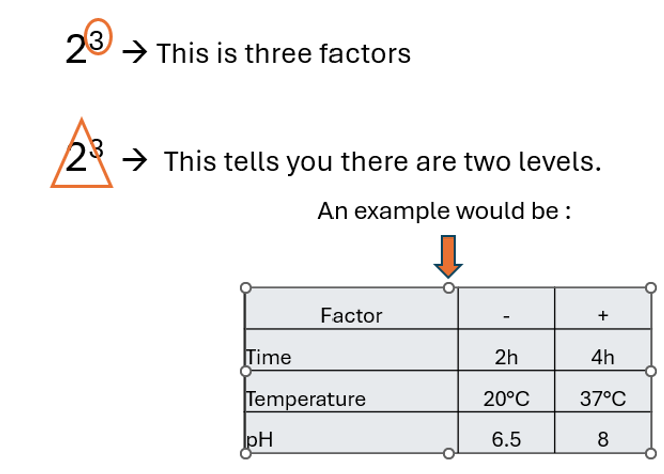
The Short hand for factorial designs looks like an exponential. For example, a 3-factor experiment tested at 2 levels is written as:

We include high levels which coded as Plus (+) and low level as Minus (-). 


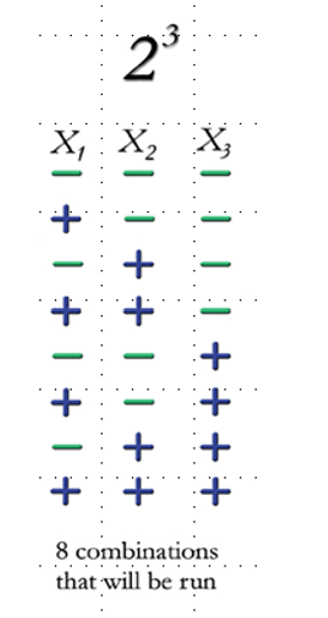
By combining all possible combinations of factor levels, a balanced design is created so that more than one variable can be tested at a time. The number of runs to perform a full factorial can be calculated by treating the above design as an exponential. Thus the 23 factorial design above needs 23 experiments which equals 2*2*2 or 8 experiments.  The design is balanced so that every combination is run and each factor/level combination is run once. The 23 factorial design would be as follows:

What About Our Situation?


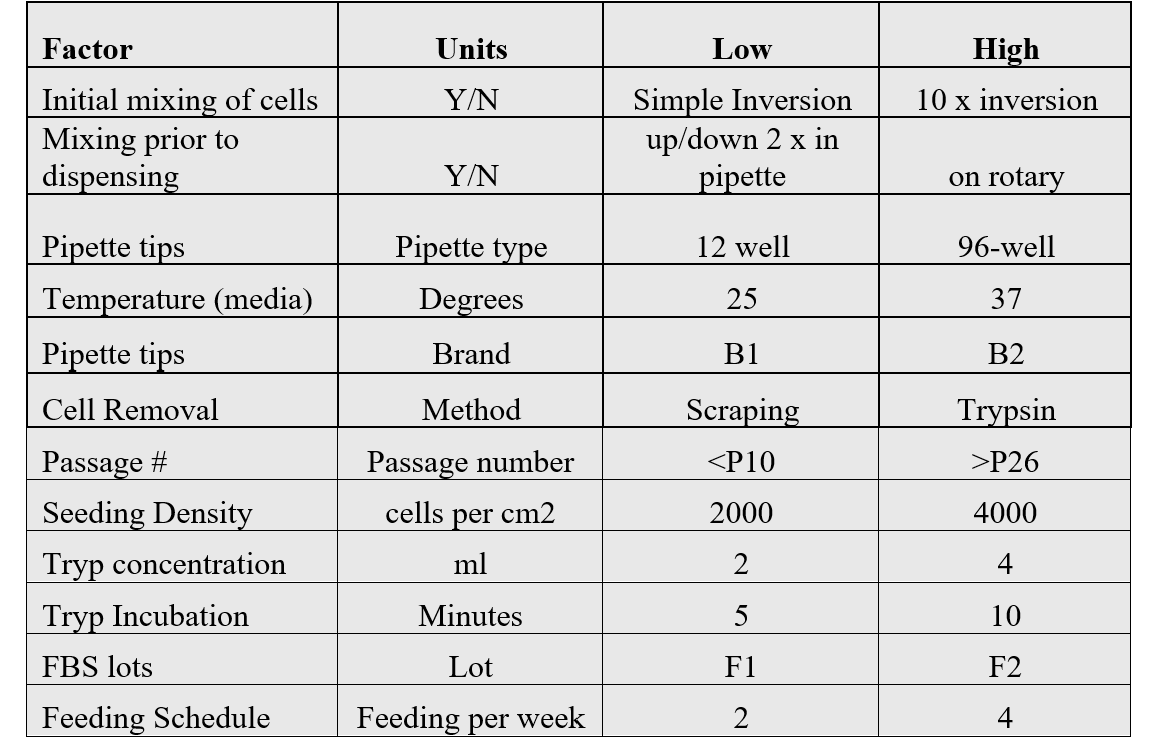
What about our situation? The optimization of cell culturing conditions? Step 1 is to determine which factors to optimize and the levels to run them at: 

The Reality of Full Factorial Designs


This would represent 12 factors at 2 levels. Whoaa…that would be 212 = 4096 runs! Clearly not feasible. Instead of starting with a full factorial, we implement a screening design first. Screening designs do not capture all the interactions which might happen between the factors and don’t tell you the best level to run of each factor, but instead focuses on determining which factors impact your system. Once you have eliminated the non-critical factors you can then focus on a smaller full factorial design.


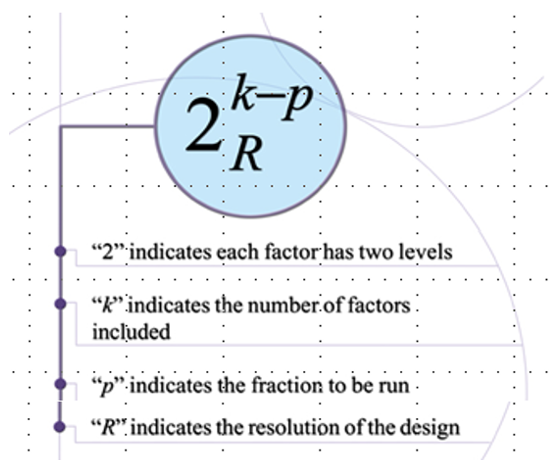
For statistical and practical reasons, we try to limit our screening designs to 5 or 6 parameters. Screening designs are written as follows:

Applying Screening Designs


Therefore, for the above example, we might run 2 screening experiments, each looking at 6 factors. For the example above, a 26-2 design was selected. This was done in 18 runs (which equals 24). These designs are complex and will need to be designed either with the help of a statistician or with the use of a commercial-off-the-shelf-software (such as JMP, Design-Expert, Minitab, and MODDE).


In this example, we optimized plate homogeneity. We did not run the entire assay, but merely plated cells, let them adhere and looked for consistent well-to-well cell counts. It is critical to understand what you are optimizing and select an appropriate readout, which in this case was a simple viability dye staining assay.


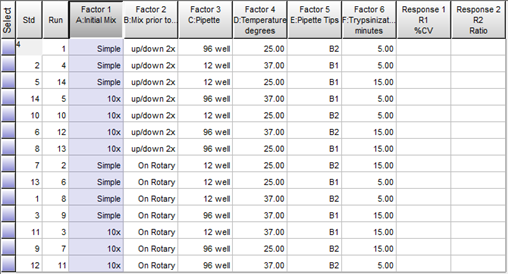
The software designed the following runs for one of our experiments:

Practical Considerations in the Lab


Notice in this design there are 14 plates and that each plate is handled differently. This makes these experiments arduous in the laboratory, as plates cannot be batched. We all learn, usually the hard way, that if we think we can run 8 plates a day, when performing DoEs, we can probably only run 4 per day! Be conservative in the designs. Always error on the side of smaller designs.

Analyzing Results

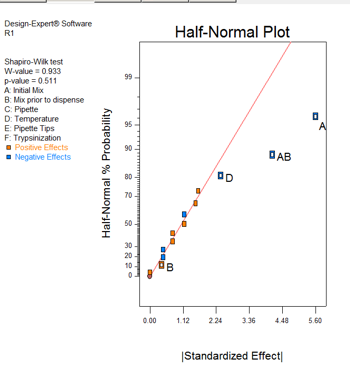
Once the data is collected and analyzed, we plot the half-normal plots to look for factors which account for variation from the model. In this case, how we mixed the cells and the thawing temperature turned out to be critical factors. The other factors were then simply set and used for further experimentation. The critical factors were studied using a full factorial design and best working ranges were established.

Final Outcome


The entire case study took about 3 weeks and resulted in a robust assay with excellent plate homogeneity.


This same approach can be taken to optimize how to freeze cells, thaw vitals and plate frozen-ready-to-use cells, incubation times for second messenger read-outs, and almost any other aspect of the overall cell-based assay.

Newsletter Information

Looking Ahead

Stay tuned for Volume 6 where we discuss our reward for developing a robust, accurate and precise bioassay…. and show the world how well we have done. We really get to strut our stuff! This is known as Bioassay Validation.

Have Questions?

We want to hear your burning bioassay questions.


Send your questions to Dr. Laureen Little (laureen.little@fastraincourses.com) and she and our team of instructors will answer them in the coming newsletters.

If you are interested in learning more about using DoE for optimization, explore FasTrain's Potency Bioassay Development & Validation course.

Interested in FasTrain Bioassay Courses?

Explore the full list of bioassay courses we offer.


Potency Bioassays Development & Validation


CMC Relative Potency Analytical Methods: A Technical Deep Dive


Introduction to Statistics for Potency Bioassays


Statistical Method in Bioassay


Cell Culture and Cell-Based Assays