September 2025

Topics Included:

Faster Turn Around on Clostridium Testing

Dairyland Labs has moved Clostridium testing in-house to provide greater reliability for your results.


What to watch for:

Clostridial fermentations are easily detected by an unpleasant smell, similar to rancid butter, caused by the butyric acid produced during fermentation. Affected silage may also appear slimy and darkly discolored. Because clostridia naturally inhabit soil, samples with high ash content are at greater risk of clostridial fermentation.


C. perfringens is commonly encountered in livestock environments. Its spores are found in soil, water, decaying vegetation, and the guts of healthy animals. Livestock can be exposed through contaminated feed or water, and the bacteria may spread within a herd via fecal contamination. Infections can lead to enterotoxemia, bloat, abdominal pain, lethargy, decreased appetite, neurological symptoms, and even sudden death.


Suspect clostridia issues in your silage?

Available tests include (3-5 day turnaround time):

  • Total clostridia - $30
  • C. perfringens - $30


Visit our website to learn more about our full range of silage hygiene testing services. 

Byproduct Breakdown

Analytical Tools for Soy Products

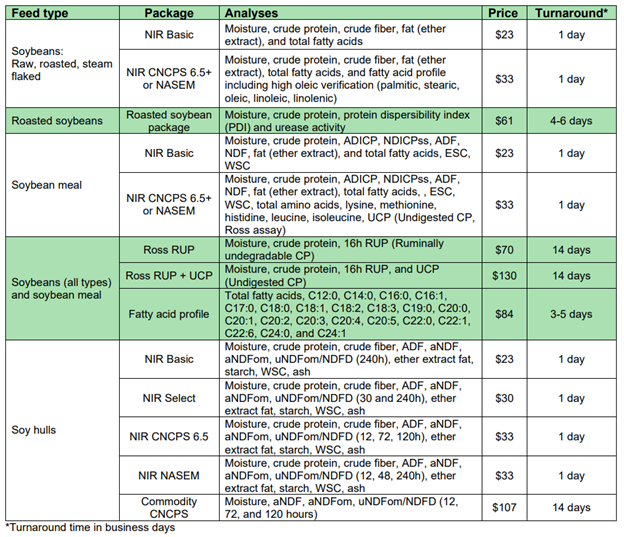
Whether you need to optimize diet formulations, evaluate roasting quality, or verify fatty acid profiles, our soy analysis packages provide actionable insights into the composition and quality of soybeans and their byproducts.


All xml files and example reports referenced in this document can be found in the link to supporting files.


Formulate according to soybean type

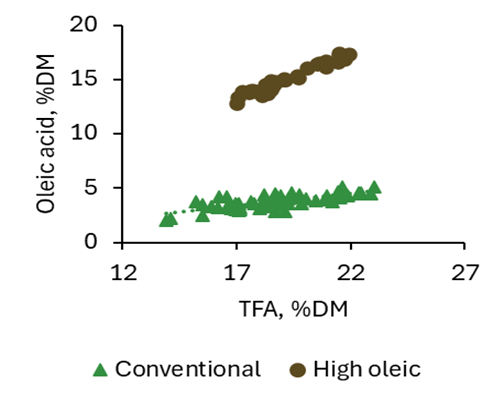
Making informed, cost-effective decisions starts with measuring the right factors. Book values can guide ration formulation for known soybean varieties, as natural variation is typically small. Most ration balancing platforms already include soybeans in their feed libraries, but if yours doesn’t, the XML files linked above can be used as reasonable starting points for formulation inputs. Book values are type-specific and should not be applied across soybean varieties (Figure 1). The following XML files are available:

High oleic:     Raw | Roasted

Conventional: Raw | Roasted


If the variety is uncertain or if you’re feeding a blend of high oleic and conventional beans, testing is recommended to ensure accurate formulation and NIR analysis is the most economical way to determine fatty acid profiles. The following sample reports for soybeans are included in the link to supporting files:

NIR Packages:           Basic | CNCPS 6.5+ | NASEM

Roasted soybeans:    Protein dispersibility index (PDI)

Digestibility:              Ross 16h RUP + Undigested CP

Figure 1. Although oleic acid is strongly correlated to total fatty acid (TFA) content within each soybean type, the relationship is not consistent across types

Soybean meal is a key source of protein in livestock nutrition, but its nutrient profile isn’t uniform. Processing methods like extrusion and solvent extraction cause differences in composition and digestibility.


How processing method shapes soybean meal

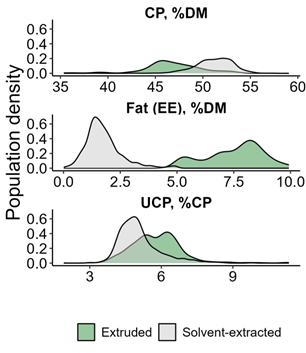
Extruded soybean meals tend to vary more in nutrient content than solvent-extracted meals because the conditions in extrusion are less uniform than the solvent extraction process (Figure 2). Book values for solvent-extracted and extruded soybean meals are provided for these types of soybean meals in the link to supporting files:

50 CP:           Solvent-extracted

48 CP:           Extruded | Solvent-extracted

44-46 CP:      Extruded | Solvent-extracted

Figure 2. Extruded soybean meal has more nutrient variability and higher UCP than solvent-extracted soybean meal.

Because extruded soybean meal has greater nutrient variability, NIR analysis is recommended to ensure accurate ration formulation. This approach allows you to quickly assess nutrient levels and account for batch differences, helping maintain consistent diet quality and performance. Check out these sample reports in the link to supporting files:

NIR:               Basic | CNCPS 6.5+ | NASEM

Chemistry:     Fatty acid profile


Nutritional value and digestion kinetics of soy hulls

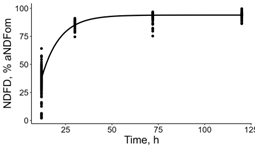
Soy hulls are an economical source of digestible fiber that can enhance energy supply in dairy rations. They are readily consumed and may replace part of the forage or concentrate in the diet. NDF digestibility (NDFD) of soy hulls is variable at 12 h but becomes consistent by the end of fermentation (Figure 3). A reference XML file for soy hulls can be found in the link to supporting files along with sample reports for:  

NIR:                 Basic | Select | CNCPS 6.5 | NASEM

Chemistry:       Commodity CNCPS


Questions? E-mail us at spectra@dairylandabs.com

Figure 3. Soy hulls have low NDFD12h, followed by rapid and nearly complete digestion.

Visit With Us at World Dairy Expo 2025

We look forward to seeing you Sept 30 - Oct 3, 2025 at World Dairy Expo in Madison, WI.


You will find us in two locations on the Expo grounds:

  • in Exhibition Hall, at Booth #EH 4104, and
  • staffing the Forage Superbowl Booth at the south end of the Trade Center.

We will have a variety of staff attending over the duration of Dairy Expo. Be sure to talk with us about clostridium testing in-house, all the testing options for soy products, or any other items of interest. We look forward to visiting with you!.  

If someone sent you this newsletter, or you found it via social media, and want to subscribe, please use the link below.

Dairyland Laboratories, Inc. | 608-323-2123 | Email

 
Facebook  Twitter  Linkedin  Instagram  Youtube