Faulkner County Agriculture Update
December 19, 2025
| | |
Holiday Update
First of all I would like to say Merry Christmas to everyone! This is my favorite time of year to spend a little time with family and friends. The Faulkner County Extension office will be closed from December 24 through January 1. This will also be the last update for 2025 and the next one will be January 9, 2026.
| | |
Grow Your Own Groceries Conference
The award winning Grow Your Own Groceries program is moving to the next level with an in-person conference! Join us February 10, 2026 at the Conway Expo & Event Center for a fun-filled and educational day of learning how to grow healthy, nutritious food in your own backyard and get some tips for cooking and preserving your harvest.
You will be able to choose 6 different classes (3 in the morning and 3 in the afternoon) from the topics below. We’ll also serve lunch and have a fun presentation to enjoy while you eat.
Break-out Session Topics
- Using Cover Crops in the Garden
- Planning for an Abundant Harvest
- Food Preservation Methods
- Growing in High Tunnels
- Hydroponic Vegetable Production
- Composting
- Nurturing Your Soil
- Getting Started with Beekeeping
- Setting Up a Drip Irrigation System
If anyone has any questions feel free to give me or Krista Quinn a call at the office. I have included the registration link below.
| | |
Weather
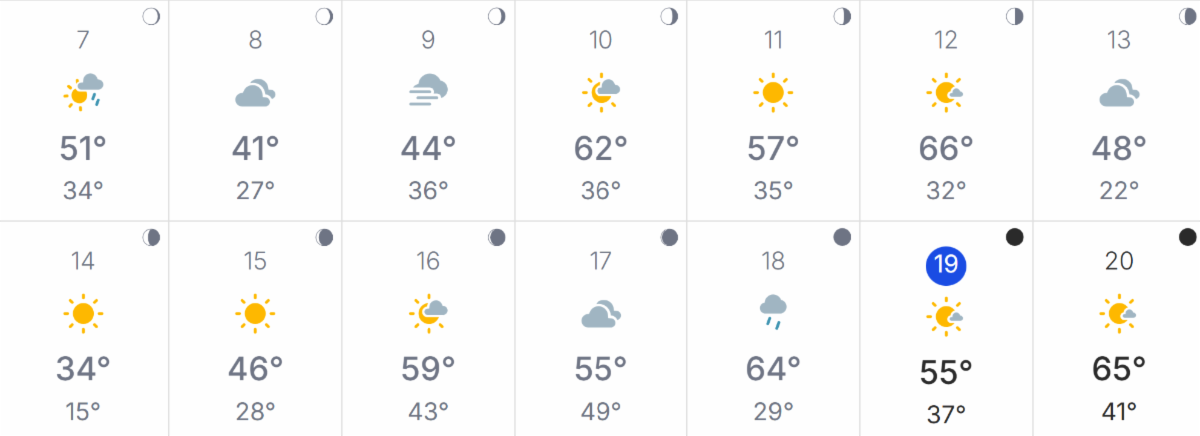
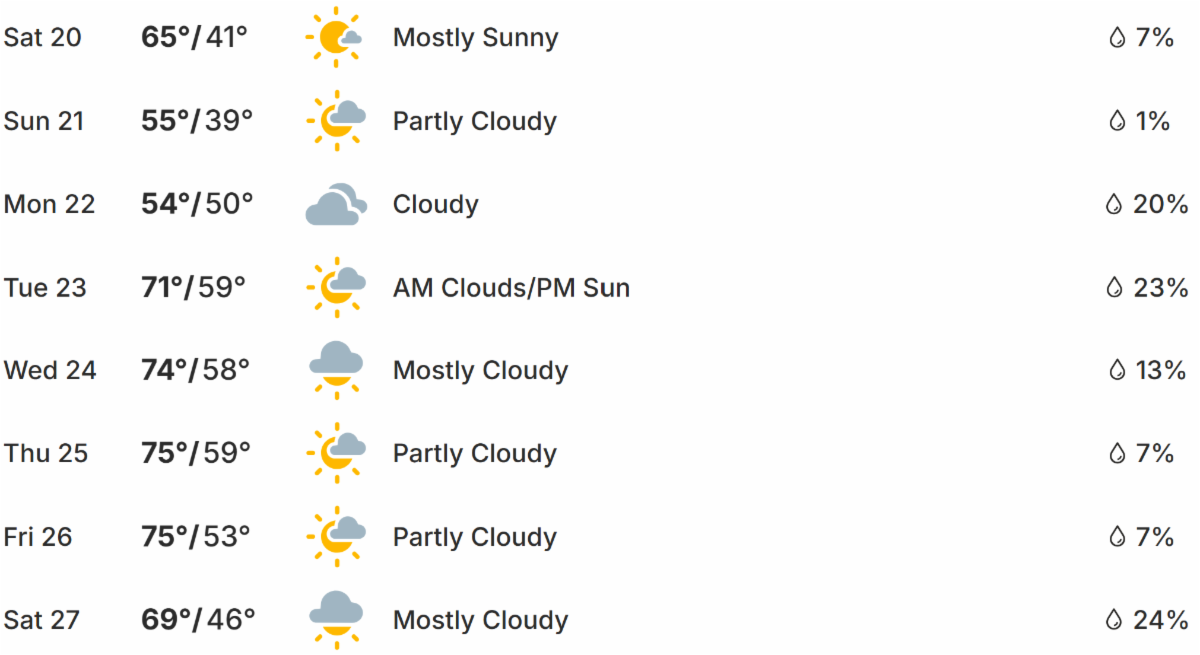
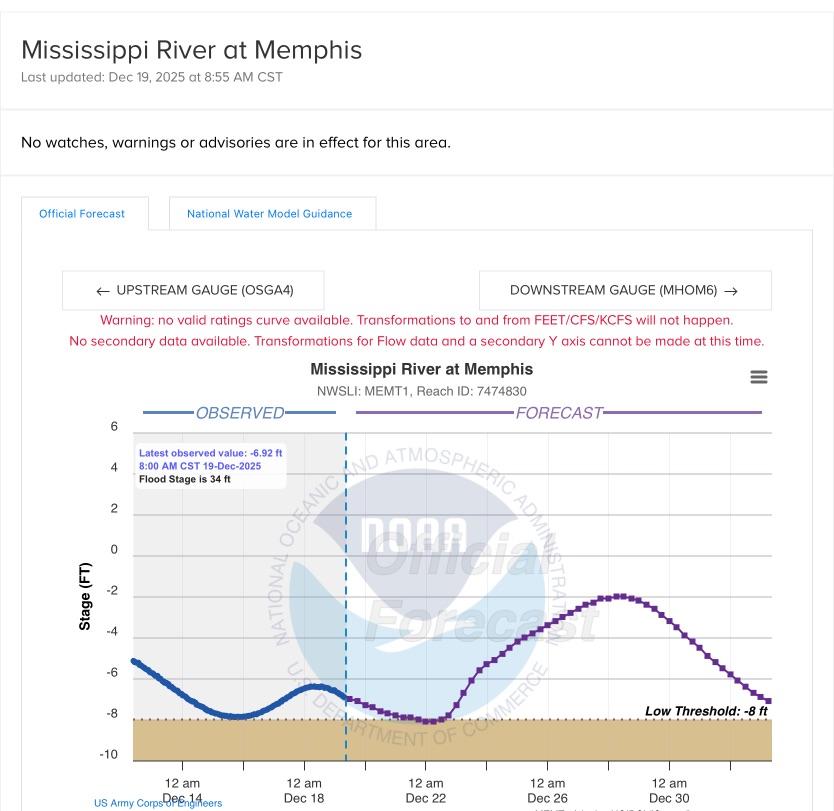
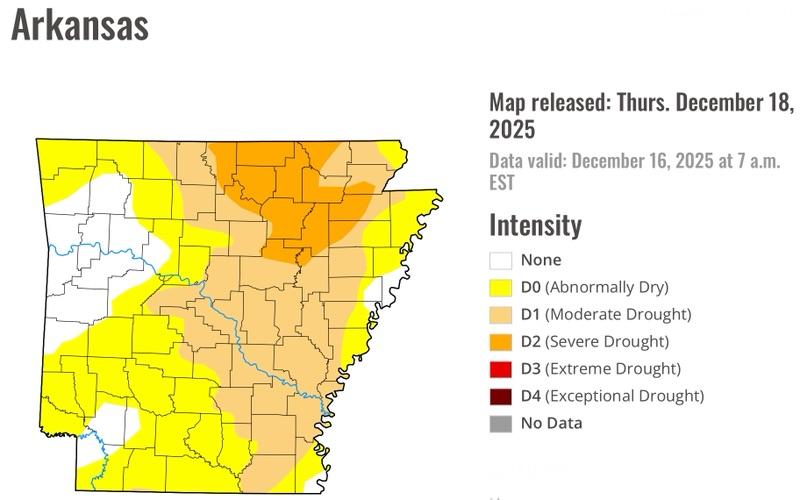
Rain came through yesterday, but again there wasn't much there. We got another 0.33 inches which brings our total for December up to 0.66 inches. That sure isn't much for this time of year. The whole county has moved into a D1 drought status. Next week doesn't show much of a hope of any rain around the corner. It looks like it will be a warm Christmas with shorts and short sleeves!
| | Arkansas and Mississippi River | |
USDA December Outlook for 2025 PLC Payment
by Scott Stiles
USDA revised its’ projections for 2025 cotton and rice Price Loss Coverage (PLC) payments in December. At the present time, USDA is projecting 2025 PLC payments for several program commodities. Projected payment rates and more information is included in the link.
| |
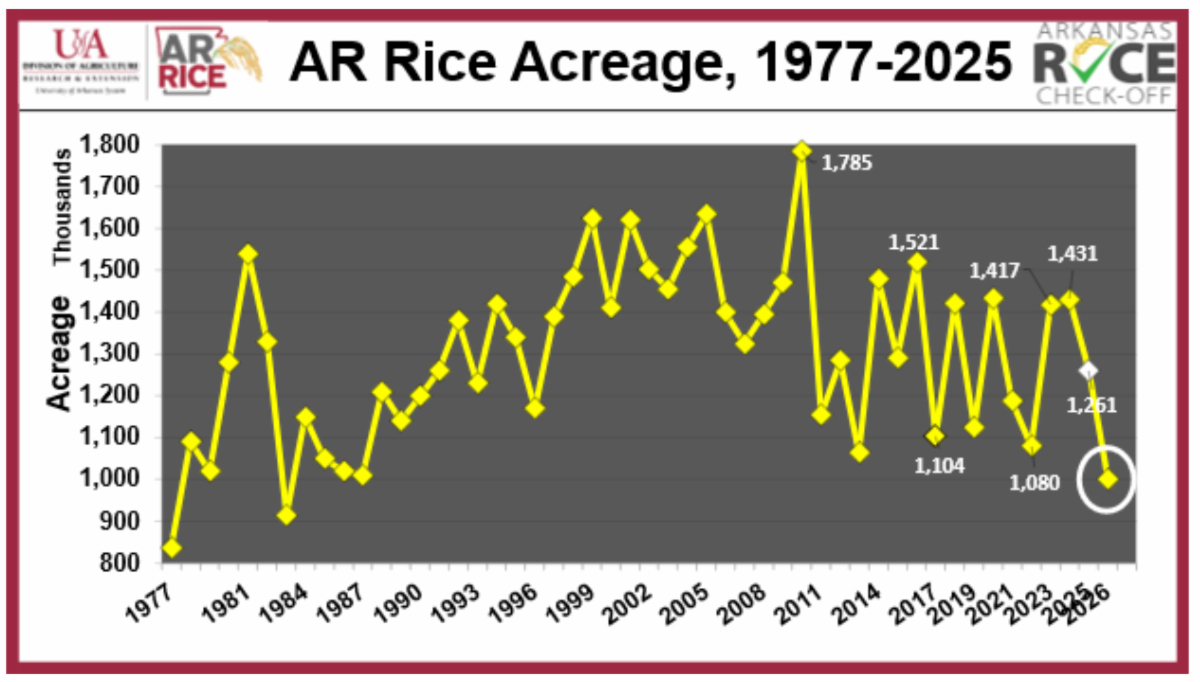
Arkansas Rice Update 12-12-25
by Jarrod Hardke, Scott Stiles, & Trent Roberts
The following link is an update from our rice team including information on next year's acres, soil sampling, variety selection, and marketing.
| |
Tri-State Soybean Forum returns to Arkansas
Experts from Arkansas, Louisiana and Mississippi will share information about issues facing soybean producers in the South at the 69th annual Tri-State Soybean Forum on Jan. 9, 2026.
The annual event rotates among the three major soybean production states, bringing together producers, researchers and other agriculture industry professionals. The University of Arkansas System Division of Agriculture Cooperative Extension Service, Louisiana State University AgCenter and Mississippi State University Extension Service jointly plan the conference.
“Arkansas is proud to host this year,” said Tri-State Soybean Forum chair Grant Beckwith, who is also the Arkansas County agriculture extension agent for the Division of Agriculture. “We know these are tough times for soybean producers, and this year’s forum will focus on issues affecting them as we head into 2026.”
The half-day event begins at 8 a.m. at the Dumas Community Center, 18 Belmont St. in Dumas, Arkansas.
Schedule
8–8:30 a.m. — Registration
8:30–9:15 a.m.— H-2A Pointers and Pitfalls William L. Mencer, Attorney at Law
9:15–10 a.m. — Ag Law & Policy Update, Rusty Rumley, Senior Staff Attorney, National Ag Law Center
10–10:15 a.m. — Break
10:15–10:45 a.m. — Weather Drivers for the Lower Mississippi Valley, Jay Grymes, Louisiana State Climatologist
10:45–11:15 a.m. — Soybean Market Outlook, Will Maples, Associate Professor-Ag Economics, Mississippi State
11:15–11:45 a.m. Dicamba Update, Susie Nichols, Pesticide Section Manager, Arkansas Department of Agriculture
11:45 a.m. – 12 p.m. — Equipment Care & Maintenance Strategies for Soybean Production - Brittney Schrick, Associate Professor & Family Life Specialist, U of A System Division of Agriculture
12–12:15 p.m. — Updates from State Soybean Agronomists - Arkansas, Louisiana, Mississippi
12:15–12:30 p.m. — Arkansas Soybean Board Update, Arkansas Soybean Promotion Board
12:30 p.m. Lunch – Sponsored by Farm Bureau Federation
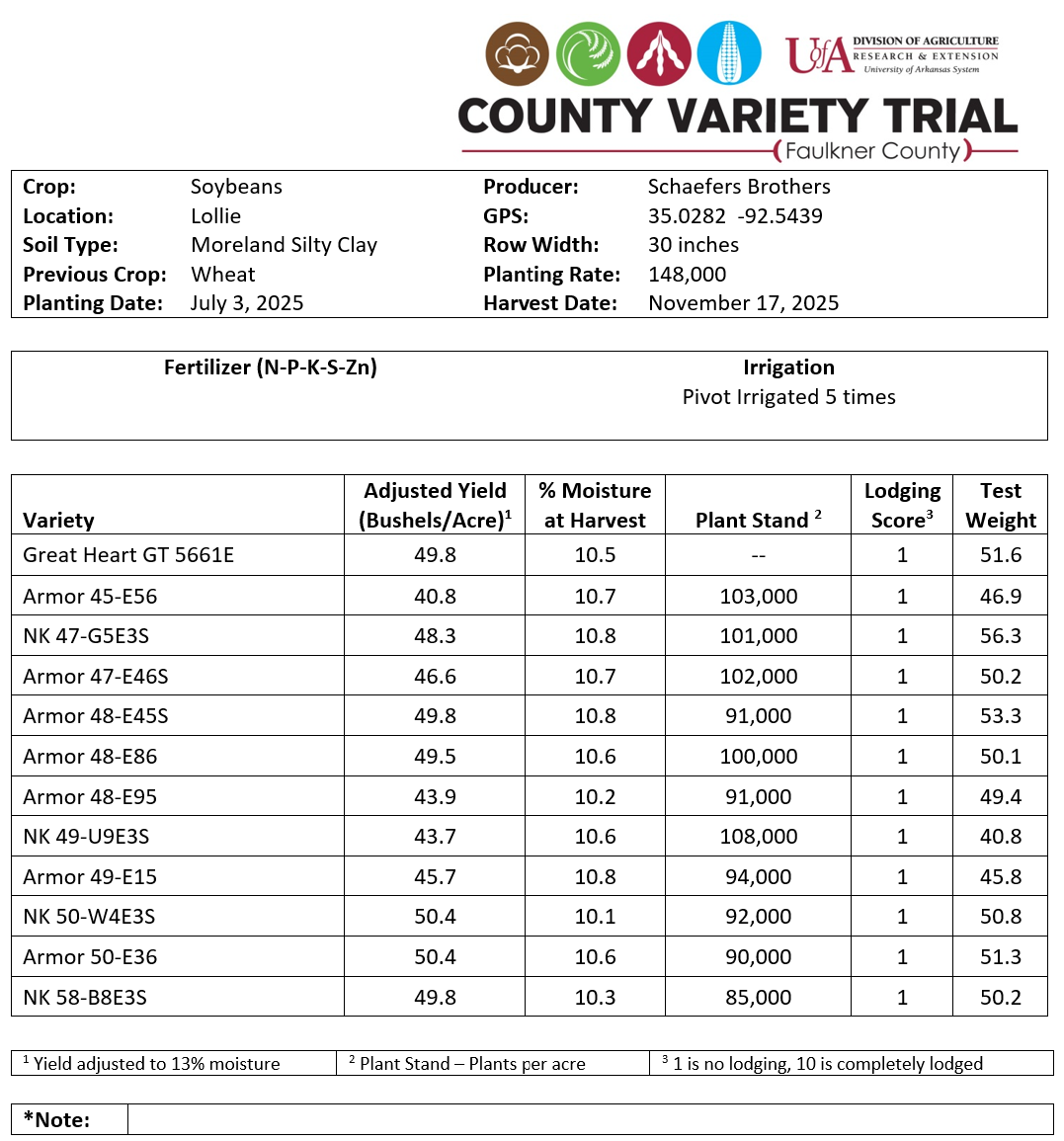
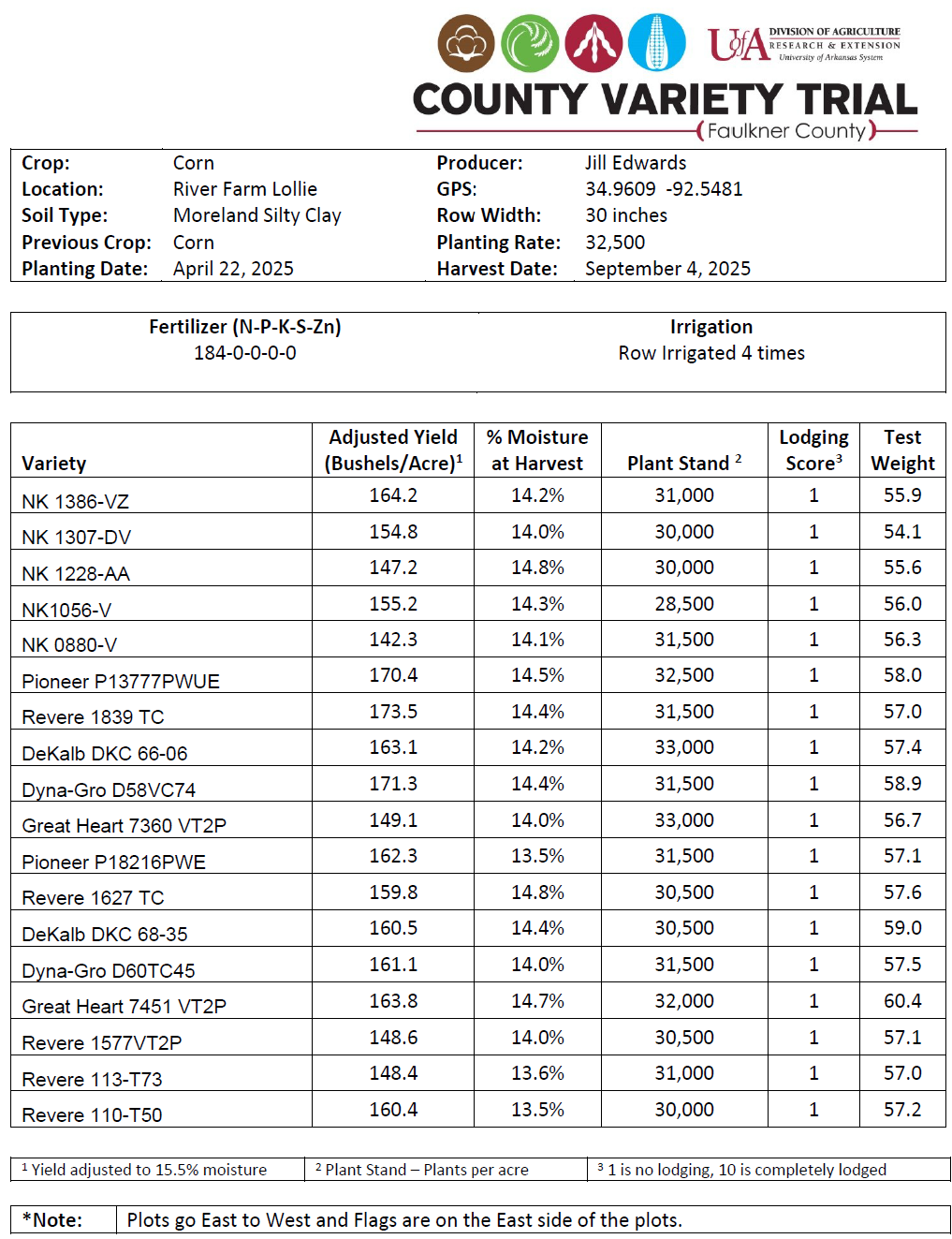
| | 2025 Faulkner County Variety Trials | |
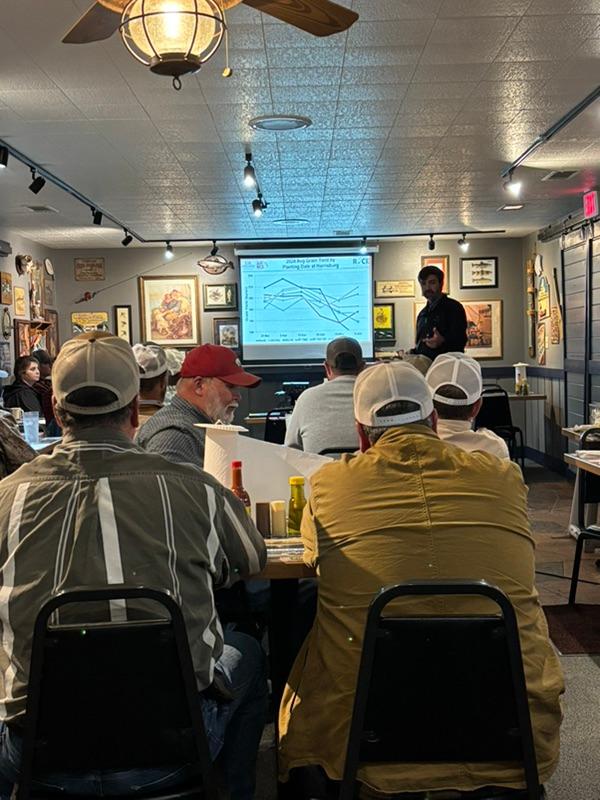
2025 Arkansas Rice Performance Trials
Jarrod Hardke, Rice Extension Agronomist
The link to Rice Information Sheet No. 185 Arkansas Rice Performance Trials 2025 is provided below. This contains the final results of the Arkansas Rice Performance Trials (ARPT) and DD50 Planting Date studies, as well as updated cultivar descriptions and disease ratings.
| | |
Row Crop Production Meetings
Our annual row crop production meetings will be coming up in early 2026. Save theses dates and I will share more information as we get it.
Corn and Soybean Production Meeting - January 22, 2026 - Morrilton (Place TBA)
Rice Production Meeting - February 24, 2026 - The Barn at Lollie
| |
Crop Enterprise Budgets
Below is a link to the 2026 Crop Enterprise Budgets. If anyone needs assistance with these budgets please let me know.
| | |
December 2025 WASDE Lowers Rice Price by 9% and the Farmer Bridge Assistance (FBA) Program is Announced
Dr. Hunter D. Biram, Assistant Professor and Extension Agricultural Economist, University of Arkansas
Mr. H. Scott Stiles, Program Associate, University of Arkansas
Introduction
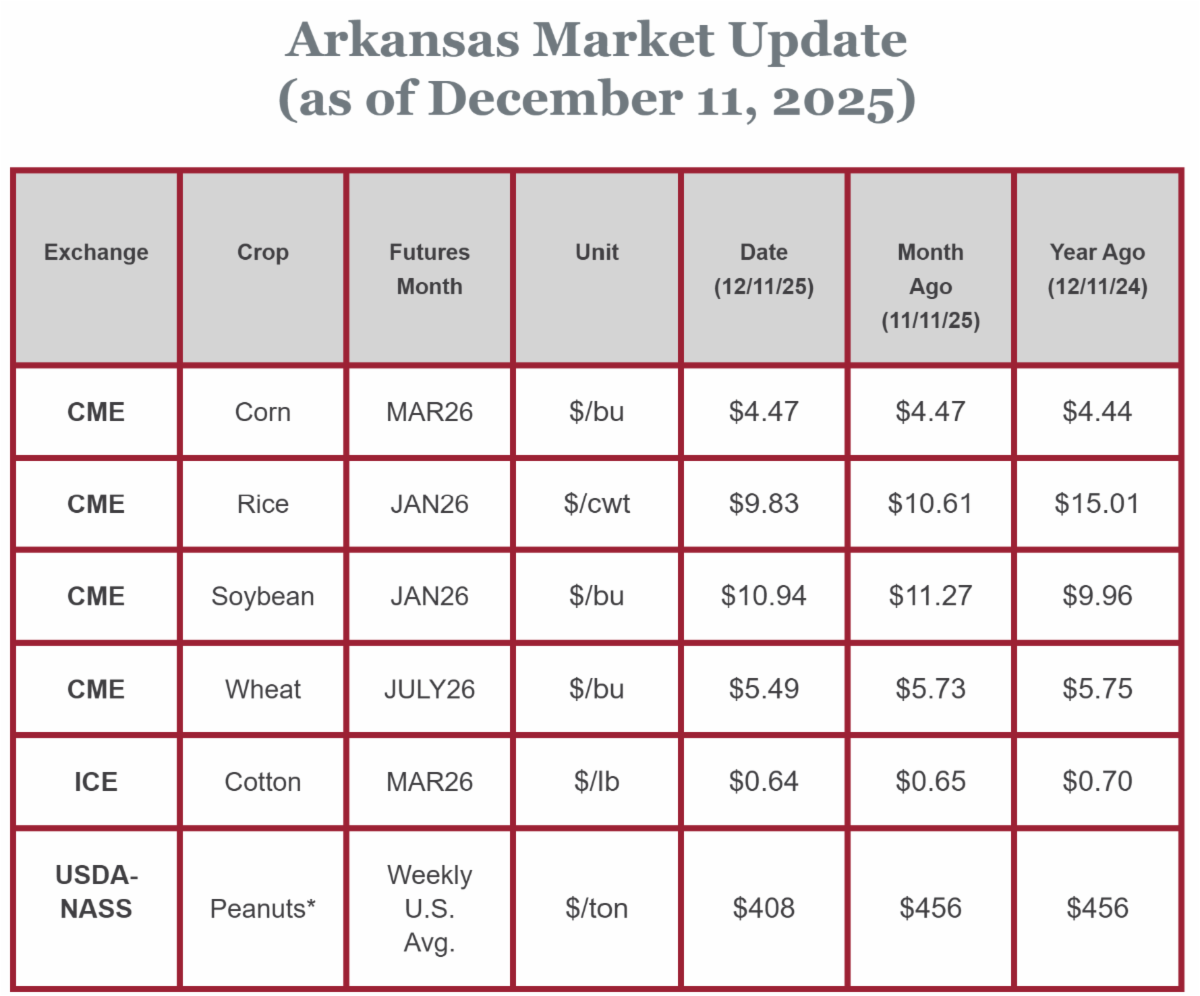
The December 2025 World Agricultural Supply and Demand Estimates (WASDE) report released on December 9, 2025 included very few changes to balance sheets which resulted in very few changes in season-average farm prices (SAFPs). SAFPs for wheat, corn, and soybeans remained unchanged at $5.00/bushel, $4.00/bushel, and $10.50/bushel, respectively. However, two notable changes in SAFPs were for rice and cotton. The 2025/26 all rice SAFP forecast was lowered by $1.10/cwt (i.e., 9%) to $11.60/cwt (i.e., $5.23/bushel) while the 2025/26 cotton price forecast was reduced to $0.60/pound which is down 3 cents per pound year-over-year and down 31 cents per pound since the 2021/22 marketing year. We provide crop-specific breakdowns of changes to the balance sheet driving these price revisions below. Using the latest 2025/26 price projections, we provide purely speculative commentary on what potential Farmer Bridge Assistance (FBA) program payments look like.
Long-Grain Rice
The only supply-side adjustment this month to the long-grain balance sheet was a 1 million cwt. reduction in imports to 43 million. Exports were reduced 2.0 million cwt. to 62.0 million on continued sluggish sales and shipments of rough rice to Mexico and other Latin American markets. At 62 million cwt., 2025/26 exports are still projected to be above last year’s 60.8 million. For the week ending November 13th, U.S. long-grain export sales were running 36% behind last year’s level for the comparable week. Ending stocks were increased by 1 million cwt. to 37 million and on par with 2024/25 stocks of 37.3 million cwt. The December outlook for the 2025/26 season-average farm price is $10.50/cwt. or $4.73 per bushel. This is down 25% from last year’s $6.30 per bushel and would be the lowest average farm price since 2016/17. The projected 2025/26 PLC payment rate for long-grain now sits at 6.4 cents per pound or $2.89 per bushel.
Cotton
This month’s 2025/26 U.S. cotton balance sheet shows slightly higher production, historically low domestic mill use, and larger ending stocks compared to November and last year. Beginning stocks, exports, and imports were unchanged. Production was increased this month about 150,000 bales to 14.27 million bales. A new production estimate will be made in January followed by end-of-season revisions in May. Yields were increased this month for the Southeast and Midsouth regions. Record high cotton yields are forecast for: Alabama, Arkansas, Florida, Louisiana, Mississippi, North Carolina, and Tennessee. As a result, the national average yield was increased 10 pounds to 929 pounds per acre. Mill use was reduced by 100,000 bales to 1.6 million, the lowest in almost 150 years. Exports were unchanged at 12.2 million, which is 300,000 bales above the 2024/25 exports of 11.9 million. For the week ending November 13th, U.S. export sales were 15% behind last year’s level for the comparable week. Ending stocks are now projected at 4.5 million bales, up from 4 million bales in 2024/25. The projected season average farm price was reduced by 2 cents this month to 60 cents per pound, a decline of 3 cents from last year and 31 cents since 2021/22. The projected 2025/26 seed cotton PLC payment rate currently stands at 9.48 cents per pound, up from 8.63 cents last month.
Corn
The 2025/26 U.S. corn outlook for December is only slightly bullish with greater exports and lower ending stocks despite the unchanged price outlook. Exports were raised 125 million bushels to 3.2 billion bushels for the 2025/26 marketing year. Strong foreign demand for corn during November implies that total shipments over the September-October-November period will likely surpass 800 million bushels which is more than the previous high set in 2007. With total supply unchanged, ending stocks were revised downward 125 million bushels to 2.0 billion. The SAFP forecast for corn remains at $4.00/bushel for the 2025/26 marketing year.
Soybeans
The U.S. soybean balance sheet was the quietest with no changes in supply, use, and price projections. The 2025/26 global soybean outlook includes a 0.8 million tons in production driven by higher production for Russia and India despite lower production for Canada and Ukraine. Global crush was increased 0.3 million to 365.2 million tons driven by higher supplies putting downward pressure on domestic prices in Russia and India. Global soybean exports are lowered 0.3 million tons along with a reduction in imports for Japan, Russia, and Saudi Arabia. Brazilian imports were increased. Global ending stocks for soybeans are increased 0.4 million tons to 122.37 million largely driven by greater stocks for Brazil and Russia. The SAFP forecast for U.S. soybeans remains at $10.50/bushel for the 2205/26 marketing year.
Farmer Bridge Assistance (FBA) Program
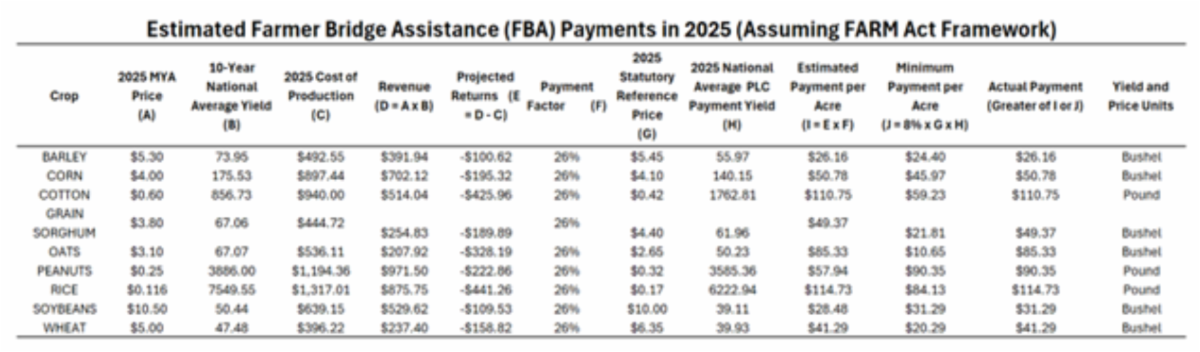
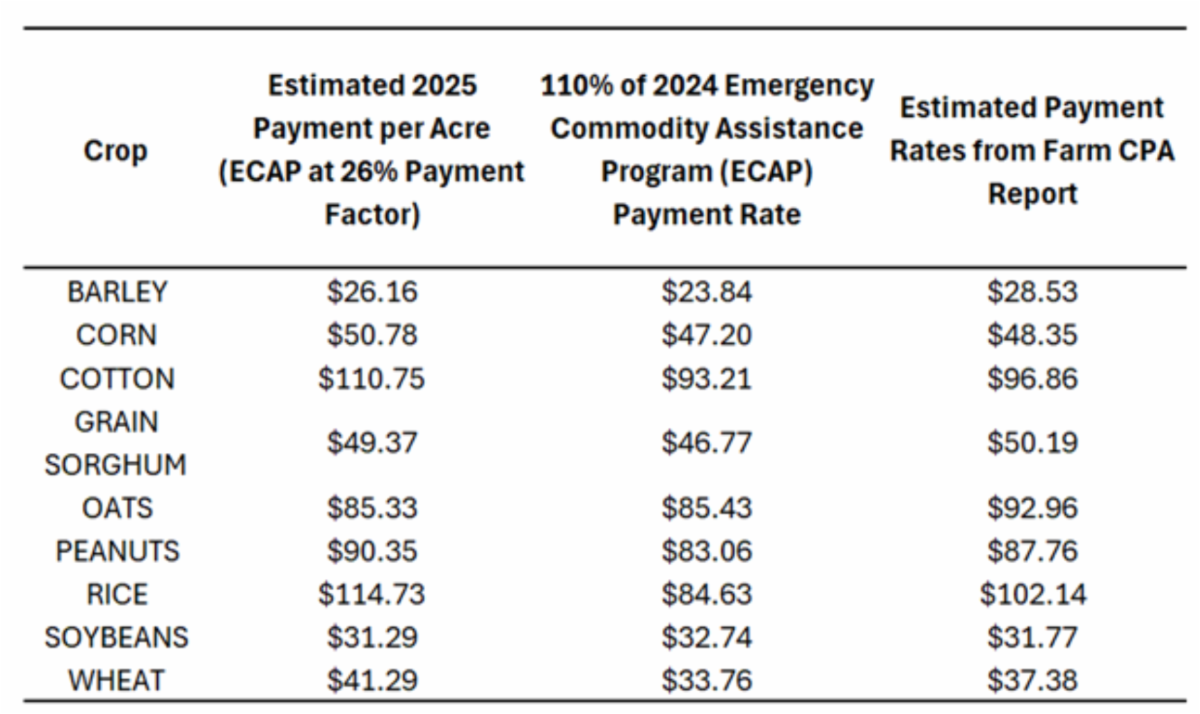
The USDA’s newly announced $12 billion Farmer Bridge Assistance (FBA) Program (see USDA press release here) has generated substantial interest, and while official payment rates are still forthcoming, early speculation provides a sense of what farmers may expect. We emphasize that FBA payment rates have not been released by USDA and that the following analysis is speculative and based on prior policy parameters (i.e., Emergency Commodity Assistance Program, or ECAP). Using USDA Farm Service Agency planted acreage data, four payment-rate scenarios were modeled: an “ECAP 2.0” approach using December 2025 WASDE prices, a scenario assuming payments equal to 110% of ECAP 1.0, estimates published in the Farm CPA Report, and a lowest-cost option using the minimum of Scenarios 1 and 2. Estimated payment rates by crop under an ECAP 2.0 scenario are given in Table 1 below while estimated rates across the different scenarios are given in Table 2. Estimated total program costs across these scenarios range from $10.39 to $11.36 billion, with the lower-bound scenario allocating the largest shares to corn ($4.58B), soybeans ($2.51B), wheat ($1.63B), and cotton ($748M). Prevented planting acres are excluded from eligibility, a notable factor for crops such as rice, which had 20% of its reported acres in PP.
Table 1. Breakdown of Estimated FBA Program Payment Rates Under the Framework Provided by the Emergency Commodity Assitance Program (ECAP) The calculations used to arrive at the estimates for the 2025 FBA Program Payments are provided in the table below. These are only estimates and should not be considered final. According to the USDA, the final payment rates for the FBA will be released the week of December 22, 2025. The 2025 MYA Price, 10-Year National Average Yield and 2025 Cost of Production come from the September 2025 USDA-WASDE report, USDA-NASS, and USDA-ERS, respectively. The calculations for the minmum payment per acre are based on calculations from Dr. Hunter D. Biram. The 2025 Effective Reference Price and 2025 National Average PLC Payment Yield come from https://www.fsa.usda.gov/resources/programs/arc-plc/program-data. The 2025 National Average PLC Payment Yield is a weighted average. It is found by calculating the total "base acre" production of each crop (i.e., number of base acres enrolled in PLC times PLC payment yield) and dividing this value by the total amount of base acres in PLC by crop.
| Table 2. Estimated Farmer Bridge Assistance (FBA) Program Payment Rates (Assuming ECAP Framework) The table below presents estimates for the FBA program based on the Emergency Commodity Assistance Program (ECAP). According to the USDA, the final payment rates for the FBA will be released the week of December 22, 2025. | While the analysis is purely speculative, it offers a timely snapshot for stakeholders seeking clarity in the wake of the announcement. We reiterate that no payment rates for FBA have been released, and the ones provided in Table 1 are only estimates based on prior policy parameters. What is known today is that FBA payments—capped at $155,000 per qualifying legal entity—will be issued by February 28, with $11 billion reserved specifically for row-crop producers. There will not be a provision for farmers whose income from farming comprises 75%, or more, of total adjusted gross income (AGI). Final payment rates are expected by the end of the month. For additional context and ongoing updates, readers can view the University of Arkansas Division of Agriculture press release here: https://www.uaex.uada.edu/media-resources/news/2025/december2025/12-9-2025-ark-bridge-package.aspx. | | Beef, Small Ruminants, & Forages | | |
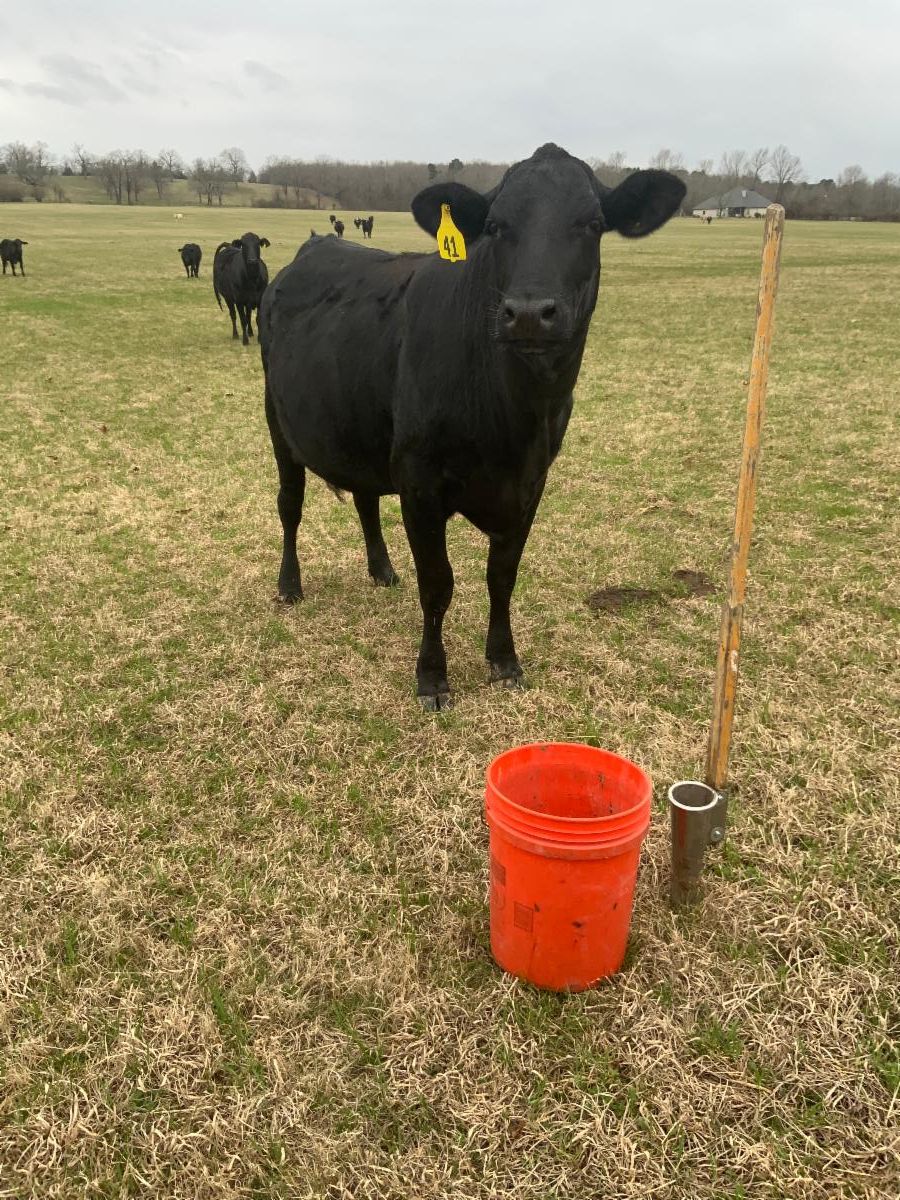
Timing of Soil Sampling Forage Ground
One of the most common questions I get about soil sampling is what is the best time to sample. The answer to that question is the standard County Extension Agent answer - it depends. If you have several years of samples on a field or if you just acquired some new ground and are starting the soil sampling process, try to always soil sample at the same time of year. It doesn't matter if you do it in the fall, winter, or spring, just make sure you always do it at that same time of year each time. I recommend sampling every three years. The reason you want to do that is that depending on how wet or dry the soil is will change your values. If you really want to improve your soil over time we need to be comparing apples to apples and that only happens if you do it at the same time of year.
Now, like in all of agriculture, weather does play into this. The last few falls and early winters have been extremely dry. This could lead to some differences that you need to be aware of. If you have a history of samples over several years, always compare to the past samples to see where you are. Dr. Trent Roberts actually addressed this issue in the Rice Update that I posted earlier in this update. Here is what Dr. Roberts says about pH during drought.
"Soil pH is the measurement of hydrogen ions in the soil solution and prolonged periods of drought will often lead to a decrease in soil pH measurements compared to samples collected during periods of “normal” soil moisture or compared to samples collected during the winter (when soils generally have higher soil moisture). Research has shown that soil sampling during droughty periods can results in soil pH values that are 0.3-0.5 units less than soil samples taken during periods with adequate rainfall. Most producers and consultants notice this drop in pH when they sample in the late summer/early fall and compare values to samples that were taken during the winter. This “artificial” drop in pH due to the dry soil conditions at sampling may trigger liming recommendations so it is important to look at the trends in soil pH over time to make management decisions."
Soil sampling is a vital part of growing forages in Faulkner County, and my recommendation is to get a soil sampling plan and don't just decide at the drop of a hat that you need to sample. Plan to do a third of your acres every year or all your acres every three years and do it at the same time of the year every time.
| | |
Mating Decisions and Gene Combination Value
Build Back Better – Replacement Heifer Series – Article 6
Mark Z. Johnson, Oklahoma State University Extension Beef Cattle Breeding Specialist
Mating decisions made in commercial cow-calf operations determine if (and how much) Gene Combination Value (GCV) we create in the next generation.
In the genetic model: Phenotype = Genotype + Environment. Genotype represents the genetic potential of an animal to reach a level of performance and can be split into two components. The component of Breeding Value (additive genetic merit) was covered last week. The focus of this article is GCV which can also be thought of as the non-additive part. GCV is based on the effect of gene pairs at loci across the genome. It is part of the animal’s genotypic value and impacts the animal’s performance potential; however, since it is based on gene pairs, it can’t be transmitted from parent to offspring. In commercial cow-calf operations we can create GCV through mating decisions. The decision to crossbreed is a mating decision.
Crossbreeding provides commercial cattlemen the opportunity to combine desirable characteristics of two or more breeds (breed complementarity) and increase performance due to hybrid vigor (heterosis). Hybrid vigor is the result of GCV.
For example, if we make the mating decision to use a Charolais bull on our Angus cows, we are creating F1 black-nosed smoke calves with 100% level of individual heterosis. Why? Because the F1 generation will have a Charolais gene paired with an Angus gene across all loci.
Hybrid vigor is the superiority in the level of crossbred offspring’s performance over the average level of the purebred parents involved in the cross. In scientific literature, levels of heterosis are typically expressed as a percentage as shown in the example below:
A Charolais bull with the additive genetic potential for 660 pounds of weaning weight is crossed with a herd of Angus cows with the additive genetic potential for 640 pounds of weaning weight. The resulting F1 crossbred calves weigh 683 pounds at weaning.
- Average of the purebred parents is 650
- The 683 pound weaning weight of calves is 33 pounds more than average of the parents
- (33/650) x 100 = 5% level of heterosis from this cross.
The 5% level of heterosis is not additive, it is the result of the biological phenomenon of hybrid vigor created by crossbreeding resulting in a GCV that is non-additive.
It is noteworthy that if the F1 heifers and bulls resulting from this cross were mated, or if we began a two breed rotation involving an Angus bull mated to the F1 females from this cross, we would lose hybrid vigor (GCV) in the resulting F2 calf crop. Why? Because not all loci would have a Charolais gene paired with an Angus gene. Hence, GCV (based on gene pairs) is NOT transmittable from parents to offspring. It must be created through mating decisions. Thereby, purebred animals are an essential component for effective crossbreeding programs.
Final Thoughts for Building GCV
Each selection and mating decision should be intentional, deliberate and made for a purpose. Selection decisions impact BV. Mating decisions impact GCV. Choose breeds (and breeding stock within those breeds) with high breeding value for traits of economic importance to your operation. Crossbreeding (to increase GCV/hybrid vigor) does not replace additive genetic merit, it builds off of it. Finally, more breeds introduced into a crossbreeding program will result in more heterosis but also increase variation. Performance levels of some traits are influenced more by additive genetic merit, other traits benefit more GCV. More on that topic next week.
| | |
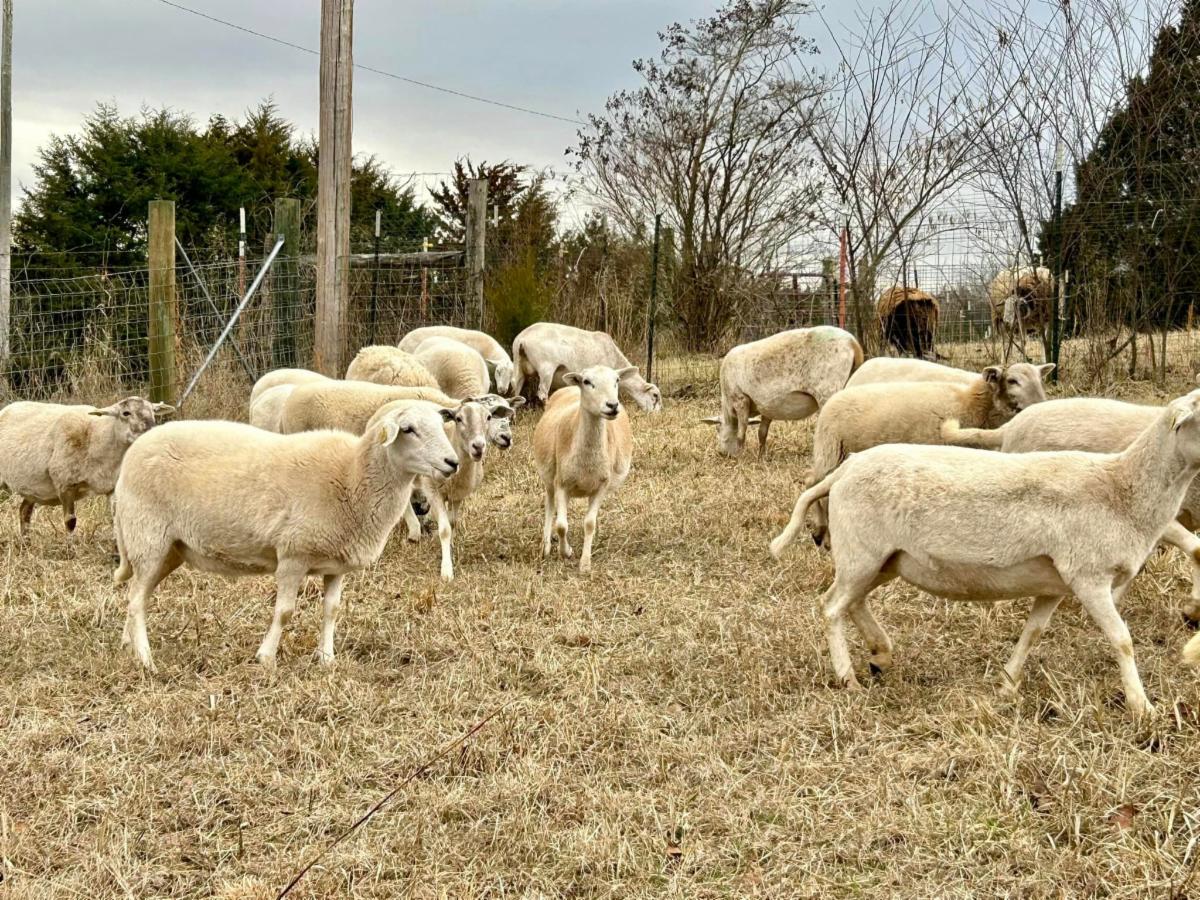
2026 Sheep Workshops/Pre-Lambing Workshop
For 2026 we are planning four quarterly sheep workshops. The first workshop will be a pre-lambing workshop on January 17, 2026 at the Faulkner County Extension Office. We are planning to start at 9:00 and be done by 12:00. There will be more information in the next newsletter but I wanted everyone to go ahead and save the date.
Plans for other workshops include composting of manure, economics, and a farm tour.
| | |
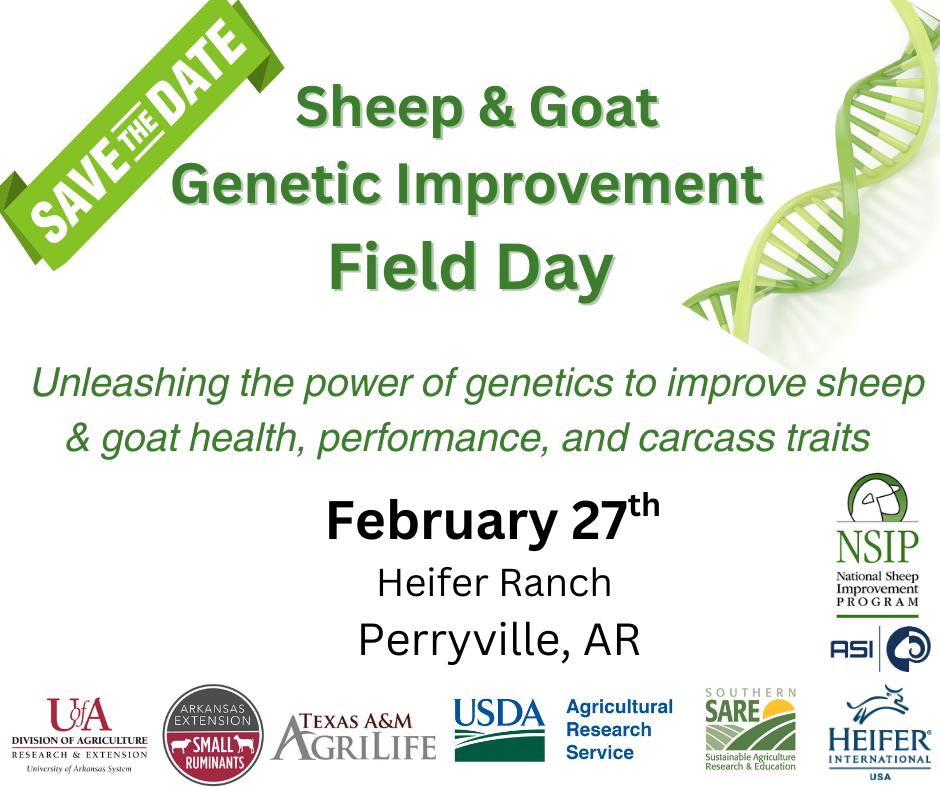
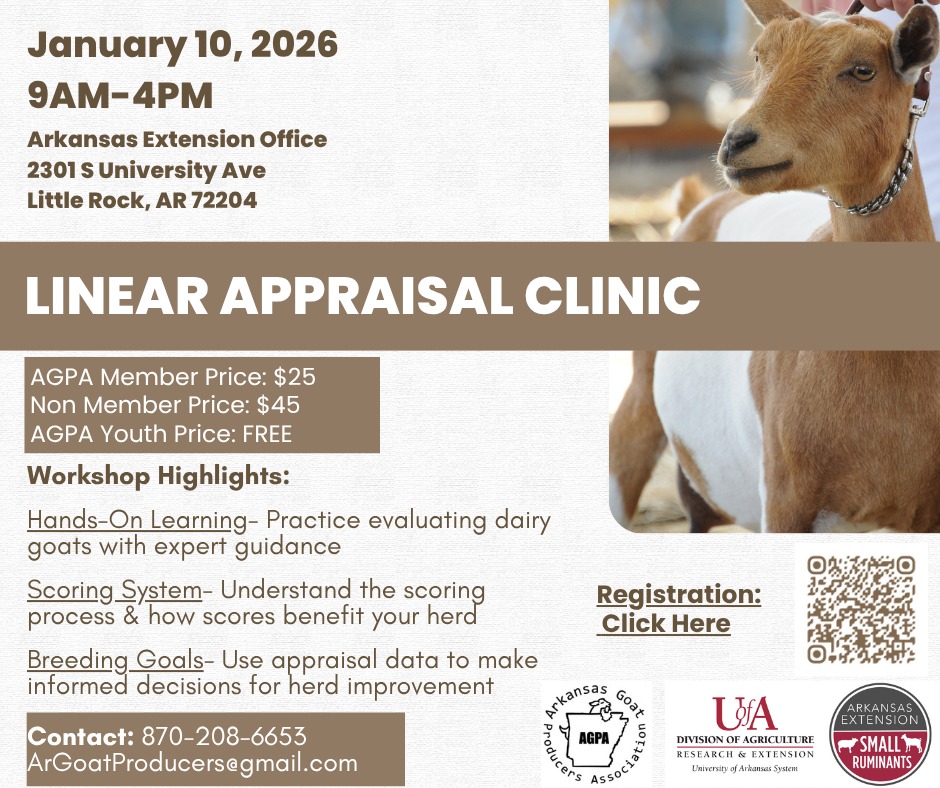
Sheep & Goat Genetic Improvement Field Day
by Dr. Dan Quadros
We have rescheduled it! Save the date: The "Sheep & Goat Genetic Improvement Field Day" will take place on February 27th (Friday), now in a new location, at Heifer Ranch (55 Heifer Rd, Perryville, Central Arkansas), from 9:30 am to 3:30 pm. The program and registration website will be released in January.
I know that some of you will be busy with the lambing/kidding season, but please plan in advance to attend.
| | Cool Season Annual Resources | | |
Pesticide Applicator Trainings
In order to purchase restricted use pesticides (herbicides, insecticides, fungicides, etc) you must have a private applicators license. The license is good for 5 years.
To obtain a license you must first attend a certification training. Certification trainings are done in person by a County Extension Agent or you can go online and be certified. Below is a link to the online training.
In person trainings this year will all be at the Faulkner County Extension Office and will be on:
January 29 - 6:00 PM
March 12 - 6:00 PM
April 30 - 2:00 PM
A certification training costs $20 and is due the day of the training.
Once a producer is certified, they will go through the Arkansas Department of Agriculture to obtain the license which is $45.
Please call the Extension office at 501-329-8344 to sign up for one of these dates.
There will be other opportunities for trainings in Perry and Conway County and I will post those as soon as those dates are available.
If you have a question about your license, please follow the License Search and Verification link below to find your license.
| | |
Livestock Market Report
The weekly livestock market report is available on the Arkansas Department of Agriculture website.
| | |
Sign up for Text Alerts
You can now sign up for text alerts from me throughout the year. I have two areas you can sign up for which includes Faulkner Livestock or Faulkner Ag (Row Crop Updates). To sign up you can follow one of these links or use the QR Codes below.
| | Pursuant to 7 CFR § 15.3, the University of Arkansas System Division of Agriculture offers all its Extension and Research programs and services (including employment) without regard to race, color, sex, national origin, religion, age, disability, marital or veteran status, genetic information, sexual preference, pregnancy or any other legally protected status, and is an equal opportunity institution. | | | | |