|
People do not learn when there is fear, and let’s face it, even the best teachers struggle to teach in fear.
I led an amazing Title 1 high school in Northern Virginia for seven years - a majority of the students were Hispanic and over 35% were English Learners. When I left the school, the staff was more focused and dedicated than ever on doing whatever it took to provide meaningful learning opportunities for ALL kids. When I began my leadership and turnaround journey in this school, teachers feared teaching multilingual learners because they did not want to be unsuccessful, and the multilingual students feared being in those classrooms because they were unwelcoming and inequitable.
When you think about it, education itself is multilingual and we know that it is multifaceted. However, the ironic truth is that many monolingual teachers fear teaching multilingual students, which is detrimental to student outcomes, school culture and climate. Because the demographics of the high school I led was unique in our district, I had to lean on the elementary and middle school principal colleagues in my cluster for experience on improving classroom climate and instruction.
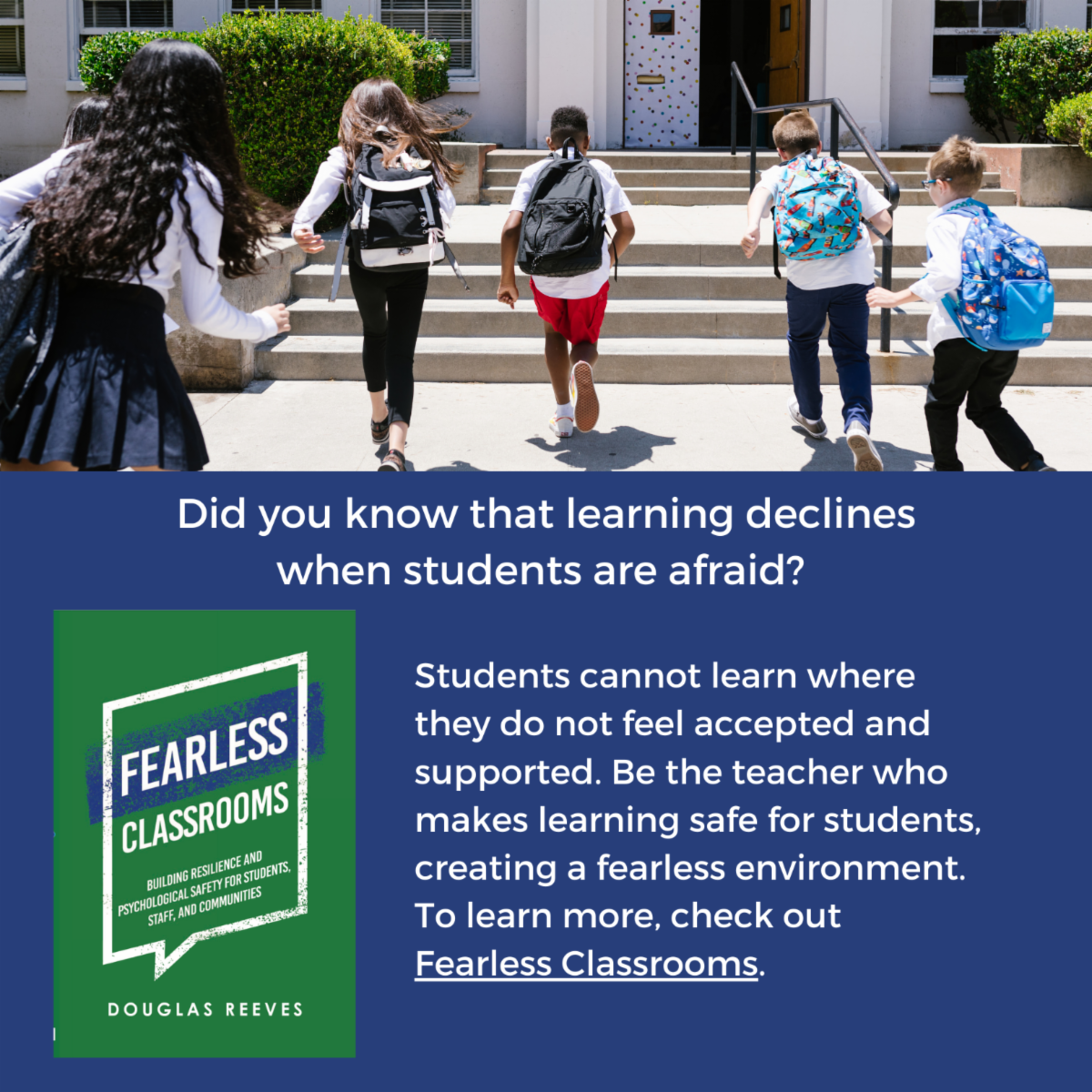
In Fearless Classrooms, Dr. Douglas Reeves reminds us how much educators can glean from our Pre-K and Kindergarten classrooms, “where mistakes result in giggles rather than shame.” I never liked a quiet classroom, even as an English teacher. I wanted my classroom to have the sound of organized chaos, where it was safe for students to create and connect with content, with one another, and with me as their teacher. What I saw and heard as principal of this school was way too much “teacher talk” and not enough “student talk”. Many traditional high school classrooms are not physically planned to foster student collaboration. Recall your own eleventh grade English or Algebra 2 classrooms; I’m sure your mind’s eye sees rows of desks and a podium at the front.
In an effort to be revolutionary, I sent some of my core content teachers on field trips to observe our neighboring elementary teachers’ classrooms. I did this for two main reasons - the demographics were the same, and the teachers were teaching kids and not just content. I asked my high school teachers to notice how new content was introduced and how the elementary teachers received feedback about students’ learning. All of the teachers came back with the same message, “They were teaching in small groups a lot of the time.”
I purchased flexible seating, student and teacher desks on wheels, and used the mantra, “Say NO to the ROW” when I observed teachers teaching. We began a school-wide implementation of personalized learning focusing on literacies (speaking, reading, writing, and listening) within content areas. Teachers used stations (much like they observed in their elementary colleagues’ classes) for students to engage in new material in smaller groups, extending the opportunities for students to ask questions, take risks, and make mistakes in safer, more intimate settings. Non-fiction writing was infused in all classes. Additionally, in these smaller groups, bilingual students were able to assist their newcomer peers by explaining directions and procedures simultaneously assisting their monolingual teachers. Teachers were then freed up to examine student work and provide feedback in English as the bilingual students acted as translator, at times. Simply, teachers and students were all engaged in student learning, and no one was afraid.
Finally, many of these high school teachers began using simple, consistent classroom routines, such as entrance tickets and exit tickets at the beginning and end of every class, to check for student understanding and to collect important formative data on the quality of their own teaching. In doing so, the learning of both students and teachers flourished because both were seeing progress and receiving constant feedback.
It was nothing revolutionary, and slowly, the classrooms in my high school became “fearless”, where making mistakes became part of the learning process, and ALL students, especially the multilingual students, flourished in knowledge and not fear.
|