|
Fearless Grading: The Power of Reform | |
Here’s the latest from Creative Leadership Solutions, where we believe in evidence, passion, and results. We value respect, trust, service, collaboration, and reason. This month, we share the impact of grading reform on both students and faculty. | |
|
Action Research Task Force
Science Fair Videos
| |
The videos below showcase the culmination of Creative Leadership Solutions' action research task force projects and the positive impact on student achievement. | |
Learn More
Further watching and reading that emphasize people and practices over products
| |
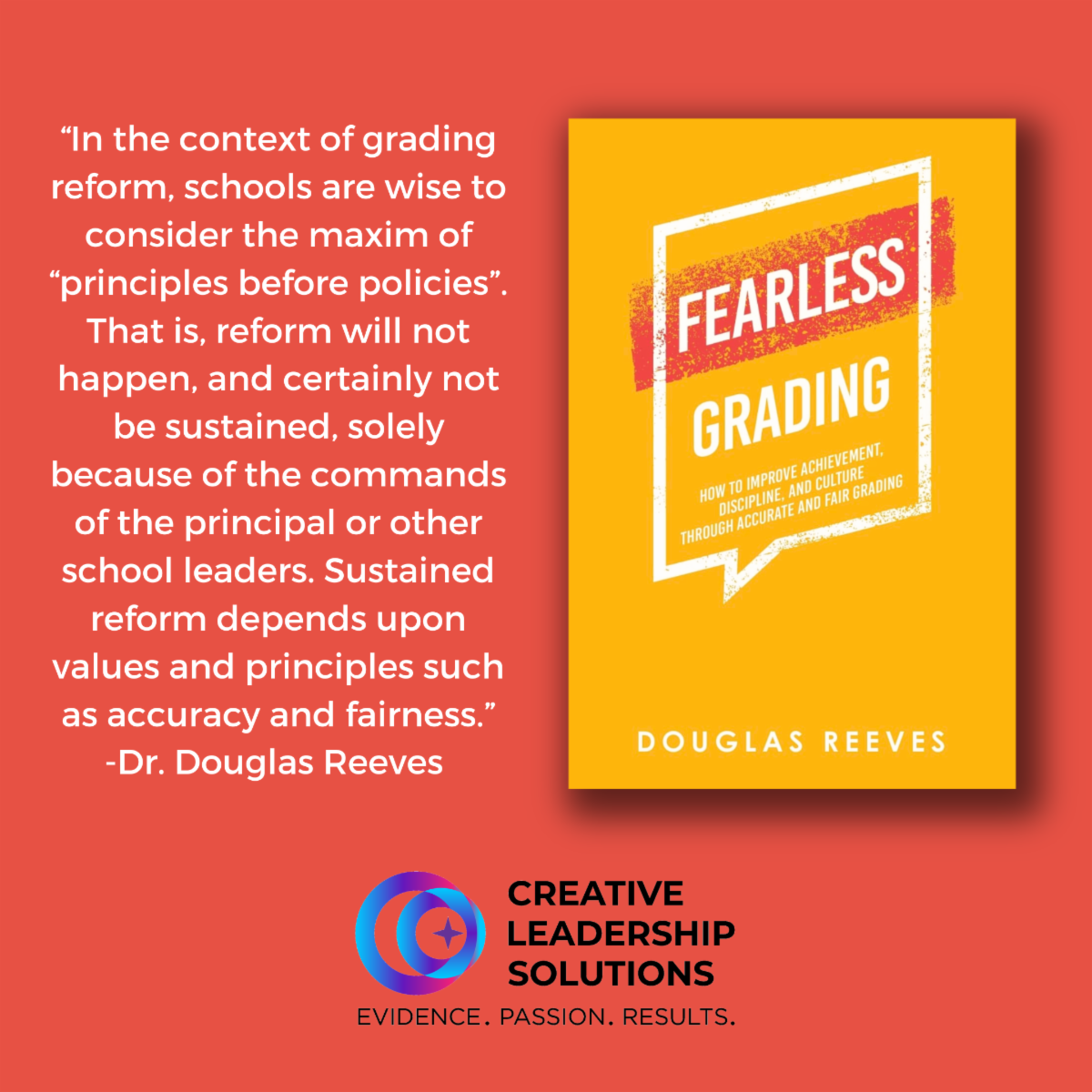
When grades are accurate and fair, students and teachers will see immediate improvements in academic performance, student behavior, and attendance. But when schools cling to toxic grading practices that are demonstrably inaccurate and unfair, then failures persist. Click below to enjoy a free excerpt from Fearless Grading. | |
The Case Against The Zero | |
In a publication still relevant today, Dr. Douglas Reeves presents evidence as to why the use of the zero on a 100-point scale should be replaced with a more accurate and fair system. Read the article below.
| | | |
Teach Like a Scientist: PLCs and Action Research | |
Written by Dr. Emily Freeland and Allyson Apsey
One of our favorite questions from a teacher recently was, "So, we should teach like scientists?" And, the answer was a resounding, "YES!". The question came from a group of New York high school teachers who were learning about the...
| | | |
What's In The Works at CLS? | |
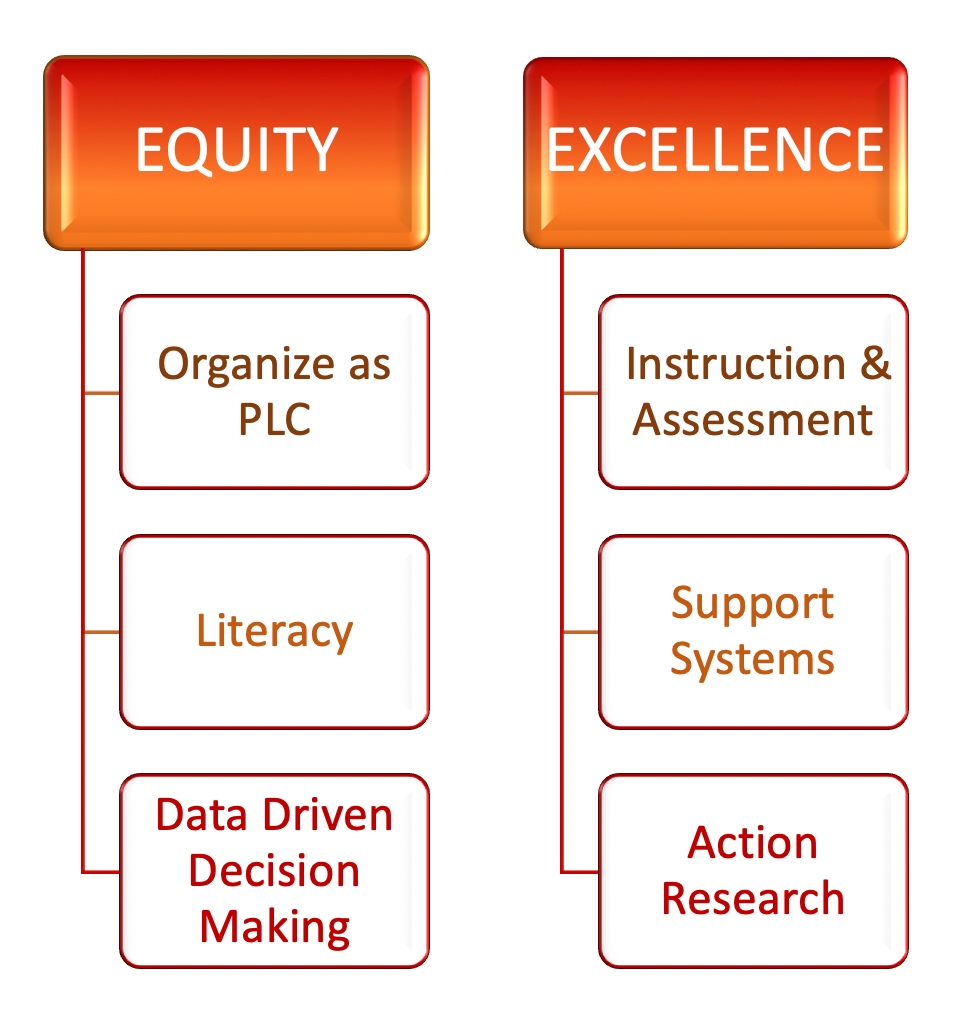
Based on the 90 90 90 research and practices, we are excited to launch a new solution—partner with CLS to become an Equity and Excellence School. Based on a pre-assessment, the partnership will consist of a systematic and customized approach to job-embedded professional development. | |
Service Highlight
Just one of the many services we offer
| |
Fearless Grading: Action Research Task Force | |
|
Focusing on What Works
Whether in their own classrooms or as a collective within a collaborative team, teachers identify learning challenges and select practices to address their students' needs. Unfortunately, the shortfall is in memorializing the steps taken and the results of effectiveness. A simple way to formalize this process so that it can be repeated is through action research. Action research allows educators to simultaneously investigate and solve a learning challenge, so the inquiry and action take place at the same time.
Through a simple three-step model of Challenge-Practice-Results, it is possible to capture the results achieved by students and to relate the teacher practices that caused those results. Having both the results and the actions leading to those results can make the connection between teaching practices and student learning, thereby measuring impact.
By sharing those results through an adult science fair (tri-fold boards and gallery-walk presentations) the evidence needed to replicate success is captured and celebrated. Action research is an effective and efficient way to maximize improvement initiatives and change learning for students. Because it is adaptable to any context, this three-step process can be used at all levels of learning – classroom, school, and district. By utilizing a collaborative meeting series, individual participants and teams complete research of their own, guided by a CLS Associate. With this service teachers, schools and districts have evidence of local impact.
Deliverables
Task Force Facilitation: CLS will collaborate with teachers and leaders to support the facilitation of the Action Research Task Force and support the analysis of their existing challenges, structures, and practices. Participants will leave with a plan to make significant improvements that will bear fruit in the form of better engagement and student results. In addition to facilitating the action research task force meetings, each day CLS is in the district CLS will meet with the cabinet, district and school leaders, department leaders, and teacher-leaders, as directed by the district. CLS will provide feedback to district leadership on school and district meetings and classroom observations.
Action Research Task Force Meeting
Sample Agenda
7:30-9:00: Building Staff Meeting
9:15-10:30: Building Administrators Meeting
10:45-12:00: Department Meetings
12:15-1:30: Working Lunch with Administrators
1:45-2:45: 1:1 Teacher or Instructional Leadership Support
Meetings
3:00-5:00: Action Research Task Force Meeting
Two (2) Site Visits: In addition to the five task force meetings, CLS Associates will be on-site for an additional two days to further support participating teachers and leaders.
| |
CLS Associates understand that the right people make all the difference. | |
Dr. Emily Freeland's 29 years of experience includes administrative positions at the state, district, and school levels, as well as teaching science. Her work focuses on school turnaround principles, the effective use of data, closing achievement gaps, and increasing graduation rates. She has also worked with curriculum and assessment development, new teacher mentoring, at-risk programs, credit recovery, and instructional design. She holds a B.A. and M.A. in science education, an educational specialist degree, and a doctorate in educational leadership. | |
 | Dr. Ann McCarty Perez is a passionate educator with over 27 years of experience working in schools to improve processes and outcomes. She has been a middle school teacher, high school assistant principal, middle school principal, and central office administrator for curriculum, instruction, and assessment. Her experience includes a variety of settings to include urban, sub-urban, and rural schools. As a presenter and facilitator, Dr. McCarty Perez has helped school leaders with vision and mission, master scheduling, equity and courageous leadership, implementation of MTSS, power standards, and Professional Learning Communities to increase teacher capacity and improve instructional outcomes. As a school and district leader, she has demonstrated results of closing achievement gaps and improving outcomes for all students through continuous improvement efforts and strategic planning. Dr. McCarty Perez has been an adjunct professor at George Washington University where she worked with aspiring school leaders on supervision of instruction. Most recently, she authored the books The Successful Middle School Schedule and The Successful Middle School Counseling Program. | | | |
We are seeing a substantial number of students with Ds and Fs in our school. What can we do to reduce the number of failures?
| |
|
One of the significant impacts many schools are experiencing since school closures and remote learning is the increased number of students who are struggling academically. This is resulting in more course and grade-level failures. Many of these students have low grades because of missing or incomplete work, which means more zeros are being added to the gradebook. For others, it is the low quality of work students are turning in, which translates into low grades.
One simple and effective way to start addressing failure rates and restore hope to students is to examine the grading scale. Most of us use some traditional form of averaging system that uses the 100-point scale. When you consider that the 100-point scale includes more levels of failure than of passing, it is no wonder that we have higher levels of students who are failing.
| |
Think about what it would mean if we changed to a scale that gave the F equal value to the A, the B, the C, and the D. Whether using a 4-point, a 0-50, or 50-100 scale, each letter grade has an equivalent value on the scale. By making this simple change, we give the 0-F/failure category equal weighting to the levels of passing. | |
|
We haven’t lowered our requirements or expectations; we have simply corrected a mathematical inequality that disproportionally penalizes students for missing work. This one change will have a significant impact on reducing the number of failures and will also restore hope and motivation to those students who need it.
Once we have fixed the mathematical inaccuracy of the zero on the 100-point scale, we can work on the root cause associated with low grades.
Addressing the reasons students do not hand in work.
When we consider the reasons that students do not hand in work, the list can be long. However, to truly name and understand, completing a root cause analysis leads us to things we can control. One key factor to getting work completed and handed in is ensuring that the directions and expectations are clear. In John Hattie’s work, Teacher Clarity carries a .85 effect size in the classroom. When students know the expectations there is a higher likelihood of successful completion of the task. When we set forth assignments for students, it is important that we are clear about the steps they will take to be successful.
A second key factor is whether students have the time, space, and support to get their work done. When work is assigned to be completed outside of class, we assume that students have these things at their disposal. The reality is that many students do not. What if we included time and space like make-up workdays, lunchtime help, or catch-up room to be used with students who need it? What if a teacher were there to provide support during that time? We know the answer to this, the amount and quality of student work completed increases.
These simple practices, when used school-wide, have a dramatic impact on student performance. And the evidence of impact is clear. To see more ideas from schools that have implemented these and other practices, click here for videos.
| |
Grading Reform Without Tears: From Theory to Action
| |
Join Dr. Ann Perez, CLS Associate, and Dr. Terry Metzger, K-12 Superintendent, as they highlight the journey to achieving grading focused on fairness, accuracy, and learning. They discuss the highlights and challenges of implementing the 4, 3, 2, 1 grade scale and provide participants with strategies to help their teachers put the work into action in the classroom. | | |
Creative Leadership Solutions | Website | |
| | | |