Nine. That’s how many local laws on average there are in Californian cities to criminalize public standing still, sitting, eating, sleeping, and lying down. If you are houseless�or you are a resident in an SRO [single room occupancy dwelling] hanging out in front of your building because you don’t have a living room�there are legal obstacles anywhere you go. If the police want to make your life difficult, we recently found they have nine options to choose from in order to jack you up, give you a ticket, arrest you, ask for ID, run checks on you�just to make your life miserable and get you to move on. And that’s what they do. What really is criminalized is the fact that you exist.
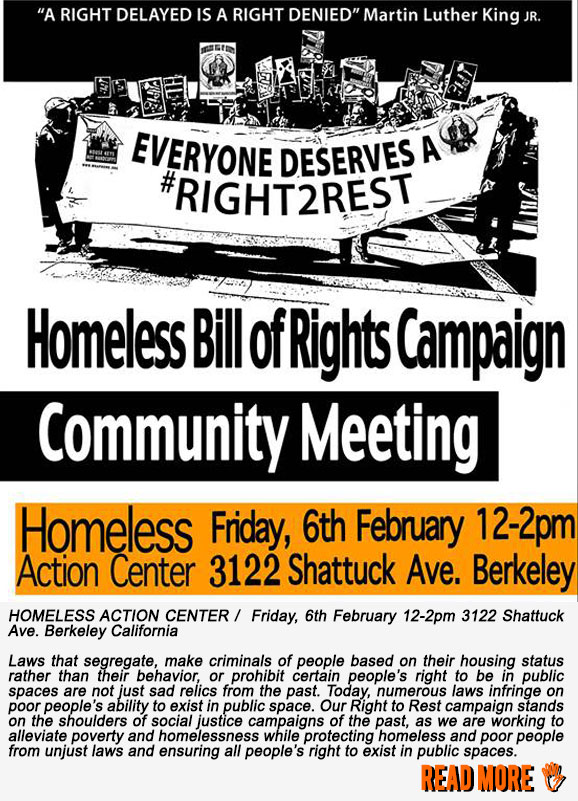
At the Western Regional Advocacy Project (WRAP), we think that’s unconstitutional. After talking to nearly 1,500 homeless people about police enforcement trends, WRAP, acting in partnership with 135 organizations and thousands of individuals, launched a campaign to pass the Right to Rest Act. We plan to get it introduced in Oregon, California and Colorado.
Under the Act, (Full Document Link Here) local governments will no longer be able to criminalize basic actions such as public sitting because everyone’s going to do it, regardless of skin color, regardless of housing status, regardless of income level. How can those activities become criminal offenses? They are universal human needs.
� It’s been done before.
This country has a long, well-documented pattern of local governments using their authority to implement local time, place and manner restrictions in their communities to
discriminate against those they want gone. The “crimes” are passed by local politicians, enforced by local police departments, adjudicated in local courts by local judges and the people are then incarcerated in local jails. Today’s laws are often promoted, supported and written by local business groups.
When you look at Jim Crow, anti-Okie laws, Sundown Towns, Ugly Laws (which criminalized people with disabilities), the Japanese-American Exclusion Act or the Bracero Treaties, every 20 or 30 years we see another campaign to rid communities of people that are deemed undesirable. (Full Document Link Here).
We must stop discriminatory laws and enforcement.
The time has come to not just end anti-homeless policing, but to once and for all stop this racist, classist policing policy in order to address social issues. That’s why we’re telling politicians “Hey, wait a second. You work for us. We’re no longer asking you to write bills to help us.� We’re writing our own bill and asking you, as our representative, to introduce it.”
We want people to realize that no matter what happens, they can’t criminalize us for trying to stay alive. Once we’ve established those ground rules, then if having people sleep in the streets is driving everybody crazy, including those sleeping in the streets, then we can actually start working on the race and class issues that are behind why this exists. Getting to the roots.
The data shows that when we cut $50 billion from funding for affordable housing we created the current situation. That was over 30 years ago, in 1983, and the funding has never been restored. Meanwhile, the federal government has also spent over 10 times as much on wars over the last decade as it has on public housing.
That’s why it’s not surprising that homelessness is getting worse. Any reference to homelessness “going down” is a delusion, which is a direct result of the Point in Time Headcount. It is a method developed by the Department of Housing and Urban Development (HUD), in which staff and volunteers go out at the end of January �(with flashlights) to conduct a headcount of homeless people that they see in parks and streets of local communities. This is the coldest month of the year, yet the assumption is that most homeless people will somehow be on the streets to be counted. As if that is a meaningful analysis or source of data.
Local governments have proven that given the authority, selective members of our communities will be targeted for exclusion. WRAP’s goal is not to just stop anti-homeless people policing, but to make sure that these local laws from our past, and now again in our present, never can rear their ugly heads again. We have a moral and ethical responsibility to do whatever we need to do to see that the Right to Rest Act gets passed. First in the states we are active in today, and then, just as the discriminatory laws spread across the country, we need to make sure that this social justice legislation spreads from state-to-state. The Homeless Bill of Rights campaign, when fully implemented, can make sure that equal justice for all is not a meaningless slogan. (Full Document Link Here)





 Donate Now!
