|
|
|
Vol. 3 Issue 2-Board Meeting | |
While school is in session, his newsletter will publish monthly issues, detailing happenings at recent meeting(s) of the Howard County Board of Education | |
Contents:
Joint Meeting with Council, February 11, 2025
- Use of County's annual excess of capital funds
- State budget impact on Local school systems
- School start times, bus transportation, and walk areas
- In-School Violence
- By teachers
- By students (increase in middle schools)
Report from the front lines on school violence
| |
Council & Board Joint Meeting | |
Use of County's Excess Annual Capital Funds | |
|
Councilmember Liz Walsh.
-
Every year, the County budget has millions of dollars in the capital budget that is not spent, primarily due to overestimating expenditures in the Budget. This deprives both the County and Board of Education the use of those funds. These excess funds become "PAYGO" and are generally spent the next year for small projects.
- In 2021, there was an excess of $127 million; in 2022, $124 million, and in 2023, $141 million. There needs to be a sea-change in how we use those funds.
Councilmember Deb Young.
- There is a task force studying that issue, but it isn't making any progress.
- Agrees with Councilmember Walsh, adding that in 2024, there was a $214 million overage.
- Agrees that there haven't been adequate funding of capital projects for education. We should decide to devote these unused capital dollars it to the school system's capital budget.
-
Noted that the proposed school budget is $79 million short of what they need, and says that HCPSS should ask for what they actually need.
Councilmember David Yungmann
- Agreed that the PAYGO funds should go to the schools.
| |
State budget impact on county | |
|
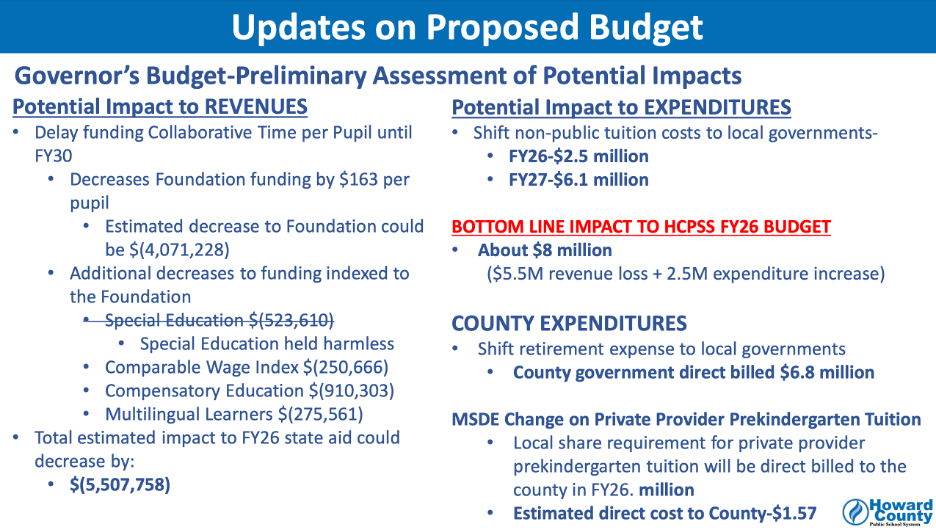
Department Report by HCPSS Chief Financial Officer.
- Below is their best estimate based on the State's estimates.
| |
|
Councilmember Young.
- Although they've been shown the likely State impact, what about the impact of the federal government's potential changes?
Answer:
- Waiting for results of court cases.
Councilmember Young.
- Can you give us an overview of potential impacts? How does fed distribute the funds? Is there a contract signed for grants? Do they go directly to the State and from the State to the counties?
Answer.
- Federal funding to be paused and pollibly cut: Food nutrition funds; Grants, for Title I funds, IDEA, and other formula grants. A huge impact on the school systems
- Most grants are signed with the State and the State signs with the feds. Some direct grants we sign directly with the feds, but they are rare.
| |
School Start Times and Transportation | |
|
Superintendent Barnes
- Last year, there was a great deal of discussion about the fact that the earliest start time had been moved to 7:50 am, rather than the 8:00 am time the Board had requested. The Board wanted an assurance that the 8:00 am start time can be implemented.
- After an analysis of both the cost of making the change with more buses, or a compression of the timeline of pick-ups, it was clear that the market will not support such a move.
Boardmember Young
- Strongly supports moving start time to 8:00 am at least in part because studies show teenagers biological clock is not attuned to mornings, having to be at school so early does not allow them to function during their first class.
- Looked for alternative solutions such as moving elementary school to the earlier start time, since that's when their bodies are awake.
Boardmember Watts
-
Supports moving elementary school start time to the earliest hour, agreeing with Boardmember Young.
- This is an equity issue because the parents with adequate income drive their teenagers to school, while lower-income parents cannot.
Councilmember Rigsby.
- Agreed for the need to provide later start times, but understands issues.
- Wants to begin a study to analyze moving elementary schools to earlier start times
Councilmember Yungmann
- Asked about alternatives such as leasing buses, having drivers be contractors rather than employees.
- Noted that moving elementary school to the earliest start time creates its own set of problems for parents with respect to child care in the afternoons before the older siblings get home.
| |
|
Boardmember McCoy.
- Noted that the labor market has changed significantly and student behavior on buses has changed.
- She concluded that to go through what would be necessary to move the time from 7:50 to 8 am would not be worth the effort.
- We have to deal with what we have. It would be foolish to continue to press for something we cannot get.
Boardmember Chen
- Agreed with Boardmember McCoy
Boardmember Ricks
- Asked about the proposed changes in bussing to shrink the walk area.
Answer
- They have engaged 7 additional bus contractors, plus 4 new contracts with existing vendors to meet the need to convert an additional 1,700 walkers into bus riders.
- The new boundaries should be dne and posted by March.
| |
School Violence: Process for investigating claims of inappropriate behavior of HCPSS and contractors | |
|
Councilmember Walsh
- Had asked for more detail as to how these issues are pursued, for example, when would they send out a community message particularly in the event of a sexual assault.
Response by Michael Carson, Human Resources Executive Officer.
- Supplied the members a document showing the policies and sections that apply.
- With respect to messaging parents/community, we work collaboratively with social services and the police department.
- It is complex since an incident could fall under one of several policies, which would lead to different processes.
- Usually, incidents are first investigated by Social services and then the police.
- We are not authorized to notify anybody or begin an investigation until those agencies have begun their investigation or until we get authorization from those agencies that we are not interfering with their investigations.
Councilmember Walsh
- Continued with questions about when parents would be notified; are there differences if the victim is an elementary school student or a high school student; when does the Administration talk to the students about an incident.
- Not satisfied with answer.
- Has received a number of calls from parents indicating that these processes are not being followed, and they don't feel that they are being taken seriously.
Response by Michael Carson
- Wants Councilmember Walsh to get in touch with him offline to see what can be done
| |
School Violence: Middle School Students | |
|
Report by Jennifer Robinson, Chief Schools Officer
- Acknowledged there are disturbing rates of violence in middle schools. They are seeing many more impulsive behaviors. Studnets are using social media to bully and harass. Therefor students don't want to come to school.
- We are building on the restorative approach and other coping mechanisms, but students are choosing to use violence.
- Directors at each level are monitoring reports, school by school, and analyzing data jointly.
- Important that the response be the same in all schools.
- We have staffing go through alternative options, but not at all schools yet.
- Nothing is working. We are looking to see what's missing. Community involvement? It is a challenge. We don't have a good answer. It's all hands on deck.
| |
Report from the front lines on school violence | |
|
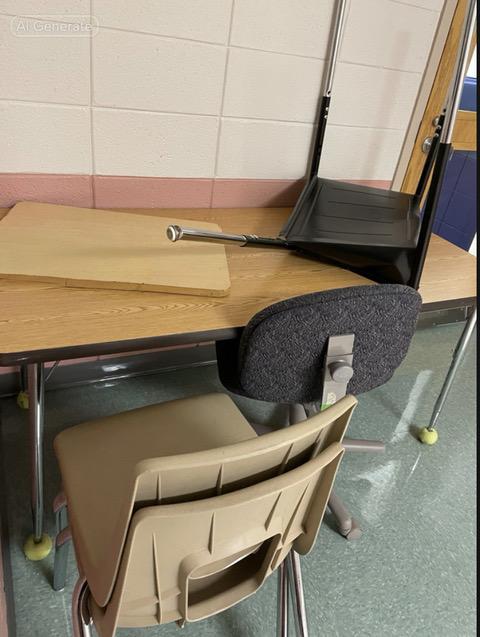
Violence is also increasing in the elementary schools. Below is a commentary sent to me by a teacher who has actual, first-hand experience.
"It’s not surprising to hear the reports on increased violence in HCPSS middle school. What is surprising is how the BOE ignore teachers, paraeducators, and HCEA when they request assistance to address the violence in HCPSS elementary schools.
"Unfortunately, these behaviors have become more severe as children have become desensitized to violence witnessed as young as kindergarten in the very place they should have been kept safe. Now these children are older, they are bigger, stronger and can do incredible physical and emotional damage to peers and adults. It’s too bad the BoE did not increase interventions and disciplinary actions while the students were younger.
| |
|
"Take a look at the photo. You see a desk that was destroyed by an elementary student. This is a standard piece of furniture in elementary classrooms that was thrown and beaten repeatedly. Notice how the wooden top has been completely busted off. Zoom in and notice the metal leg is almost detached. What a dangerous weapon the severed metal leg would have been had this crisis carried on any longer. Our leaders need to stop minimizing violence at the elementary level and stop underestimating the damage that can be made by young children. As long as primary aged children’s first school experiences are violent there is little hope for their secondary educational experiences."
| | | | |