| Contact Us Division of Personnel Security and Access Control (DPSAC), Office of Research Services Building 31, Room 1B03
Hours: 8:00 a.m. - 5:00 p.m. Monday - Friday Personnel Security Helpdesk: 301-402-9755 E-mail: orspersonnelsecurity@ mail.nih.gov Access Control Helpdesk: 301-451-4766 E-mail: facilityaccesscontrol@ mail.nih.gov   |
|
| |
Your Position Sensitivity Level - the Starting Point in the Badging Process to Safeguard the NIH Workforce
This is the fourth and final installment in a series that explores Position Sensitivity Levels (PSLs) and their role in the vetting and protection of the approximately 37,000 employees, contractors and affiliates who are issued a Personal Identity Verification (PIV) card (a.k.a., HHS ID Badge) and become part of the NIH workforce.
Introduction
Every person entering NIH facilities is required to have an identification badge issued by DPSAC or the NIH Police. All federal employees, contractors and organizational affiliates who require access to federal facilities and/or information systems for a period greater than six months must complete the Personal Identity Verification (PIV) process [i] in order to be issued a PIV card (HHS ID Badge) or, in some cases, an NIH Restricted Local Access (RLA) Badge).[ii]
As part of the PIV process, each position at NIH is assigned a level of risk and sensitivity that determines what type of background check will be required for that position.
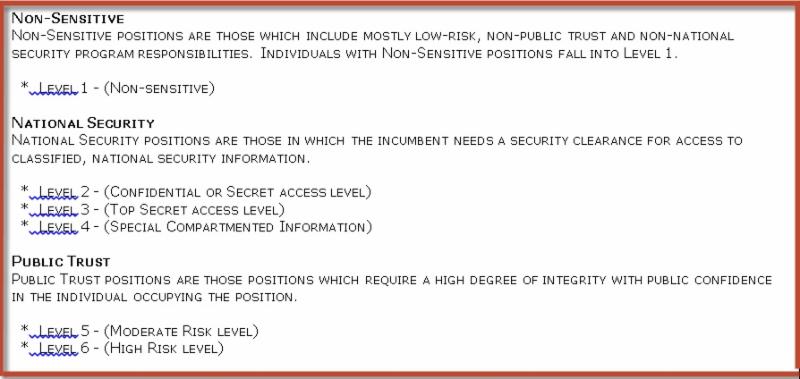
While all employee, contractor and affiliate positions at NIH fall within one of three major security categories -- Non-Sensitive, Public Trust and National Security -- each position also has a defined risk and sensitivity profile that determines the type of background investigation that must be completed (Figure 1)
|
|
|
Figure 1. The three main Security Categories and the Personal Security Levels associated with them.
|
A Closer Look at 'National Security' Level 2, Level 3 and Level 4 Position Sensitivity Levels (PSLs)
This final installment on PSLs examines the "National Security" security category and the Level 2 (Confidential or Secret Access Level), Level 3 (Top Secret Access Level) and the Level 4 (Special Compartmented Information) PSLs that fall within the scope of National Security (Figure 1).
For demonstration purposes, we will use "Lab Chief" to demonstrate how to register an applicant at a Level 2 (Confidential or Secret Access Level) PSL using the NIH Form 2866 worksheet. We'll use 'Deputy Directors, NIH' to illustrate how to register a Level 3 (Top Secret Access Level) PSL in NED and "Director, NIH" to illustrate how to register a Level 4 (Special Compartmented Information) position.
Applicants for these three PSL levels are required to complete the Form SF86 background investigation questionnaire.
NED Registration
When an AO Sponsor begins the registration process for any new employee/contractor/affiliate in NED, s/he will need to select one of sixteen (16) position classifications presented in the drop down menu of the 'Classification' field. (Examples include NIH FTE-including GS, SES; Title 42, etc.; Contractor; NIH FTE - Commissioned Corps; Collaborator (Clinical); Collaborator (Non-Clinical); Guest Researcher; Fellow; etc.
For these examples, the AO will be selecting the classification field 'NIH FTE-including GS, SES.'
Also on that first screen, the AO will indicate whether the applicant is a Summer Student (N), whether the anticipated appointment time is more than or less than six months (more than six months), the SAC/Organization unit, and the position contact information (the name of the Supervisor and the Servicing AO).
On the following screen, the user will be prompted to fill out the online interactive worksheet (NIH Form 2866) that will calculate the appropriate sensitivity level and corresponding background investigation for a specific NIH position.
In all instances, the applicants will be required to complete the background investigation questionnaire Form SF86 in e-QIP.*
I. Calculating the PSL for the "Lab Chief" position according to the NIH Form 2866 worksheet
To determine the PSL for the 'Lab Chief" position using the NIH Form 2866, the AO will need to complete the following steps:
Step 1 of the worksheet prompts the user to select the Position Title from a drop-down menu. S/he will select "Lab Chief." It is important to select the correct position title. If the user is not certain about the correct position title, s/he should contact the individual's supervisor for confirmation.
Step 2 automatically validates the Position Sensitivity Level for the Selected Position Title/Function as a Level 5b Public Trust (Moderate Risk Level).
Steps 3 in the worksheet allows the AO to select "exception factors" that require a minimum position sensitivity Level 5B. In this example the AO selected two exception factors requiring a minimum position sensitivity Level 5B:
- Step 3a: Unrestricted access to building areas designated by ORS as Level 5:
- Step 3g: Biosafety Level 3 (BSL-3) Worker:
Step 4 allows the AO to select "exception factors" that would elevate the minimum sensitivity level to Level 2 PSL (Level 2 requires a higher level background investigation than Level 5B). In this example, the AO has checked off:
- 4a. Assigned to work with Select Agents and Toxins
- 4b. Access to NIH areas containing Select Agents and Toxins
- 4c. Access to NIH areas associated with the containment of Select Agents and Toxins
Step 5
asks the user to "Select Additional Exception Factors Requiring No Position Sensitivity Level Changes." The only Exception Factor listed here is 'Works with children.' Applicants who work with children require additional scrutiny in their background investigation but will remain under Public Trust Level 5B. In this example, the applicant does not work with children.
The Position Sensitivity Level and Background Investigation for "Lab Chief" position are revealed
The NIH Form 2866 has computed the minimum position sensitivity level at (Confidential or Secret Access Level) with a corresponding background investigation of Access National Agency Check and Inquiries (ANACI).
Note: When completing the NIH Form 2866 in NED, it is important never to guess! If you are not sure how to complete part of the form, DPSAC strongly advises you to reach out to the individual's supervisor. Be aware that DPSAC updates the NIH Form 2866 against the OPM Position Designation Tool (PDT) annually to ensure compliance.
e-QIP and the SF86 the questionnaire for a Level 2 (Confidential or Secret Access Level) position investigation
Once the AO completes sponsorship of the individual in NED, an applicant who needs to complete a background investigation will receive an e-mail from DPSAC with instructions to complete e-QIP (the Electronic Questionnaires for Investigations Processing) and any necessary forms.
Individuals whose position has been calculated at a PSL Level 2 (Confidential or Secret Access Level) will be asked to complete the SF86 questionnaire in e-QIP. As noted above, for this PSL, the NIH Form 2866 has calculated the appropriate background investigation as ANACI.
Note: If the individual does not complete e-QIP and submit the required forms, DPSAC will not be able to issue a new ID Badge to that person. This e-mail provides a secure link to e-QIP that allows the individual to access and complete his/her background investigation form online.
Access to the e-QIP system occurs only after the applicant has been sponsored for an ID badge in NED and has received his/her e-mail from DPSAC.
The scope and cost of the ANACI investigation
The ANACI is comprised of:
- NACLC plus written inquiries to current and past employers, schools and references covering past 5 years.*
(Note: The SF86 investigates the past 10 years.
Figure 2 compares the SF85, SP85P and SF86 and illustrates the additional requirements for an SF 85P investigation.
The cost of an ANACI
Once the NIH Form 2866 is complete, NED will also require a Common Account Number (CAN) to cover the costs of the background investigation. The cost of an ANACI is $421.00
II. Calculating the PSL for the "Deputy Director, NIH" position according to the NIH Form 2866 worksheet
To determine the PSL for the 'Deputy Director, NIH' position using the NIH Form 2866, the AO will need to complete the following steps:
Step 1
of the worksheet prompts the user to select the Position Title from a drop-down menu. S/he will select "Deputy Director, NIH
." It is important to select the correct position title. If the user is not certain about the correct position title, s/he should contact the individual's supervisor for confirmation.
Step 2
automatically validates the Position Sensitivity Level for the Selected Position Title/Function as a Level 3 (Top Secret Access Level).
Steps 3
in the worksheet allows the AO to select "exception factors" that require a minimum position sensitivity Level 5B. In this example the AO selected three exception factors requiring a minimum position sensitivity Level 5B:
- Step 3b: Performs Simplified Acquisition Certifications (Level 1) or higher procurement duties;
- Step 3d: Has approval authority for actions committing the government to a course of action involving financial and/or privacy act data (e.g., travel orders, personnel actions);
- Step3e: Files Public Financial Disclosure Report (SF-278).
Step 4
in the worksheet allows the AO to select "exception factors" that would elevate the minimum sensitivity level to Level 2 PSL (Level 2 requires a higher level background investigation than Level 5B). In this example, the AO will leave Step 4 blank since there are no Exception Factors requiring a Minimum Position Sensitivity Level 2.
Step 5
asks the user to "Select Additional Exception Factors Requiring No Position Sensitivity Level Changes." The only Exception Factor listed here is 'Works with children.' Applicants who work with children require additional scrutiny in their background investigation but will remain under Public Trust Level 5B. In this example, the applicant does not work with children.
The Position Sensitivity Level and Background Investigation for "Deputy Director, NIH" position are revealed
Since the AO has determined that the applicant's position does not have exception factors to move him or her to a higher position sensitivity level or to an elevated background investigation, the NIH Form 2866 has computed the minimum position sensitivity level at a Level 3 - (Top Secret Access Level) with a corresponding background investigation of Single Scope Background Investigation (SSBI).
Note: Don't guess when completing the NIH Form 2866 in NED! If you are not sure how to complete part of the form, DPSAC strongly advises you to reach out to the individual's supervisor. Be aware that DPSAC updates the NIH Form 2866 against the OPM Position Designation Tool (PDT) annually to ensure compliance.
e-QIP and the SF86 questionnaire for Level 3 (Top Secret Access Level) and Level 4 (Special Compartmented Information) position investigations
Once the AO completes sponsorship of the individual in NED, an applicant who needs to complete a background investigation will receive an e-mail from DPSAC with instructions to complete e-QIP (the Electronic Questionnaires for Investigations Processing) and any necessary forms.
Individuals whose position has been calculated by the NIH Form 2866 as Position Sensitivity Level 2 (Top Secret Access Level), Level 3 (Top Secret Access Level) or Level 4 (Special Compartmented Information) will be asked to complete the SF86 questionnaire in e-QIP. For PSL Level 3 and Level 4, the NIH Form 2866 calculated the appropriate background investigation as SSBI.
Note: If the individual does not complete e-QIP and submit the required forms, DPSAC will not be able to issue a new ID Badge to that person. This e-mail provides a secure link to e-QIP that allows the individual to access and complete his/her background investigation form online.
Access to the e-QIP system occurs only after the applicant has been sponsored for an ID badge in NED and has received his/her e-mail from DPSAC.
The scope and cost of the SSBI investigation
As noted above, the NIH Form 2866 calculated the PSL for the 'Deputy Directors, NIH' at a Level 3 with an associated background investigation type of SSBI.
 The SSBI includes:
- a National Agency Check (NAC) plus credit search;
- a Personal Subject Interview (PRSI);
- NAC on spouse or cohabitant;
- interviews at employment for past 7 years;
- interviews at schools and residences covering the past three years;
- review of any court actions covering the past 10 years;
- interview with any former spouse divorced within the past 10 years;
- interview of 4 social references who collectively cover at least the past 7 years;
- checks at local law enforcement agencies where the subject lived, worked and/or attended school within the last 10 years, and if applicable, of the appropriate agency for any identified arrests;
- verification of legal status of all foreign-born immediate family members and cohabitant.*
(Note: The SF86 investigates the past 10 years. Figure 2 compares the investigation requirements for the three investigations).
The cost of an SSBI:
Once the NIH Form 2866 is complete, NED will also require a Common Account Number (CAN) to cover the costs of the background investigation. The cost of an SSBI is $5,389.
The FY 2017 OPM Pricing Schedule for the eight most commonly ordered background investigations at the NIH are posted on the DPSAC website at:
https://www.ors.od.nih.gov/ser/dpsac/bgchecks/Pages/pricing.aspx
III. Calculating the PSL for "Director, NIH" position according to the NIH Form 2866 worksheet
Steps 1 and 2.
When the AO selects the position "Director, NIH" position in Step 1 of the NIH Form 2866, the worksheet automatically "validates the PSL for the position title as a Level 4 (Special Compartmented Information) in Step 2.
Steps 3. For illustration purposes, the AO will select the same "exception factors" that require a minimum position sensitivity level 5b for Division Director, NIH as s/he did for Director, NIH in step 3:
- Step 3b: Performs Simplified Acquisition Certifications (Level 1) or higher procurement duties;
- Step 3d: Has approval authority for actions committing the government to a course of action involving financial and/or privacy act data (e.g., travel orders, personnel actions);
- Step3e: Files Public Financial Disclosure Report (SF-278)
Step 4
on the worksheet for 'Director, NIH' is left blank since there are no Exception Factors requiring a Minimum Position Sensitivity Level 2.
Step 5 will also be left blank, since the applicant again does not work with children.
The Position Sensitivity Level and Background Investigation for "Director, NIH" are revealed
The NIH Form 2866 computed the minimum position sensitivity level for 'Director, NIH' at a Level 4 (Special Compartmented Information) and an associated background investigation of SSBI.
The applicant will be required to complete the background investigation questionnaire, Form SF86, in e-QIP.
The scope and cost of the SSBI investigation
Note that the background investigation associated with "Director, NIH" (Level 4) was determined to be the same as for "Deputy Director, NIH" (Level 3), namely an SSBI. See above.
Figure 2
. Compares the scope of the SF85 questionnaire (for the NACI investigation) with the SF85P questionnaire (for the MBI/BI investigations) and the SF86 (ANACI or SSBI). Note: the SF85P investigates the past 5 years but may be expanded to 7 years depending on the risk designation of the position. The SSBI again expands the scope of the investigation and examines the past 10 years of the applicant history. Click here to view this graphic in an enlarged format.
As part of the investigation process, the applicant will be asked to complete other forms in addition to the SF86. At a minimum, s/he will need to complete the following:
- OF 306 (Declaration for Federal Employment)
- OF 612 (Employees and Affiliates) (Optional Application for Federal Employment)
- Any other required forms as directed in the e-mail
Help is available when completing the SF86
DPSAC has posted two useful guides on its website to help applicants complete the SF86:
Once e-QIP is complete, DPSAC will review the submitted forms and forward them to the Office of Personnel Management (OPM) to conduct the background investigation. Once the investigation is complete, DPSAC will notify the applicant.
Examples of positions that fall into the 'National Security' Position Sensitivity Level 2, Level 3 and Level 4
Position Title / Function Sensitivitiy Level 2
Individuals who are assigned to work with Select Agents and Toxins, or who require access to NIH areas containing Select Agents and Toxins or who require access to NIH areas associated with the containment of Select Agents and Toxins are assigned a Level 2 (Confidential or Secret Access Level) PSL.
Position Title / Function Sensitivity Level 3
Deputy Director, CIT
Director, CIT
Deputy Directors, NIH (PSL 3 or 4)
Position Title / Function Sensitivity Level 4
Deputy Director, NIH (PSL 3 or 4)
Director, NIH
CIO or CISO, NIH
Deputy CIO, NIH
* Descriptions of the investigations referenced above:
NAC (National Agency Check)
is an integral part of all background investigations, consisting of searches of OPM's Security/Suitability Investigations Index (SII), the Defense Clearance and Investigations Index, the FBI Identification Division's name and fingerprint files and other files or indices when necessary.
PRSI - (Personal Subject Interview)
--is conducted by federal investigators (Special Agents) and federal contract investigators (Special Investigators).
SSBI (Single Scope Background Investigation)
- requirements are spelled out above.
NACLC (National Agency Check with Local Agency Check with Credit)
-- NAC plus credit search and checks at local law enforcement agencies where the subject has reside, been employed, or attended school for six months or more for the past seven years.
ANACI (Access National Agency Check and Inquiries)
-- NACLC plus written inquiries to current and past employers, schools and references covering past 5 years. For federal employees who will need access to classified national security information at the Confidential or Secret level.
[i]
Personal Identity Verification (PIV) is a common credentialing and standard background investigation process required by Homeland Security Presidential Directive 12 (HSPD-12).
Certain classifications of individuals who are at NIH and who require access to NIH facilities will not require fingerprinting or a background investigation. These individuals will, however, undergo a standard criminal history check that will be conducted by the NIH Police prior to being issued an alternate NIH (Legacy) ID Badge.
[ii]
A PIV card is a United States federal smart card that contains the necessary data for the cardholder to be granted access to federal facilities and information systems and assure appropriate levels of security for all applicable federal applications.
|
Revised Policy Requires Certain Staff in the NIH Irradiator Program be Elevated from PSL Level 1 to PSL Level 5b
The February 1, 2017 DPSAC News continued its series on Position Sensitivity Levels (PSLs), featuring Public Trust Level 5 (Moderate Risk Level) and Public Trust Level 6 (High Risk Level) positions along with a review of their associated background investigation, MBI and BI, respectively.
Following publication of the newsletter, DPSAC learned that the Office of the Associate Director for Security and Emergency Response (ADSER) had recently directed the ORS Division of Radiation Safety (DRS) to elevate certain NIH staff enrolled in the NIH Irradiator Program from a Level 1 (Non-Sensitive) to a Level 5b (Moderate Risk Level) PSL.
This action ensures that affected individuals, namely, Contractors, Guest Researchers and Special Volunteers who need access to an irradiator room meet the background investigation requirements as specified in the Irradiator Program.*
The DRS recommends that Contractors. Guest Researchers and Special Volunteers enrolled in the Irradiator Program work with their Administrative Officer (AO) to ensure that the appropriate PSL is entered into their NED profile.
Current Background Investigation Requirements for Accessing Irradiator Rooms at NIH
Currently, it is acceptable for MOST researchers who need physical access to an irradiator room, or who have a need to know security-sensitive information about an irradiator room, be registered in NED at the PSL
Level 1. The exceptions are:
- Building 33 (Bethesda campus)
- the NIAID Integrated Research Facility (IRF) at Fort Detrick,
- Maryland/Rocky Mountain Laboratories (RML) Montana accessors, and/or contractors, guest researchers and special volunteers.
These exceptions require a Level 5b MBI at a minimum.
According to DRS, the Bldg 33/IRF/RML accessors require an elevated PSL not because of irradiator position requirements per se, but because of Building 33/IRF/RML access requirements.
Elevating PSLs to 5b for Contractor, Guest Researcher, and Special Volunteer Staff Accessing Irradiator Rooms
While guidance from DRS has always been in place to require a 5b MBI PSL for access to Bldg 33/IRF/RML irradiator rooms, this same background investigation requirement will now extend to contractors, guest researchers, and special volunteers who need access to any irradiator room at NIH.
This new policy is the result of a Nuclear Regulatory Commission (NRC) requirement that background investigations for non-federal staff examine 7 years of their employment history. Level 1 investigations only go back 5 years and are therefore insufficient. Federal employees are exempt from the NRC's background investigation requirement altogether.
AOs are urged to share this information with their colleagues since the current NIH Form 2866 worksheet does not yet reflect this new policy for these non-federal workers.
If an individual is unable to meet the requirements of a Level 5b MBI, s/he may be allowed access to an irradiator room only if accompanied by an approved escort at all times.
*The Irradiator Program is the enrollment process run by the Division of Radiation Safety (DRS), ORS through which all individuals across the Institutes and Centers are routed if they need access to an irradiator room at NIH. DRS works closely with DPSAC to ensure these individuals meet the background investigation and fingerprint requirements before they are authorized to access an irradiator room with their HHS ID Badge. This is a centralized program through DRS, and most Institutes and Centers are represented in the user community.
|
Helpful Tips
Do not lend your ID badge to anyone! -- lending out your ID badge is prohibited. The issuance of ID badges is based on strict identity proofing and the determination of one's suitability for a specific position classification. To do so is a criminal offense.
ALT cards -- need to be returned to the IC ALT card coordinator -
NOT to the Division of Personnel Security and Access Control (DPSAC).
All Building 31 badging services -- Enrollment, Badge Issuance and Customer Service -- now offered at a single, convenient location in 1B03. All badging services in Building 31 are available between 8:00 a.m. and 5:00 p.m., Monday through Friday. DPSAC also offers Enrollment and Badging services in the South Lobby of the Clinical Center from 7:30 a.m. to 4:30 p.m. on weekdays.
Administrative Officers (AOs) who wish to obtain sponsor authority -- must complete the sponsor training (see:
http://www.ors.od.nih.gov/ser/dpsac/Training/Pages/administrators.aspx) and e-mail a copy of your signed certificate to the NIH HSPD-12 Program Office at
hspd12@od.nih.gov. Upon receipt of the certificate, the Program Office will authorize the AO as a Sponsor.
Please note: ONLY individuals with an Administrative Officer role are eligible to be HHS ID Badge/PIV Card Sponsors.
ICs that want to add Lifecycle Work Station (LWS) operators to the approved roster -- send a written request to Richie Taffet at: taffetr@mail.nih.gov. Your request should include:
- the new operator's name
- his/her Institute or Center (IC)
- his/her NED number
- the operator's e-mail address, building/room and phone number
- the hours of operation of the Lifecycle Work Station
Once Mr. Taffet has approved the request, he will forward the name(s) to
HHSIdentityAdmins@deloitte.com to complete the approval process, add the name(s) to the LWS operator roster, and inform the IC that the individual is now approved to operate the LWS.
Need to make changes to the LWS operator directories? -- drop an e-mail to Lanny Newman,
newmanl@mail.nih.gov, and let him know what needs changing (e.g., adding new operators or LWS locations, removing operators, etc.). Remember, before a new operator can be added to the LWS directory, s/he must first be approved by Richie Taffet (see preceding Helpful Tip).
If an LWS is not available in your IC or your immediate area, and you work in the greater Bethesda or Rockville area -- please call 301-402-9755 to schedule an appointment with DPSAC, located in Building 31, Room 1B03 or in Building 10, South Lobby, Room 1C52.
If you work outside the Bethesda/Rockville area, contact your local badge issuance office. You can find contact information for all badge issuance offices at:
http://www.ors.od.nih.gov/ser/dpsac/Pages/contactinfo.aspx.
Know someone who should be reading DPSAC News? -- have the person contact Lanny Newman,
newmanl@mail.nih.gov, and ask to be put on the mailing list.
|
News Briefs
The Top 10 Reasons People Are Denied a Security Clearance
Excerpted from a January 24, 2017 GovExec.com article by Lindy Kyzer, editor of ClearanceJobs.com and a former Defense Department employee.
In 2016, the Defense Office of Hearing and Appeals held 1,142 security clearance appeals hearings. They made decisions on security clearance eligibility, placement into public trust positions and Common Access Card denials.
If you are denied a security clearance or your security clearance is revoked due to adverse information that has been discovered or self-reported, you have the right to appeal the decision before DOHA. A study of the cases and their outcomes offers a good chance to see the trends in security clearance denials.
Here's an overview of the top 10 issues that appeared before the board in 2016:
Adjudicative Guideline (2015/2016)
- Guideline F: Financial Considerations (499/864)
- Guideline E: Personal Conduct (225/257)
- Guideline H: Drug Involvement (122/102)
- Guideline B: Foreign Influence (87/78)
- Guideline J: Criminal Conduct (70/61)
- Guideline G: Alcohol Consumption (59/47)
- Guideline C: Foreign Preference (41/45)
- Guideline K: Handling Protected Information (8/16)
- Guideline M: Use of IT Systems (4/8)
- Guideline D: Sexual Behavior (8/7)
Financial issues are time and again the top reason for a security clearance denial. The issue is often not simply that an applicant has debt, but that the applicant has taken no steps to remedy a pattern of overspending. The cause of debt is a consideration, and for good reason-financial motivations are often the prompt behind espionage, and create an opportunity for blackmail.
Personal conduct is also often at the top of the list, because that category encompasses any number of issues that arise over the course of an investigation, including falsifying information on the SF-86 (omitting negative information). Employment issues from falsifying time cards to a pattern of rule violation also fall under the personal conduct adjudicative criteria.
The most important thing is to be completely up front about any issues from day one, and to be organized and detailed in your response to a security clearance denial.
To continue reading this excerpt, click
here.
|
Safety Corner 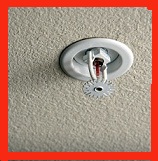
Fire Protection Sprinkler Systems: Fiction and Fact
The following fire safety awareness article was prepared by the Division of the Fire Marshal, ORS
FICTION #1: Sprinklers cause unnecessary water damage.
Actually, sprinkler heads are closed until heat from a fire activates them. Only the sprinkler head(s) nearest the fire open(s) up. They produce far less water than a fire hose would release.
Each sprinkler head is temperature activated; therefore, every sprinkler head does not open at the same time as is commonly depicted on TV and in the movies. Water from the open sprinkler head(s) extinguishes or controls the fire to keep it from spreading, thus minimizing costly damage from fire or water.
FICTION #2: Sprinklers go off accidentally.
The accidental activation of a fire protection sprinkler system is, indeed, a rare occurrence. In fact, sprinkler system piping is subjected to a rigorous pressure test before the system installation is approved.
Accidents involving fire protection sprinkler systems are far less likely to occur than mishaps involving standard domestic plumbing systems.
FICTION #3: Sprinkler systems are unattractive.
In most finished areas, fire protection sprinkler system piping can be concealed above drop ceilings or in walls. Any exposed sprinkler piping may be painted to match the wall or ceiling color. Also, some modern sprinkler heads may be virtually concealed or mounted almost flush with the wall or ceiling.
FICTION #4: Sprinkler systems are expensive.
The installation of fire protection sprinkler systems, including residential sprinkler systems, is now far less expensive than in the past. In residences this is due to the use of modern lightweight materials and designs.
It is estimated that the cost of installing a residential fire protection sprinkler system adds only one to two percent to the cost of a newly constructed home, while the homeowner could reap as much as 50 percent savings in fire insurance premiums.
In commercial properties, the cost of installing sprinkler systems could be offset by similar reduction in insurance premiums in as little as five years and could also eliminate the need for costly fire walls and fire doors that are typically required in buildings without sprinklers.
FACT #1: Each year, approximately 6,000 people in the United States die in fires resulting in millions of dollars in property damage.
Many deaths could be prevented and property damage minimized through the installation of fire protection sprinkler systems.
FACT #2: At NIH, we install automatic sprinkler systems in all new facilities as they are built and in older facilities during renovations.
They are also being installed in our residential settings on campus.
Of paramount importance, of course, is the number of lost lives and burns that can be prevented by these systems. They more than pay for themselves when you consider the millions of dollars in lost property from fires.
If you have any questions concerning fire protection sprinkler systems, please contact the Division of the Fire Marshal, Office of Research Services at 301-496-0487.
|

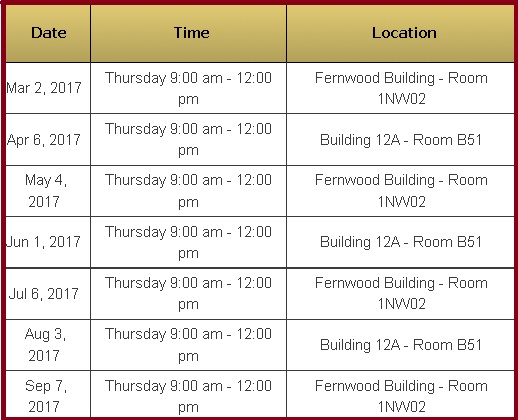
NED Training Schedule for FY '17
Description:
This course provides an overview of the NED Portal and the NIH business functions it supports from the perspective of a NED Portal user with the AO or AT role. Upon completing the course, students will have a solid working knowledge of the NED Portal and be able to perform the following tasks: Register/Activate, Update, Modify, Transfer, Badge Renewal, and Deactivate.
The course will also familiarize students with other aspects of the NED Portal so they can: set their primary SAC coverage using Preferences; determine the status of a person's ID badge and/or network account request; look up and view information in a person's NED record; and, utilize NED reporting capabilities.
Intended Audience:
New or relatively inexperienced NED Portal users with the Administrative Officer (AO) or Administrative Technician (AT) role.
Prerequisites:
Basic personal computer skills and experience with web-based computer applications.
Reasonable Accommodations/Interpreting Services:
For deaf or hard-of-hearing individuals requiring interpreting services, please enter your request online in the Interpreting Services System at least five (5) days before the start of the class.
If you want to make a request, or have any questions regarding this service, you may contact the ORS Division of Amenities and Transportation Services (DATS) Interpreting Team at (301-402-8180). Individuals who need other reasonable accommodations to participate in any of the Center for Information Technology (CIT) Training courses should let CIT Training know at least 5 days prior to the class.
|
|
A biweekly e-newsletter from the Office of Research Services, Division of Personnel Security and Access Control (ORS/DPSAC) to keep you informed as NIH rolls out "Homeland Security Presidential Directive 12" (HSPD-12) establishing a common identification standard to better safeguard NIH and its workforce.
|
|
| |
|