In every place that I have worked, getting work properly scheduled and planned has been a serious issue. For the past year, we've worked on various ways to try to solve the problem. The Internet is full of different applications that supposedly will help, but in reality, most of them don't. Before I get into that, let me go through some of the issues that have been a problem everywhere I have worked.
1. Completing Projects on Time: I always wonder when I hear someone claim a project was done "on time and under budget". I am sorry, but this seems to be a unicorn. Most projects, big or small that I've ever seen are not completed by the projected date and the cost is always greater than anticipated for somebody.
I suspect this happens because of overoptimism and lack of analysis. When I was in the Air National Guard we took on a community service project to pave some trails in a park with gravel. My commander told the parks people it would take 2 weeks to complete the job. I sat and did an analysis, and the problem was you could only take one dump truck at a time down the trail. I came up with about 3 months to complete.
This holds true in every project. If you spend time breaking down what you need to do by task, you may find out that your initial "gut level" feeling is very, very wrong. So any system you develop has to take this into account, otherwise you will be forever explaining why such and such a job is so many weeks or even months behind.
2. Unforeseen Events: One thing you can be easily predict is that unpredictable things can and will happen. On any given day, more things can happen than you can possibly plan for. It can range from fairly likely (a key employee getting sick) to very unlikely (a meteor hitting the jobsite). Some methods of planning, such as Critical Path allows adjustments when this happens and you can see how the finish date is slipping away from you.
3. The Human Factor: Scheduling and keeping up with projects takes work, and it will tend to fall by the wayside. Also, when you try to update where any project is, there is a tendency for people to overstate the progress of what they are doing.
There are more issues that make getting jobs done, but the above are the three big issues we have run into. We've researched a lot of software solutions, and we've run into serious problems such as:
- Finding software that is applicable to what we do. We did find one scheduling program that did absolutely everything we would do as an engineering firm - track time on projects, money spent, progress of a project. The whole system was written by a large engineering firm to manage its work, and they were selling subsciptions.
It required a dedicated server, Windows Server (not Small Business Server), and a static IP address. To translate the technobabble I just spouted, it meant about $8,000 to $10,000 to set up a system that just might not work.
- Some of the "solutions" are more difficult to use than doing the work itself. Just the process of inputting jobs, tasks, and so on on many programs eats up just too much time. It reminded me of when we got into "Quality" when I was with the Government, and "Total Quality Management" took more time than our actual jobs did, and quality disappeared.
- Most of the stuff we tried just caused downright confusion.
So, what did we find worked? We found it was best to use three levels of planning. We use a web based planning system, a white board, and to do list.
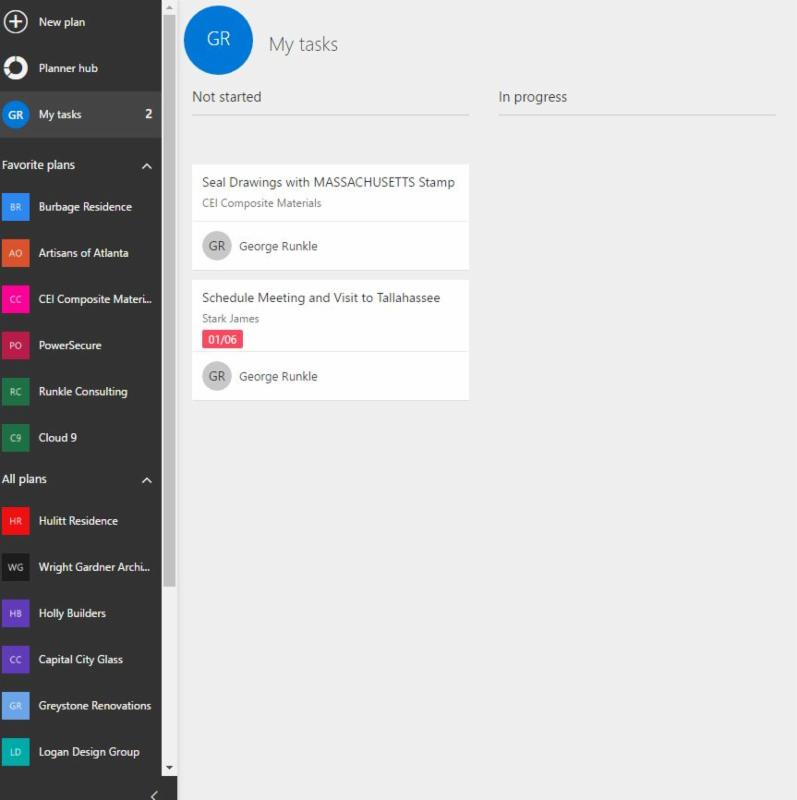
Office 365 for business includes Microsoft Planner, which is our web based planning system. We use it to list our various projects and the tasks we have to do for them to be complete. This allows us to make sure we don't have any project fall through the cracks and we have an idea of where we are on all projects. It is simple to use and easy to understand. It is web based so all of us can access it anywhere and it requires no new additional equipment. Planner is very easy and intuitive to use, and doesn't lead to a lot of confusion.
|
|
| Planner Is Fairly Easy To Use and Not Too Complicated |
The white board is really helpful on a weekly basis. We meet at the beginning of the week, list our projects for that week and discuss what we have to do to get through them. As the jobs get completed we get the satisfaction of crossing them out on the board.
I personally use the final one - a simple to do list. I write out on a sheet of paper what I aim to do for the day. Then I can cross off each task as it's done. Really low tech, but it works. Where it really comes in handy is when I don't feel up to doing anything. I can use the list to force myself forward through the day, and actually accomplishing something.
We also start each day discussing what we have to do, and making sure we all have a direction to go. The system seems to work pretty well.
At issue is how the System itself can be a time waster. In the Air National Guard, I had to attend staff meetings every day with my boss, and afternoon staff meetings to go over what was done that day. A lot of the stuff could have been accomplished with an e-mail to the commander, I didn't need to know the status of aircraft on the base, and I have no idea why everyone in the unit needed to know that my maintenance people unclogged a toilet in Bldg 300 on a given day.
The system doesn't work perfect, but no system does. As I wrote this, I found out we haven't updated our projects in Planner. Item 3 kicks in regularly unfortunately. What we found that is important is to have a system.