February 2022 | Volume 14 Issue 2 |
|
Happy February!
It's World Wetlands Day tomorrow! There are materials and more information on what you can do to help wetlands here.
The 9th Native Prairie Restoration/ Reclamation Workshop, is next week! We're excited for the presentations and case studies we have lined up this year! And there's more information about the virtual workshop below, as there are a few more days to register! If you have registered already, you should have received your login credentials for the virtual platform.
We had one Speaker Series presentation in January, Dan Routhier, with Stantec Consulting Ltd joined us to discuss habitat occupancy by grebes. The recording is available on PCAP's YouTube Channel!
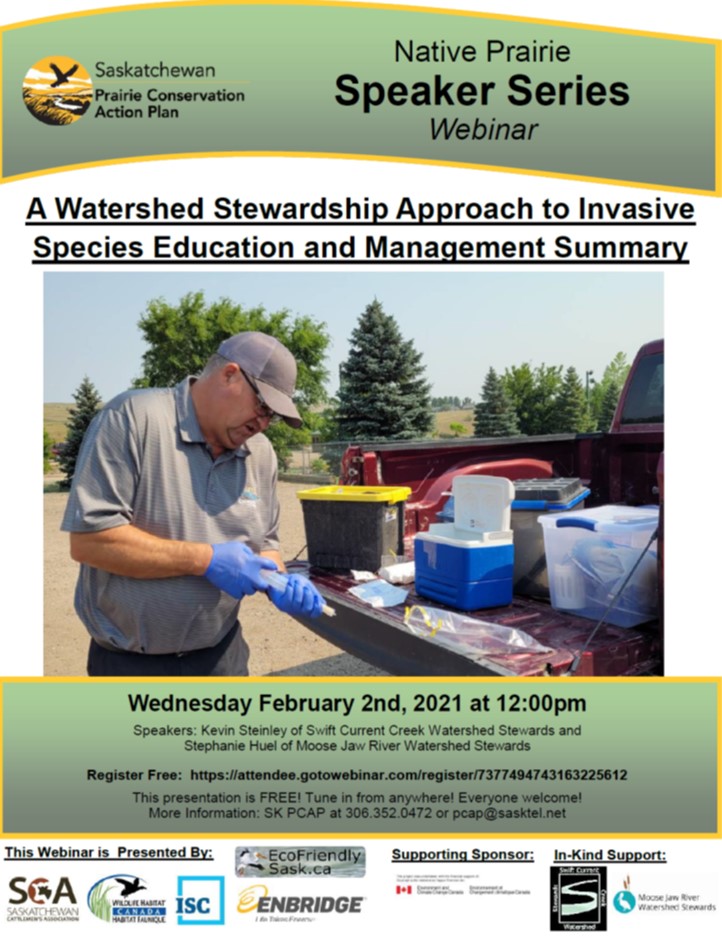
For our February Native Prairie Speaker Series, we have Kevin Steinley and Stephanie Huel discussing their approach to invasive species education and management! You can register here! We also have the registration links for the March and April webinars available, you can register today!
And finally, we would like to thank our sponsors for their generous support: Camp Wolf Willow, EcoFriendly Sask, Enbridge, Information Services Corporation, Saskatchewan Cattlemen's Association, SaskPower, SaskTel, Wildlife Habitat Canada and Environment and Climate Change Canada, as well as the continuous support of all the PCAP Partners.
Carolyn Gaudet, SK PCAP Manager
|
The 9th Native Prairie Restoration/ Reclamation Workshop will occur virtually February 8-10, 2022!
Theme: "Restoration, Reclamation, Resilience - Improving Soil, Water and Habitat"
There is still time to register!
Last day to register is Friday, Feb 4th!
Students : $60.00 + GST
Regular registration (after January 21st) : $160.00 + GST
Please note that all presentations and case studies will be recorded and available to registered participants on the PheedLoop platform for 6 months after the workshop.
|
There will be a troubleshooting/basic training session for the virtual platform on Monday Feb 7th at 2-3 PM CST.
Check the NPRRW website for details.
If you have already registered, you should have received your login credentials. Check your junk/spam folders. Make sure you can access the virtual platform before Feb 7th!
|
Great Horned Owl Research
The University of Regina and Royal Saskatchewan Museum are starting a new study on Great horned owl distribution and habitat use in Alberta and Saskatchewan. We are looking for citizen scientists to submit their owl sightings to the U of R and the RSM. They are generally interested in great horned owl sightings in rural settings south of the boreal forest! They have developed an easy to use google form https://forms.gle/8uMARqn6Y9oJXBZF6 to submit information to them, but if you use eBird or INaturalist, please continue to use those apps. All information is kept confidential, will only be used for research purposes, and no personal information is kept. Please use ethical birding practices and please keep disturbance to the owls at a minimum! Thank you for your help - they have an email address on the form if you have any questions!
|
PCAP Partner Spotlight
Water Security Agency
Submitted by Magfur Rahman, WSA
The Water Security Agency (WSA) is responsible for water management in the Province of Saskatchewan. This includes managing the province’s water supply, protecting water quality, ensuring safe drinking water, reducing flood and drought damage and protecting aquatic habitat. WSA also manages and operates 72 dams and related supply channels across the province.
Modern water management decision-making relies on readily available data and information. WSA conducts widespread data collection and makes it available to the public to ensure transparency and accountability.
Water Quality:
WSA monitors all water treatment plants in the province and collects data to ensure the drinking water supply is clean, safe and reliable. WSA is responsible for monitoring, collecting data and regulating the operation of all sewage treatment plants and lagoons to ensure effluent discharge in natural waterbodies complies with regulatory standards to protect our environment.
WSA monitors surface water to assess the state of water quality in provincial rivers and lakes, and to determine whether there have been long-term changes to water quality. WSA’s water quality database includes data from 1,900 stations scattered throughout the province’s lakes and streams. Some stations have more than 50 years of historical data available that helps provide a clear picture of our province’s water quality and quantity over time.
Water quantity
A network of over 270 hydrometric stations throughout the province’s rivers and streams produces valuable data used for flow forecasting and community flood vulnerability analysis. WSA manages this network in partnership with the federal government. WSA also monitors water levels of major lakes, with historical data available as far back as the 1940s.
A system of 70 wells throughout the province measures the natural fluctuations in groundwater aquifers. Monitoring stations are equipped with digital water level recorders that collect data at hourly intervals and transmit it to a central server in near-real-time. Monitoring also include collection of historic groundwater chemistry data for selected aquifers. Moreover, WSA tracks over 1,500 drill sites annually which are submitted by the water well drillers.
Dam safety
WSA conducts near real-time monitoring of dam stability. Instruments installed underground send water pressure and deformation data automatically to the server in our head office via cell or satellite connectivity. This monitoring system not only allows seamless data collection for archiving and forecasting dam performances, but it also warns for potential dam safety risks.
Wetland and drainage Inventory
The abundance and density of wetlands in southern Saskatchewan is unparalleled in the Canadian Prairies. They provide important ecosystem benefits including water filtration for improved water quality, flood control, groundwater recharge and carbon sequestration. Wetlands also provide a critical habitat for migrating birds as well as an area for hunting activities. A comprehensive inventory of all wetlands is critical for their conservation and sustainability. WSA and its partners have been documenting Canadian wetland inventory data for close to 15 years. In that time coverage has expanded to 60 per cent of Saskatchewan’s agricultural landscape, with more collection planned to increase the cumulative inventory area coverage to 80 per cent of Saskatchewan’s agricultural lands by 2024. All wetlands greater than 200 sq. m are mapped. The locations of drainage ditches are also mapped.
Wetland conservation databases
Many government and non-government agencies work with farmers and ranchers to conserve, restore and retain wetlands. WSA coordinates this for data compilation and management reporting through databases such as Prairie Habitat Joint Venture and the National Tracking System. These databases play key roles for planning and setting targets for wetland conservation at provincial and national levels.
Geomatics
WSA manages a central data repository containing hundreds of GIS layers and administers several web-based mapping applications and high resolution aerial photography, satellite imagery, LiDAR elevation data and drone imagery. WSA continues to work towards modernizing information technology and information management platforms to improve public access to data to improve client satisfaction, as well as strengthen informed decision making.
|
For people and nature, now is the time to take action for wetlands
Submitted by Chuck Deschamps, DUC
This World Wetlands Day, Ducks Unlimited Canada (DUC) is once again asking Canadians to join us in celebrating wetlands and the value they bring to our lives. Around the world and here at home, wetlands continue to disappear three times faster than forests. We urgently need to conserve and restore these natural systems, for people and for nature.
Whether protecting us from floods and droughts, storing carbon, or improving water quality, wetlands are delivering crucial infrastructure functions, naturally. Canada’s wetlands provide billions of dollars of economic value to communities every year.
As a society, we think a lot about economics. We work hard to protect our assets, safekeeping those resources that generate revenue or save us money. We don’t often think about how natural assets like wetlands do both, providing tangible goods and services to governments, cities, towns and rural municipalities.
That cattail-lined pond in your community helps prevent bridges and roads from washing out and homes from being flooded; it helps keep the local lake from turning green with algae. Failing to account for these values and removing that asset means replacing those environmental services with other costly infrastructure or repairs.
Wetlands deliver real economic value to Saskatchewan communities and are worthy of the same level of care enjoyed by other public assets like parks, libraries and roads.
For over 80 years, DUC has been proud to partner with individuals, communities and industries to conserve and restore wetlands on the landscape and protect these natural systems that benefit us all. And happily, with each passing World Wetlands Day, we see more and more examples of true community leadership in this regard, such as:
- The City of Saskatoon has inventoried all natural assets within its limits, including wetlands, and has identified and tallied the ecosystem services they provide to city residents;
- In eastern Saskatchewan, First Nations and farmers are restoring wetlands on their lands, returning nutrient abatement capacity to the landscape, and improving water quality downstream;
- And within the mining industry, potash companies have mitigated the impacts of their operations by restoring over 1500 wetland acres in the areas they operate.
It’s time we realize that wetlands and nature are embedded in our economy, not separate from it. It’s time to act on behalf of the flood-ravaged communities on Canada’s east and west coasts, the farmers and ranchers on the Prairies still feeling the financial sting of drought, and all others suffering from the impacts of a changing climate. And it’s time we measure and manage our natural assets for the resource they are, with an eye for the many ways they support our economic and societal prosperity.
Wetlands have our backs, it’s time for us to return the favour.
To learn more about wetlands and how you can join DUC in taking action for nature this World Wetlands Day visit https://www.ducks.ca/world-wetlands-day-2022/.
|
A Word from our NPRRW Sponsors:
The Helium Opportunity in Saskatchewan
Submitted by North American Helium
On November 15, 2021, the Government of Saskatchewan launched its Helium Action Plan which outlined how the province aims to become a world leader in helium production with a goal to supply ten percent of the global helium market share by 2030.
What is helium used for and why is it important?
Helium is an inert gas produced by the decay of uranium and thorium that is trapped in underground reservoirs proximal to the source. Its unique physical properties make it vital for several high technology applications where there is often no substitute. Helium's low boiling point and non-reactive nature make it vital for the pressurization and purging of liquid fuels in rockets for space exploration and satellite infrastructure. Helium is also required for semiconductor manufacturing, MRI machines and certain welding applications due to its high heat capacity.
North American Helium Inc. supports PCAP and is aligned on many of the organizations Guiding Principles of: Collaboration, Adaptability, Sustainability and Engagement for positive conservation outcomes. Our commitment to environmental stewardship is evidenced in all our operations to explore for and produce non-hydrocarbon based helium. We use boring practices for sensitive areas, zero disturbance drilling and friendly drilling mud spreading practices.
For more information on North American Helium Inc. visit www.nahelium.com
|
|
Plan to attend our upcoming Native Prairie Speaker Series webinars! |
Speakers: Kevin Steinley of Swift Current Creek Watershed Stewards and Stephanie Huel of Moose Jaw River Watershed Stewards
Wed Feb 2, 2022 @ 12PM
SAVE THE DATE
for the March and April webinars:
An overview of the Alberta Invasive Species Council and their biocontrol release program
Speaker: Paige Kuczmarski, Alberta Invasive Species Council
Wed, Mar 2, 2022 12PM
Using new technologies to track terns in the prairies and beyond
Speaker: Ann McKellar, ECCC
Thurs April 17, 2022 12PM
|
Feb 8-10, 2022
February 9 @ 7PM
Maple Creek, SK
Feb 10-11, 2022
February 10 @ 7:30 PM
Native Plant Society of Saskatchewan AGM and Conference
February 26, 2022
Feb 26, 2022 @ 8:30 AM
February 28-March 4
Saskatchewan Stock Growers Foundation video release and panel discussion
March 3, 2022 @ 7 PM
March 7-11, 2022
May 4 @ 8:30 AM
July 12-15, 2022
|
More detailed info on upcoming PCAP Partner Events
Native Plant Society of Saskatchewan: 27th Annual General Meeting and Conference
“Celebrating the UN Decade of Ecosystem Restoration”
February 26, 2022
Virtual Event (Zoom)
Tickets are by donation.
For tickets or more info, please visit www.npss.sk.ca
Beef and Forage Research Forum
This is an important opportunity to network and gain insight to help plan proposed research for 2022 project funding. Researchers and students who work with beef cattle and/or forage are invited, along with those interested in extending their research to beef and/or forage production. We would also like to invite staff from various commodities to discuss research projects that could be funded jointly. Beef and forage producers are encouraged to attend as well, as their needs and perspectives help mold research projects.
Saskatchewan Stock Growers Foundation are releasing a video : "A New Tool in Conservation: Term Conservation Easements" on March 3rd at 7 PM, followed by a panel discussion. More details to come!
|
2021/22 Speaker Series Supporting Sponsors
Camp Wolf Willow
|
2021/22 Education Programs:
Presenting Sponsors:
|
|
Carolyn Gaudet, Editor, Saskatchewan Prairie Conservation Action Plan Newsletter |
|
SK PCAP gratefully acknowledges financial support in 2021-2022 from:
Camp Wolf Willow, Ducks Unlimited Canada, EcoFriendlySask.ca, Parks Canada - Grasslands National Park of Canada, Pembina Pipelines, Saskatchewan Cattlemen's Association, Saskatchewan Ministry of Agriculture, Saskatchewan Ministry of Environment - Fish and Wildlife Development Fund, SaskEnergy, SaskPower, SaskTel, University of Regina, University of Saskatchewan - College of Agriculture and Bioresources, Water Security Agency and Wildlife Habitat Canada.
SK PCAP gratefully acknowledges in-kind support for 2021-22 from:
Agriculture and Agri-Food Canada - Science and Technology Branch, Canadian Parks and Wilderness Association, Environment Canada - Canadian Wildlife Service, Friends of the Royal Saskatchewan Museum, Friends of Wascana Marsh, Meewasin Valley Authority, Native Plant Society of Saskatchewan, Nature Conservancy Canada, Nature Saskatchewan, Parks Canada - Grasslands National Park, Prairie Wind & Silver Sage, Ranchers Stewardship Alliance Inc., Redberry Lake Biosphere Region, Saskatchewan Association of Rural Municipalities, Saskatchewan Association of Watersheds, Saskatchewan Bison Association, Saskatchewan Burrowing Owl Interpretive Centre, Saskatchewan Cattlemen's Association, Saskatchewan Environmental Society, Saskatchewan Forage Council, Saskatchewan Ministry of Agriculture, Saskatchewan Ministry of Environment, Saskatchewan Ministry of Energy and Resources, Saskatchewan Ministry of Parks, Culture and Sport, Saskatchewan Stock Growers Association, Saskatchewan Wildlife Federation, SaskEnergy, SaskOutdoors, SaskPower, Society for Range Management - Prairie Parkland Chapter, South of the Divide Conservation Action Program Inc., University of Regina, University of Saskatchewan - College of Agriculture and Bioresources.
|
|
|
|
|
|
|